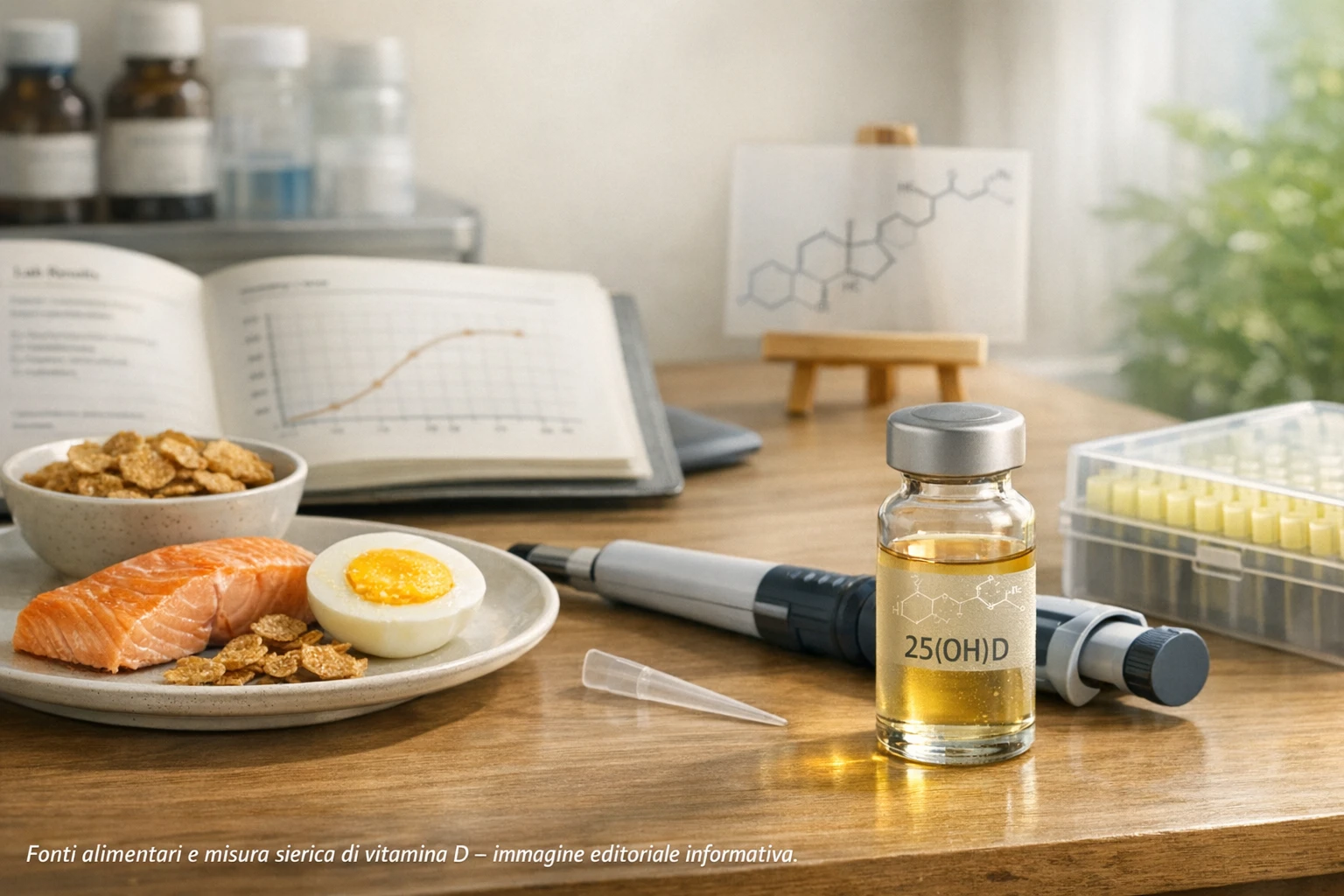
Updated and contextualized version of an article originally published on April 3, 2014
The article retains its original focus by presenting it through a scholarly and accessible perspective, supported by verifiable references.
Authors
- Dr. A. Colonnese – Nutrition biologist
- Roberto Panzironi –Independent researcher
Note editoriali
- First publication: April 3, 2014
- Last update: April 18, 2026
- Version: 2026 narrative revision
Initial note
This article was previously published and has been updated for clarity, completeness, and compliance with scientific and communication standards. Its purpose is informational: it does not replace medical advice.
IN BRIEF
- Observational studies report inverse associations between blood levels of 25-hydroxyvitamin D (25(OH)D) and the risk of certain cancers, particularly colon and breast cancer.
- Randomized clinical trials have yielded mixed results: no clear reduction in overall cancer incidence in studies on heterogeneous populations, but some data suggest a reduction in mortality or the risk of advanced cancers in subgroups or with specific dosages/durations.
- Plausible biological mechanisms exist for a protective role of vitamin D (regulation of cell proliferation, differentiation, inflammation, and immunity), but proof of causality is not yet established.
- For now, public recommendations remain based on guidelines for bone health; any intervention (sun exposure, supplements) should be evaluated on a case-by-case basis with a healthcare professional.
Abstract: what does science say?
Vitamin D is a fat-soluble prohormone obtained through sun exposure and, to a lesser extent, from diet and supplements. Numerous observational epidemiological studies show that populations and individuals with higher levels of 25-hydroxyvitamin D (25(OH)D) tend to have lower rates of certain cancers, particularly colon cancer and, in part, breast cancer. However, experimental human studies (randomized controlled trials) have yielded heterogeneous results: there is no consensus on a clear reduction in the overall incidence of cancer with generalized supplementation, while some analyses report a reduction in cancer mortality or the risk of advanced cancers under specific conditions (daily doses, deficient populations, prolonged follow-up). There are biological mechanisms consistent with a protective effect, but the strength and nature of the link (association vs. causality) differ by cancer type and context. In summary: evidence of association, biological plausibility, partial experimental data; caution remains necessary in interpretation.
Evidence: what studies show and with what limitations
The evidence on vitamin D and cancer risk is based on three main lines of research: observational studies (ecological, cohort, and case-control), experimental laboratory studies showing plausible mechanisms, and randomized clinical trials. Observational studies have documented correlations between latitude, sun exposure, average 25(OH)D levels, and the incidence of cancers such as colon and breast: in some datasets, higher 25(OH)D levels are associated with a lower risk. However, such studies cannot demonstrate a causal relationship because they are subject to confounding (e.g., lifestyle, physical activity, body mass index) and possible reverse causation effects (disease reducing vitamin D levels). Aggregate analyses and meta-analyses of cohorts agree on an overall association towards lower risk and mortality, but with heterogeneity between studies and by cancer site [1][5][8].
Observational data: what they indicate and what they do not prove
Population analyses and prospective studies have shown that individuals with high levels of 25(OH)D often have lower rates of colon cancer and, in some studies, breast cancer. Some ecological analyses use latitude and UV radiation as proxies for cutaneous vitamin D synthesis and find geographical patterns consistent with the protective hypothesis. However, such evidence represents associations: it does not prove that increased vitamin D alone reduces risk. Possible causes include confounding factors and differences in level measurement (seasonality, analytical method) [1][5].
Randomized Clinical Trials: Results and Interpretation
Randomized trials provide the best design for causal proof. The VITAL study, a large preventive trial in US adults, did not show a significant reduction in the incidence of invasive cancer in the entire sample treated with 2,000 IU/day of vitamin D compared to placebo, but subsequent secondary analyses highlighted possible reductions in the risk of advanced cancers or cancer mortality in particular subgroups and with specific dosing and duration methods [2][3]. Meta-analyses of RCTs suggest a possible reduction in cancer-related mortality, while the effect on overall incidence remains uncertain and dependent on study details (dose, frequency, duration, baseline 25(OH)D status) [4][8].
Plausible Biological Mechanisms
At the cellular and molecular level, the active form of vitamin D (1,25(OH)2D) interacts with the vitamin D receptor (VDR), modulating gene expression in various tissues; this can influence cell proliferation, differentiation, apoptosis, inflammation, and immune responses. In vitro experiments and animal models support anti-tumor effects and modulation of the tumor microenvironment, offering biological plausibility to epidemiological observations, although open questions remain regarding the quantitative translation of these mechanisms in humans [6][7].
What it means in practice
For the general public, the practical interpretation of the evidence is as follows: there are consistent signals linking higher levels of 25(OH)D to a lower risk or better prognosis for certain cancers, but the relationship is not definitively causal for all populations and for every type of cancer. For this reason, health authorities recommend interventions primarily aimed at preventing deficiency (especially for bone health) rather than promoting generalized supplementation for anti-cancer purposes. There are three available interventions: prudent sun exposure, diet (foods rich in vitamin D), and supplementation. Sun exposure increases skin synthesis but must be balanced with the risk of skin damage; diet alone is often insufficient to achieve high levels of 25(OH)D; supplements allow for dose control, but the choice of dosage and duration should be personalized. In contexts of documented deficiency or for individual at-risk patients (e.g., people with low sun exposure, malabsorption, the elderly), medical evaluation and measurement of blood levels are useful tools for deciding on potential supplementation. The evidence does not currently support universal recommendations for very high doses for cancer prevention in unselected populations [2][4][8].
KEY POINTS TO REMEMBER
- Vitamin D is inversely associated with certain cancer risks in observational studies, but association does not equal causation.
- Randomized trials have yielded mixed results: a net reduction in overall cancer incidence has not been demonstrated in all studied populations, but there are signals supporting a reduction in mortality or advanced cancers under specific conditions.
- Biological mechanisms (VDR, gene regulation, control of inflammation and immunity) are plausible, but clinical proof that increased levels causally reduce risk remains incomplete.
- For the public, the priority is to prevent documented deficiency; any supplements or sun exposure should be discussed with a doctor or specialist.
Limitations of the Evidence
It is important to clarify the main limitations. Observational studies do not fully control for all confounding factors and may overestimate associations; variability in 25(OH)D measurement and in the thresholds defined as "sufficient" complicates comparisons between studies. Randomized trials have practical limitations: dosages and methods (daily vs. bolus), follow-up duration, and studied populations (often not very deficient initially) influence the results. There is heterogeneity by tumor site: effects observed for the colon do not necessarily replicate for other cancers. Finally, the translation of cellular mechanisms into large-scale clinical effects is not automatic: promising results in vitro or in animal models do not guarantee equal efficacy in humans [2][4][6][8].
Editorial conclusion
The literature on the effects of vitamin D on the risk and prognosis of certain cancers is vast and evolving. Today, we have consistent signals: epidemiological associations, biological plausibility, and some positive signals from trials and meta-analyses regarding reduced mortality or advanced cancers in specific circumstances. However, the evidence for a generalizable causal effect is not complete. For the reader, the reasoned recommendation is to maintain adequate vitamin D levels for general health, avoid extremes (excessive sun exposure or very high supplementation without control), and consult their doctor to measure 25(OH)D levels and evaluate any personalized interventions. Research continues: new trials and analyses targeting deficient populations, with different dosages and methods, will help clarify the potential role of vitamin D in cancer prevention and prognosis.
Editorial note
Article updated for clarity and alignment with the best available evidence. The information is for informational purposes only and does not replace individual medical advice.
SCIENTIFIC RESEARCH
- McDonnell SL, Baggerly LL, French CB, et al. Serum 25‑Hydroxyvitamin D Concentrations ≥40 ng/ml Are Associated with >65% Lower Cancer Risk: Pooled Analysis of Randomized Trial and Prospective Cohort Study. PLoS One. 2016;11(4):e0152441. https://doi.org/10.1371/journal.pone.0152441
- Manson JE, Cook NR, Lee IM, et al.; VITAL Research Group. Vitamin D Supplements and Prevention of Cancer and Cardiovascular Disease. N Engl J Med. 2019;380(1):33‑44. https://doi.org/10.1056/NEJMoa1809944
- Chandler PD, Chen WY, Ajala ON, et al. Effect of Vitamin D3 Supplements on Development of Advanced Cancer: A Secondary Analysis of the VITAL Randomized Clinical Trial. JAMA Netw Open. 2020;3(11):e2025850. https://doi.org/10.1001/jamanetworkopen.2020.25850
- Keum N, Lee DH, Greenwood DC, et al. Vitamin D supplementation and total cancer incidence and mortality: a meta‑analysis of randomized controlled trials. Ann Oncol. 2019;30(5):733‑743. https://doi.org/10.1093/annonc/mdz059
- Chowdhury R, Kunutsor S, Vitezova A, et al. Vitamin D and risk of cause specific death: systematic review and meta‑analysis of observational cohort and randomised intervention studies. BMJ. 2014;348:g1903. https://doi.org/10.1136/bmj.g1903
- Feldman D, Krishnan AV, Swami S, Giovannucci E, Feldman BJ. The role of vitamin D in reducing cancer risk and progression. Nat Rev Cancer. 2014;14:342‑357. https://doi.org/10.1038/nrc3691
- Negri M, Gentile A, De Angelis C, et al. Vitamin D‑Induced Molecular Mechanisms to Potentiate Cancer Therapy and to Reverse Drug‑Resistance in Cancer Cells. Nutrients. 2020;12(6):1798. https://doi.org/10.3390/nu12061798
- Arayici ME, Basbinar Y, Ellidokuz H. Vitamin D Intake, Serum 25‑Hydroxyvitamin‑D (25(OH)D) Levels, and Cancer Risk: A Comprehensive Meta‑Meta‑Analysis Including Meta‑Analyses of Randomized Controlled Trials and Observational Epidemiological Studies. Nutrients. 2023;15(12):2722. https://doi.org/10.3390/nu15122722
Original source of the attached article: Medi Magazine (link provided in the original input).