Updated and contextualized version of an article originally published on July 24, 2014
The article retains its original focus by presenting it through a scholarly and accessible perspective, supported by verifiable references.
Authors
- Dr. M. Bitonti – Biologist
- Roberto Panzironi –Independent researcher
Note editoriali
- First publication: July 24, 2014
- Last update: April 20, 2026
- Version: 2026 narrative revision
IN BRIEF
- Vegetables from the Brassicaceae family (cruciferous vegetables) contain fiber, vitamins (C, K), folate, and glucosinolates which, after transformation, generate isothiocyanates such as sulforaphane.
- Biological mechanisms (detoxification, modulation of cellular signals, antioxidant/anti-inflammatory action) explain the plausibility of protective effects observed in preclinical and epidemiological studies, but do not prove certain causality.
- Observations on risk reduction for some cancers (colon, lung, pancreas, breast) are consistent but modest in magnitude and variable; results depend on dose, cooking methods, gut microbiota, and genetic variants of metabolism.
- Vitamin K present in cruciferous vegetables is involved in bone metabolism; some meta-analyses indicate effects on bone density and fractures in selected populations, but generalization is limited.
- For daily practice: regularly including cruciferous vegetables in a varied diet is reasonable for general health; individual choices and clinical conditions should be discussed with a doctor.
Abstract: what does science say?
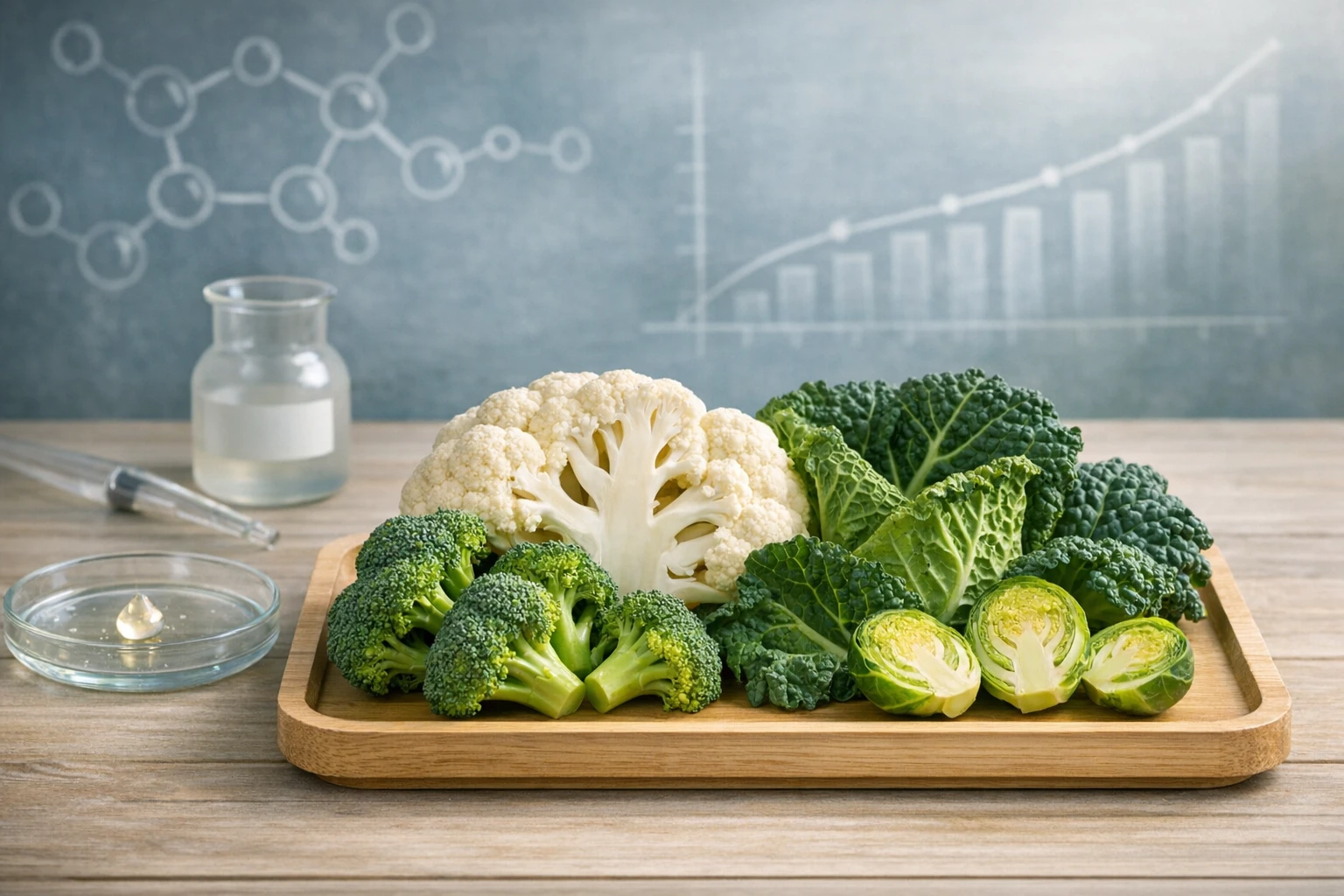
Cruciferous vegetables — broccoli, cauliflower, savoy cabbage, Brussels sprouts, and similar — provide essential nutrients (fiber, vitamins, and minerals) and precursors of biologically active compounds called glucosinolates. During chewing or processing, these precursors can transform into isothiocyanates (e.g., sulforaphane), molecules studied for their ability to modulate detoxification enzymes, anti-inflammatory signals, and cell death pathways in preclinical models [1][2]. Epidemiological evidence suggests inverse associations, of modest magnitude, between cruciferous vegetable consumption and some cancers (colon, lung, pancreas, breast), with variations depending on study method and population [3][4][5][6]. Vitamin K in cruciferous vegetables is plausibly useful for bone health, but the clinical benefits observed in trials are concentrated in studies on specific formulations and populations [7]. The dietary fiber present in these foods contributes to bowel regularity and can improve glycemic control in individuals with type 2 diabetes when the overall diet is appropriate [8]. Important limitations concern the observational nature of many studies, variability in food composition, the role of the microbiome, and possible interaction with genetic polymorphisms in isothiocyanate metabolism [5][9]. In summary, there is biological plausibility and consistent reports, but the strength of evidence varies by outcome and context; targeted clinical studies and more robust intervention data are needed to confirm causal effects and define effective doses.
MAIN SECTION
What are cruciferous vegetables and their bioactive components
Cruciferous vegetables (Brassicaceae family) include broccoli, cauliflower, savoy cabbage, Brussels sprouts, and cabbage. In addition to vitamins and minerals, they are rich in glucosinolates, inert molecules that, thanks to the myrosinase enzyme present in plants or intestinal microbes, transform into isothiocyanates and indoles. Among these, sulforaphane is the most studied for its effects on detoxification enzymes and antioxidant pathways in experimental models [1]. The levels of these compounds vary by species, cultivar, ripeness, and cooking method; intense cooking can reduce myrosinase activity and thus the formation of isothiocyanates [2].
How isothiocyanates work biologically
In laboratory studies, isothiocyanates modulate various cellular processes: they induce phase II enzymes involved in carcinogen detoxification, activate antioxidant pathways (e.g., Nrf2), influence apoptosis, cell cycle arrest, and inflammatory response. These mechanisms explain the biological plausibility of the protective role against tumor onset observed in animal and in vitro models [2]. However, the translation into clinical effects in humans is complex and depends on actual exposure, individual metabolism, and interactions with other dietary components.
Epidemiological evidence: what observational studies show
Numerous observational studies and meta-analyses have investigated associations between cruciferous vegetable consumption and cancer risk. For colorectal cancer, reviews and meta-analyses show a favorable trend associated with higher cruciferous vegetable consumption, with modest and variable effects between studies [3]. A meta-analysis on breast cancer risk found a reduction in risk associated with high cruciferous vegetable consumption, but the data were heterogeneous and largely from case-control studies [4]. For lung cancer, results suggest an inverse association, particularly in some subpopulations and in relation to genetic variants that influence isothiocyanate metabolism [5]. For pancreatic cancer, meta-analyses are available that indicate a possible risk reduction, but with methodological limitations and the need for prospective confirmations [6]. In general, the observed associations are of modest magnitude and do not establish causality.
PRACTICAL SECTION
What it means in practice
For those seeking a healthy dietary approach, regularly including cruciferous vegetables in the diet as part of an eating pattern rich in fruits, vegetables, whole grains, and lean proteins is reasonable and consistent with public recommendations. Evidence suggests potential benefits for the prevention of some chronic diseases, but cruciferous vegetables should not be considered a unique remedy or a substitute for medical treatments. The preparation method affects active compounds: consuming some raw or lightly steamed vegetables can preserve the myrosinase enzyme and promote the formation of isothiocyanates compared to prolonged boiling [2]. In the presence of anticoagulant therapies that interfere with vitamin K or specific clinical conditions, it is advisable to consult a doctor before significantly changing the intake of these foods.
KEY POINTS TO REMEMBER
- Cruciferous vegetables contain fiber, vitamins (C, folate, K), and glucosinolates; the transformation into isothiocyanates is crucial for many biological effects.
- Biological mechanisms (detoxification, inflammation modulation, redox regulation) are well-characterized in experimental models, but evidence of clinical efficacy remains limited and contextual [1][2].
- Observational studies suggest inverse associations with some cancers (colon, lung, pancreas, breast) but the evidence is not uniform and does not demonstrate certain causality [3][4][5][6].
- Vitamin K present in many cruciferous vegetables is biologically relevant for bone metabolism; some trials and meta-analyses report favorable effects on BMD and fractures in specific contexts, but generalization is limited [7].
- For glycemic control, vegetable fiber can contribute to improvements when part of an overall adequate dietary plan [8].
LIMITATIONS OF EVIDENCE
It is important to distinguish between observational associations and causal evidence. Much of the literature on the protective effect of cruciferous vegetables comes from case-control studies or observational cohorts, which can be influenced by residual confounding, imprecise dietary measurement, and selection bias. Differences between plant species, cooking methods, glucosinolate content, and interindividual variability of the microbiome and enzymatic polymorphisms (e.g., GSTM1/GSTT1) make it difficult to estimate actual exposure to isothiocyanates and attribute precise effects [5][9]. Clinical intervention studies in humans are still relatively few and often short-term or with surrogate outcomes. For these reasons, recommendations must remain cautious and based on overall dietary patterns, not on single foods considered "therapeutic."
Editorial Conclusion
Cruciferous vegetables are nutritious foods with plausible biological mechanisms that can help reduce the risk of some health problems. Current evidence indicates consistent but not definitive associations: the observed benefits are generally modest and depend on context, consumption method, and individual characteristics. For public health, the most robust approach remains to promote varied, plant-rich diets, including cruciferous vegetables, and to support clinical research that verifies efficacy, doses, and methods of use in defined groups.
SCIENTIFIC RESEARCH
- Fahey JW, Zhang Y, Talalay P. Broccoli sprouts: An exceptionally rich source of inducers of enzymes that protect against chemical carcinogens. Proc Natl Acad Sci U S A. 1997;94(19):10367-10372. https://doi.org/10.1073/pnas.94.19.10367
- Clarke JD, Dashwood RH, Ho E. Mechanisms of the anticancer effects of isothiocyanates. Enzymes. 2015; DOI: https://doi.org/10.1016/bs.enz.2015.06.001
- Tse G, Eslick GD. Cruciferous vegetables and risk of colorectal neoplasms: A systematic review and meta-analysis. Nutr Cancer. 2014;66(1):128-139. https://doi.org/10.1080/01635581.2014.852686
- Liu X, Lv K. Cruciferous vegetables intake is inversely associated with risk of breast cancer: A meta-analysis. The Breast. 2013;22(3):309-313. https://doi.org/10.1016/j.breast.2012.07.013
- Lam TK, Gallicchio L, Lindsley K, et al. Cruciferous vegetable consumption and lung cancer risk: a systematic review. Cancer Epidemiol Biomarkers Prev. 2009;18(1):184-195. https://doi.org/10.1158/1055-9965.EPI-08-0710
- Li D, Ji J, Huang J, et al. Cruciferous vegetable consumption and the risk of pancreatic cancer: a meta-analysis. World J Surg Oncol. 2015;13:44. https://doi.org/10.1186/s12957-015-0454-4
- Cockayne S, Adamson J, Lanham-New S, Shearer MJ, Gilbody S, Torgerson DJ. Vitamin K and the prevention of fractures: systematic review and meta-analysis of randomized controlled trials. Arch Intern Med. 2006;166(12):1256-1261. https://doi.org/10.1001/archinte.166.12.1256
- Mao T, Huang F, Zhu X, et al. Effects of dietary fiber on glycemic control and insulin sensitivity in patients with type 2 diabetes: A systematic review and meta-analysis. J Funct Foods. 2021;82:104500. https://doi.org/10.1016/j.jff.2021.104500
- Tang L, Zirpoli GR, Jayaprakash V, et al. Cruciferous vegetable intake is inversely associated with lung cancer risk among smokers: a case-control study. BMC Cancer. 2010;10:162. https://doi.org/10.1186/1471-2407-10-162