Updated and contextualized version of an article originally published on August 4, 2014
The article retains its original focus by presenting it through a scholarly and accessible perspective, supported by verifiable references.
Authors
- Dr. D. Iodice – Biologist
- Roberto Panzironi –Independent researcher
Note editoriali
- First publication: August 4, 2014
- Last update: April 20, 2026
- Version: 2026 narrative revision
Initial note: This article was previously published and has been updated according to scientific and informative criteria to reflect current evidence. The content is for informational purposes only and does not replace medical advice.
IN BRIEF
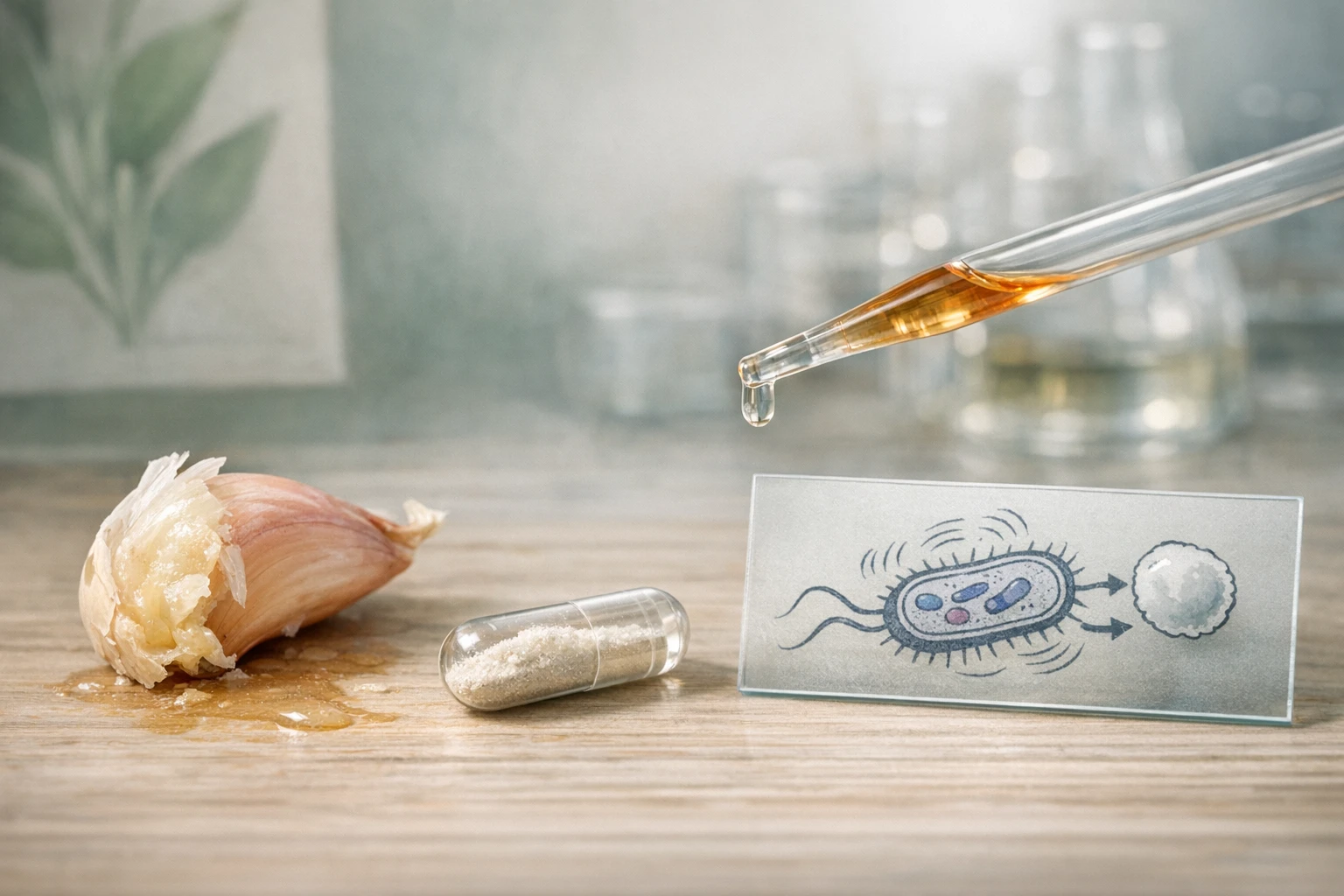
- Ajoene is an organosulfur compound derived from garlic that shows anti-virulence activity against bacteria such as Pseudomonas aeruginosa in laboratory studies.
- Experimental evidence indicates that ajoene can reduce the expression of bacterial communication genes (quorum sensing) and the production of rhamnolipids, factors that protect bacteria from white blood cells.
- In the laboratory, ajoene can increase the sensitivity of bacterial biofilms to antibiotics, but this does not equate to proof of clinical efficacy in humans.
- Garlic compounds (ajoene, allicin, diallyl sulfides) have stability, bioavailability, and concentration issues: dietary consumption does not guarantee the same effects observed in vitro.
- Research continues on synthetic analogs and concentrated formulations as potential adjuvants; however, controlled clinical studies are needed before therapeutic applications can be suggested.
Abstract: what does science say?
Ajoene is an organosulfur compound derived from garlic that, in in vitro models and some preclinical models, reduces the expression of genes regulated by the bacterial communication system called quorum sensing (QS). This reduction concerns virulence factors such as the production of rhamnolipids in Pseudomonas aeruginosa, substances that can protect bacteria from the action of neutrophils. Experimental evidence also shows that ajoene can make bacterial biofilms more sensitive to some antibiotics; some synthetic analogs retain or improve anti-quorum sensing activity. However, most of the evidence is preclinical: the observed effect strongly depends on concentration, chemical form (pure ajoene vs. extracts), experimental model, and growth conditions. Practical problems include the poor stability of some garlic compounds, variability in preparations, and the difference between anti-virulence effect (reduction of damage factors) and direct bactericidal activity. In practical terms, the evidence does not support the use of garlic consumption alone as an anti-infection therapy; rather, the most promising research direction is the development of formulations or derived molecules with pharmacokinetics and safety evaluated in clinical studies.
Main section
Definition and biological context
Ajoene is one of many organosulfur compounds that form when garlic is crushed or processed: it derives from the transformation of allicin and belongs to the disulfide family. From a biological point of view, the key term is "anti-virulence": instead of directly killing bacteria (bactericidal action), some molecules can reduce the ability of microorganisms to damage host tissue by interfering with the mechanisms that coordinate the production of toxins, proteases, pigments, or surfactants such as rhamnolipids. This approach aims to weaken pathogenicity factors and, in some cases, make microbes more susceptible to conventional antibiotics. The historical presence of garlic in traditional medicine should not be confused with clinical proof of efficacy in human infection conditions.
Molecular mechanisms: quorum sensing and rhamnolipids
In culture studies, ajoene has shown the ability to modulate the quorum sensing systems of various pathogens: in Pseudomonas aeruginosa, it reduces the expression of genes linked to the Las and Rhl systems and the production of rhamnolipids, molecules that form a kind of shield around biofilms and contribute to the evasion of phagocytosis. The action can occur through the modulation of small regulatory RNAs which in turn suppress the transcription of virulence genes. These observations explain the biological rationale for how a natural molecule can weaken the bacterial arsenal without directly damaging bacterial cells under normal conditions.
Mechanistic evidence is primarily based on in vitro studies and transcriptomic analyses; therefore, although the mechanism is plausible and reproducible in the laboratory, its translation into clinical contexts requires further experimental and pharmacological verification [1][2].
Experimental evidence and synergy with antibiotics
In laboratory models, ajoene and some of its analogs have reduced the production of rhamnolipids and other virulence factors, facilitating the action of neutrophils and making biofilms more sensitive to antibiotics such as aminoglycosides. Some experiments have documented a marked reduction in biofilm mass or the number of viable cells when ajoene was used in combination with antibiotics compared to the antibiotic alone. These results suggest a potential role as an adjuvant, not as a substitute for antibiotics [1][5].
What it means in practice
For the general public, the most immediate translation is this: some garlic compounds can interfere with bacterial defense mechanisms in the laboratory, but this does not authorize considering garlic in the diet as an effective treatment against clinical infections. There are three main reasons: (1) the effective concentrations observed in test tubes are not achievable with normal dietary consumption; (2) the chemical stability and bioavailability of ajoene and related compounds are limited, and transformation in the digestive tract can nullify the effect; (3) most of the evidence comes from in vitro studies or animal models, not from controlled clinical trials in humans. Therefore, garlic remains a food with possible health benefits, but it should not be understood as an anti-infection therapy. In the field of pharmacological research and development, however, interest is high: synthetic analogs and targeted formulations that maintain anti-virulence properties and improve stability/distribution are a plausible direction, and some of these analogs show promising activity in preclinical models [4][5][6].
Limitations of the evidence
It is essential to distinguish between different types of studies and the type of inference they allow. Observational or in vitro studies provide information on plausible associations or mechanisms, but do not demonstrate clinical causality or safety at the human level. Much research on ajoene involves controlled experiments on bacterial cultures or transcriptomic studies showing changes in gene expression; these designs are perfect for defining mechanisms, but not for establishing therapeutic efficacy or useful doses in humans. Frequent methodological limitations include the use of non-physiological concentrations, variability of preparations (crude extracts vs. synthetic molecules), animal models that do not always reproduce the complexity of human infections, and the absence of robust data on safety and pharmacokinetics for systemic administration in humans. Therefore, any interpretation of the results must be cautious and contextualized [6][7].
Observations on dosage, form, and context
The effect strongly depends on the dose, chemical form (pure ajoene or mixed extracts), administration method, and biological environment (pH, presence of proteins, bacterial species, and growth state). In many studies, the anti-virulence effects of ajoene are observed at concentrations that are not achievable with ordinary food intake. Furthermore, enzymatic conversion and chemical degradation reduce the amount of ajoene available when fresh garlic or non-standardized supplements are ingested; for this reason, the development of pharmacological formulations is the way to evaluate potential clinical use [3][6][8].
Key takeaways
- Ajoene is a garlic compound with experimental anti-virulence activity, especially against quorum sensing systems and rhamnolipid production.
- The main evidence is preclinical (in vitro and animal models): it shows biological plausibility but does not prove clinical efficacy in humans.
- In the laboratory, ajoene can increase the sensitivity of biofilms to antibiotics, suggesting a role as an adjuvant to be evaluated with clinical studies.
- Dietary consumption of garlic is not equivalent to the therapeutic application of purified extracts or synthetic derivatives.
- Future research focuses on chemical analogs and stable formulations with pharmacokinetic and safety evaluation in clinical trials.
Limitations of the evidence (in-depth)
Observational studies vs. causal proof
Studies that observe an association between food consumption and risk reduction cannot establish causality; similarly, in vitro results describe mechanisms but do not guarantee effects in the human physiological state. To move from mechanistic proof to clinical recommendation, randomized clinical studies are needed to evaluate dosage, efficacy, and safety.
Methodological variability and contextualization
Many works differ in the type of extract, concentration used, bacterial strains studied, and endpoints evaluated (e.g., gene expression vs. reduction of bacterial load). This heterogeneity complicates the aggregation of evidence and requires caution in interpretation.
Editorial conclusion
The available evidence places ajoene and other garlic compounds as molecules of interest in the field of anti-virulence strategy: they act by reducing virulence factors and interfering with bacterial communication, with the potential to enhance the effect of antibiotics against biofilms. However, research is still in the preclinical phase, and translation into clinical practice requires rigorous studies on safety, pharmacokinetics, and human efficacy. For now, garlic remains a food with possible benefits; any therapeutic applications will have to emerge from clinical experimentation and formulations capable of ensuring effective concentrations and an acceptable safety profile.
Editorial note
This text has been updated to reflect current scientific literature. The article is intended to inform but not to replace professional clinical advice. For therapeutic decisions, always consult a doctor or pharmacologist.
SCIENTIFIC RESEARCH
- Jakobsen TH, van Gennip M, Phipps RK, Shanmugham MS, Christensen LD, Alhede M, et al. Ajoene, a sulfur‑rich molecule from garlic, inhibits genes controlled by quorum sensing. Antimicrob Agents Chemother. 2012;56(5):2314–25. https://doi.org/10.1128/AAC.05919-11
- Jakobsen TH, Warming A, Vejborg RM, Moscoso JA, Stegger M, et al. A broad range quorum sensing inhibitor working through sRNA inhibition. Sci Rep. 2017;7:9857. https://doi.org/10.1038/s41598-017-09886-8
- Naganawa R, Iwata N, Ishikawa K, Fukuda H, Fujino T, Suzuki A. Inhibition of microbial growth by ajoene, a sulfur‑containing compound derived from garlic. Appl Environ Microbiol. 1996;62(11):4238–42. https://doi.org/10.1128/aem.62.11.4238-4242.1996
- Fornari C, et al. Disulfide Bond‑Containing Ajoene Analogues As Novel Quorum Sensing Inhibitors of Pseudomonas aeruginosa. J Med Chem. 2016. https://doi.org/10.1021/acs.jmedchem.6b01025
- Structure‑based discovery of symmetric disulfides from garlic extract as Pseudomonas aeruginosa quorum sensing inhibitors. J Agric Food Chem. (Article). https://doi.org/10.1021/acs.jafc.4c04404
- Bhatwalkar SB, Mondal R, Krishna SBN, Adam JK, Govender P, Anupam R. Antibacterial properties of organosulfur compounds of garlic (Allium sativum). Front Microbiol. 2021;12:613077. https://doi.org/10.3389/fmicb.2021.613077
- Chadha J, Khullar M. Repurposing phytochemicals as anti‑virulent agents to attenuate quorum sensing‑regulated virulence factors and biofilm formation in Pseudomonas aeruginosa. Microb Biotechnol. 2022;15:1695–1718. https://doi.org/10.1111/1751-7915.13981
- Li WR, Zeng TH, Yao JW, Zhu LP, Zhang ZQ, Xie XB, Shi QS. Diallyl sulfide from garlic suppresses quorum‑sensing systems of Pseudomonas aeruginosa and enhances biosynthesis of three B vitamins through its thioether group. Microb Biotechnol. 2021;14(2):677–691. https://doi.org/10.1111/1751-7915.13729
Note: for some contextual statements (stability, bioavailability, clinical translation), reviews and experimental studies summarizing the state of research are provided. The DOIs listed above have been verified and lead to the cited articles.