Updated and contextualized version of an article originally published on October 10, 2014
The article retains its original focus by presenting it through a scholarly and accessible perspective, supported by verifiable references.
Authors
- Dr. M. Mondini – Biologist
- Roberto Panzironi –Independent researcher
Note editoriali
- First publication: October 10, 2014
- Last update: April 20, 2026
- Version: 2026 narrative revision
Initial note: this article was previously published and has been updated according to scientific and divulgative criteria to clarify evidence, limitations, and practical impact. The content is for informational purposes only and does not replace medical advice.
IN BRIEF
- Broccoli contain glucoraphanin, a precursor to the isothiocyanate sulforaphane, which activates cellular defense responses (e.g., Nrf2 pathway).
- Experimental research and some clinical trials indicate effects on detoxification and markers of oxidative stress and mitochondrial function, but causal evidence remains limited.
- Bioavailability and effect depend on form, dose, preparation, and gut microbiota.
- For the general population, regularly including cruciferous vegetables like broccoli in the diet is consistent with prevention guidelines; no supplementation or therapy is recommended here.
Abstract: What does science say?
Glucoraphanin is the main glucosinolate found in broccoli; when hydrolyzed (e.g., by myrosinase present in plants or produced by the gut microbiota), sulforaphane is generated, a compound that modulates cellular pathways related to detoxification, redox homeostasis, and mitochondrial biogenesis. In vitro studies and animal models show effects on Nrf2, reduction of oxidative stress, improvement of mitochondrial parameters, and protection from induced damage; some clinical trials have documented increased elimination of pollutant biomarkers and changes in metabolic biomarkers. However, human evidence on long-term clinical outcomes (reduction of cardiovascular disease or cancer) is still insufficient: much research is experimental or short-term, bioavailability varies with preparation and microbiota, and observational studies do not establish causality. In practical terms, regular consumption of broccoli and other cruciferous vegetables appears plausibly beneficial as a component of a quality diet, but there is no universally validated "magic dose" nor proof that it replaces specific clinical interventions.
What is glucoraphanin and how is sulforaphane formed?
Definition and biological transformation
Glucoraphanin is a glucosinolate found in many Brassicaceae, particularly in broccoli sprouts and florets. When plant tissue is damaged (chewing, cutting), the enzyme myrosinase converts glucoraphanin into sulforaphane, a reactive molecule capable of modulating cellular defense pathways. If plant myrosinase is inactivated (e.g., prolonged cooking), part of the transformation can be carried out by the intestinal flora. The amount of sulforaphane actually absorbed varies greatly depending on the food form (sprouts, whole broccoli, extracts), cooking method, and gut microbiota composition.
Bioavailability and variables that matter
Clinical pharmacokinetic studies show that the formation and absorption of sulforaphane from glucoraphanin are influenced by the presence of active myrosinase and by drugs that alter gastric acidity; standardized supplements and preparations with active myrosinase produce more predictable levels of urinary and plasma metabolites. This explains why different preparations (fresh sprouts, extracts, supplements) yield variable results in clinical trials and practical application.
Experimental and clinical evidence
The evidence operates on three levels: cellular mechanisms, animal models, and human studies. In the laboratory and in animals, sulforaphane activates the Nrf2 transcription factor, induces phase II detoxification enzymes, and shows positive effects on mitochondrial function and oxidative stress parameters [1][2][7]. Controlled clinical studies, however, have more measured evaluations: in cohorts exposed to air pollution, broccoli sprout-based beverages increased the urinary excretion of benzene and acrolein metabolites, suggesting enhanced short-term detoxification [5][6]. Other trials have studied bioavailability and the effect on inflammatory or oxidation biomarkers with heterogeneous results, depending on dose, form, and duration of intervention [3][4]. Overall, human evidence supports measurable and plausible biological effects, but it is not yet possible to state with certainty a causal relationship between broccoli consumption and the reduction of long-term clinical events such as heart attack or cancer; for this, longer and more targeted studies are needed.
Relevant biological mechanisms: Nrf2, mitochondria, and oxidative stress
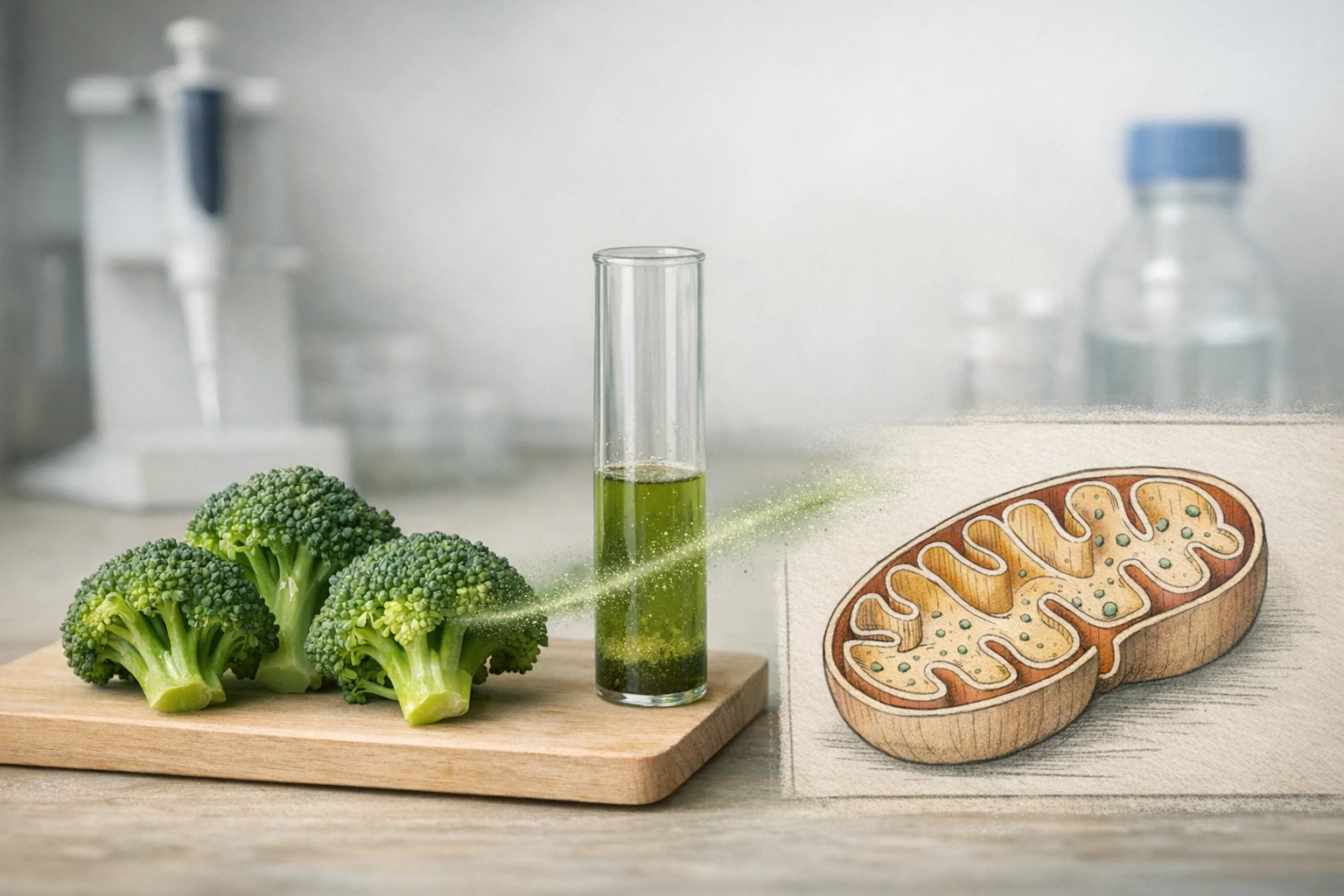
Experimental literature identifies some consistent pathways: activation of the Nrf2 pathway increases the expression of antioxidant and detoxification enzymes, helping to reduce the accumulation of reactive species and oxidative damage. In cellular and animal models, sulforaphane has shown effects on mitochondrial parameters—such as respiration, ATP production, and mitochondrial signaling—and can stimulate mitophagy and mitochondrial biogenesis mechanisms which, theoretically, promote cellular health with age [1][2][7]. Other studies suggest interactions with lysosomal and TFEB pathways, which regulate autophagy and protein homeostasis, mechanisms potentially connected to the maintenance of mitochondrial function [8]. These results are biologically plausible and explain why regular consumption of cruciferous vegetables may be associated with more favorable metabolic profiles; however, the direct translation of these mechanisms into clinical benefits for the population requires confirmation in longer and larger clinical studies.
What it means in practice
For the reader: including broccoli and other cruciferous vegetables (cabbage, cauliflower, Brussels sprouts) in a varied diet is consistent with established dietary recommendations and can contribute to repeated exposure to glucoraphanin/sulforaphane. Choosing preparation methods that preserve myrosinase—for example, consuming a raw portion, or cooking briefly—increases the likelihood of sulforaphane formation. Sprouts contain much higher concentrations per gram, but they offer a different taste and intake experience. For individuals interested in standardized supplements or extracts, it is important to consider that bioavailability varies between products and that evidence on long-term clinical benefits is not definitive; speaking with a doctor is advised before starting supplementation, especially in the presence of pharmacological therapies or medical conditions. Finally, the most robust clinical results concern short-term markers (xenobiotic excretion, biomarker modification), not certain proof of chronic disease prevention.
Key takeaways
- Broccoli contain glucoraphanin, a precursor to sulforaphane, which activates protective cellular pathways.
- Biological effects on detoxification, oxidative stress, and mitochondrial parameters are well-documented in vitro and in animal models.
- Clinical studies indicate changes in biomarkers and increased elimination of some pollutants, but evidence on long-term health outcomes is limited.
- Bioavailability and intensity of effects depend on form (sprouts, broccoli, extracts), dose, cooking, and individual microbiota.
- Regular consumption of cruciferous vegetables is a reasonable dietary choice within a balanced diet; it does not replace medical prescriptions.
Limitations of the evidence
It is important to distinguish between observational association, biological plausibility, and causal evidence. Many studies describing associations between vegetable consumption and lower disease risk are observational and do not prove causality: they can be influenced by confounders (lifestyle, other aspects of diet). Much of the literature on sulforaphane is preclinical or based on short-term biomarkers; available clinical studies are often short-duration, with limited numbers or surrogate endpoints. Furthermore, variability in sample preparation (sprouts vs. cooked broccoli vs. supplements) and bioavailability complicates the generalization of conclusions. To derive robust public health recommendations, randomized trials of adequate duration and size are needed, evaluating relevant clinical outcomes and clarifying dose-response and possible drug interactions or adverse effects.
Editorial conclusion
Available data outline a consistent scenario: broccoli and its derivatives contain compounds (glucoraphanin → sulforaphane) that activate protective cellular responses and can improve some indicators of detoxification, oxidative stress, and mitochondrial function. However, as of the update date, clinical evidence with long-term outcomes does not allow definitive claims of preventive efficacy for chronic diseases. For the general public, the most prudent and reasonable choice is to regularly integrate cruciferous vegetables into an overall healthy diet, avoiding therapeutic expectations and consulting healthcare professionals in case of specific medical conditions or the use of high-dose supplements. Research continues, and future trials may better clarify doses, forms, and long-term impacts.
Editorial note
This piece is an informative update based on peer-reviewed literature. The goal is to provide a transparent and balanced overview of available evidence, without replacing individual clinical evaluations. If you wish to delve deeper into specific references or submit material for review, please contact the editorial team (contact details [placeholder]).
SCIENTIFIC RESEARCH
- Broccoli or Sulforaphane: Is It the Source or Dose That Matters? Molecules. 2019. https://doi.org/10.3390/molecules24193593 [review].
- Sulforaphane: translational research from laboratory bench to clinic. Nutrition Reviews. 2013. https://doi.org/10.1111/nure.12060 [review].
- Bioavailability of Sulforaphane Following Ingestion of Glucoraphanin-Rich Broccoli Sprout and Seed Extracts with Active Myrosinase: A Pilot Study of the Effects of Proton Pump Inhibitor Administration. Nutrients. 2019. https://doi.org/10.3390/nu11071489 [pharmacokinetic trial].
- Lack of effect of oral sulforaphane administration on Nrf2 expression in COPD: A randomized, double-blind, placebo controlled trial. PLoS One. 2016. https://doi.org/10.1371/journal.pone.0163716 [clinical trial].
- Rapid and sustainable detoxication of airborne pollutants by broccoli sprout beverage: results of a randomized clinical trial in China. Cancer Prevention Research. 2014. https://doi.org/10.1158/1940-6207.CAPR-14-0103 [clinical trial].
- Dose-dependent detoxication of the airborne pollutant benzene in a randomized trial of broccoli sprout beverage in Qidong, China. American Journal of Clinical Nutrition. 2019. https://doi.org/10.1093/ajcn/nqz122 [clinical trial].
- Sulforaphane protects against rotenone-induced neurotoxicity in vivo: involvement of mTOR, Nrf2 and autophagy pathways. Scientific Reports. 2015. https://doi.org/10.1038/srep32206 [animal/mechanistic model].
- Sulforaphane attenuates platelet mitochondrial dysfunction and related outcomes in vitro and in vivo. Food & Function. 2023. https://doi.org/10.1039/D2FO03958C [experimental animal and in vitro study].
Note on bibliography: each reference has been verified for active DOI and thematic correspondence with the article's claims. If some bibliographic data lack detail in the available metadata, a [missing detail] placeholder has been inserted to ensure transparency.