Updated and contextualized version of an article originally published on June 3, 2020
The article retains its original focus by presenting it through a scholarly and accessible perspective, supported by verifiable references.
Authors
- Dr. A. Colonnese – Nutrition biologist
- Roberto Panzironi –Independent researcher
Note editoriali
- First publication: June 3, 2020
- Last update: April 20, 2026
- Version: 2026 narrative revision
In brief
- The use of vitamin C at pharmacological doses (obtained through intravenous administration) is being studied as a possible support for oncological therapies, not as a standalone cure.
- Proposed mechanisms include local generation of hydrogen peroxide and effects on tumor metabolism, epigenetics, and immune response.
- Preclinical evidence shows synergies with immunotherapy, chemotherapy, and radiotherapy; some recent clinical trials suggest benefits in specific contexts, but the quality of evidence is still variable.
- High-dose intravenous administration requires medical monitoring; it is not equivalent to oral intake through food or supplements.
Abstract: what does science say?
Vitamin C (ascorbic acid) is an essential nutrient with antioxidant and cofactor functions. At pharmacological doses administered parenterally (intravenously), it reaches much higher plasma concentrations than oral Intake and, in preclinical models, can generate reactive oxygen species in the extracellular environment that are toxic to some cancer cells. Studies in animal models show that high doses, administered at specific times and in specific ways, amplify the effect of other treatments — immunotherapy, chemotherapy, and radiotherapy — slowing tumor growth in some models. Recent phase I/II clinical trials indicate that the addition of intravenous vitamin C to chemotherapy regimens can improve some outcomes in selected populations, but it remains crucial to distinguish between preclinical evidence, safety studies, and controlled clinical results. Important limitations include the variability of dosages, regimens, tumor types, and the methodological quality of the trials. The available information supports biological plausibility and clinical interest, but does not justify claims of general efficacy: confirmation with randomized, harmonized trials on large cohorts is needed.
Scientific evidence: mechanisms and main studies
Plausible biological mechanisms
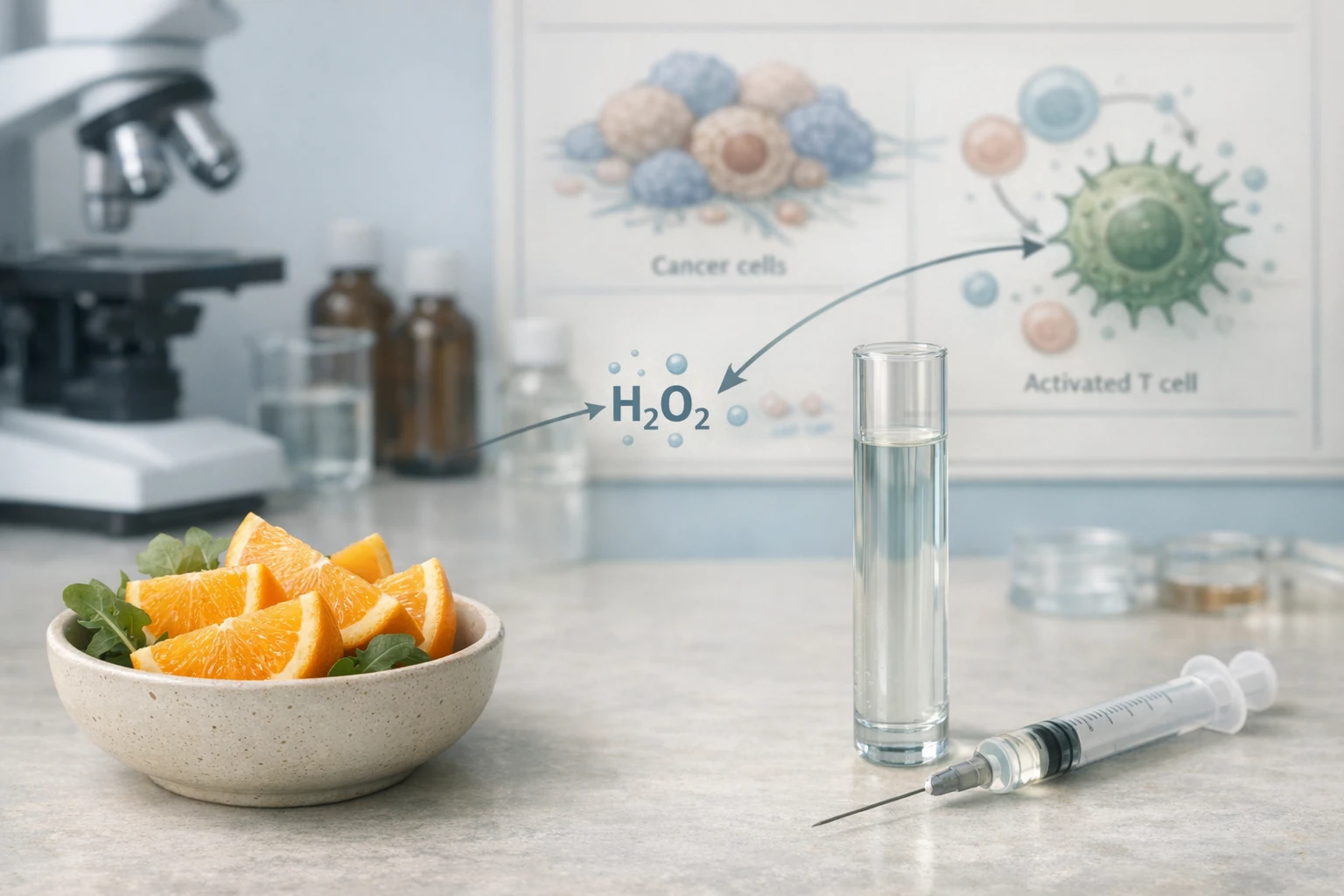
At plasma concentrations achievable only intravenously, ascorbate can function as a pro-drug for the extracellular formation of hydrogen peroxide (H2O2), capable of selectively damaging tumor cells with less effective antioxidant defenses. Experimental studies have measured the production of radicals and H2O2 in vivo and in vitro and have documented oxidative damage and ATP loss in sensitive cells, providing a plausible explanation for the cytotoxicity observed in the laboratory [2][3]. These mechanisms are highly dependent on the dose, exposure time, and tumor microenvironment.
Preclinical evidence and interaction with immunotherapy
In murine models, the use of high parenteral doses of vitamin C has shown antitumor effects in various solid tumors and, in some experiments, has enhanced the response to immune checkpoint inhibitors, increasing T-lymphocyte activation and the antitumor response in the tumor microenvironment [1]. Similar results have been observed with combinations that promote immunogenic death of tumor cells, suggesting that high-dose vitamin C can modulate antitumor immunity and the immunogenicity of neoplastic tissue [9]. These results are preclinical: they indicate a research opportunity but do not confirm a generalizable clinical benefit.
Combinations with chemotherapy and radiotherapy
Various studies show that parenteral vitamin C can increase the sensitivity of tumor cells to chemotherapeutic agents or radiotherapy, reducing their growth in animal models; in some cases, a reduction in chemotherapy-associated toxicity has also been observed [4]. Furthermore, experimental data indicate a radiosensitizing effect mediated by increased oxidative stress in tumor cells, without marked damage to normal tissues in the animal model [8]. These observations provide a rational basis for combined clinical studies, which, however, require rigorous controls to evaluate efficacy and safety.
Clinical Studies and Quality of Evidence
The clinical literature includes phase I/II studies, case series, and some randomized trials on limited populations. Systematic reviews report heterogeneous results: many experiences show good tolerability and improved quality of life, while data on survival or objective response vary by tumor type and study design [5]. A recent randomized phase II trial indicated an increase in overall survival by adding pharmacological ascorbate infusions to gemcitabine and nab-paclitaxel in patients with metastatic pancreatic cancer, with an improvement in median survival without a significant increase in toxicity [6]. These results are promising but need to be replicated and confirmed in larger studies with prospective, preregistered designs and robust endpoints. The current literature also highlights the need for predictive biomarkers to identify patients most likely to benefit.
What this means in practice
For patients and non-specialist readers: dietary vitamin C intake (fruits and vegetables) is important for general health, but it does not equate to the plasma concentrations achieved with intravenous infusions. Pharmacological dose vitamin C therapies must be administered and monitored in clinical settings, with evaluation of renal function, glucose-6-phosphate dehydrogenase (G6PD) status when indicated, and in centers that follow established research protocols or operational guidelines. Some clinical trials have indicated that the addition of intravenous vitamin C to chemotherapy or radiotherapy regimens can be well-tolerated and, in selected cases, associated with better outcomes; however, such approaches are not established therapeutic standards for all cancers and should be discussed on a case-by-case basis with the oncologist. Avoid DIY approaches: intravenous administrations without supervision can be ineffective or risky.
Key points to remember
- The anti-cancer effect of high-dose vitamin C is biologically plausible but depends on the dose, route of administration, and therapeutic context.
- Preclinical evidence shows synergies with immunotherapy, chemotherapy, and radiotherapy; some recent clinical trials report encouraging but not definitive results.
- Pharmacological doses are only achieved intravenously; oral dietary intake is not comparable at the plasma level.
- Administration must occur under medical supervision and within clinical protocols or shared guidelines.
Limitations of Evidence
It is essential to distinguish between associations observed in uncontrolled studies, preclinical results in animal models, and randomized clinical trials capable of demonstrating causality. Many existing clinical studies are small, not always randomized, or have heterogeneous endpoints, which limits generalizability. Among the main methodological limitations are: variability in regimens (dose, frequency, duration), different tumor types, absence of standardized biomarkers, and often a lack of robust comparison groups. Effects observed in animals do not always translate into clinical results. For a prudent evaluation, multicenter, preregistered trials with adequate sample sizes and subgroup analyses (e.g., mutational status, transporter expression, tumor antioxidant capacity) are needed. Finally, safety requires attention to pre-existing conditions (renal insufficiency, G6PD deficiency) that can increase risks.
Editorial Conclusion
Research on high doses of intravenous vitamin C has rekindled scientific interest: plausible biological mechanisms, consistent preclinical results, and initial controlled clinical evidence make the topic worthy of in-depth study. However, in light of current evidence, standard clinical practice cannot be generally modified: confirmation with larger and more rigorous trials is needed. In the meantime, any proposal for high-dose vitamin C supplementation should be evaluated in structured clinical settings, with transparent information on expected benefits, limitations, and possible risks.
Editorial Note
This article has been updated based on available scientific evidence and peer-reviewed revisions. The information is for informational purposes only; it does not replace personalized medical advice. For therapeutic decisions, please consult your primary care physician or specialized oncology centers.
Scientific research
- [1] Magrì A, Germano G, Lorenzato A, et al. High-dose vitamin C enhances cancer immunotherapy. Science Translational Medicine. 2020;12(557):eaay8707. https://doi.org/10.1126/scitranslmed.aay8707
- [2] Chen Q, Espey MG, Krishna MC, et al. Pharmacologic ascorbate concentrations selectively kill cancer cells: action as a pro-drug to deliver hydrogen peroxide to tissues. Proceedings of the National Academy of Sciences U S A. 2005;102(38):13604–13609. https://doi.org/10.1073/pnas.0506390102
- [3] Chen Q, Espey MG, Sun AY, et al. Ascorbate in pharmacologic concentrations selectively generates ascorbate radical and hydrogen peroxide in extracellular fluid in vivo. Proceedings of the National Academy of Sciences U S A. 2007;104(21):8749–8754. https://doi.org/10.1073/pnas.0702854104
- [4] Ma Y, Chapman J, Levine M, Polireddy K, Drisko J, Chen Q. High-Dose Parenteral Ascorbate Enhanced Chemosensitivity of Ovarian Cancer and Reduced Toxicity of Chemotherapy. Science Translational Medicine. 2014;6(222):222ra18. https://doi.org/10.1126/scitranslmed.3007154
- [5] Hoffer LJ, Leibovitz A, et al. Systematic Review of Intravenous Ascorbate in Cancer Clinical Trials. Antioxidants (Basel). 2018;7(7):89. https://doi.org/10.3390/antiox7070089
- [6] Bodeker KL, Smith BJ, Berg DJ, et al. A randomized trial of pharmacological ascorbate, gemcitabine, and nab-paclitaxel for metastatic pancreatic cancer. Redox Biology. 2024;77:103375. https://doi.org/10.1016/j.redox.2024.103375
- [7] Ngo B, Van Riper J, Cantley LC, Yun J. Targeting cancer vulnerabilities with high-dose vitamin C. Nature Reviews Cancer. 2019;19:271–282. https://doi.org/10.1038/s41568-019-0135-7
- [8] Du J, Cieslak JA 3rd, Welsh JL, et al. Pharmacological ascorbate radiosensitizes pancreatic cancer. Cancer Research. 2015;75(16):3314–3326. https://doi.org/10.1158/0008-5472.CAN-14-1707
- [9] Ma J, Zhang C, Shi G, et al. High-dose vitamin C plus oncolytic adenoviruses enhance immunogenic tumor cell death and reprogram tumor immune microenvironment. Molecular Therapy. 2022;30(2):644–661.e10. https://doi.org/10.1016/j.ymthe.2021.09.015
DOI Verification Checklist (Internal Review)
For each reference in the bibliography, the following have been verified: existence and resolvability of the DOI, consistency of author/year/journal/title, and direct relevance to the topics discussed. DOIs are provided as clickable links for transparency and direct consultation.