Updated and contextualized version of an article originally published on April 28, 2014
The article retains its original focus by presenting it through a scholarly and accessible perspective, supported by verifiable references.
Authors
- Dr. A. Conte – Biologist
- Roberto Panzironi –Independent researcher
Note editoriali
- First publication: April 28, 2014
- Last update: April 18, 2026
- Version: 2026 narrative revision
Preliminary note for the reader
This article has been previously published and updated according to scientific and divulgative review criteria. The purpose is informative: it does not replace medical advice. For personal situations, consult a healthcare professional.
IN BRIEF
- There is no universal "secret": weight loss depends on many variables (calories, food quality, adherence, and individual context).
- Clinical evidence shows that low carb diets can provide temporary advantages for weight and some metabolic parameters, but long-term results are often similar to other controlled diets. [2][3][4]
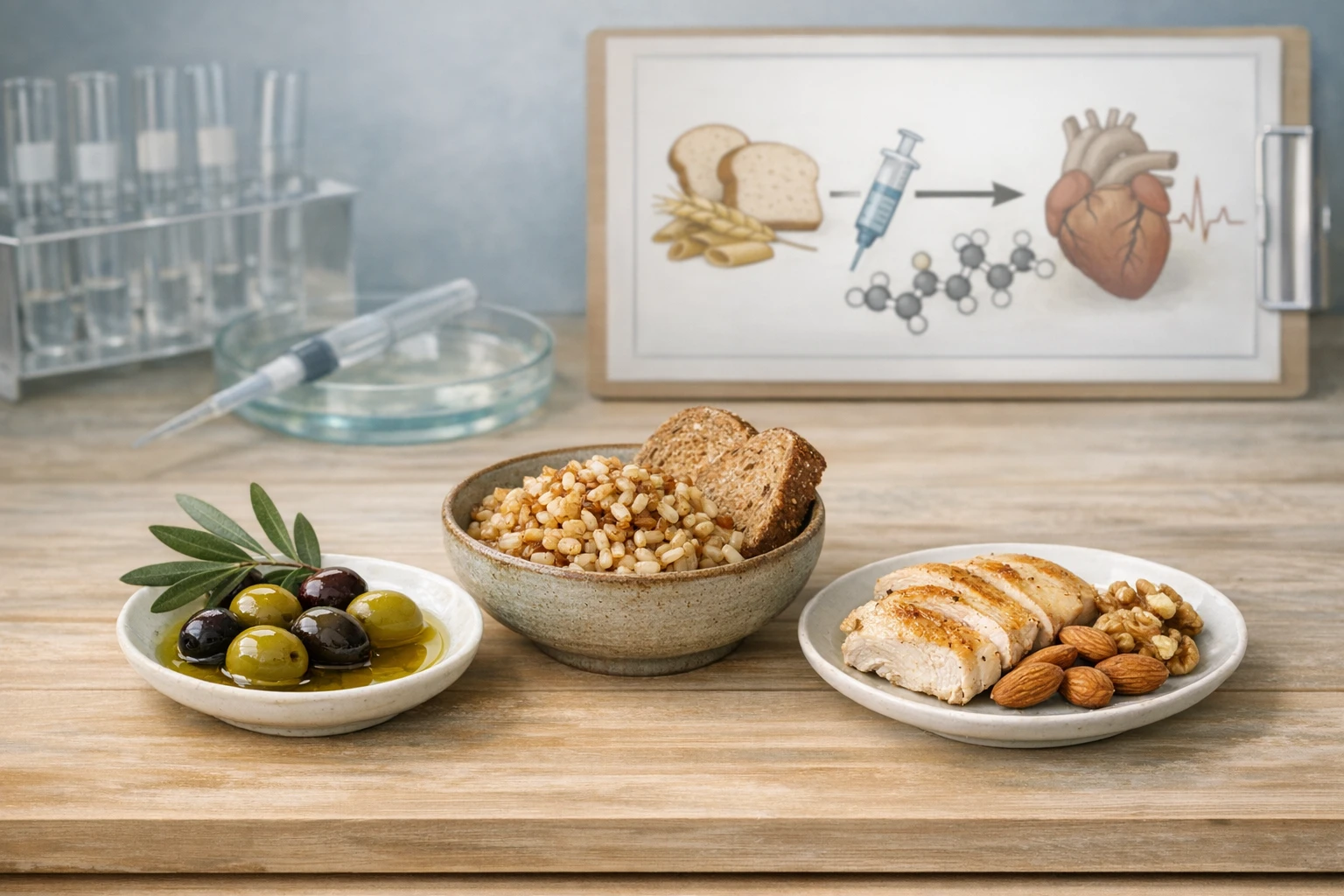
- A Mediterranean diet rich in "good" fats (such as olive oil) reduces cardiovascular events in clinical trials compared to a low-fat control. [1]
- Observational studies indicate that excessive or very reduced carbohydrates can be associated with different risks depending on the source (plant vs. animal) and context. [7]
Abstract: what does science say?
The question of whether "eating more fat and fewer carbohydrates" is the secret to weight loss summarizes a broad and recent scientific debate. Available evidence includes controlled clinical trials, meta-analyses, and observational studies: many trials show that reducing carbohydrates can promote faster weight loss in the first few months and improve some lipid markers, but at 1–2 years, weight differences tend to diminish. At the same time, dietary patterns with predominantly unsaturated fats (e.g., Mediterranean diet) are associated with fewer cardiovascular events in randomized studies. Observations on long-term outcomes depend on the source of nutrients (meat vs. plants, types of fat), adherence, and individual characteristics; therefore, the evidence should be interpreted with caution and does not imply absolute causal relationships. [1][5][7]
Main Section
What controlled clinical studies show
Trials of varying size and duration have compared lower-fat diets with Mediterranean or low carb diets. In a large randomized trial, the Mediterranean diet, despite having more total fats largely derived from unsaturated sources, reduced the risk of cardiovascular events compared to a low-fat control. [1]
Other clinical studies have directly compared low carb diets with low-fat diets: some found greater weight loss at 6–12 months with lower carbohydrate intake, while other trials at 1–2 years showed no significant differences between groups. [2][3]
Meta-analyses and synthesis of evidence
Recent systematic reviews and meta-analyses indicate that the average differences between diets (low carb vs. low-fat) are modest and often depend on adherence, study duration, and the measures considered. In the medium term, low-carb diets tend to increase HDL and reduce triglycerides; low-fat diets can reduce LDL. The choice of diet therefore appears to depend on individual clinical goals and risk profile. [5]
Biological hypotheses: insulin, metabolism, and energy
One proposed explanation for the greater initial success of some low carb diets is the so-called carbohydrate-insulin model: according to this hypothesis, high glycemic load foods would stimulate insulin, promoting fat storage and increased hunger. However, the model is subject to debate: critical analyses and experimental trials do not agree on a single, dominant effect that explains the obesity epidemic. Controlled studies under ad libitum consumption show that food composition and energy density can influence spontaneous energy intake. [6][9]
PRACTICAL SECTION
What it means in practice
For a person who wants to lose weight or improve metabolic health, current evidence suggests that there is no universal formula valid for everyone. Reducing carbohydrates can help lose weight quickly and improve triglycerides and HDL in the short term; at the same time, diets rich in unsaturated fats (olive oil, nuts, fish) are compatible with cardiovascular benefits when included in a balanced dietary pattern. [1][5]
Food quality matters: choosing whole grains, fiber, vegetables, and sources of unsaturated fats is plausibly healthier than consuming ultra-processed foods, added sugars, or large amounts of saturated fats of animal origin. Furthermore, diet sustainability (i.e., the ability to follow it over time) is one of the determining factors for long-term results. [7]
Non-prescriptive indications for interpreting the evidence
If considering a reduction in carbohydrates, evaluate its duration, any clinical need (e.g., glycemic control), and the quality of substitutions (more unsaturated fats and protein from plant sources or fish, less saturated fats). For people with specific medical conditions (diabetes, dyslipidemia, kidney disease), the choice should be discussed with a healthcare professional. [8]
KEY POINTS TO REMEMBER
- Weight loss does not depend solely on one macronutrient: quantity, food quality, adherence, and behavioral context are central.
- Low carb diets can promote faster weight loss in the short term and improve triglycerides and HDL. [2]
- At 1–2 years, the average weight loss differences between low-carb and low-fat approaches tend to diminish; the practical choice should consider sustainability and cardiometabolic profile. [3][4]
- A diet rich in unsaturated fats, such as the Mediterranean diet, has shown cardiovascular benefits in randomized clinical trials. [1]
- Observational studies report associations between very low carb diets (especially when based on animal sources) and higher mortality, but these are non-causal associations. [7]
LIMITATIONS OF THE EVIDENCE
It is important to distinguish between study types. Observational studies can show associations between dietary patterns and long-term outcomes, but they do not prove causality: confounding factors and limited dietary measurements can influence the results. [7]
Randomized trials provide stronger evidence for cause-and-effect relationships but are often of limited duration, with practical difficulties in ensuring adherence and with selected populations; their results may vary depending on the duration and level of behavioral support offered. [2][3][5]
There are also common methodological limitations: variable definitions of "low-carb" or "low-fat," poor standardization of the type of fat or carbohydrate, and the relevance of individual factors (age, ethnicity, metabolic status). Therefore, the evidence requires cautious and contextualized interpretation. [5][9]
Editorial Conclusion
The simplified narrative "more fat = guaranteed weight loss" is not linearly supported by scientific literature. There is evidence that an increase in healthy fats in a balanced dietary pattern can be associated with cardiovascular benefits and that carbohydrate reduction can promote initial weight loss and improvements in some biomarkers. However, individual response is variable, and the practical sustainability of the diet remains the most important factor for medium- to long-term results. Dietary decisions should therefore be informed by preferences, health status, and context, and discussed with relevant professionals.
EDITORIAL NOTE
This text updates previous content: the re-elaboration follows criteria of transparency, scientific relevance, and institutional divulgative language (EFV). The material is informative and is not intended to replace personalized medical recommendations.
SCIENTIFIC RESEARCH
- Primary prevention of cardiovascular disease with a Mediterranean diet. New England Journal of Medicine. 2013. https://doi.org/10.1056/NEJMoa1200303. [1]
- Effects of low-carbohydrate and low-fat diets: a randomized trial. Annals of Internal Medicine. 2014. https://doi.org/10.7326/M14-0180. [2]
- Weight and metabolic outcomes after 2 years on a low-carbohydrate versus low-fat diet: a randomized trial. Annals of Internal Medicine. 2010. https://doi.org/10.7326/0003-4819-153-3-201008030-00005. [3]
- Effect of low-fat vs low-carbohydrate diet on 12-month weight loss in overweight adults: the DIETFITS randomized clinical trial. JAMA. 2018. https://doi.org/10.1001/jama.2018.0245. [4]
- The effects of low-fat, high-carbohydrate diets vs. low-carbohydrate, high-fat diets on weight and metabolic markers: systematic review and meta-analysis. European Journal of Clinical Nutrition. 2022. https://doi.org/10.1038/s41430-021-00927-0. [5]
- Effect of a plant-based, low-fat diet versus an animal-based, ketogenic diet on ad libitum energy intake. Nature Medicine. 2021. https://doi.org/10.1038/s41591-020-01209-1. [6]
- Dietary carbohydrate intake and mortality: a prospective cohort study and meta-analysis. The Lancet Public Health. 2018. https://doi.org/10.1016/S2468-2667(18)30135-X. [7]
- Effects of a low-intensity intervention that prescribed a low-carbohydrate vs. a low-fat diet in obese, diabetic participants. Obesity (Silver Spring). 2010. https://doi.org/10.1038/oby.2009.460. [8]
- The Carbohydrate-Insulin Model of Obesity Is Difficult to Reconcile With Current Evidence. JAMA Internal Medicine. 2018. https://doi.org/10.1001/jamainternmed.2018.2920. [9]