Updated and contextualized version of an article originally published on April 28, 2014
The article retains its original focus by presenting it through a scholarly and accessible perspective, supported by verifiable references.
Authors
- Dr. M. Mondini – Biologist
- Roberto Panzironi –Independent researcher
Note editoriali
- First publication: April 28, 2014
- Last update: April 18, 2026
- Version: 2026 narrative revision
IN BRIEF
- Strawberries contain vitamin C, folate, fiber, and phenolic compounds (especially anthocyanins) which account for a good part of their biological activities.
- Laboratory and animal models indicate antioxidant, anti-inflammatory effects, potential protection of the gastric mucosa, and photoprotective activity in skin cells.
- Controlled clinical trials suggest favorable effects on some cardiovascular markers and metabolic parameters in at-risk individuals, but results are not universal.
- Evidence varies greatly by study type (in vitro, animal, observational, RCT), dose, and form of strawberry (fresh, freeze-dried, extracts): interpret with caution.
Abstract: what does science say?
Strawberries (Fragaria × ananassa) are low-energy fruits, rich in vitamin C, folate, potassium, fiber, and phenolic compounds such as anthocyanins, responsible for their characteristic red color. These components offer biological plausibility for antioxidant and anti-inflammatory effects that may contribute to skin protection (in cellular models) and the improvement of some cardiovascular markers (in clinical studies and meta-analyses). However, the evidence shows heterogeneity: many results come from in vitro or animal studies, or from short-term interventions with concentrated forms of strawberry. Randomized clinical trials indicate favorable effects on selected parameters (insulin resistance, lipoprotein profile), but not always on all metabolic measures or post-prandial response. For a cautious evaluation, it is necessary to distinguish between observational associations, biological plausibility, and causal evidence defined by adequate RCTs; questions remain about dose, duration, consumption methods, and the populations most benefited.
Why red? Pigments, composition, and biological plausibility
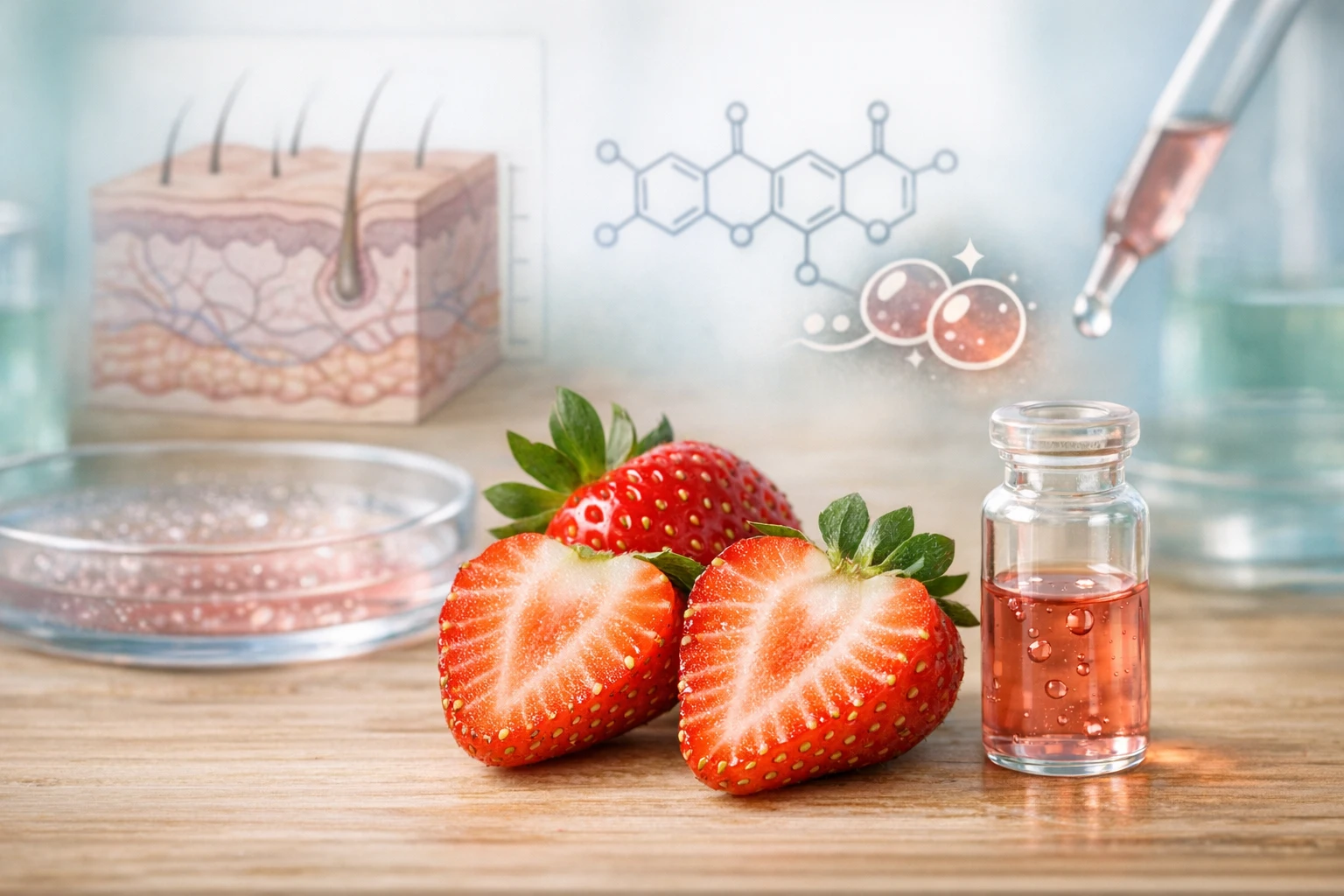
The red color of strawberries is mainly due to anthocyanins, a class of polyphenolic flavonoids that includes pelargonidin and conjugated cyanidin. These pigments, along with other polyphenols (ellagitannins, quercetin) and vitamin C, determine a chemical profile with high antioxidant capacity in laboratory tests. The biological plausibility for effects on the skin and cardiovascular system is based on two main properties: the ability to modulate oxidative stress and the possibility of influencing inflammatory and cell signaling pathways (e.g., NF-κB and antioxidant pathways like Nrf2). It is important to emphasize that the presence of these molecules in the fruit does not automatically guarantee clinical effects. Intestinal absorption, metabolism (including microbial transformation into urolithins for ellagitannins), and the form of intake (fresh vs. freeze-dried vs. extract) influence bioavailability and systemic effects. Cultivar variability, cultivation practices, and processing then affect the final concentration of bioactive compounds.
What are anthocyanins and why do they matter?
Anthocyanins are water-soluble pigments that contribute to the color of strawberries and some biological activities. In experimental models, they show direct antioxidant action and modulation of endogenous antioxidant enzymes; they can also act on inflammation pathways and cellular signals involved in vascular health. The quantity and profile of anthocyanins can vary greatly between cultivars and post-harvest processes, with practical implications for the final effect on humans. For these reasons, when evaluating benefits, it is essential to consider the effective dose of anthocyanins received and the form (fresh vs. freeze-dried powder). [1]
Evidence on skin and photoprotection
Experimental data indicate that strawberry extracts, rich in anthocyanins and other polyphenols, can reduce damage induced by UV-A radiation in human fibroblast cultures, decreasing markers of oxidative stress and signs of cellular damage. These results show biological plausibility for a protective role of the polyphenolic fraction against light stress on the skin. However, such studies are in vitro and do not replace clinical evidence on the effectiveness of oral consumption in preventing sun damage in the population. The proposed mechanism includes the reduction of reactive oxygen species and the modulation of cellular repair and inflammatory pathways, but the translation into large-scale clinical benefits requires well-designed human studies. [2][8]
Evidence on heart and cardiovascular risk factors
Strawberries and their derivatives have been the subject of controlled clinical studies and meta-analyses to evaluate their impact on lipids, blood pressure, oxidative stress, and inflammation. Several short-term randomized trials, including studies with freeze-dried strawberry powder at doses corresponding to dietary portions, have reported improvements in some markers (reduction in insulin resistance, improvement in atherogenic lipoproteins and biomarkers of oxidative stress and endothelial function) in people with metabolic risk. [4][5] A meta-analysis of RCTs synthesized modest but significant effects on LDL and other parameters, with more evident results in subjects with high baseline levels. [6] However, not all studies agree: acute interventions measuring post-prandial response have not always shown benefits on triglycerides and markers of vascular function. [7] Overall, clinical data suggest a possible role for strawberries in improving some cardiovascular risk factors, especially in at-risk populations, but do not support therapeutic or generalized claims without further long-term evidence.
What it means in practice
From a practical point of view, strawberries can be considered a food rich in nutrients and bioactive compounds that contribute to the overall quality of a fruit-rich diet. The available evidence suggests that regular consumption, within a balanced dietary pattern, can help improve indicators of oxidative stress, inflammation, and some cardiometabolic markers in at-risk individuals. However, there is insufficient data to recommend the use of strawberries as a "cure" for specific diseases or to prevent major clinical events. The form of consumption matters: many clinical studies have used freeze-dried powder to control the dose; the results are not automatically comparable to occasional consumption of fresh strawberries or sugar-added products. For those with known allergies or food sensitivities, consumption should be avoided or discussed with a professional. Finally, hygiene and washing are good practices for raw fruit consumption, but they do not alter the intrinsic nutritional benefits of the fruit.
Key takeaways
- The red color indicates the presence of anthocyanins, which provide biological plausibility for antioxidant and anti-inflammatory actions. [1][8]
- Cellular and animal models show skin protection from UV-induced damage and gastric protection in acute models, but these results do not automatically translate into generalized clinical benefits. [2][3]
- Short-term RCTs and meta-analyses report improvements in some cardiovascular and metabolic markers, especially in at-risk individuals; however, the results are heterogeneous. [4][5][6]
- There is insufficient evidence to state that strawberries definitively prevent chronic diseases; longer studies on clinical outcomes are needed. [6]
- The form, dose, and duration of the intervention are critical factors: freeze-dried powders and concentrated extracts are not identical to daily consumption of fresh fruit.
Limitations of the evidence
It is essential to distinguish between different levels of evidence. In vitro and animal studies provide information on mechanisms and biological plausibility, but experimental conditions (doses, exposures, extract forms) do not always reflect normal human consumption. Observational studies can show associations useful for generating hypotheses, but they do not prove causality because they can be confounded by behavioral and dietary factors. The strongest evidence comes from well-conducted RCTs: many strawberry trials are small, short-term, or use concentrated formulations; this limits generalizability and the ability to conclude on long-term clinical outcomes. The biological variability of fruit (cultivar, ripening, storage) and differences in individual metabolism (gut microbiota) add further uncertainty. Therefore, practical conclusions must remain cautious and based on the totality of the evidence, always distinguishing between plausibility and causal proof.
Editorial conclusion
Strawberries are a food with a favorable nutritional profile and bioactive compounds that offer plausibility for benefits on skin and cardiometabolic factors. Experimental evidence and some controlled clinical studies support effects on oxidative stress, inflammation, and cardiovascular risk markers, especially in people with risk factors. However, the literature does not authorize definitive therapeutic claims: larger and longer clinical studies are needed to confirm reductions in clinical events. In the meantime, including strawberries as part of a varied diet, rich in fruits and vegetables, is consistent with established nutritional recommendations. For personalized advice on specific medical conditions, it is always advisable to consult your doctor or a nutrition professional.
Editorial note
This article was drafted from previously published material and updated following criteria of evidence-based communication and divulgative clarity. It is for informational purposes only and does not replace medical advice. For personal clinical decisions, consult your doctor or a qualified healthcare professional.
SCIENTIFIC RESEARCH
- Giampieri F, Álvarez‑Suárez JM, Battino M. Strawberry and human health: Effects beyond antioxidant activity. J Agric Food Chem. 2014;62(18):3867–3876. https://doi.org/10.1021/jf405455n
- Giampieri F, Álvarez‑Suárez JM, Tulipani S, et al. Photoprotective potential of strawberry (Fragaria × ananassa) extract against UV‑A irradiation damage on human fibroblasts. J Agric Food Chem. 2012;60(9):2322–2327. https://doi.org/10.1021/jf205065x
- Álvarez‑Suárez JM, Dekanski D, Ristić S, et al. Strawberry polyphenols attenuate ethanol‑induced gastric lesions in rats by activation of antioxidant enzymes and attenuation of MDA increase. PLoS ONE. 2011;6(10):e25878. https://doi.org/10.1371/journal.pone.0025878
- Basu A, Izuora K, Betts NM, et al. Dietary strawberries improve cardiometabolic risks in adults with obesity and elevated serum LDL cholesterol in a randomized controlled crossover trial. Nutrients. 2021;13(5):1421. https://doi.org/10.3390/nu13051421
- Basu A, Izuora K, Betts NM, et al. Dietary strawberries improve biomarkers of antioxidant status and endothelial function in adults with cardiometabolic risks in a randomized controlled crossover trial. Antioxidants (Basel). 2021;10(11):1730. https://doi.org/10.3390/antiox10111730
- Effects of strawberry intervention on cardiovascular risk factors: a meta‑analysis of randomized controlled trials. Br J Nutr. 2020;124:241–246. https://doi.org/10.1017/S000711452000121X
- Incorporating freeze‑dried strawberry powder into a high‑fat meal does not alter postprandial vascular function or blood markers of cardiovascular disease risk: a randomized controlled trial. Am J Clin Nutr. 2017;105(2):313–322. https://doi.org/10.3945/ajcn.116.141804
- Del Rio D, Costa LG, et al. Behind the scenes of anthocyanins—From the health benefits to potential applications in food, pharmaceutical and cosmetic fields. Nutrients. 2022;14(23):5133. https://doi.org/10.3390/nu14235133