Updated and contextualized version of an article originally published on May 13, 2014
The article retains its original focus by presenting it through a scholarly and accessible perspective, supported by verifiable references.
Authors
- Dr. M. Bitonti – Biologist
- Roberto Panzironi –Independent researcher
Note editoriali
- First publication: May 13, 2014
- Last update: April 18, 2026
- Version: 2026 narrative revision
This article is based on previously published content and has been updated according to scientific criteria and for public clarity. It is for informational purposes only and does not replace medical advice. For personal decisions regarding supplementation or therapies, consult a healthcare professional.
IN BRIEF
- Coenzyme Q10 (CoQ10) is a molecule present in the skin that contributes to both cellular energy production and antioxidant defense.
- Small, recent clinical studies show that topical formulations and some oral supplementations (often combined with collagen or other antioxidants) can improve parameters such as dermal density, elasticity, and skin roughness.
- The observed effect depends on the type of administration (topical vs. oral), the formulation (e.g., water-soluble forms or delivery systems), and the studied population; the results are not universal and require cautious interpretation.
Abstract: What does science say?
Simple definition
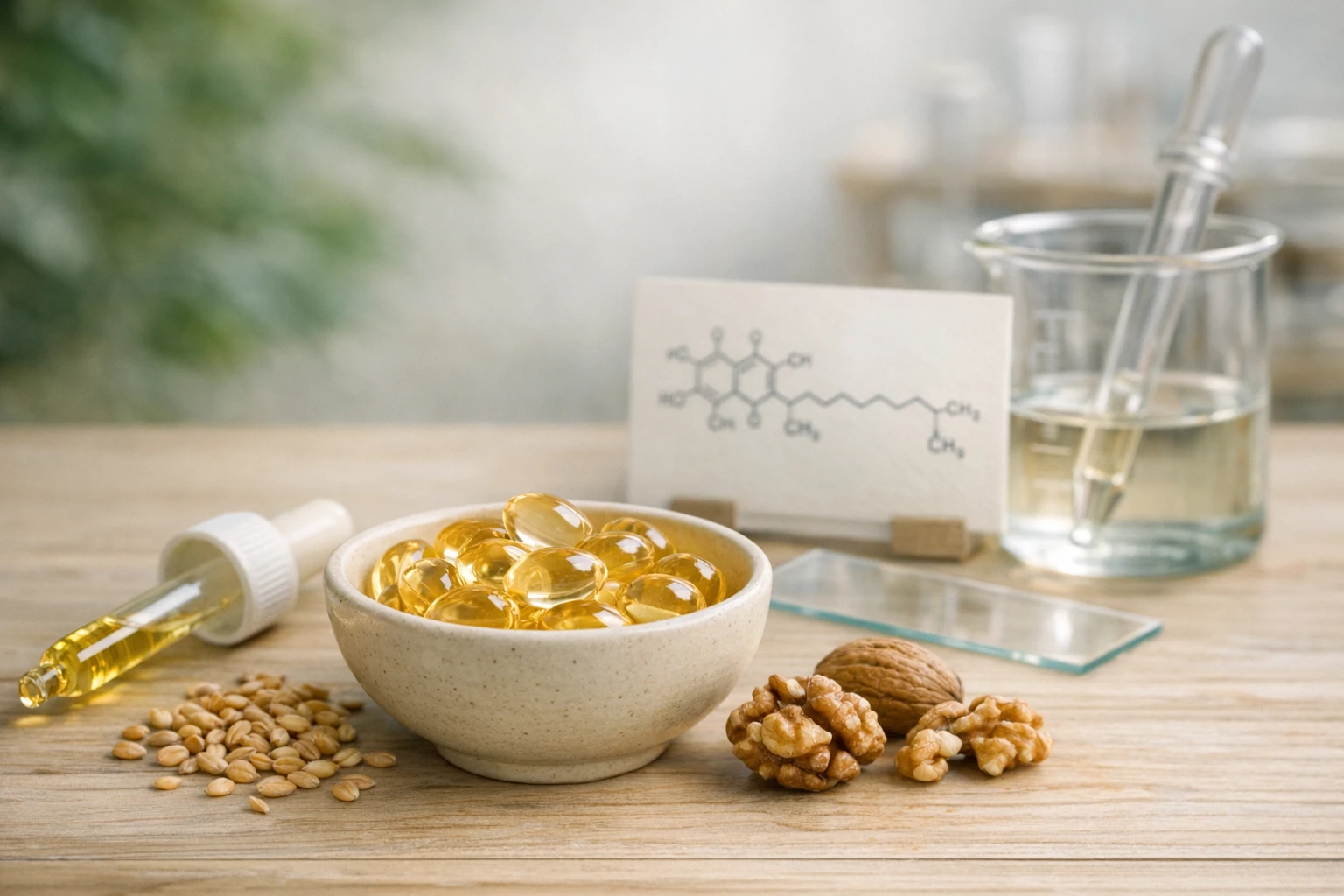
Coenzyme Q10 (CoQ10, ubiquinone) is a lipophilic substance produced by the body that has two main roles: transporting electrons in the mitochondrial respiratory chain (energy support for cells) and acting as a lipid antioxidant. In the skin, these roles contribute to maintaining cellular function and limiting oxidative damage that promotes the loss of collagen and elasticity.
What available evidence shows
Evidence includes laboratory studies, animal models, skin penetration studies, and small-to-medium sized clinical trials. Experimental studies indicate that CoQ10 can reduce oxidative stress and support energy production in keratinocytes and fibroblasts; clinical studies have reported measurable improvements in parameters such as dermal density, roughness, and wrinkle depth in selected groups when CoQ10 is applied topically or taken in specific forms along with other ingredients. However, clinical effects vary according to formulation, dose, and study duration [1][2][3][4][5].
Dependence on form, dose, and context
Efficacy is influenced by the mode of administration: topical CoQ10 reaches useful skin levels if the formulation promotes penetration; oral intake can be useful, especially if the molecule is in a highly bioavailable form or combined with other nutrients (e.g., collagen), but clinical results report modest and not immediate improvements. Furthermore, different populations (age, phototype, sun exposure, concomitant therapies) may respond differently [3][4][5].
Interpretive limitations
Many studies are small, sometimes industry-sponsored, or combine CoQ10 with other ingredients, making it difficult to attribute effects to a single active ingredient. Laboratory evidence on mechanisms (antioxidation, regulation of MMPs, and collagen synthesis) is robust, but clinical translation requires larger, independent studies to confirm efficacy and optimal dosages [1][2][3][4][5].
What it means in practice
The practical application of evidence must be approached realistically: CoQ10 is a biologically plausible principle for supporting skin health, but there are no guarantees of spectacular results or equivalence with medical interventions (e.g., regenerative treatments). Topicals designed to promote molecule penetration can increase the presence of CoQ10 in the skin layer and are the most direct strategy to act on dermal tissue. For oral intake, water-soluble formulations or those combined with collagen have shown improvements in controlled studies, but the benefits are generally modest and require weeks of continuous intake [3][4].
From a practical and public communication perspective: consider CoQ10 as a reasonable component in a multifactorial strategy for skin care (sun protection, hydration, balanced diet, control of risk factors such as smoking and UV exposure), avoiding expectations of a "miracle cure." Furthermore, the choice of a product should prioritize formulations with published data and transparency regarding concentrations and the chemical form of the molecule [4][5].
Key takeaways
- CoQ10 is both an energy cofactor and an antioxidant: functions relevant to the skin but not exclusively "anti-aging."
- Well-formulated topicals can increase CoQ10 levels in the skin and show effects on roughness and wrinkles in small studies. [2][4]
- Some clinical trials on oral supplements (often combined with collagen) have reported skin improvements, but the effect depends on the formulation and the study context. [3]
- Vitamin E, zinc, and selenium are nutrients with plausible biological roles in maintaining the skin matrix and antioxidant defense; their supplementation should be evaluated on a case-by-case basis. [6][7][8]
Limitations of evidence
Difference between observational studies and causal evidence
Experimental in vitro studies and controlled in vivo studies provide evidence of plausible mechanisms, but observational studies do not demonstrate causality. Many clinical trials are randomized and controlled but are small or involve combinations of ingredients: this limits the ability to attribute a direct and robust effect to CoQ10 alone [1][3][4].
Methodological limitations
Recurring methodological criticalities include limited samples, short duration, variable subjective or instrumental measures, and possible conflicts of interest associated with industrial sponsorship. Furthermore, there is a lack of comparative studies between different forms of CoQ10 and of sufficient size to evaluate long-term safety in different populations [2][3][4].
Context variability
Skin response depends on age, UV exposure, nutritional status, use of medications (some, like statins, can reduce CoQ10 levels), and co-supplementation. This means that the results of individual studies may not apply uniformly to the entire population [1][5].
Need for cautious interpretation
Practical indications must take into account the overall evidence: CoQ10 is supported by mechanistic data and RCTs on specific formulations, but uncertainties remain regarding optimal dose, duration, and added value compared to basic measures (sun protection, hydration, nutrition). Therefore, generalized clinical recommendations are not justified without further evidence [1][3][4][5].
Editorial conclusion
Coenzyme Q10 is a molecule with strong biological plausibility for contributing to skin health: it acts as an energy cofactor and antioxidant, and modern formulations—topical or integrated—can improve instrumental skin parameters in controlled studies. However, the observed clinical effects are generally modest, conditioned by the formulation and the studied population, and do not replace established measures of skin protection and care. The choice of products containing CoQ10 should be guided by transparency, published data, and an integrated approach to skin health. Independent, larger, and better-controlled studies are still needed to precisely define benefits, safety, and optimal dosages.
Original source cited in the starting material: Prof. Raffaella Garofalo.
SCIENTIFIC RESEARCH
- Elena Díaz-Casado M et al. The Paradox of Coenzyme Q10 in Aging. Nutrients. 2019. https://doi.org/10.3390/nu11092221.
- Hoppe U, Bergemann J, Diembeck W, et al. Coenzyme Q10, a cutaneous antioxidant and energizer. Biofactors. 1999. https://doi.org/10.1002/biof.5520090238.
- Žmitek K, Žmitek J, Rogl Butina M, Pogačnik T. Effects of a Combination of Water‑Soluble Coenzyme Q10 and Collagen on Skin Parameters and Condition: Results of a Randomised, Placebo‑Controlled, Double‑Blind Study. Nutrients. 2020. https://doi.org/10.3390/nu12030618.
- Topical Delivery of Coenzyme Q10‑Loaded Microemulsion for Skin Regeneration. Pharmaceutics. 2020. https://doi.org/10.3390/pharmaceutics12040332.
- Abi Nahed R, Hussein A, Cottet‑Rousselle C, et al. Coenzyme Q10 protects keratinocytes against oxidation‑induced energy stress as revealed by spatiotemporal analysis of cell energetics. Sci Rep. 2025. https://doi.org/10.1038/s41598-025-98793-4.
- Age‑dependent increase of collagenase expression can be reduced by α‑tocopherol via protein kinase C inhibition. Free Radical Biology and Medicine. 1999. https://doi.org/10.1016/S0891-5849(99)00007-6.
- Zinc in wound healing modulation. International Journal of Molecular Sciences. 2018. https://doi.org/10.3390/ijms19020439.
- Brown KM, Arthur JR. Selenium, selenoproteins and human health: a review. Public Health Nutrition. 2001. https://doi.org/10.1079/PHN2001143.
Editorial contacts: [Placeholder for editorial data and contact information].