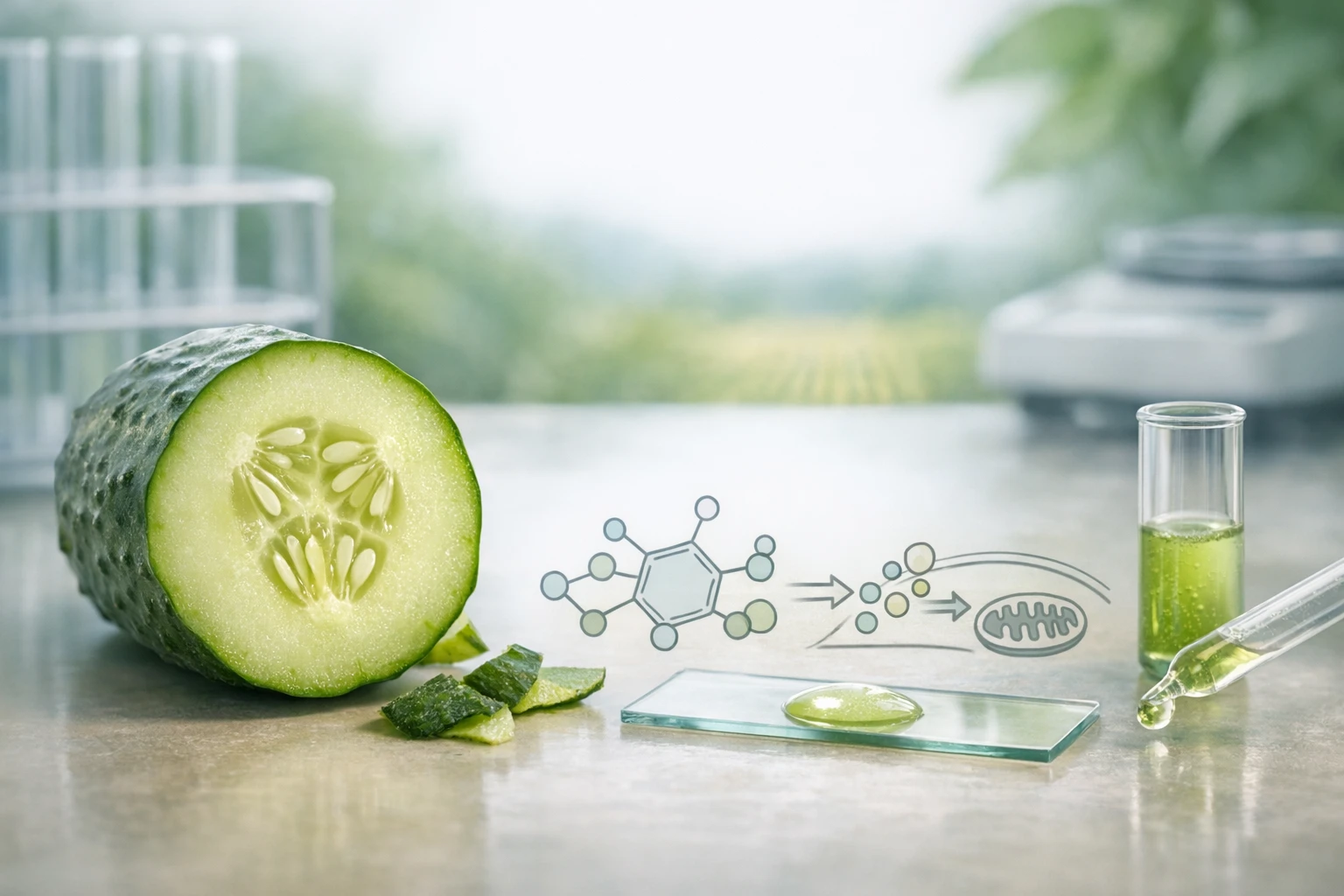
Updated and contextualized version of an article originally published on May 13, 2014
The article retains its original focus by presenting it through a scholarly and accessible perspective, supported by verifiable references.
Authors
- Dr. A. Conte – Biologist
- Roberto Panzironi –Independent researcher
Note editoriali
- First publication: May 13, 2014
- Last update: April 18, 2026
- Version: 2026 narrative revision
Brief note: This article was previously published and has been updated following scientific and informative criteria. It does not replace medical advice.
IN BRIEF
- Cucumbers are primarily water and contain minerals, vitamins, and phytonutrients with antioxidant and anti-inflammatory activity.
- Components such as cucurbitacins and lignans show biological activities in preclinical studies, but clinical evidence is limited and often preliminary.
- The peel may contain silicon, a mineral with a plausible role in connective tissue; however, the direct dietary contribution to skin or bones is still uncertain.
- Some cucumber extracts have shown anti-inflammatory effects in cells and animal models: translating these results to human practice requires more robust controlled studies.
Abstract: what does science say?
Cucumbers (Cucumis sativus) are foods with high water content and low caloric intake that provide vitamins, minerals, and a combination of phytonutrients (including cucurbitacins, flavonoids, and phenolic compounds). Experimental evidence indicates that extracts and some isolated compounds can exert antioxidant activity, modulate inflammatory responses, and interfere with cellular pathways relevant to tumor proliferation. Studies on plants, cell assays, and animal models suggest plausible biological mechanisms; however, clinical evidence in humans is scarce or small-scale. The effects depend on the form of consumption (pulp, peel, seeds, concentrated extract), the dose, and the context (dietary vs. concentrated supplementation). To evaluate the actual role of cucumber as an "anti-aging" food, well-designed clinical trials and standardized measures of endpoints (e.g., markers of oxidative stress, inflammation, skin health parameters) are needed. Current information supports biological plausibility but does not allow for definitive causal claims.
Composition and biological mechanisms
Nutritional profile and hydration
Cucumbers are composed of over 90% water, with a very low caloric intake. They provide small but useful amounts of potassium, magnesium, and vitamin C, nutrients that contribute to water balance, muscle function, and basic antioxidant defense. This combination partly explains the traditional use of cucumbers for maintaining hydration and skin tone. From a physiological point of view, the intake of water-rich foods helps overall water balance and can promote less dehydrated skin, but relevant systemic effects on energy or metabolism always require considering the entire diet and lifestyle [1].
Phytonutrients: cucurbitacins, lignans, and antioxidants
Cucumbers contain various phytonutrients characteristic of the Cucurbitaceae family, including cucurbitacins (triterpenes) and various polyphenols. Cucurbitacins have been intensely studied in the laboratory for their biological activities, which include modulation of signaling pathways involved in cell proliferation and inflammation. In in vitro and in vivo models, some of these compounds have shown antiproliferative activity on tumor cell lines and the ability to interfere with pathways such as JAK-STAT and PI3K/Akt, mechanisms often cited in the literature on cucurbitacins. Lignans (e.g., pinoresinol and secoisolariciresinol) are found in various plants and have been associated with biological effects in observational and preclinical studies; their presence in cucumbers contributes to the plausibility of possible health effects, especially as modulators of redox and hormonal processes. It is important to note that the concentration of each phytocompound in fresh fruit tends to be low compared to the concentrated extracts used in laboratory experiments [3][4].
Experimental and clinical evidence
Cellular and animal studies on inflammation and antioxidants
Numerous in vitro studies have shown that cucumber extracts can reduce markers of oxidative stress and modulate the inflammatory response in cell lines; for example, a water/ethanol extract of Cucumis sativus attenuated the LPS-induced inflammatory response in endothelial cells, reducing the secretion of pro-inflammatory cytokines and supporting the expression of protective genes [5]. Other preclinical assays indicate antioxidant capacity with a reduction in reactive markers and proteins involved in inflammation. These effects are consistent with the presence of polyphenols and vitamins in the fruit, but often come from concentrated extracts or animal models; direct translation to humans requires caution [6].
Evidence on blood pressure, metabolism, and anticancer
In animal models, favorable effects on blood pressure and some metabolic parameters have been observed after administration of cucumber extracts or juice; studies in mice or rats suggest vasodilatory and antioxidant mechanisms that can modulate the response to angiotensin II [7]. In oncology, compounds isolated from cucurbits, including cucurbitacin C isolated from cucumber, have shown antiproliferative activity in vitro and in animal models, and cucumber seed oil has been evaluated in experimental models of cancer prevention with promising results [4][8]. This research provides scientific interest but does not represent clinical evidence of therapeutic efficacy in humans; rather, it forms the basis for future studies.
What it means in practice
For readers interested in improving skin appearance and health or integrating dietary choices for well-being, cucumbers can be a useful food within a varied diet: they provide water, some micronutrients, and compounds with antioxidant activity. The traditional topical use (slices or compresses) is consistent with a local hydrating effect and the soothing action of fresh juice, but controlled clinical evidence on specific dermatological outcomes (e.g., skin elasticity, cellulite reduction) is limited or lacking. Concentrated extracts or cucumber-based supplements study pharmacological effects in experimental contexts; these are not comparable to daily food consumption. Therefore, including cucumbers in the diet can be considered a healthy and low-risk option, but it should not be understood as a treatment or substitute for established medical therapies. Any use of concentrated extracts or supplements should be evaluated on a case-by-case basis and, in the presence of clinical conditions, discussed with a healthcare professional [1][5].
Limitations of the evidence
Available research shows important differences in study type and methodological quality. Much evidence comes from in vitro studies, concentrated extracts, or animal models, which generally cannot confirm a direct and causal effect in humans. Existing clinical studies are few, often small-scale or with uncontrolled designs, which limits generalizations and effect estimates. The variability of phytochemical content depending on cultivar, soil, part of the fruit (pulp, peel, seeds), and extraction method makes it difficult to standardize doses and compare studies. Furthermore, the use of concentrated extracts introduces a qualitative difference compared to food consumption: doses used in experimental assays can be much higher than what is obtained by eating the fruit. To assert causal relationships, randomized clinical trials are needed, with relevant clinical endpoints and standardized measures of exposure and outcomes [3][5].
Key points to remember
- Cucumbers are a low-calorie source of water, potassium, vitamin C, and phytonutrients with potential antioxidant activity.
- Compounds like cucurbitacins and some lignans show biological activities in the laboratory, but this does not imply a direct clinical effect in humans. [3][4]
- The peel may contain silicon, which is biologically plausible for connective tissue; the actual dietary impact is still to be clarified. [2]
- Cucumber extracts have shown anti-inflammatory activity in cellular and animal models; clinical studies remain limited. [5][6]
- Consuming cucumbers as part of a varied diet is reasonable; the use of concentrated extracts requires professional evaluation and supervision.
Editorial conclusion
Cucumbers are simple and nutritious foods, with a combination of water, minerals, and plant molecules that justify scientific interest. Experimental literature provides plausible signals on mechanisms that could contribute to better skin hydration, modulation of the inflammatory response, and antioxidant activity. However, the current level of evidence does not allow cucumber to be considered an autonomous "anti-aging cure": the most robust results come from preclinical studies or concentrated extracts. The practical recommendation, based on a prudent and evidence-based approach, is to consider cucumbers as part of a balanced diet and to await further clinical studies to translate laboratory observations into clinical or therapeutic recommendations.
Editorial note
Article originally published in the past; updated according to scientific and informative criteria for clarity and source verification. The content is for informational purposes only and does not replace medical consultation. For personalized advice, consult a healthcare professional.
SCIENTIFIC RESEARCH
- Mukherjee PK, Nema NK, Maity N, Sarkar BK. Phytochemical and therapeutic potential of cucumber. Fitoterapia. 2013;84:227–236. https://doi.org/10.1016/j.fitote.2012.10.003
- Tripathi D, Dwivedi MM, Tripathi DK, Chauhan DK. Silicon bioavailability in exocarp of Cucumis sativus Linn. 3 Biotech. 2017 Dec;7(6):386. https://doi.org/10.1007/s13205-017-0960-x
- Cai Y, Fang X, He C, et al. Cucurbitacins: A Systematic Review of the Phytochemistry and Anticancer Activity. Am J Chin Med. 2015;43(7):1331-1350. https://doi.org/10.1142/S0192415X15500755
- Mao Y, Zhang J, et al. In Vitro and In Vivo Antitumor Activity of Cucurbitacin C, a Novel Natural Product From Cucumber. Front Pharmacol. 2019;10:1287. https://doi.org/10.3389/fphar.2019.01287
- Bernardini C, Zannoni A, Bertocchi M, et al. Water/ethanol extract of Cucumis sativus L. fruit attenuates lipopolysaccharide-induced inflammatory response in endothelial cells. BMC Complement Altern Med. 2018;18:194. https://doi.org/10.1186/s12906-018-2254-1
- Yadav S, et al. Free Radical Scavenging and Analgesic Activities of Cucumis sativus L. Fruit Extract. J Basic Clin Pharm. 2010;2(4):365–368. https://doi.org/10.4103/0975-1483.71627
- Hendrayana T, et al. Cucumber (Cucumis sativus L.) Fruit and Combination with Losartan Attenuate the Elevation of Blood Pressure in Hypertensive Rats Induced by Angiotensin II. (Korean Pharmacol Intl). 2023;26(4):298–306. https://doi.org/10.3831/KPI.2023.26.4.298
- Bakam BY, Pambe JCN, Grey T, et al. Cucumis sativus (Cucurbitaceae) seed oil prevents benzo(a)pyrene-induced prostate cancer in vitro and in vivo. Environ Toxicol. 2023;38(9):2069–2083. https://doi.org/10.1002/tox.23830
Note: the listed research has been verified for DOI and relevance to the topic discussed. For further information, consult the original sources.