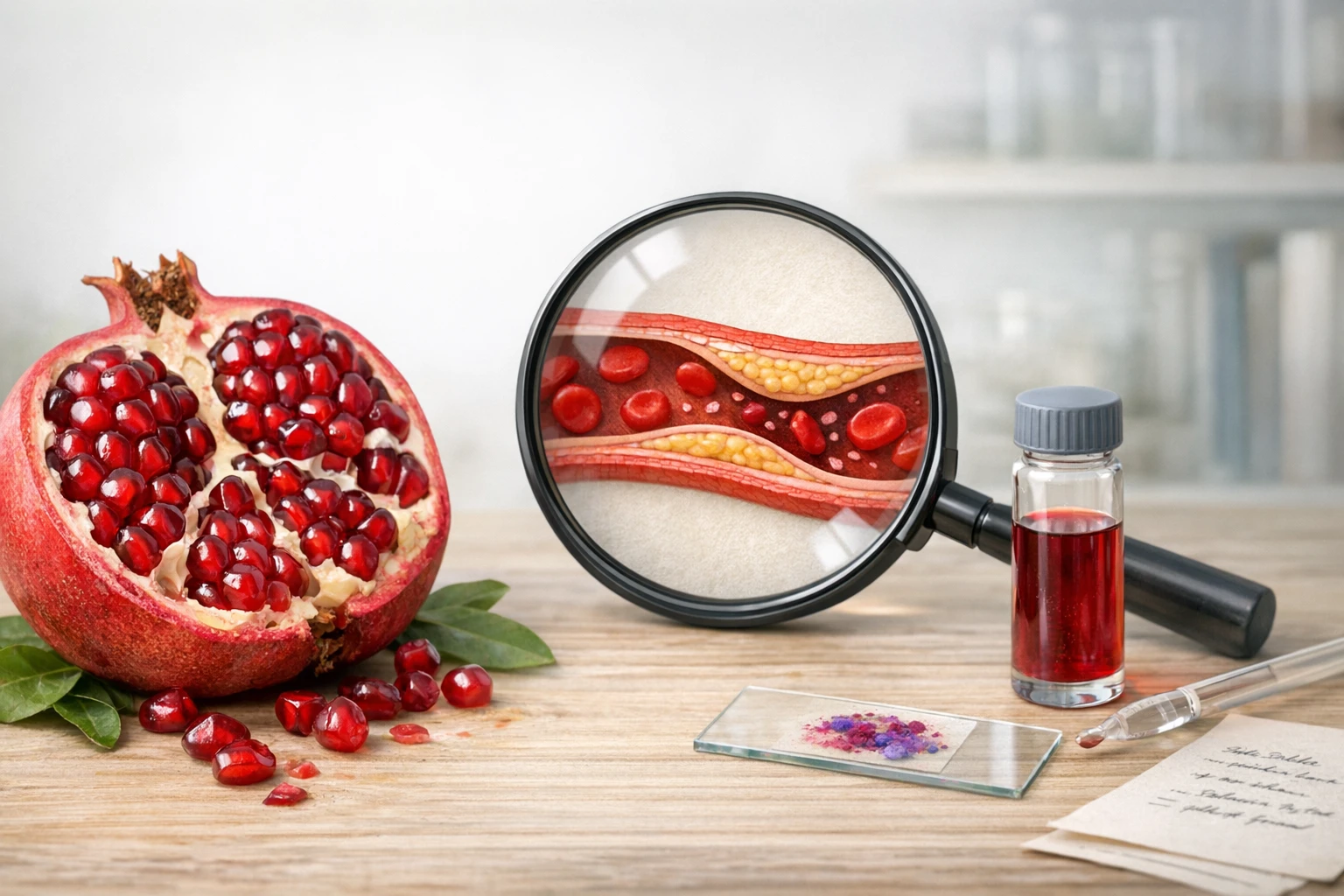
Updated and contextualized version of an article originally published on May 13, 2014
The article retains its original focus by presenting it through a scholarly and accessible perspective, supported by verifiable references.
Authors
- Dr. A. Conte – Biologist
- Roberto Panzironi –Independent researcher
Note editoriali
- First publication: May 13, 2014
- Last update: April 18, 2026
- Version: 2026 narrative revision
Editorial note: this article was previously published and updated according to scientific and informative criteria. The text is for informational purposes only and does not replace medical advice. If you have health conditions or are taking medications, consult a doctor before changing your diet or taking supplements.
IN BRIEF
- Some experimental studies on animal models show that pomegranate extracts and juice can reduce parameters associated with atherosclerosis and oxidative stress.
- A small clinical study documented reductions in carotid intima-media thickness in subjects with carotid stenosis after prolonged juice consumption, but clinical evidence is not yet conclusive or generalizable to the general population.
- Proposed mechanisms include reduction of oxidative stress, modulation of paraoxonases, anti-inflammatory effects, and potential inhibition of angiotensin-converting enzyme (ACE).
- The quality and form of the product (whole juice, standardized extract, peel) influence the concentration of active ingredients and experimental results.
- Practical recommendations must be cautious: pomegranate can be part of a healthy diet, but it is not a substitute for proven medical therapies.
Abstract: what does science say?
Pomegranate (Punica granatum) is rich in polyphenols (punicalagins, ellagitannins, ellagic acid), compounds with antioxidant activity and potential biological effects on vascular tissues. In animal models predisposed to atherosclerosis, various fruit preparations have reduced plaque size and fragility and decreased markers of oxidative stress. In limited-size clinical studies, improvements in cardiovascular surrogate endpoints (e.g., carotid intima-media, oxidative parameters, blood pressure) have been observed, while meta-analyses report variable results on blood pressure. The evidence suggests biological plausibility but has methodological limitations: small sample sizes, heterogeneity of products and dosages, and a prevalence of experimental studies. Therefore, pomegranate can be considered a food with potential cardiovascular benefits, but its clinical efficacy as a primary or therapeutic intervention remains to be established with rigorous, large-scale clinical studies.
Proposed biological mechanisms
Pomegranate contains numerous polyphenolic compounds that explain the biological plausibility of its cardiovascular effects. Polyphenols act as direct antioxidants and modulate cellular pathways involved in lipid peroxidation, endothelial function, and inflammatory response. In experimental models, an increase in the activity of protective enzymes such as paraoxonase (PON) is observed, associated with reduced oxidation of low-density lipoproteins (LDL) and less lipid accumulation in macrophagic cells, key processes in atherogenesis [2][8].
Antioxidants and oxidized LDL
Pomegranate polyphenols reduce the susceptibility of LDL to oxidation, an important step in the formation of atherosclerotic plaques. Studies on murine models and cells show a decrease in lipid peroxidation and less formation of foam cells, correlated with a reduction in the size of atherosclerotic lesions [2][4]. These effects are consistent with reduced serum oxidative stress measures in some human trials.
Inflammation, macrophages, and plaque stability
Pomegranate appears to modulate inflammatory markers and macrophage activity within the plaque: in animals, less macrophagic infiltration, a reduction in intralesional necrosis, and increased collagen deposition are observed, which can translate into greater plaque stability [1][5]. These processes suggest a possible effect not only on the size but also on the vulnerability of the atherosclerotic lesion.
Blood pressure and the renin-angiotensin system
Some studies indicate that pomegranate components can inhibit angiotensin-converting enzyme (ACE) activity and influence vascular response, with modest reductions in systolic blood pressure in some clinical trials and meta-analyses. However, the magnitude of the effect is variable and depends on duration, dosage, and the population studied [9].
What experimental and clinical studies show
Research includes in vitro studies, animal models, and small or short-term clinical trials. In murine models predisposed to atherosclerosis, the consumption of juices or extracts has often reduced lipid accumulation and the size of atherosclerotic lesions, with improvements in markers of oxidation and inflammation [1][2][4][5]. These experimental results provide mechanistic support but do not guarantee the same magnitude of effect in humans.
In clinical studies, notable results have been published in selected populations: a small study on subjects with carotid stenosis documented a reduction in carotid intima-media thickness after regular consumption of pomegranate juice, along with improvements in oxidative markers [3]. Other controlled trials have reported favorable effects on some biomarkers (blood pressure, oxidative stress parameters, lipids) in specific contexts such as hemodialysis patients or healthy volunteers who took standardized extracts [6][7].
Meta-analyses and systematic reviews show contradictory results: some analyses observe an average reduction in blood pressure associated with pomegranate consumption, while others highlight heterogeneity and limited quality of evidence, emphasizing the need for larger and standardized studies [9][8].
What it means in practice
For the general public, current evidence suggests that pomegranate can be considered a polyphenol-rich food with a potential role in reducing oxidative stress and some cardiovascular risk factors. However, there is not enough evidence to recommend pomegranate as a primary therapy or substitute for proven pharmacological treatments for coronary artery disease, hypertension, or dyslipidemia.
If you wish to include pomegranate in your diet: consumption as a whole fruit or as natural juice can contribute to polyphenol intake as part of a balanced diet. It is important to consider that whole juice may contain sugars; the standardized extracts used in clinical trials differ in their content of punicalagins and other active compounds, so the effects observed in studies with concentrated extracts are not automatically comparable to simply consuming the fruit.
Finally, those taking medications for blood pressure, anticoagulants, or other treatments should consult their doctor: some extracts may interact with medications or affect blood parameters.
Key points to remember
- Biological plausibility exists: pomegranate compounds modulate lipid oxidation and vascular inflammation.
- Preclinical evidence (animal models) shows a reduction in atherosclerotic lesions in various experimental models [1][4][5].
- Some clinical studies and meta-analyses document improvements in surrogate markers (CIMT, blood pressure, oxidative biomarkers), but the results are heterogeneous [3][6][9].
- The product form and dosage influence the effects: juice, standardized extract, and peel contain different chemical profiles [8].
- Pomegranate is a potentially useful dietary supplement in the context of a healthy diet, but it is not a substitute for validated cardiovascular therapies.
Limitations of the evidence
It is important to distinguish between plausible associations and causal evidence: most mechanistic evidence comes from in vitro or animal studies; clinical studies have limitations such as small samples, limited duration, lack of rigorous placebo control in some cases, and heterogeneity of the products studied. Observational studies can show useful correlations for generating hypotheses but do not establish causality. Furthermore, many measures used as endpoints are surrogates (e.g., intima-media thickness, biochemical markers) and do not always correspond to demonstrated reductions in major clinical events (heart attack, stroke, cardiovascular death).
Variability in the chemical composition of pomegranate-based products complicates interpretation: different extraction methods and plant parts (arils, seeds, peel) produce very different concentrations of punicalagins and other polyphenols, with direct implications for efficacy and safety. For these reasons, cautious interpretation and the need for randomized, controlled, long-term studies with relevant clinical endpoints are required.
Editorial conclusion
The scientific literature on pomegranate and cardiovascular health is rich in plausible hypotheses and promising experimental data. Preclinical studies indicate favorable effects on processes involved in atherosclerosis and plaque stability; some clinical trials, mostly on small samples or selected populations, show improvements in surrogate markers. At present, pomegranate can be considered a food with potential nutraceutical value within a varied diet and a healthy lifestyle, but there is not yet robust evidence to recommend its therapeutic use instead of standard treatments. More extensive clinical research, with standardized products and defined clinical endpoints, is needed to clarify its role, dosages, and safety.
Final editorial note
This update has been prepared following criteria of transparency and source verification. The information provided here is for informational purposes only and should not be used as personalized medical advice.
SCIENTIFIC RESEARCH
Below are the researches cited in the article (numbered list in order of appearance):
- Effect of pomegranate extract on coronary artery atherosclerosis in SR-BI/apoE double knockout mice. Atherosclerosis. DOI: https://doi.org/10.1016/j.atherosclerosis.2013.02.025 [1]
- Pomegranate juice supplementation to atherosclerotic mice reduces macrophage lipid peroxidation, cellular cholesterol accumulation and development of atherosclerosis. J Nutr. DOI: https://doi.org/10.1093/jn/131.8.2082 [2]
- Pomegranate juice consumption for 3 years by patients with carotid artery stenosis reduces common carotid intima-media thickness, blood pressure and LDL oxidation. Clinical Nutrition. DOI: https://doi.org/10.1016/j.clnu.2003.10.002 [3]
- Pomegranate byproduct administration to apolipoprotein E-deficient mice attenuates atherosclerosis development as a result of decreased macrophage oxidative stress and reduced cellular uptake of oxidized LDL. J Agric Food Chem. DOI: https://doi.org/10.1021/jf0528207 [4]
- Pomegranate peel extract decreases plaque necrosis and advanced atherosclerosis progression in Apoe-/- mice. Frontiers in Pharmacology. DOI: https://doi.org/10.3389/fphar.2022.888300 [5]
- Antioxidant properties and beneficial cardiovascular effects of a natural extract of pomegranate in healthy volunteers: a randomized preliminary single-blind controlled study. Antioxidants. DOI: https://doi.org/10.3390/antiox11112124 [6]
- Pomegranate juice supplementation to hemodialysis patients: randomized crossover trial showing improvements in cardiometabolic markers. J Sci Food Agric. DOI: https://doi.org/10.1002/jsfa.10096 [7]
- Pomegranate protection against cardiovascular diseases: review summarizing mechanistic and clinical evidence. Evidence-Based Complementary and Alternative Medicine. DOI: https://doi.org/10.1155/2012/382763 [8]
- Effects of pomegranate juice on blood pressure: systematic review and meta-analysis of randomized controlled trials. Pharmacological Research. DOI: https://doi.org/10.1016/j.phrs.2016.11.018 [9]