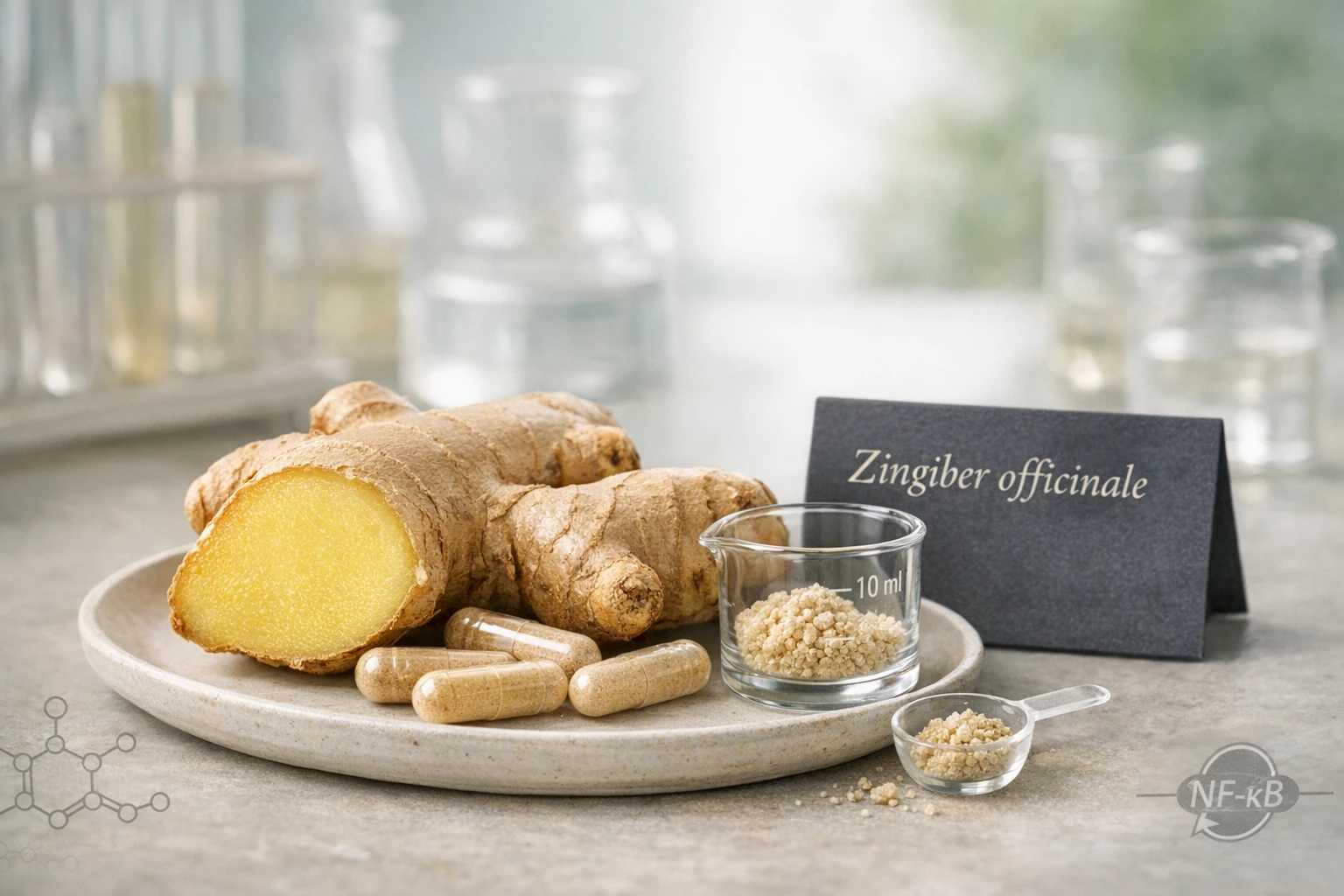
Updated and contextualized version of an article originally published on May 15, 2014
The article retains its original focus by presenting it through a scholarly and accessible perspective, supported by verifiable references.
Authors
- Dr. A. Colonnese – Nutrition biologist
- Roberto Panzironi –Independent researcher
Note editoriali
- First publication: May 15, 2014
- Last update: April 18, 2026
- Version: 2026 narrative revision
Initial note: This article was originally published in the past and updated here to reflect a critical and updated synthesis of the evidence. The text is for informational purposes only and does not replace the advice of a healthcare professional.
In brief
- Ginger (Zingiber officinale) contains biologically active compounds (gingerols, shogaols) that show anti-inflammatory and analgesic effects in the laboratory and in some clinical studies.
- Experimental evidence indicates that short daily ginger supplementation can reduce exercise-induced muscle pain in healthy volunteers, but the effect size is moderate.
- Meta-analyses in chronic conditions (osteoarthritis, dysmenorrhea) report mixed results: some benefit exists, but the quality and heterogeneity of studies are limiting.
- Short-term safety appears acceptable for most people; pay attention to drug interactions and gastrointestinal effects. Before changing therapies or starting supplements, consult a doctor.
Abstract: what does science say?
Ginger is a root used for centuries in both cooking and traditional medicine. Over the past twenty years, clinical and laboratory research has investigated the ability of its components (gingerols, shogaols) to modulate biological processes related to pain and inflammation. In controlled studies on healthy volunteers, daily intake of ginger in powder or extract form has, on average, reduced muscle pain after intense exercise compared to placebo. In chronic conditions (e.g., knee osteoarthritis) and for menstrual cycle-related pain, systematic reviews report a modest reduction in pain, but with non-uniform results across studies. The evidence indicates that the effect depends on the dose, duration of intake, form of preparation (powder, extract, heated), and clinical context. The main limitations are the small size of many trials, the variability in formulations, and the poor methodological homogeneity. Overall, biological plausibility is supported by known laboratory mechanisms, but the strength of clinical evidence remains moderate and requires further well-characterized trials.
Clinical evidence on exercise and muscle pain
Experimental laboratory studies have used standardized models of muscle damage induced by eccentric exercise to test the effect of ginger on post-activity pain. In a randomized trial on healthy adults, daily intake of 2 g of ginger for several days showed an average reduction in muscle pain compared to placebo [1]. These experimental designs allow pain to be caused and measured in a controlled manner, but they reflect an acute context and not necessarily chronic conditions or populations with comorbidities.
Evidence in chronic conditions and other types of pain
For chronic conditions such as knee osteoarthritis, meta-analyses of randomized trials suggest a modest reduction in pain and improved function after ginger intake, but the overall quality of evidence is moderate and effects vary across studies [2]. For primary dysmenorrhea, systematic reviews indicate that ginger doses between 750 and 2,000 mg in the first days of the cycle can reduce menstrual pain compared to placebo [3]. In both cases, promising results are attenuated by heterogeneity in dosages, formulations, and duration of interventions.
What it means in practice
For those who engage in physical activity, the most supported hypothesis is that ginger can help reduce acute muscle pain after very intense sessions. However, the average reduction is not equivalent to immediate healing: we are talking about a decrease in perceived discomfort, not complete elimination of pain. The form (powder, standardized extract, capsules), dose, and continuity of intake influence the observed effect. In chronic conditions such as osteoarthritis and dysmenorrhea, some patients may experience benefit, but clinical guidelines continue to prioritize therapies with more solid evidence (e.g., NSAIDs for dysmenorrhea or specific treatments for osteoarthritis). The use of ginger as a supplement should not replace prescribed medications without medical consultation. Furthermore, it should be remembered that the quality and standardization of commercial products vary widely; clinical studies use characterized preparations and known dosages, which do not always correspond to products available on shelves.
Studied forms and dosages
Trials that evaluated exercise-induced muscle pain often used 2 g/day of ginger powder for short periods (days) and measured pain within 72 hours after exercise [1]. For dysmenorrhea, reviews consider doses between 750 mg and 2,000 mg administered in the first days of the cycle [3]. In meta-analyses of inflammatory conditions and oxidative stress, doses between 500 mg and 3 g were used, with durations varying from weeks to months [4][5]. The variability makes it difficult to define a 'standard dosage' valid for all conditions.
Safety and possible interactions
Ginger is generally well tolerated in short-term clinical trials, with adverse effects mainly mild gastrointestinal (heartburn, belching). Reviews and preclinical studies also report potential interactions with anticoagulant drugs or with drugs metabolized by certain liver enzymes; for some high-dose preparations, a higher probability of study dropout was observed compared to placebo [2][8]. Therefore, in subjects on chronic therapy (anticoagulants, antiplatelets, liver drugs), it is prudent to consult a doctor before starting ginger-based supplements.
Key takeaways
- Ginger has plausible biological mechanisms to reduce inflammation and pain: it contains gingerols and shogaols that modulate pathways such as NF-κB, COX, and other inflammatory mediators [6][8].
- In controlled experiments on physical exercise, short-term ginger intake reduced muscle pain compared to placebo, with moderate and not universally large effects [1].
- Meta-analyses show modest benefits in osteoarthritis and dysmenorrhea, but studies are heterogeneous and of variable quality [2][3].
- The pharmaceutical form, dose, and duration are determinants for the effect; commercial products do not always correspond to the formulations studied.
- Short-term safety is good for most people, but there may be interactions with medications; consult a doctor in case of concurrent therapies.
Limitations of the evidence
It is important to distinguish between epidemiological observations, experimental evidence, and consolidated causal evidence. Much of the available data on ginger comes from small clinical trials or in vitro/animal experimental studies that outline plausible mechanisms. Available meta-analyses often highlight methodological heterogeneity (differences in dosages, formulations, and duration) and limitations in randomization criteria or intention-to-treat analysis [2][4]. Furthermore, studies on exercise-induced pain are useful models for testing an acute effect but do not prove efficacy in complex chronic conditions. Finally, the risk of publication bias and the variability in the quality of commercial products represent additional factors that require careful interpretation of conclusions.
Editorial conclusion
Research on Zingiber officinale shows biological plausibility and preliminary clinical data indicating a potential benefit in reducing acute muscle pain after exercise and, in certain conditions, modest relief in chronic pain such as osteoarthritis or dysmenorrhea. The overall strength of the evidence is moderate: the results are promising but not sufficient for generalized recommendations or to replace treatments with more robust documentation. For those considering ginger as a supplement, it is essential to evaluate the formulation, dose, and possible drug interactions and discuss it with a healthcare professional. Further randomized trials, with standardized products and larger samples, are needed to clarify the magnitude and duration of effects and to define evidence-based practical recommendations.
Editorial note
This update was carried out according to scientific and informative criteria to make the evidence accessible to the general public. The article does not provide personalized therapeutic indications and does not replace professional medical advice. For clinical decisions, always consult a doctor or pharmacist.
Scientific research
- Black CD, Herring MP, Hurley DJ, et al. Ginger (Zingiber officinale) Reduces Muscle Pain Caused by Eccentric Exercise. The Journal of Pain. 2010. https://doi.org/10.1016/j.jpain.2009.12.013
- Bartels EM, Folmer VN, Bliddal H, et al. Efficacy and safety of ginger in osteoarthritis patients: a meta-analysis of randomized placebo-controlled trials. Osteoarthritis and Cartilage. 2015;23(1):13-21. https://doi.org/10.1016/j.joca.2014.09.024
- Park E, et al. Efficacy of Ginger for Alleviating the Symptoms of Primary Dysmenorrhea: A Systematic Review and Meta-analysis of Randomized Clinical Trials. Pain Medicine. 2015. https://doi.org/10.1111/pme.12853
- Morvaridzadeh M, Fazelian S, Agah S, et al. Effect of ginger (Zingiber officinale) on inflammatory markers: A systematic review and meta-analysis of randomized controlled trials. Cytokine. 2020;135:155224. https://doi.org/10.1016/j.cyto.2020.155224
- Sheikhhossein F, et al. Effects of ginger supplementation on biomarkers of oxidative stress: A systematic review and meta-analysis of randomized controlled trials. Clinical Nutrition ESPEN. 2021. https://doi.org/10.1016/j.clnesp.2021.07.010
- Chen J, et al. 6‑Shogaol inhibits the proliferation, apoptosis, and migration of rheumatoid arthritis fibroblast‑like synoviocytes via the PI3K/AKT/NF‑κB pathway. Phytomedicine. 2022. https://doi.org/10.1016/j.phymed.2022.154562
- Boarescu I, Pop RM, Boarescu PM, et al. Ginger (Zingiber officinale) Root Capsules Enhance Analgesic and Antioxidant Efficacy of Diclofenac Sodium in Experimental Acute Inflammation. Antioxidants. 2023;12(3):745. https://doi.org/10.3390/antiox12030745
- Grzanna R, Lindmark L, Frondoza CG. Ginger—An Herbal Medicinal Product with Broad Anti‑Inflammatory Actions. Journal of Medicinal Food. 2005;8(2):125-132. https://doi.org/10.1089/jmf.2005.8.125