Updated and contextualized version of an article originally published on May 16, 2014
The article retains its original focus by presenting it through a scholarly and accessible perspective, supported by verifiable references.
Authors
- Dr. D. Iodice – Biologist
- Roberto Panzironi –Independent researcher
Note editoriali
- First publication: May 16, 2014
- Last update: April 18, 2026
- Version: 2026 narrative revision
Initial note: this article was previously published and has been updated following scientific and informative criteria. The purpose is informational and does not replace medical advice.
In brief
- Tea tree oil is the essential oil extracted from the leaves of Melaleuca alternifolia; it mainly contains terpinen-4-ol and other monoterpenes.
- In the laboratory, it shows antimicrobial and antifungal activity; clinical evidence for some local applications (e.g., acne) is limited but indicates possible benefits.
- The component terpinen-4-ol appears to contribute to anti-inflammatory effects observed in in vitro and animal studies.
- Topical use requires dilution and caution: the product can oxidize and cause contact reactions in sensitive individuals.
- Clinical evidence is heterogeneous: interpret results with caution and consult a professional in case of disorders or concomitant therapies.
Abstract: what does science say?
Tea tree oil (essential oil of Melaleuca alternifolia) is a natural extract traditionally used for its antimicrobial activity. In vitro studies and some reviews indicate that the oil and its main constituent, terpinen-4-ol, have antibacterial, antifungal, and modest anti-inflammatory properties. Clinical evidence, gathered from controlled studies and systematic reviews, shows variable results: in some local conditions (for example, mild-to-moderate acne, some oral affections) improvements are observed, while for other indications, data are scarce or inconsistent. Topical use can cause irritation or allergy, especially when the oil is oxidized. In summary, there is biological plausibility and robust preclinical data; clinical evidence is useful but limited and requires prudent interpretation in relation to concentration, formulation, frequency of use, and the population involved.
Composition, quality, and storage
Main components and quality standards
Melaleuca alternifolia oil is a complex mixture of monoterpenes and terpene alcohols. The most abundant and studied component is terpinen-4-ol, along with γ-terpinene, α-terpinene, and 1,8-cineole. The composition varies depending on cultivation, distillation method, and storage conditions. There are criteria and technical standards for oil quality (e.g., ISO), useful for distinguishing products with acceptable chemical profiles from altered or oxidized mixtures. The presence and percentage of terpinen-4-ol are often used as indicators of quality and potential biological activity. Fresh oil has less allergenic potential than oxidized oil: oxidation produces more sensitizing compounds, often responsible for skin reactions.
Storage and formulations
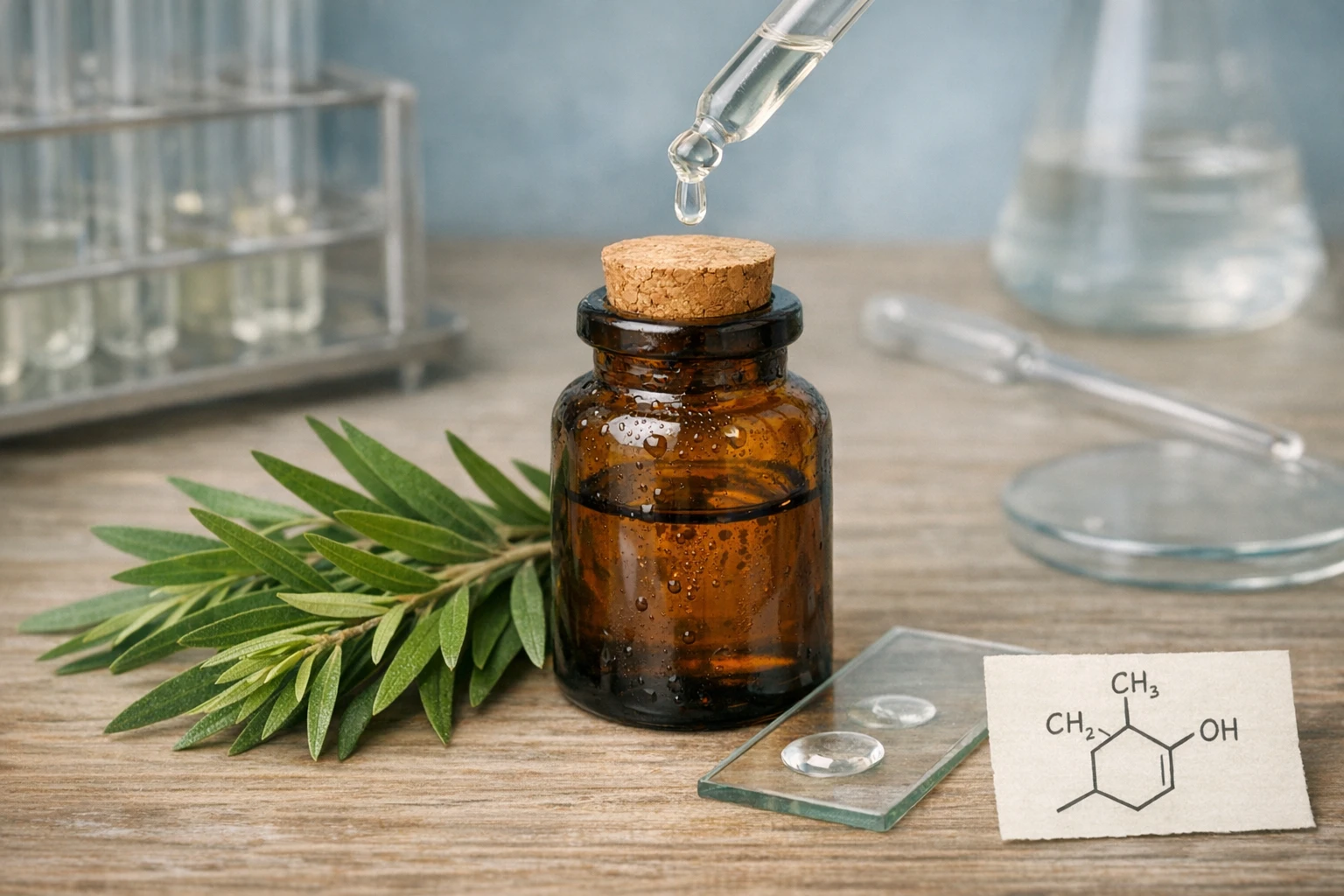
To preserve its properties, the oil is stored in dark glass bottles, away from light and heat. For skin use, diluted formulations (carrier oils, gels, or creams) and stabilized products are recommended to minimize oxidation. Commercial products can vary greatly in concentration: therefore, it is important to check the label or choose standardized preparations. The use of a few diluted drops is common practice; applying pure oil to the skin increases the risk of irritation or allergy.
Biological mechanisms (plausibility and limitations)
Antimicrobial action and effects on microorganisms
In the laboratory, the oil and its components show bactericidal and fungicidal effects on numerous strains: the spectrum includes gram-positives, some gram-negatives, dermatophytes, and Candida. These effects have been documented in reviews and in vitro studies that explain the mechanisms through alteration of the microbial membrane and loss of cellular function [1]. Such data support the plausibility of topical use as an antiseptic or integrative agent, but the effect in clinical conditions depends on the concentration reached on the treated surface and the stability of the formulation.
Anti-inflammatory activity and the role of terpinen-4-ol
Terpinen-4-ol, the main component of the oil, has shown the ability to reduce the production of inflammatory mediators in immune cells in vitro and in experimental models [3]. These biological results partly explain why the product can help reduce redness and inflammation in some skin conditions. However, effects observed in vitro or in animals do not automatically translate into systemic clinical efficacy or across all inflammatory conditions.
Clinical evidence for common uses
Acne and inflammatory skin conditions
Some controlled clinical studies have evaluated 5–6% tea tree oil gels for mild-to-moderate acne; results indicate reductions in lesion count and severity compared to placebo, although methodological quality and sample sizes vary between studies [2]. Recent systematic reviews confirm possible local efficacy but highlight the heterogeneity of studies and the need for further quality trials. In practice, the observed benefit is moderate and depends on the formulation, concentration, and duration of treatment.
Fungal infections and specific components
Experimental data support the antifungal activity of tea tree oil and, in particular, terpinen-4-ol; in vivo studies on animal models show promising effects against Candida and other fungal species [4]. However, clinical evidence for the treatment of onychomycosis or cutaneous mycoses is limited and does not allow for general recommendations. For systemic or deep infections, it is not appropriate to use the oil as a substitute for conventional antifungal therapies.
Oral applications and further uses
Preparations containing Tea Tree Oil have shown activity against some oral bacteria in vitro, and there are trials evaluating mouthwashes or gels for gum conditions with variable results [6]. Some small clinical studies have explored applications for cold sores or oral hygiene problems with mixed outcomes: in some cases, a reduction in microbial load or symptoms is observed, in others not [7]. These results require more robust confirmation before defining routine use.
What it means in practice
Available information suggests that tea tree oil can offer benefits in some topical applications, especially as a local adjuvant in controlled formulations. Choosing a standardized product and appropriate dilution reduces the risk of skin reactions. It is essential to distinguish experimental data (in vitro or animal) from clinical evidence in humans: while the former documents plausibility, the latter defines real efficacy in target populations. In the presence of suspected infections, extensive lesions, or systemic conditions, it is advisable to consult a healthcare professional before using tea tree oil products.
Directions for use and recommended dilutions (indicative)
For superficial skin applications, commercial formulations at low concentrations (e.g., 5%) are the most studied in clinical settings. Pure oil is generally not recommended for direct use on sensitive skin. For massages and muscular use, the essential oil is normally diluted in a carrier oil (e.g., sweet almond) at much lower percentages. Avoid contact with eyes, mucous membranes, and open wounds; do not ingest the oil. In all cases, perform a patch test on a small skin area to assess tolerability.
Precautions and warning signs
Skin reactions, including contact dermatitis, are reported and increase if the oil is oxidized or applied pure. Use on very young children or pets requires particular caution: there are reports of toxicity upon ingestion and adverse reactions. In case of persistent erythema, itching, or worsening symptoms, discontinue use and consult a doctor.
Key takeaways
- Tea tree oil has proven antimicrobial activity in vitro, but clinical efficacy varies by indication and formulation. [1]
- For some local applications (e.g., mild-to-moderate acne), controlled studies show modest benefits. [2]
- Terpinen-4-ol is the main component responsible for many biological actions, including moderate anti-inflammatory activity. [3]
- Topical use requires dilution and quality products to limit the risk of irritation and sensitization. [8]
- Do not use the oil as a substitute for systemic therapies or in severe infections; consult a professional for relevant clinical cases. [4]
Limitations of evidence
It is important to clarify the difference between observational data, in vitro/animal studies, and randomized clinical trials. Many claims about tea tree oil are based on laboratory results or small clinical studies with limited samples and variability in formulations. Systematic reviews highlight methodological heterogeneity, different concentrations, and often short follow-up duration [2]. Furthermore, the chemical stability of the oil, oxidation, and commercial variability complicate the reproducibility of results. Therefore, interpret reported benefits with caution: where clinical studies exist, they may suggest an effect but do not always define its magnitude or the populations for which it is recommended. Finally, the prevalence of contact reactions and the presence of sensitizing compounds require consideration in risk/benefit assessments [8].
Editorial conclusion
Tea tree oil is a natural product with solid experimental foundations and some clinical evidence supporting its topical use in specific contexts. Biological plausibility is well documented, especially in the laboratory, but translation into clinical practice requires attention: concentration, quality of formulation, and monitoring of adverse reactions are determining factors. Practitioners and readers should prioritize standardized products, avoid ingestion, and consult a healthcare professional in case of worsening conditions or the need for systemic therapy.
Editorial note
This article is an update of previously published content and has been revised in light of available scientific literature. The information is for informational purposes and does not replace medical advice. For personal clinical decisions, consult your doctor or trusted pharmacist.
SCIENTIFIC RESEARCH
- Melaleuca alternifolia (Tea Tree) oil: a review of antimicrobial and other medicinal properties. Clinical Microbiology Reviews, 2006. https://doi.org/10.1128/CMR.19.1.50-62.2006
- Efficacy and safety of Melaleuca alternifolia (tea tree) oil for human health—A systematic review of randomized controlled trials. Frontiers in Pharmacology, 2023. https://doi.org/10.3389/fphar.2023.1116077
- Terpinen-4-ol, the main component of the essential oil of Melaleuca alternifolia, suppresses inflammatory mediator production by activated human monocytes. Inflammation Research, 2000. https://doi.org/10.1007/s000110050639
- In vivo activity of terpinen-4-ol, the main bioactive component of Melaleuca alternifolia against human pathogenic Candida species. BMC Infectious Diseases, 2006. https://doi.org/10.1186/1471-2334-6-158
- Antifungal activity of the components of Melaleuca alternifolia (tea tree) oil. Journal of Applied Microbiology, 2003. https://doi.org/10.1046/j.1365-2672.2003.02059.x
- Susceptibility of oral bacteria to Melaleuca alternifolia (tea tree) oil in vitro. Oral Microbiology and Immunology, 2003. https://doi.org/10.1046/j.0902-0055.2003.00105.x
- Melaleuca alternifolia (tea tree) oil gel (6%) for the treatment of recurrent herpes labialis. Journal of Antimicrobial Chemotherapy, 2001. https://doi.org/10.1093/jac/48.3.450
- Tea tree oil: contact allergy and chemical composition. Contact Dermatitis, 2016. https://doi.org/10.1111/cod.12591