Updated and contextualized version of an article originally published on May 16, 2014
The article retains its original focus by presenting it through a scholarly and accessible perspective, supported by verifiable references.
Authors
- Dr. M. Bitonti – Biologist
- Roberto Panzironi –Independent researcher
Note editoriali
- First publication: May 16, 2014
- Last update: April 18, 2026
- Version: 2026 narrative revision
Initial note: this article was previously published and updated according to scientific and informative criteria. It is for informational purposes only and does not replace medical advice.
In brief
- Fennel (Foeniculum vulgare) is a low-energy vegetable/flavoring, rich in fiber and a source of minerals such as potassium, calcium, and phosphorus.
- Experimental and clinical evidence indicates plausible carminative and antispasmodic effects; some studies suggest benefits in reducing crying in infants with colic.
- Limited and variable quality data exist for its use as a galactagogue (increasing lactation) and for other applications; evidence is not definitive.
- The main active substances include anethole (essential oil) and various phenolic compounds; safety depends on dose, form (bulb, seeds, oil), and context of use.
Abstract: what does science say?
Fennel (Foeniculum vulgare) is a Mediterranean plant used as food and a traditional remedy. Recent reviews collect chemical-nutritional data confirming relatively good quantities of potassium, calcium, and phosphorus, along with fiber and aromatic compounds (including anethole). In vitro studies and animal models show plausible antioxidant, antimicrobial, and antispasmodic activity; some clinical trials, often small or on mixtures, report reductions in crying in infants with colic and favorable effects on digestion. For effects on milk production and hormonal symptoms, the evidence is limited and heterogeneous. Interpretation requires caution: much evidence is observational or preclinical, clinical results are heterogeneous, and safety depends on the dose and form of intake.
What is fennel and its nutritional composition
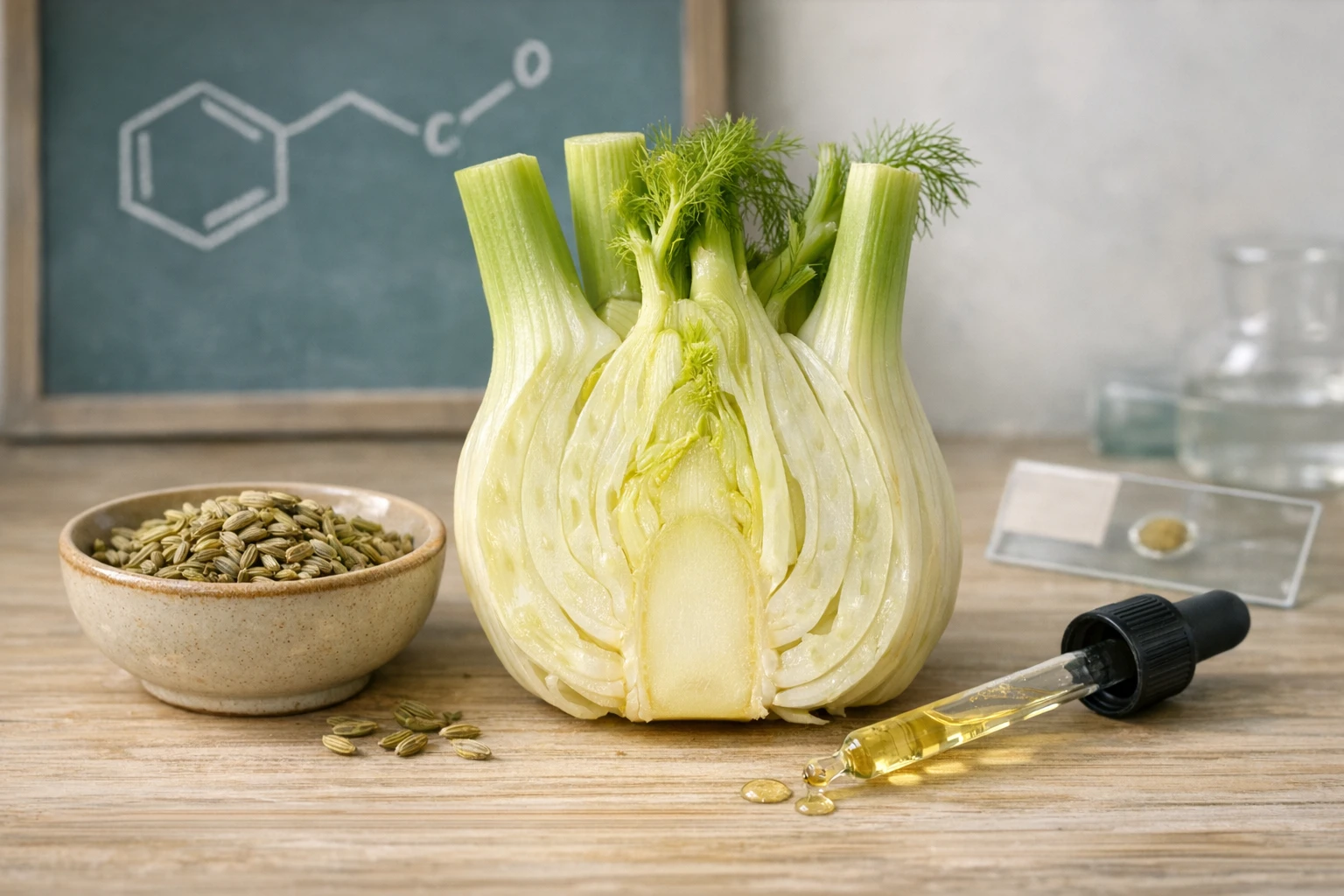
Fennel (Foeniculum vulgare Mill.) is a species of the Apiaceae family traditionally used in cooking and phytotherapy. Different parts of the plant are used: the bulb (consumed as a vegetable), the seeds (spice), the leaves, and the essential oil. Modern analyses summarized in recent reviews show that fennel is a low-energy-density food, with high water and fiber content, and a macro- and micronutrient composition that varies depending on the part considered and the cultivar [1].
In particular, the seeds are more concentrated in nutrients (lipids, proteins, minerals), while the bulb contains fewer calories and remains a useful source of fiber, vitamin C, and minerals such as potassium, calcium, and phosphorus; the absolute quantities vary with the part of the plant and the local nutritional table, but the presence of these minerals is repeatedly reported in specialized literature [2].
Minerals: calcium, phosphorus, and potassium — role and content in fennel
Calcium, phosphorus, and potassium play well-defined physiological roles: calcium is important for bone health and nerve transmission, phosphorus for energy and structural metabolism, and potassium for fluid and electrolyte balance and muscle function. Fennel, especially in its dry component (seeds), contributes appreciable amounts of these minerals compared to other vegetables; the bulb provides modest but useful amounts for a varied diet [1][2].
From a practical point of view, fennel does not replace foods very rich in minerals or supplements when therapeutic goals are necessary, but it can be beneficially included in a balanced diet to contribute to the daily requirement of potassium, calcium, and phosphorus, especially if consumed regularly as a vegetable or spice [1].
Plausible biological mechanisms: anethole, phytoestrogens, fiber, and digestive action
The biological properties of fennel are attributable to multiple classes of compounds. The essential oil, rich in trans-anethole and fenchone, is responsible for the characteristic aroma and many biological activities observed in the laboratory [3]. Anethole shows various effects in cellular and animal studies, including modulation of inflammatory and antimicrobial pathways; however, its pharmacology strongly depends on the dose, route of administration, and form (oil or extract) [8][3].
Furthermore, fennel contains phenolic compounds and flavonoids with antioxidant activity in vitro; dietary fiber and essential oils can modulate intestinal motility, favoring the reduction of intestinal gas and counteracting the fermentative processes that cause flatulence. Finally, some phytoestrogens and estrogen-like compounds have been identified in fennel: the biological plausibility of effects on hormones and lactation exists, but clinical translation requires controlled evidence [2][3].
Clinical evidence on digestion, infant colic, and breastfeeding
Clinical data on fennel cover different areas and show variable results. For digestion and functional gastrointestinal symptoms, experimental studies and small trials indicate antispasmodic and pro-motility activity in laboratory instruments and in some human studies, supporting traditional use for complaints such as bloating and dyspepsia [1][2].
For infant colic, controlled trials have evaluated fennel-based preparations alone or in combination with other herbs. Some randomized studies report reductions in crying time or colic scores compared to placebo, especially with standardized extracts or commercial mixtures; however, methodological quality is variable, and meta-analyses emphasize the need for larger, independent studies [4][5][6].
For lactation, systematic reviews on herbal galactagogues report conflicting data: some trials, often small or not replicated, report an increase in some lactation parameters after administration of tea or extracts containing fennel, but the overall evidence remains uncertain and dependent on the product and dosage [7][9].
Infant colic: clinical evidence
Clinical studies conducted with fennel-based preparations (tea, seed oil emulsions, or the herbal mixture ColiMil) have in some cases shown a reduction in crying and subjective improvement of symptoms in infants compared to placebo [3][4]. Systematic reviews indicate that the results are promising but not definitive: the quality of studies varies (sample size, diagnostic criteria, product standardization) and not all effects are replicated in independent trials [6].
Galactagogues and women's health
Some reviews on herbal galactagogues report data suggesting a possible effect of fennel on milk volume in specific clinical contexts, but the available trials are few and often have methodological limitations. Reviews dedicated to women's health recognize a traditional use in dysmenorrhea, menopause, and increased lactation, with variable clinical results that require confirmation with more rigorous studies and standardized products [7][9].
Digestive and antispasmodic effects
Experimental mechanisms (in vitro, animal, and limited human motility studies) show that fennel extracts and their components can act as spasmolytics on smooth muscle and, in some cases, promote gastric transit in certain regions of the stomach; this combination of activities explains the traditional use for bloating, flatulence, and dyspeptic symptoms [1][2].
Safety, doses, interactions, and warnings
The safety of fennel depends on the form (bulb, seeds, essential oil, extract), the concentration of anethole, and the context (infants, pregnant/breastfeeding women, iatrogenic events). At low dietary doses, fennel is generally well tolerated; anethole, the main constituent of the oil, has a recognized safety profile for food uses, but at high doses, it can pose toxicological risks observed in animal models, with possible reactive metabolites implicated in hepatic toxicity in some experimental studies [8].
It is important to avoid administering pure essential oil to infants or using non-standardized extracts in high doses without supervision. Furthermore, there are potential drug interactions and variability in composition among products: for this reason, regulatory bodies recommend caution and preference for standardized and tested products [1][8].
What this means in practice
For a general audience: fennel is a healthy and versatile food. Consuming the bulb or seeds as part of a varied diet can contribute to the intake of potassium, calcium, and phosphorus and provide fiber. For mild digestive disorders (bloating, feeling of fullness), the use of light fennel-based preparations (herbal tea, as a spice in food) can be useful and reasonable, recognizing that the effects are of modest and subjective intensity [1][2].
In the case of infant colic, some fennel-based products have shown reductions in crying in controlled trials, but the decision to use such products must consider product quality and the pediatrician's advice. For increased lactation and hormonal uses, the evidence remains limited: a discussion with a healthcare professional is advisable before taking extracts or therapeutic doses [4][5][7].
Key points to remember
- Fennel is a low-calorie food, rich in fiber, and contributes potassium, calcium, and phosphorus to the daily diet. [1][2]
- The main active compounds include anethole and flavonoids; these explain many biological activities observed in the laboratory. [3][8]
- Preliminary clinical evidence supports positive effects on infant colic and digestive disorders, but the quality of studies is variable. [4][5][6]
- For lactation, data are still uncertain: some studies suggest effects, but more rigorous trials are needed. [7][9]
- Safety is good at the food level; the use of essential oils or concentrated extracts requires caution and supervision. [8][1]
Limitations of the evidence
Most of the available evidence comes from observational studies, in vitro experiments, animal models, or small clinical trials with products that are not always standardized. Observational studies can indicate associations but do not prove causality; existing controlled clinical trials often use herbal mixtures, making it difficult to attribute the effect solely to fennel. Systematic analyses recommend larger, standardized, and independent studies to confirm suggested benefits and define risks and safe doses [6].
Editorial conclusion
Fennel remains a useful food ingredient and a natural source of micronutrients and fiber. Modern research supports the biological plausibility of beneficial effects on digestion and shows encouraging, but not conclusive, results for the treatment of infant colic and for some aspects of women's health. For therapeutic uses or for infants and pregnant/breastfeeding women, it is advisable to consult healthcare professionals and prefer certified and standardized products. Science is progressing: larger and well-controlled clinical studies will be useful to clarify efficacy, doses, and safety.
Editorial note
Article updated according to scientific rigor and readability criteria. The information summarized here comes from selected peer-reviewed reviews and studies; it does not constitute medical advice. For personal questions, always consult a healthcare professional.
Scientific research
- Rafieian F, Amani R, Rezaei A, et al. Exploring fennel (Foeniculum vulgare): Composition, functional properties, potential health benefits, and safety. Crit Rev Food Sci Nutr. 2024. https://doi.org/10.1080/10408398.2023.2176817
- Badgujar SB, Patel V V, Bandivdekar AH. Foeniculum vulgare Mill: a review of its botany, phytochemistry, pharmacology, contemporary application, and toxicology. Biomed Res Int. 2014;2014:842674. https://doi.org/10.1155/2014/842674
- Di Veroli A, Piffanelli A, et al. The leaf transcriptome of fennel (Foeniculum vulgare Mill.) enables characterization of the t-anethole pathway and discovery of molecular markers. Sci Rep. 2018;8:10459. https://doi.org/10.1038/s41598-018-28775-2
- Weizman Z, Alkrinawi S, Goldfarb D, Bitran C. Efficacy of an herbal tea preparation in infantile colic. J Pediatr. 1993;122(4):650–652. https://doi.org/10.1016/S0022-3476(05)83557-7
- Savino F, Cresi F, Castagno E, Silvestro L, Oggero R. A randomized double‑blind placebo‑controlled trial of a standardized extract of Matricariae recutita, Foeniculum vulgare and Melissa officinalis (ColiMil®) in the treatment of breastfed colicky infants. Phytother Res. 2005;19(4):335–340. https://doi.org/10.1002/ptr.1668
- Biagioli E, Tarasco V, Lingua C, et al. Pain‑relieving agents for infantile colic. Cochrane Database Syst Rev. 2016;9:CD009999. https://doi.org/10.1002/14651858.CD009999.pub2
- Mortel M, Mehta SD. Systematic review of the efficacy of herbal galactogogues. J Hum Lact. 2013. https://doi.org/10.1177/0890334413477243
- Heilmann J, Aponte J, et al. Metabolic activation of trans‑anethole plays a role in hepatic cytotoxicity in mice. J Agric Food Chem. 2016. https://doi.org/10.1021/acs.jafc.5c01944
- Mahboubi M. Foeniculum vulgare as Valuable Plant in Management of Women's Health. J Menopausal Med. 2019;25(1):1–14. https://doi.org/10.6118/jmm.2019.25.1.1