Updated and contextualized version of an article originally published on May 22, 2014
The article retains its original focus by presenting it through a scholarly and accessible perspective, supported by verifiable references.
Authors
- Dr. M. Bitonti – Biologist
- Roberto Panzironi –Independent researcher
Note editoriali
- First publication: May 22, 2014
- Last update: April 20, 2026
- Version: 2026 narrative revision
IN BRIEF
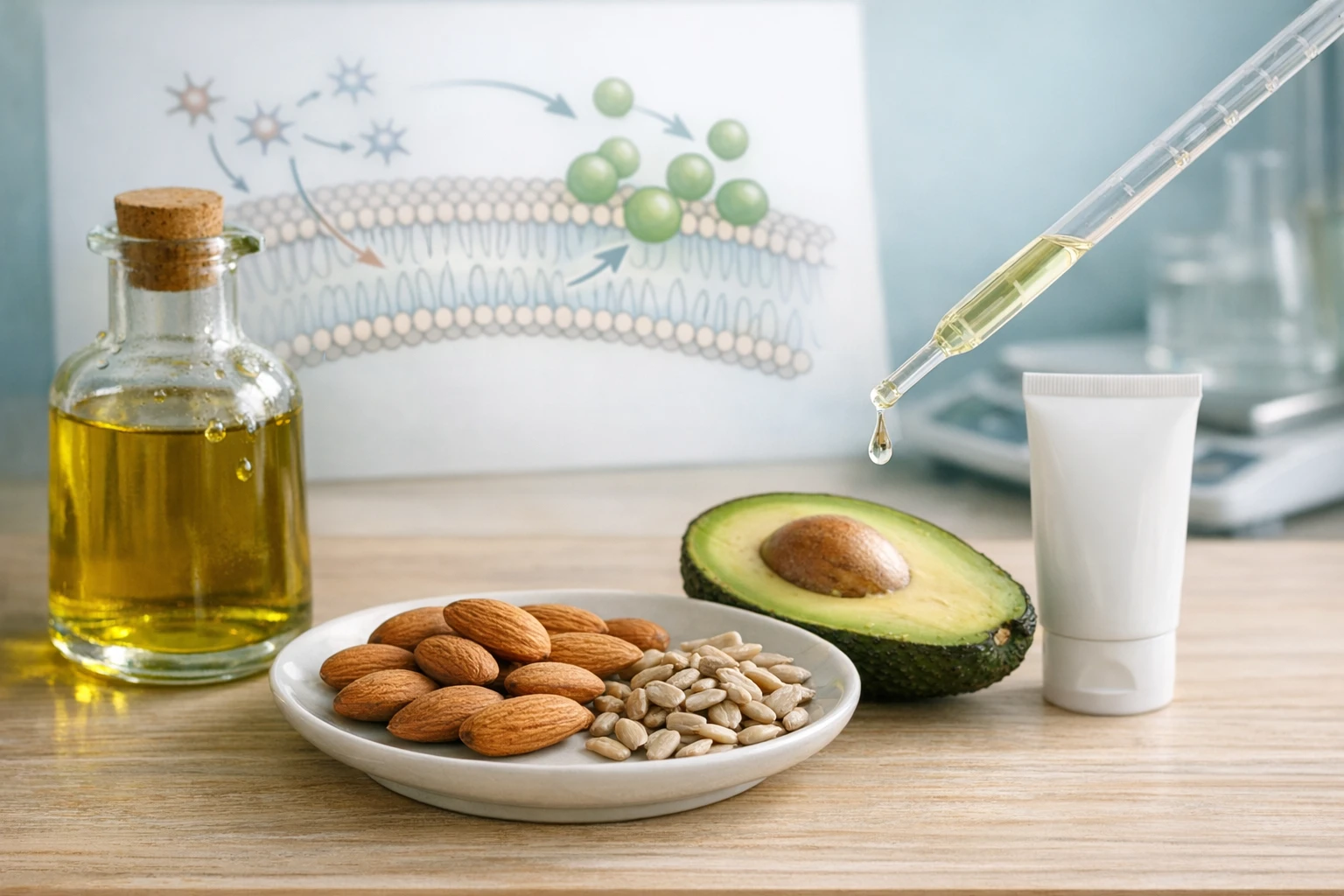
- Vitamin E is a group of fat-soluble compounds (tocopherols and tocotrienols) with antioxidant function in cell membranes.
- Main food sources: vegetable oils, nuts, seeds, and some vegetables; dietary intake influences plasma levels. [1]
- Clinical evidence is mixed: observational studies suggest possible protective associations; controlled trials on supplements show conflicting results and possible vascular risks. [2][3][4]
- For skin and some eye conditions, evidence is partial; topical use may be useful in some contexts but does not replace standard therapies. [7][6]
Abstract: what does science say?
Vitamin E is a collective term for fat-soluble molecules with antioxidant activity that protect membrane lipids from oxidative stress. Observational studies link higher dietary intake to favorable outcomes on some vascular events and skin health parameters, but results from experimental studies with supplements are heterogeneous. Randomized trials on high-dose supplements have not confirmed clear systemic benefits and have reported possible increased risk for some hemorrhagic complications. For specific conditions (some cases of advanced macular degeneration, selected skin diseases, or some studies on already diagnosed Alzheimer's), data are partially positive; however, the effect depends on the chemical form, dose, exposure time, and context (dietary vs. supplemental). Current recommendations promote dietary intake and a risk/benefit assessment before using high-dose supplements.
Where is vitamin E found?
Vitamin E is mainly found in foods rich in unsaturated fats. Vegetable oils (sunflower, corn, soy, wheat germ), nuts (almonds, hazelnuts), seeds (sunflower seeds), and some green leafy vegetables are the most relevant sources: dietary contribution influences plasma levels of α- and γ-tocopherol. [1] Dairy products and some fortified cereals may contain variable amounts. Absorption is influenced by the lipid content of the meal and the presence of other nutrients. Differences between forms of vitamin E (α-tocopherol predominant in supplements compared to the mixture of tocopherols/tocotrienols present in whole foods) are important: α-tocopherol is favored by plasma transport, while other forms may have distinct biological actions. [1]
Storage and cooking affect stability: vitamin E is relatively stable, but prolonged exposure to heat, light, and oxygen can reduce its available amount. For this reason, attention to non-excessive cooking methods and the consumption of fresh or minimally processed foods helps maintain its intake.
What is it for?
The main biological function attributed to vitamin E is the antioxidant protection of cell membranes: it neutralizes lipophilic free radicals and limits lipid peroxidation. This activity has led to the hypothesis that vitamin E may contribute to various health areas (cardiovascular, neurodegenerative, skin, ocular), but the evidence differs by study type and context.
Skin
Clinical observations and reviews indicate that lower plasma levels of vitamin E are associated with various inflammatory skin conditions (eczema, psoriasis, acne), and that topical applications or combined formulations can improve some clinical parameters in selected contexts. However, the quality of studies is variable and skin sensitization reactions are described; the therapeutic effect is not uniformly demonstrated and depends on the formulation and type of lesion. [7]
Eye
For age-related retinal diseases (advanced macular degeneration, AMD), research is rich in studies on combinations of antioxidants: in high-risk patients, the AREDS formulation has shown benefits in slowing progression to advanced AMD in specific clinical profiles, but the effect cannot be attributed solely to vitamin E. Systematic reviews conclude that the use of preparations containing vitamin E may be useful in defined contexts, while isolated supplementation is not recommended for prevention in the general population. [6]
Cardiovascular health and hemorrhagic risk
Observational studies have suggested associations between dietary vitamin E intake and a reduction in some vascular events, but large randomized trials on supplements have not confirmed a general benefit on cardiovascular prevention. In particular, extensive trials and systematic reviews have not shown consistent reductions in coronary events; some meta-analyses of clinical studies indicate a possible increased risk of hemorrhagic stroke associated with vitamin E supplementation. [3][4][8]
Brain and cognitive decline
For Alzheimer's disease and states of cognitive decline, the evidence is complex: some trials on patients with already established disease have observed a slowing of functional progression with high doses of α-tocopherol, while studies on unaffected populations do not show convincing evidence of prevention. The effect observed in diagnosed subjects does not automatically imply a preventive role in the healthy population. [5][6]
What it means in practice
For the reader: vitamin E is useful as a component of a balanced diet rich in vegetable oils, nuts, and seeds; intake from food remains the preferred way to obtain biological benefits without exposing oneself to undesirable effects. [1] Routine use of high-dose supplements is not recommended for the general prevention of cardiovascular or neurodegenerative diseases, because randomized trials have not shown clear benefits and have reported potential risks in some subgroups. [3][4]
In specific clinical contexts (patients with advanced AMD or with already diagnosed Alzheimer's disease), specialist evaluation may consider the role of antioxidants or vitamin E in combination with other therapies: these decisions must be made together with the treating physician, evaluating the dose, form of vitamin E, possible drug interactions, and hemorrhagic risk conditions. [6][5]
Key takeaways
- Vitamin E is primarily a fat-soluble antioxidant found in foods rich in unsaturated fats.
- Prefer food sources (oils, nuts, seeds) rather than high-dose supplements for the general population.
- Supplements have not shown clear systemic benefits in cardiovascular prevention; they may pose risks in some cases.
- For specific conditions (e.g., advanced AMD, some already diagnosed neurological situations), specialist medical intervention may be appropriate.
- Evaluation of the individual clinical picture and concomitant therapies is essential before starting significant supplementation.
Limitations of the evidence
Available sources include observational studies, randomized clinical trials, reviews, and meta-analyses. Methodological differences between these designs explain some of the discrepancies between results: observational studies show associations that do not prove causality, while randomized trials test interventions but can vary in dose, duration, chemical form, and selected population. [3][8]
Other frequent limitations: heterogeneity in exposure measures (dietary intake vs. supplement; different forms of vitamin E), variable follow-up, and possible interference from other nutrients or nutritional conditions. The generalizability of high-dose trials from the general population is limited. Therefore, conclusions must be interpreted with caution and contextualized on a case-by-case basis.
Editorial conclusion
Vitamin E remains a biologically relevant micronutrient for antioxidant protection. The best public health strategies prioritize obtaining it through a varied diet based on whole foods. The use of supplements, especially at high doses, requires careful clinical evaluation: benefits are not established for general prevention, and there are signals of risk for specific outcomes. For individual decisions, it is advisable to consult a healthcare professional.
Editorial note
This article was published in a previous version and updated according to scientific and divulgative criteria. The purpose is informative and does not replace medical advice. For therapeutic or prescriptive evaluations, consult your reference professional.
SCIENTIFIC RESEARCH
- Effect of vitamin E intake from food and supplement sources on plasma α‑ and γ‑tocopherol concentrations in a healthy Irish adult population. British Journal of Nutrition (2014). https://doi.org/10.1017/S0007114514002438
- Effects of vitamin E on stroke subtypes: meta‑analysis of randomised controlled trials. BMJ (2010). https://doi.org/10.1136/bmj.c5702
- Effects of long‑term vitamin E supplementation on cardiovascular events and cancer: a randomized controlled trial. JAMA (2005). https://doi.org/10.1001/jama.293.11.1338
- A controlled trial of selegiline, α‑tocopherol, or both as treatment for Alzheimer’s disease. New England Journal of Medicine (1997). https://doi.org/10.1056/NEJM199704243361704
- Effect of vitamin E and memantine on functional decline in Alzheimer disease: the TEAM‑AD VA cooperative randomized trial. JAMA (2014). https://doi.org/10.1001/jama.2013.282834
- Antioxidant vitamin and mineral supplements for preventing/slowing progression of age‑related macular degeneration (AREDS reports and Cochrane reviews). Archives of Ophthalmology / JAMA Ophthalmology / Cochrane (AREDS and AREDS2 related reports). https://doi.org/10.1001/archopht.119.10.1417
- Serum vitamin E levels and chronic inflammatory skin diseases: systematic review and meta‑analysis. PLoS One (2021). https://doi.org/10.1371/journal.pone.0261259
- Supplementation with vitamin E alone is associated with reduced myocardial infarction: a meta‑analysis. Nutrition, Metabolism & Cardiovascular Diseases (2015). https://doi.org/10.1016/j.numecd.2015.01.008