Updated and contextualized version of an article originally published on May 22, 2014
The article retains its original focus by presenting it through a scholarly and accessible perspective, supported by verifiable references.
Authors
- Dr. A. Colonnese – Nutrition biologist
- Roberto Panzironi –Independent researcher
Note editoriali
- First publication: May 22, 2014
- Last update: April 20, 2026
- Version: 2026 narrative revision
Brief initial note: This article was previously published and has been updated according to scientific and informative criteria. It provides general information and does not replace the advice of a doctor or healthcare professional.
IN BRIEF
- Goji berries (Lycium barbarum), also known as wolfberry, contain polysaccharides, carotenoids (especially zeaxanthin/zeaxanthin dipalmitate), vitamins, and minerals; some small clinical trials suggest effects on oxidative stress, lipids, and general well-being.
- Clinical evidence is limited in size and duration: there are RCTs with favorable outcomes on lipid profile and oxidative biomarkers, but the results are not yet conclusive for therapeutic recommendations.
- Composition and quality vary greatly depending on origin, processing, and contamination; cases of interaction with anticoagulants (warfarin) have been reported.
- In vitro or animal evidence shows possible anti-inflammatory and antitumor actions, but these do not authorize therapeutic claims in humans.
Abstract: what does science say?
Goji berries (Lycium barbarum) are fruits traditionally used in Asian medicine and are now popular as a food rich in bioactive compounds. Laboratory studies and reviews show that water-soluble components (polysaccharides) and lipophilic components (carotenoids, particularly zeaxanthin and its esters) have antioxidant activity, modulate immune pathways, and influence metabolic parameters in preclinical models. Small randomized clinical trials have documented modest effects on oxidative stress biomarkers, lipid profile, and feelings of well-being; however, the quality of evidence is variable, and results depend on dose, form (standardized juice, extract, or dried fruit), duration, and the population studied. There are signs of possible interactions with drugs (e.g., warfarin) and variability in active ingredient concentrations due to the production chain. Overall, the evidence supports a biological plausibility of benefits but not definitive causal proof for specific clinical outcomes; longer, standardized, and independent clinical studies are needed to confirm significant effects and establish effective and safe dosages.
What it means in practice
For the public: Goji berries can be considered a nutritious food that provides carotenoids, polysaccharides, and antioxidants, and which—when included in a varied and healthy diet—can contribute to overall nutritional quality. However, they are not a miracle cure or a substitute for medical therapies for conditions such as dyslipidemia, diabetes, or chronic diseases. Some clinical trials have observed modest improvements in indicators such as HDL-cholesterol, oxidative stress biomarkers, or feelings of well-being in selected populations [1][12][5]. The effects appear to be influenced by the form of administration (whole fruit, standardized juice, or polysaccharide extract), dose, and duration of intake [6][3]. In clinical contexts (chronic therapies, anticoagulants, pregnancy), it is prudent to consult a doctor before consuming Goji supplements or large quantities because interactions and product quality variability have been reported [9][10][11].
Nutritional composition and biological components
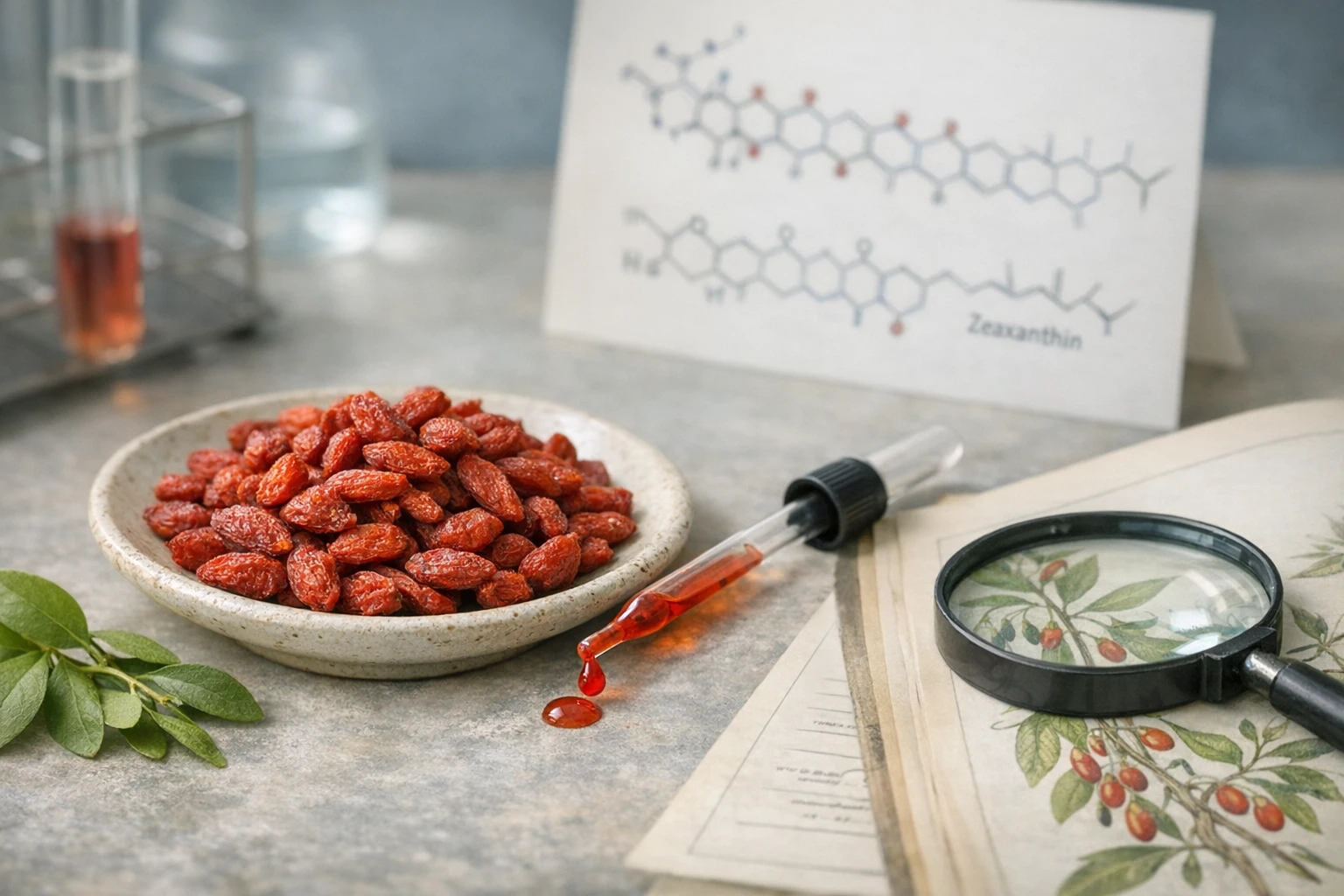
Goji berries contain a mixture of nutrients: complex carbohydrates and fiber, a protein fraction with essential amino acids, vitamins (including vitamin C and some B vitamins), minerals, and bioactive compounds. Two main classes emerge in the literature for their biological potential: water-soluble polysaccharides (LBP) and lipophilic carotenoids, with zeaxanthin and its esters often predominating. Polysaccharides are associated with antioxidant effects, immune modulation, and metabolic actions observed in experimental models and some short clinical studies [6][8]. Carotenoids, especially zeaxanthin and zeaxanthin dipalmitate, explain the fruit's recognition as a source of pigments useful for the retina and for local antioxidant activity [2]. Bioavailability and effect depend on the food matrix, processing method (drying, extraction, fermentation), and combination with dietary fat sources that facilitate carotenoid absorption [2][11].
Carotenoids and vision
The carotenoids present in Goji berries are relevant for ocular health because zeaxanthin and lutein concentrate in the macula. Food biochemistry studies and supplementation trials show that the consumption of fruits or extracts can increase plasma levels of zeaxanthin and its esters, with a possible impact on oxidative stress biomarkers related to the retina [2][11]. These observations justify biological plausibility for a protective role but do not constitute proof that Goji consumption prevents or cures specific eye diseases: focused clinical trials of adequate duration and size are needed.
Polysaccharides and metabolism
Lycium barbarum polysaccharides (LBP) are studied for potential immunomodulatory, anti-inflammatory, and metabolic effects. Recent reviews show that LBP influences cellular signals and the gut microbiota in preclinical models, and some clinical studies report improvements in glycemia and lipids in selected subjects after intake of standardized extracts [6][5]. However, formulations, concentrations, and protocols vary, and the strength of clinical evidence is still moderate.
Quality, origin, and variability
The composition of Goji berries varies with species, cultivation region, harvest, and processing methods (drying, extraction, fermentation). Chemical analyses show wide differences in polysaccharide and carotenoid content between batches and geographical areas [2][11]. Furthermore, investigations into pesticide and heavy metal residues in commercial products have shown variability and, in some samples, significant levels that require attention for food safety [11]. For this reason, product quality (traceability, certifications, laboratory analyses) is a crucial element for evaluating potential benefits and risks: standardized and tested products reduce uncertainty compared to uncontrolled products.
Safety and interactions
In general, moderate dietary consumption of Goji berries is considered safe for most people, but clinical cases of interactions with narrow therapeutic index drugs, particularly warfarin, have been documented, leading to increased INR and bleeding in patients who had consumed large quantities of the product or concentrated juice [9][10]. Reports and in vitro studies also suggest the need for caution when co-administering other drugs metabolized by cytochrome P450; clinical relevance varies depending on the dose and preparation. Other safety aspects concern microbial contamination, chemical residues, and nutritional variability of products, making it advisable to prefer suppliers with quality control and to consult a doctor if undergoing chronic therapies [11].
Key points to remember
- Goji berries are a food source of carotenoids (zeaxanthin) and polysaccharides with plausible nutritional and biological value; the effect depends on the quantity, form, and quality of the product [2][6].
- Randomized clinical research, including trials on dietary models, has observed modest improvements in HDL and oxidative biomarkers, but clinical significance remains to be confirmed by larger studies [1][12][5].
- Preclinical studies document antioxidant, immunomodulatory, and antitumor mechanisms, but these results are not automatically transferable to humans without robust clinical evidence [7][8].
- There are reports of interaction with warfarin and potential drug interferences: caution is needed in those taking anticoagulants or narrow therapeutic index drugs [9][10].
- Product quality is critical: choosing tested products with traceability and contaminant analysis reduces potential risks [11].
Limitations of evidence
The literature on Lycium barbarum is extensive but has significant methodological limitations. Many studies are preclinical (in vitro or on animal models), with interesting biological mechanisms but not directly transferable to clinical practice. Available clinical studies are often small, short-term, conducted with differentiated commercial products (extracts, standardized juice, dried fruit), and, in some cases, industry-sponsored; this affects generalizability and the risk of bias [3][4][5]. Reviews and meta-analyses summarize positive effects on general well-being and some biomarkers but highlight heterogeneity and the need for independent trials with clearly defined dosages and formulations and long-term clinical outcomes [5][6]. Finally, signals of drug interaction mainly come from case reports and in vitro pharmacological studies: they are sufficient to warrant clinical attention but not to quantify the risk in population terms [9][10].
Editorial conclusion
Goji berries are a food with an interesting nutritional profile and a solid basis of biological plausibility for antioxidant, immunomodulatory, and metabolic actions. Randomized clinical studies indicate possible modest benefits on some biomarkers and subjective well-being in selected contexts, but there is currently insufficient evidence to recommend the therapeutic use of Goji berries for specific diseases. For consumers, the practical advice is to include them as part of a varied and balanced diet, prioritize good quality products, and consult a doctor in case of chronic therapies or anticoagulant use. Research needs independent, longer, and standardized clinical studies to clarify dose-response, safety, and impact on relevant clinical outcomes.
Editorial note
This article was originally published in the past and updated following a review of evidence and good editorial practices. The update follows criteria of transparency, citation of sources, and attention to the quality of evidence. The information is for informational purposes only and does not replace personalized medical consultation. For therapeutic decisions or prescriptions, always consult a healthcare professional.
SCIENTIFIC RESEARCH
List of research cited in the text (bibliography in order of citation). DOI links are verified and clickable.
- Enhancing the cardiovascular protective effects of a healthy dietary pattern with wolfberry (Lycium barbarum): A randomized controlled trial. The American Journal of Clinical Nutrition. 2021. https://doi.org/10.1093/ajcn/nqab062
- Ultrastructural deposition forms and bioaccessibility of carotenoids and carotenoid esters from goji berries (Lycium barbarum L.). Food Chemistry. 2016. https://doi.org/10.1016/j.foodchem.2016.09.065
- A Randomized, Double-Blind, Placebo-Controlled, Clinical Study of the General Effects of a Standardized Lycium barbarum (Goji) Juice, GoChi™. Journal of Alternative and Complementary Medicine. 2008. https://doi.org/10.1089/acm.2008.0004
- Immunomodulatory effects of a standardized Lycium barbarum fruit juice in Chinese older healthy human subjects. Journal of Medicinal Food. 2009. https://doi.org/10.1089/jmf.2008.0300
- A Meta-Analysis of Clinical Improvements of General Well-Being by a Standardized Lycium barbarum. Journal of Medicinal Food. 2012. https://doi.org/10.1089/jmf.2012.0013
- Potential of Lycium barbarum polysaccharide for the control of glucose and lipid metabolism disorders: a review. Critical Reviews in Food Science and Nutrition. 2022. https://doi.org/10.1080/10942912.2022.2057529
- Antitumor Mechanisms of Lycium barbarum Fruit: An Overview of In Vitro and In Vivo Potential. Life (MDPI). 2024. https://doi.org/10.3390/life14030420
- Antitumor activity of Lycium barbarum polysaccharides with different molecular weights: an in vitro and in vivo study. Nutrition and Cancer. 2017. https://doi.org/10.1080/16546628.2017.1399770
- Possible Interaction between Warfarin and Lycium barbarum L. Annals of Pharmacotherapy. 2001. https://doi.org/10.1345/aph.1Z442
- Probable interaction between Lycium barbarum (goji) and warfarin. Pharmacotherapy. 2012. https://doi.org/10.1002/j.1875-9114.2012.01018.x
- Levels and health risk assessment of pesticides and metals in Lycium barbarum L. from different sources in Ningxia, China. Scientific Reports. 2021. https://doi.org/10.1038/s41598-021-04599-5
- Impact of following a healthy dietary pattern with co-consuming wolfberry on number and function of blood outgrowth endothelial cells from middle-aged and older adults. Food & Function. 2022. https://doi.org/10.1039/D1FO02369A