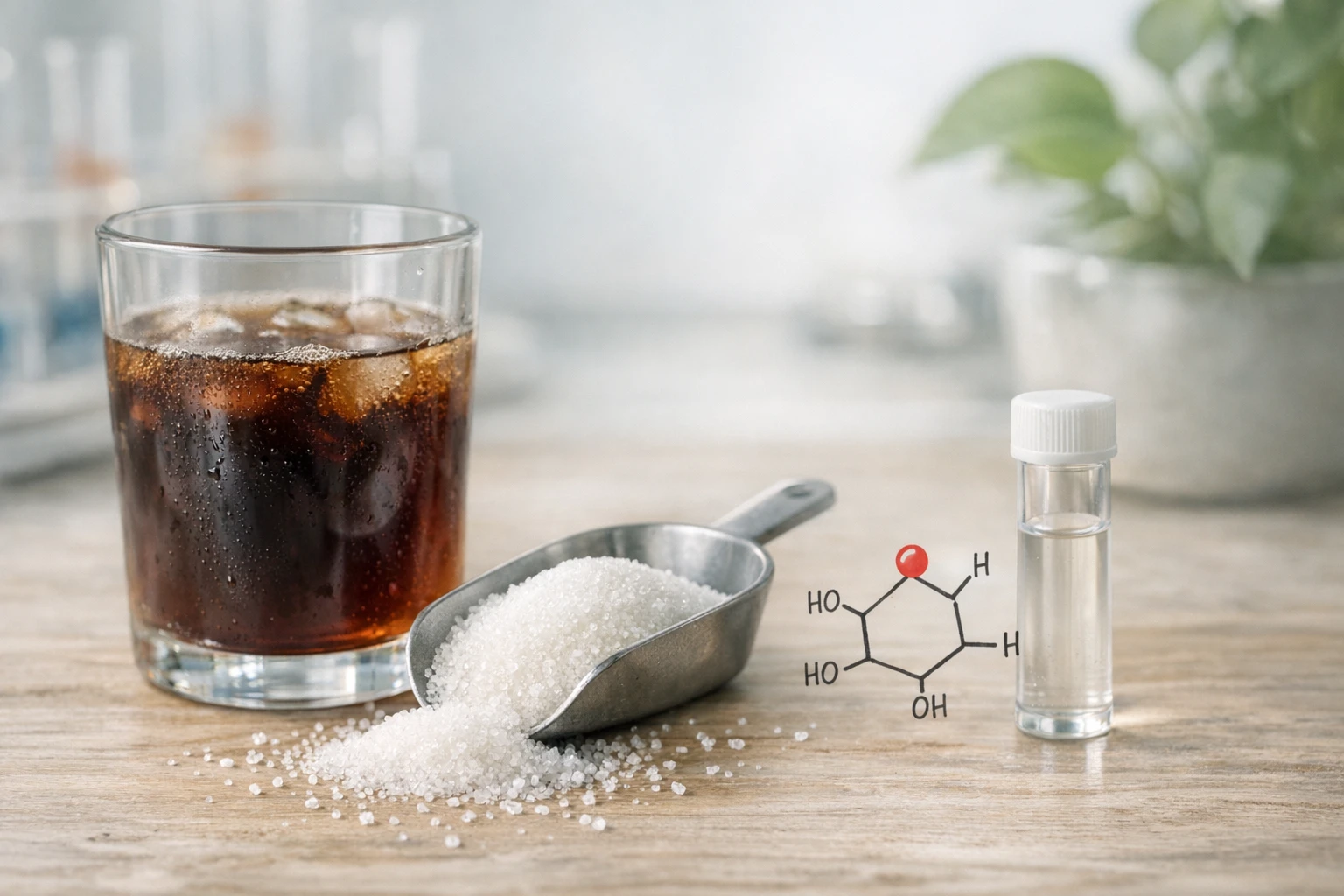
Updated and contextualized version of an article originally published on May 25, 2014
The article retains its original focus by presenting it through a scholarly and accessible perspective, supported by verifiable references.
Authors
- Dr. M. Bitonti – Biologist
- Roberto Panzironi –Independent researcher
Note editoriali
- First publication: May 25, 2014
- Last update: April 18, 2026
- Version: 2026 narrative revision
Brief initial note for the reader: this article was previously published and has been updated according to scientific and informative criteria. The purpose is informational: it does not replace medical advice. [Editorial update and source review]
IN BRIEF
- Observational evidence associates high consumption of added sugars, particularly from sugar-sweetened beverages, with an increased risk of cardiovascular disease and mortality. (See cited studies).
- Plausible biological mechanisms include increased hepatic lipogenesis, worsening of triglycerides and insulin sensitivity, and an increase in blood pressure in some contexts.
- Many studies are observational: they indicate associations and dose-response patterns, but cannot alone demonstrate definitive causality.
- International guidelines recommend moderate limits for free/added sugars (e.g., thresholds of 10% and, conditionally, 5% of total calories).
- The practical message for the public is to increase awareness of sugar sources (especially beverages) and consider dietary choices that reduce habitual exposure.
Abstract: what does science say?
Definition: by "sugar" in this context, we mean added sugars or "free sugars" (sucrose, syrups, sugars in sweetened beverages and processed products) rather than the totality of carbohydrates present in whole foods.
Available evidence: observational studies on large populations have documented associations between high proportions of calories from added sugars and an increased risk of cardiovascular mortality; examples include national analyses with long-term follow-up. Most studies indicate that sugar-sweetened beverages (SSBs) are the most relevant source in the modern diet for increasing cardiometabolic risk.
Role of dose and form: evidence suggests that risk and harm depend on the total dose of sugars and their form (beverages versus solid foods), with more consistent associations for sugar-sweetened beverages. Frequency (habitual use) is important: prolonged daily exposures are associated with greater effects.
Interpretive limits: most evidence is observational and subject to residual confounding and dietary measurement error. Biological plausibility exists (metabolism of fructose-containing sugars, effect on lipids and blood pressure), but making causal inferences requires integrating trials, mechanisms, and assessments of evidence quality. In summary, science shows credible and biologically plausible associations, but not always direct proof of unequivocal causality.
What is meant by added sugars and forms of consumption
In modern nutritional language, a distinction is made between intrinsic sugars present in whole fruit and free or added sugars incorporated during processing, preparation, or sale. Important sources in the contemporary diet are sweet beverages, snacks, and some industrial preparations. Beverages represent a particularly relevant mode of intake because they provide sugars in liquid form, which are quickly absorbed and have low satiating power, promoting additional energy intake.
Epidemiological evidence and biological plausibility
Large population studies have linked high percentages of calories from sugar to an increased risk of death from cardiovascular causes. Plausible mechanisms include increased hepatic triglyceride production (lipogenesis), alterations in insulin sensitivity, increased blood pressure, and changes in the lipid profile. Short- and medium-term interventions on volunteers have shown metabolic effects consistent with these biological pathways, strengthening the plausibility of a link between high exposure and cardiometabolic risks.
What it means in practice
For the general reader, it is useful to translate the evidence into understandable indications: occasional consumption of sweet foods in the context of a balanced diet is different from daily and habitual exposure to high quantities of added sugars, especially in the form of beverages. Institutional guidelines recommend reference limits (for example, around 10% of total calories for added sugars and, conditionally, a more restrictive threshold of 5% for additional benefits), but the practical translation depends on age, energy needs, and individual context.
From an operational point of view, the most significant source of added sugars in the US diet and many other populations remains sweetened beverages: limiting their daily consumption can reduce uncompensated caloric intake and affect risk factors (body weight, triglycerides, blood pressure). Observational studies and meta-analyses also highlight differences by form of consumption: sugars consumed in beverages tend to have more consistent associations with adverse outcomes than sugars contained in nutritious foods (like whole fruit).
The practical and reasonable choice for the public is to increase awareness: read labels, recognize beverages as a primary source of added sugars, prefer water or unsweetened beverages for daily use, and reserve sweet foods for occasional consumption in social contexts. These are population interpretations and not individual clinical prescriptions.
[If personalized medical recommendations are required, consult your doctor or trusted healthcare professional]
KEY POINTS TO REMEMBER
- High intake of added sugars is associated with an increased cardiometabolic risk in large-scale observational studies; the signal is stronger for sugar-sweetened beverages. [1][2][7]
- Biological plausibility exists: fructose and sugar mixtures can stimulate hepatic lipogenesis, increase triglycerides, and influence insulin sensitivity and blood pressure. [4][5]
- The most robust evidence is observational and requires cautious interpretation: association does not automatically equate to causality without considering confounding and exposure measurement. [6][8]
- Public recommendations (limits of 10% or, conditionally, 5% of energy from free sugars) are based on a balance of evidence and prevention of dental and cardiometabolic diseases.
- Reducing habitual consumption of sugar-sweetened beverages is a practical and sustainable strategy to reduce overall exposure to added sugars.
Limitations of the evidence
It is essential to distinguish between observational studies and causal evidence obtained from clinical trials. Cohort observations provide useful information on associations and dose-response patterns, but are subject to possible confounding (lifestyles, diet composition, physical activity) and errors in estimating sugar intake (dietary recalls, questionnaires). Many studies adjust for known variables, but residual confounding may persist.
Long-term randomized controlled trials evaluating clinical cardiovascular events are rare for practical and ethical reasons; therefore, the assessment of causality is based on a set of elements: epidemiological consistency, plausible biological mechanisms demonstrated in experiments, results of interventions on risk factors (e.g., weight, triglycerides), and critical evaluation of evidence quality using tools like GRADE. Some meta-analyses show associations, others do not uniformly confirm them for all types of sugar, highlighting study variability and the importance of form (beverage vs solid food) and the studied population. [3][6][8]
Finally, many analyses depend on the quality of dietary measurement and the definition of "added sugars" used; this contributes to the heterogeneity of results and uncertainty in directly translating epidemiological numbers into individual recommendations.
Editorial conclusion
Current scientific documentation supports the idea that daily and prolonged consumption of high quantities of added sugars, especially from sugar-sweetened beverages, is associated with an increased cardiometabolic risk and, in some studies, cardiovascular mortality. Plausible biological mechanisms exist that make this picture consistent. However, the prevalent nature of the evidence (observational) calls for caution: observed associations must be interpreted considering methodological limitations, heterogeneity among studies, and the overall dietary context.
From an informational and public health perspective, reducing habitual exposure to sweetened beverages and improving the transparency of food labels represent reasonable and evidence-based actions. Communication to the public should be clear, not alarmist, and oriented towards awareness of sugar sources and alternatives.
Editorial note
This article is an update on a topic previously addressed. The update was carried out by systematically reviewing the available peer-reviewed literature and prioritizing recent meta-analyses and reviews, as well as the most relevant original studies. The information provided is for informational purposes and does not replace an individual clinical evaluation. For personalized advice, consult a healthcare professional.
SCIENTIFIC RESEARCH
List of cited studies and reviews (DOIs verified):
- Yang Q, Zhang Z, Gregg EW, Flanders WD, Merritt R, Hu FB. Added Sugar Intake and Cardiovascular Diseases Mortality Among US Adults. JAMA Intern Med. 2014;174(4):516-524. https://doi.org/10.1001/jamainternmed.2013.13563
- Malik VS, Popkin BM, Bray GA, Després JP, Hu FB. Sugar-sweetened beverages, obesity, type 2 diabetes mellitus, and cardiovascular disease risk. Circulation. 2010;121(11):1356-1364. https://doi.org/10.1161/CIRCULATIONAHA.109.876185
- Te Morenga L, Mallard S, Mann J. Dietary sugars and body weight: systematic review and meta-analyses of randomised controlled trials and cohort studies. BMJ. 2013;346:e7492. https://doi.org/10.1136/bmj.e7492
- Stanhope KL, Schwarz JM, Keim NL, et al. Consuming fructose-sweetened, not glucose-sweetened, beverages increases visceral adiposity and lipids and decreases insulin sensitivity in overweight/obese humans. J Clin Invest. 2009;119(5):1322-1334. https://doi.1172/JCI37385
- Stanhope KL, Hatcher B, Bremer AA, et al. Dose-response effects of consuming beverages sweetened with high-fructose corn syrup on lipid/lipoprotein risk factors for cardiovascular disease in young adults. Am J Clin Nutr. 2015;101(6):1144-1154. https://doi.org/10.3945/ajcn.114.100461
- Relation of total sugars, sucrose, fructose, and added sugars with the risk of cardiovascular disease: a systematic review and dose-response meta-analysis of prospective cohort studies. Mayo Clin Proc. 2019;94(12):2399-2414. https://doi.org/10.1016/j.mayocp.2019.05.034
- Malik VS, Hu FB. Sugar-Sweetened Beverages and Cardiometabolic Health: An Update of the Evidence. Nutrients. 2019;11(8):1840. https://doi.org/10.3390/nu11081840
- Dietary sugar consumption and health: umbrella review. BMJ. 2023;381:e071609. https://doi.org/10.1136/bmj-2022-071609
- Sweetened beverage consumption and risk of cardiovascular mortality: a systematic review and meta-analysis. Diabetes & Metabolic Syndrome Clin Res Rev. 2022;16(2):102462. https://doi.org/10.1016/j.dsx.2022.102462
- Sugar- and artificially sweetened beverages consumption linked to type 2 diabetes, cardiovascular diseases, and all-cause mortality: a systematic review and dose-response meta-analysis of prospective cohort studies. Nutrients. 2021;13(8):2636. https://doi.org/10.3390/nu13082636
DOI Check: all DOIs listed above were verified with bibliographic databases at the time of the update.