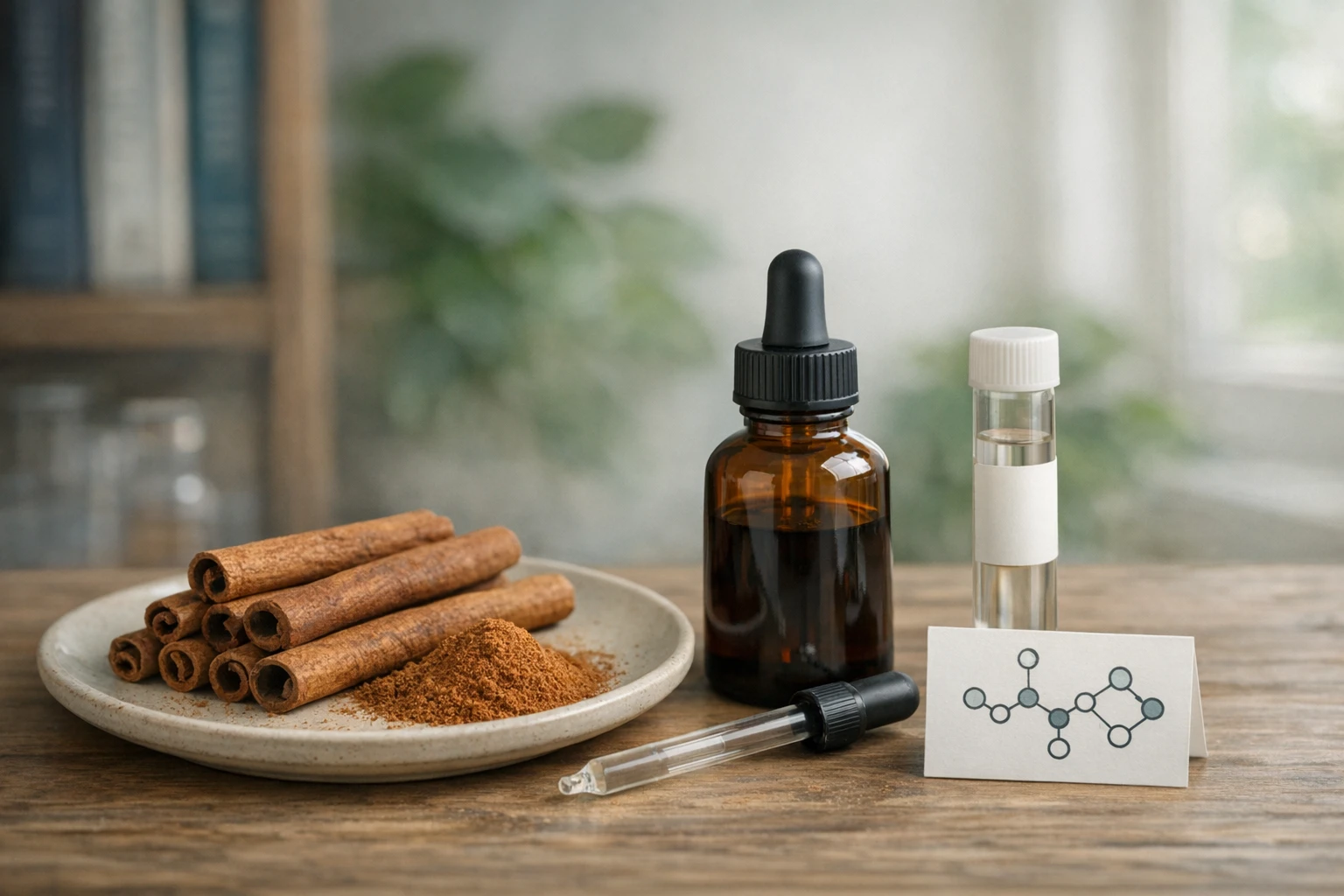
Updated and contextualized version of an article originally published on May 26, 2014
The article retains its original focus by presenting it through a scholarly and accessible perspective, supported by verifiable references.
Authors
- Dr. A. Colonnese – Nutrition biologist
- Roberto Panzironi –Independent researcher
Note editoriali
- First publication: May 26, 2014
- Last update: April 18, 2026
- Version: 2026 narrative revision
IN BRIEF
- Cinnamon bark extracts show in animal models the ability to interfere with the formation of amyloid oligomers associated with Alzheimer's (preclinical, not clinical evidence).
- Clinical studies on glycemic control with cinnamon are heterogeneous: some small trials show reductions in glycemia, but systematic reviews conclude that the evidence remains insufficient for clinical recommendations.
- Cinnamon compounds, particularly cinnamaldehyde, have antimicrobial activity and modulate platelet aggregation in experimental models; effects in humans are less defined.
- Most promising evidence is preclinical or comes from short-term or small-scale clinical studies; more robust trials and standardized formulations are needed.
Abstract: what does science say?
Cinnamon is a spice derived from the bark of trees of the genus Cinnamomum and has been used for millennia in cooking and traditional medicine. In recent decades, biomedical research has explored several aspects: actions on protein aggregation processes implicated in Alzheimer's disease in animal models, metabolic effects on glycemic control, antimicrobial properties, and activity on coagulation parameters. The strongest evidence linking cinnamon to biological changes comes from in vitro studies and animal models; clinical data in humans are varied and often limited by small sizes, short durations, or lack of standardization of preparations. In practice, cinnamon remains a food with potential biological properties but is not a proven therapy for Alzheimer's, diabetes, or other conditions. It is important to distinguish preclinical results from clinical evidence, consider the dose, form (powder, extract, oil), and botanical species, and evaluate possible drug interactions.
MAIN SECTION
Definition and origin of cinnamon
Cinnamon is the inner bark of evergreen trees of the genus Cinnamomum. The most common commercial species are Cinnamomum cassia and Cinnamomum verum (Ceylon). The chemical composition includes essential oils (with cinnamaldehyde as the main component), polyphenols, and tannins; these molecules determine the aroma, flavor, and many of the studied biochemical properties. The form of consumption (powdered spices, aqueous or alcoholic extracts, essential oils) affects both the quantity of active compounds consumed and the safety and tolerability profile: for example, cassia contains higher amounts of coumarin than Ceylon, a compound with potential hepatotoxicity at high doses. For this reason, the species, concentration, and duration of intake are important variables to consider when interpreting research results.
Plausible biological mechanisms
The proposed mechanisms for the observed effects of cinnamon are numerous and depend on the compound studied. Extracts containing cinnamaldehyde and polyphenols can alter protein aggregation in vitro, modulate antioxidant and anti-inflammatory pathways, influence insulin sensitivity signals in cells, and interfere with microbial membranes. These observations provide biological plausibility: for example, in cell and animal models, cinnamon interferes with the assembly of toxic beta-amyloid oligomers, suggesting a potential neuroprotective mechanism. Other activities include inhibition of bacterial growth through membrane damage and alteration of microbial metabolism, as well as effects on platelet aggregation observed with cinnamaldehyde in experimental models. However, biological plausibility does not equate to clinical proof: cellular or animal effects may not translate into significant or safe benefits in humans, especially if bioavailability or dose differ greatly.
Main experimental evidence
In transgenic animal models for Alzheimer's disease, a standardized cinnamon extract reduced the presence of amyloid oligomers and improved some memory and behavioral tests, suggesting an effect on protein aggregation processes [1]. Other preclinical studies report that the cinnamaldehyde metabolite, sodium benzoate, can attenuate oxidative stress and inflammation in the brain in animal models, with cognitive improvement in experimental contexts [7]. For glucose metabolism, some small clinical studies have shown reductions in fasting glycemia and lipids with daily cinnamon intake, but systematic reviews and meta-analyses have judged the evidence to be heterogeneous and insufficient for definitive inferences [2][3][4]. At the antimicrobial level, cinnamaldehyde acts against bacterial strains such as Escherichia coli in in vitro experiments, altering bacterial metabolic profiles and membrane integrity [5]. Finally, experiments on platelets and thrombosis models indicate that cinnamaldehyde can reduce platelet aggregation and thrombus formation in animal models, but the clinical relevance for the prevention of thrombotic events in humans has not been established [6].
What it means in practice
For the general public: cinnamon is a commonly used spice that can offer flavor and some components with biological activity observed in laboratory and animal models. However, clinical evidence on its effectiveness in preventing or treating chronic diseases, including Alzheimer's disease or diabetes, is not conclusive. The most robust and recent studies highlight the heterogeneity of preparations (powder, extract, oil), botanical species (cassia vs. Ceylon), doses, and duration of interventions [3][4]. Therefore, using cinnamon as a flavoring in foods is reasonable and generally safe for most people at culinary doses; the regular use of high-dose supplements should be evaluated with caution, especially in people taking anticoagulants, hypoglycemic drugs, or with liver conditions potentially sensitive to coumarin. If the goal is glycemic control, it is important not to replace prescribed therapies with spice-based remedies without medical supervision: documented clinical effects are variable and, in some cases, contradictory [2][3]. For research on Alzheimer's and neuroprotection, preclinical results are interesting and warrant controlled clinical studies with standardized formulations, but do not authorize therapeutic claims or treatment recommendations.
Key points to remember
- Preclinical research shows that cinnamon extracts can interfere with protein aggregates implicated in Alzheimer's in animal models, but there is insufficient clinical evidence to claim a benefit in humans [1][7].
- Some small clinical studies have reported improvements in glycemia with cinnamon, but systematic reviews do not confirm a robust and uniform clinical effect [2][3][4].
- Cinnamon compounds, such as cinnamaldehyde, show antimicrobial and anti-aggregating activity in the laboratory or in animal models; clinical translation is not established [5][6].
- The botanical species, form (powder, extract, oil), dose, and duration influence results and safety; Ceylon and Cassia are not equivalent in coumarin content.
- Do not replace established medical therapies with the use of cinnamon for chronic conditions without consulting a doctor; some drug interactions and risks of toxicity at high doses are possible.
Limitations of the Evidence
It is essential to distinguish between different levels of evidence. In vitro studies and animal models provide mechanisms and biological plausibility, but do not demonstrate that an analogous effect occurs in humans at current doses and forms of consumption. Available clinical studies are often small, of short duration, with non-standardized formulations, and sometimes with methodological problems (low power, lack of adherence control, absence of relevant long-term clinical measures). Systematic reviews have highlighted heterogeneity and risk of bias in trials on glycemic control, with overall inconclusive results [3][4]. Furthermore, long-term safety, particularly for products with high coumarin concentrations (usually in cassia), is not fully defined. Various contextual factors — general diet, concomitant pharmacological therapies, liver health status, differences between botanical species and extraction procedures — make it difficult to generalize the results. To translate promising observations into practical recommendations, large-scale randomized clinical trials are needed, with well-characterized preparations and relevant clinical outcomes (disease incidence, progression, quality of life).
Editorial Conclusion
Research on cinnamon occupies an interesting position between tradition and modern science: many mechanistic observations are solid and warrant further study, but clinical translation is not complete. For Alzheimer's disease, preclinical studies (particularly extracts capable of reducing amyloid oligomers in animal models) represent a promising starting point, not proof of efficacy in humans [1]. For glycemic control and other possible benefits, the variety of results and systematic reviews suggest caution. In practical terms, cinnamon can be appreciated as a spice with possible modest biological effects; therapeutic use, however, requires further evidence. As scientific publishers for the public, we recommend clarity: inform about potential benefits without exaggerating, explicitly state limitations and risks, and advise consulting a doctor in the presence of specific conditions or therapies.
EDITORIAL NOTE
This article has been updated for informational purposes compared to a previously published version. The update followed criteria of transparency and rigor: systematic reviews, clinical studies, and preclinical research with verified DOIs were consulted. The information provided does not replace individual clinical evaluation.
SCIENTIFIC RESEARCH
- Frydman-Marom A, Levin A, Farfara D, et al. Orally administrated cinnamon extract reduces β-amyloid oligomerization and corrects cognitive impairment in Alzheimer's disease animal models. PLoS One. 2011;6(1):e16564. https://doi.org/10.1371/journal.pone.0016564
- Khan A, Safdar M, Ali Khan MM, Khattak KN, Anderson RA. Cinnamon improves glucose and lipids of people with type 2 diabetes. Diabetes Care. 2003;26(12):3215-3218. https://doi.org/10.2337/diacare.26.12.3215
- Leach MJ, Kumar S. Cinnamon for diabetes mellitus. Cochrane Database Syst Rev. 2012;(9):CD007170. https://doi.org/10.1002/14651858.CD007170.pub2
- Allen RW, Schwartzman E, Baker WL, Coleman CI, Phung OJ. Cinnamon use in type 2 diabetes: an updated systematic review and meta-analysis. Clin Nutr. 2012;31(6):... https://doi.org/10.1016/j.clnu.2012.04.003
- Gao Y, et al. Cinnamaldehyde characterization as an antibacterial agent toward Escherichia coli metabolic profile using SPME-LC–MS. J Proteome Res. 2016;15:963–975. https://doi.org/10.1021/acs.jproteome.5b00992
- Huang J, Wang S, Luo X, Xie Y, Shi Y. Cinnamaldehyde reduction of platelet aggregation and thrombosis in rodents. Thromb Res. 2007;119(3):337–342. https://doi.org/10.1016/j.thromres.2006.03.001
- Joshi G, et al. Cinnamon and Its Metabolite Sodium Benzoate attenuate activation of p21rac and protect memory and learning in an animal model of Alzheimer's disease. PLoS One. 2015;10(6):e0130398. https://doi.org/10.1371/journal.pone.0130398
- Huang Y, Zhu X, et al. Beneficial effects of cinnamon and its extracts in the management of cardiovascular diseases and diabetes. Food Funct. 2021. https://doi.org/10.1039/D1FO01935J
- Systematic review: Cinnamon and cognitive function: a systematic review of preclinical and clinical studies. Nutritional Neuroscience. 2023. https://doi.org/10.1080/1028415X.2023.2166436
DOI Checklist (internal control)
For editorial transparency: the DOIs listed have been verified against databases and official journal pages prior to inclusion.