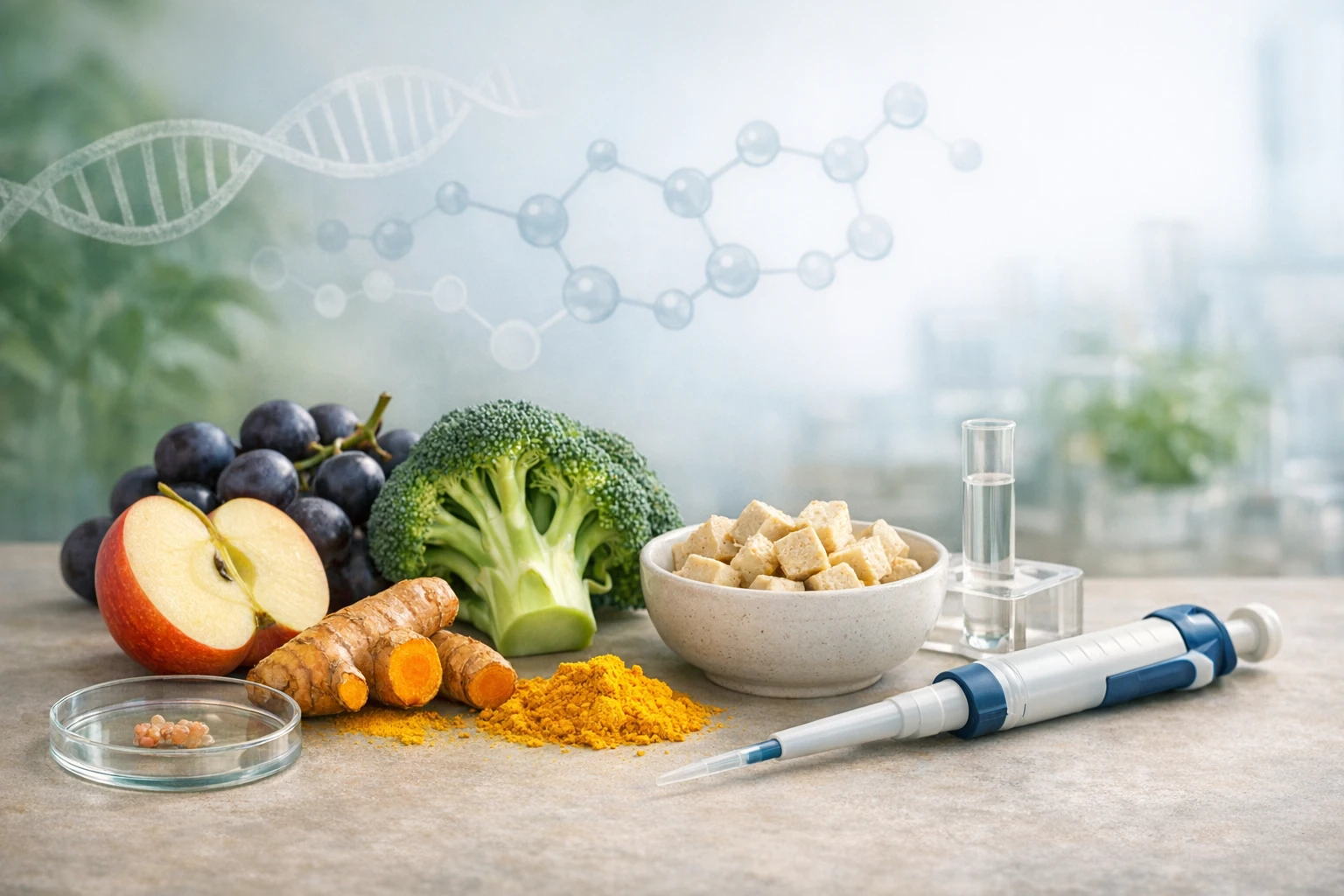
Updated and contextualized version of an article originally published on May 31, 2014
The article retains its original focus by presenting it through a scholarly and accessible perspective, supported by verifiable references.
Authors
- Dr. A. Conte – Biologist
- Roberto Panzironi –Independent researcher
Note editoriali
- First publication: May 31, 2014
- Last update: April 18, 2026
- Version: 2026 narrative revision
Editorial note: This article was previously published and has been updated according to scientific and divulgative criteria. The purpose is informative: it does not replace medical advice or personalized therapeutic indications.
IN BRIEF
- Certain compounds found in fruits, vegetables, and spices (e.g., curcumin, resveratrol, quercetin, soy isoflavones) show interesting biological effects in laboratory studies and animal models.
- Observed effects include reduced cell growth, modulation of inflammation, induction of apoptosis, and actions on subpopulations with "cancer stem cell" characteristics.
- The strongest evidence comes from preclinical and observational studies; clinical trials in humans are limited and often inconclusive.
- Combining multiple compounds can increase the effect in the laboratory, but this does not mean that foods or supplements are equivalent to a cancer cure in patients.
Abstract: what does science say?
The question is simple: some foods contain molecules that, in the laboratory, interfere with processes relevant to tumor growth. Experimental evidence shows that, in cell cultures and animal models, compounds such as curcumin (turmeric), resveratrol (grapes), quercetin (fruits and vegetables), and soy isoflavones can reduce the proliferation, migration, and, sometimes, the survival of cancer cells. In some studies, the combination of multiple molecules generates greater effects than individual compounds. However, translating these results into clinical recommendations requires controlled human studies; moreover, the effect strongly depends on dose, administration form, bioavailability, and context (type of tumor, concomitant therapy). Observational data suggest possible associations between the consumption of certain foods (e.g., soy products) and a reduction in risk or recurrence, but do not prove causality. Therefore, biological plausibility exists; causal evidence in human medicine is still limited and requires careful interpretation.
MAIN SECTION
What is meant by "natural compounds" and why they are of interest in cancer research
Many plant foods contain molecules called phytocompounds or phytochemicals: polyphenols (resveratrol, quercetin), isoflavones (genistein), curcuminoids (curcumin), and others. These substances can modulate cellular signals, reduce oxidative stress, influence inflammation, and interfere with pathways that regulate cell growth and death. For this reason, they are studied as potential modulators of carcinogenesis or the sensitivity of tumor cells to treatments. It is important to emphasize that activity observed in vitro or in mice does not automatically correspond to a clinical effect in humans: differences in dose, absorption, and metabolism can reduce or nullify the effect observed in the laboratory.
Experimental evidence: combinations of compounds and observed results
Preclinical studies have shown that combining multiple phytocompounds can increase the anti-tumor effect compared to a single compound. A recent example in murine models evaluated a combination of resveratrol, curcumin, and quercetin (sometimes referred to as RCQ): the results in breast cancer models documented reduced tumor growth and changes in the immune microenvironment [1]. In the laboratory, combinations of quercetin, curcumin, and other polyphenols reduced proliferation, invasiveness, and characteristics of cells with a "stem-like" phenotype in triple-negative breast cancer cell lines [2]. These data support the hypothesis of additive or synergistic actions, but remain preclinical and do not replace clinical evidence of human efficacy.
Effects on cells with "cancer stem cell" characteristics
Some research indicates that compounds such as resveratrol and curcumin can reduce the viability and self-renewal capacity of tumor subpopulations defined as "cancer stem-like cells" in experimental models [3][4]. These cells are studied because, in theory, they can contribute to recurrence and drug resistance. The effect is biologically plausible: phytocompounds modulate metabolic pathways and survival signals that these cells use. However, the evidence is substantially preclinical and does not prove that the same happens in patients in terms of reduced recurrence or improved survival.
Plausible biological mechanisms
Observed mechanisms include: inhibition of pro-proliferative signals (e.g., PI3K/Akt, MAPK), modulation of NF-kB and inflammatory pathways, induction of apoptosis (via caspases and regulation of Bcl-2/Bax), alterations in lipid metabolism, and modulation of autophagy. Furthermore, some compounds influence the expression of genes associated with invasion and EMT (epithelial-to-mesenchymal transition). These actions are documented in cellular and animal studies and provide a plausible biological framework that justifies further clinical research [5][6].
PRACTICAL SECTION
What this means in practice
For the reader: consuming fruits, vegetables, and spices as part of a varied diet is consistent with public health recommendations and can provide bioactive molecules with potential favorable effects. However, laboratory results do not authorize considering foods or supplements as a cancer cure. The effective quantities in experimental models often far exceed those obtainable with a normal diet; bioavailability (how much of a molecule actually reaches the tissue) is an important limitation. For patients diagnosed with cancer, it is essential to discuss the use of supplements with their oncologist: some can interfere with treatments, others have not been adequately tested. The practical message is therefore cautious and operational: favor a diet rich in plant foods, avoid definitive claims or therapeutic promises, and consult your doctor for integrative choices during oncological therapy.
KEY POINTS TO REMEMBER
- Phytocompounds contained in fruits, vegetables, and spices show anti-tumor activity in the laboratory, but clinical translation is limited.
- Combining multiple molecules can yield greater effects in experimental models; this does not prove clinical efficacy in humans.
- There is some observational evidence linking soy consumption to better outcomes in women with a history of breast cancer, but it does not establish definitive causality [6].
- Bioavailability and dose are critical factors: pharmaceutical form, vehicle, and metabolism influence the biological outcome.
- Patients undergoing cancer therapy should consult their doctor before starting supplements or drastic dietary changes.
LIMITATIONS OF EVIDENCE
Difference between observational studies and causal evidence
Observational studies (cohorts, case-control) can show associations between food consumption and outcomes (risk, recurrence, mortality), but do not prove that the food is the direct cause of the observed effect. Confounding factors (lifestyle, access to care, socioeconomic status) can explain some of the differences. Causal evidence requires randomized controlled trials, which are often lacking or small due to practical and ethical issues.
Methodological limitations and contextual variability
Many preclinical studies do not replicate the complexity of the human organism: doses, administration methods, and chemical forms differ. In clinical studies, individual variability (genetics, gut microbiota, hormonal status) can modulate the response. Furthermore, the effect may depend on menopause, ER/PR status of the tumor, and ongoing treatments. These variables make it difficult to generalize results from one context to another.
Editorial conclusion
Research on fruits, vegetables, and spices has highlighted interesting biological principles and paved the way for possible supportive strategies for oncological therapy. However, the gap between laboratory and clinical application remains significant. The cautious approach for the public is to maintain a diet rich in vegetables and discuss any supplements or modifications during oncological treatment with healthcare professionals. Science progresses in stages: future studies, particularly well-designed clinical trials, will be necessary to establish whether certain molecular combinations can have a defined therapeutic or preventive role.
EDITORIAL NOTE
This article is an update of previous content, revised in light of available scientific literature and structured with criteria of clarity and transparency. It does not constitute therapeutic indication. For medical decisions, consult your doctor or oncology team.
SCIENTIFIC RESEARCH
The following research has been verified by DOI and is cited in the text. Click on the DOIs to open the original article:
- P. R. Pandey et al., "Resveratrol suppresses growth of cancer stem-like cells by inhibiting fatty acid synthase", Breast Cancer Research and Treatment. https://doi.org/10.1007/s10549-010-1300-6. [support on resveratrol and cancer stem-like cells]
- Study on RCQ (resveratrol+curcumin+quercetin) in murine model, Scientific Reports. https://doi.org/10.1038/s41598-023-39279-z. [preclinical study on combination and tumor microenvironment]
- COMBINATION in vitro TNBC: polyphenolic combination (Quercetin+Curcumin+Berberine), Phytoplant/Pharmacology (PhyPlu). https://doi.org/10.1016/j.phyplu.2022.100265. [effects on triple-negative breast cells]
- Anti‑metastasis activity of curcumin against breast cancer via inhibition of stem cell-like properties and EMT, Phytomedicine. https://doi.org/10.1016/j.phymed.2018.11.001. [mechanisms and preclinical models]
- Review on curcumin: "Curcumin, a promising anti-cancer therapeutic" (RSC Advances). https://doi.org/10.1039/C3RA46396F. [chemical review and administration strategies]
- Observational meta-analysis on soy, isoflavones, and cancer risk (Frontiers in Nutrition). https://doi.org/10.3389/fnut.2022.847421. [observational evidence on soy and outcomes]
- Study on curcumin and proliferation in breast cell lines, Experimental and Therapeutic Medicine. https://doi.org/10.3892/etm.2018.6345. [in vitro evidence on proliferation and apoptosis]
- Nanomaterials and curcumin formulations to improve bioavailability (Nanomaterials, article ID 2017). https://doi.org/10.1155/2017/9625909. [formulations and bioavailability]
Note: For editorial clarity, names and qualifications present in the original text (e.g., Madhwa Raj, LSU Health Sciences Center) have been retained without additional amplification. Some original details have been updated based on the sources listed above. For further details on individual studies, direct reading of the cited documents is recommended.