Updated and contextualized version of an article originally published on May 31, 2014
The article retains its original focus by presenting it through a scholarly and accessible perspective, supported by verifiable references.
Authors
- Dr. M. Mondini – Biologist
- Roberto Panzironi –Independent researcher
Note editoriali
- First publication: May 31, 2014
- Last update: April 20, 2026
- Version: 2026 narrative revision
Initial note: this article was previously published and updated according to scientific and informative criteria. The information collected here is for informational purposes only and does not replace the advice of your doctor.
IN BRIEF
- Extracts from grape skins and seeds contain polyphenols (anthocyanins, proanthocyanidins, resveratrol) that show biological activities relevant to glucose metabolism.
- Preclinical data from animal models show anti-dysmetabolic effects and improved insulin sensitivity; some small clinical studies and meta-analyses suggest modest reductions in fasting glycemia and inflammatory markers, but results in humans are heterogeneous.
- Plausible mechanisms include modulation of insulin signaling pathways, inhibition of carbohydrate digestion enzymes, reduction of oxidative stress, and effects on the gut microbiota.
- Currently, there is no solid evidence to consider grape extracts as a substitute therapy for diabetes; larger and standardized randomized clinical trials are needed.
Abstract: what does science say?
Grape skin extract and grape seed preparations contain complexes of polyphenols with antioxidant and metabolism-modulating activity. In laboratory and animal models, some extracts (e.g., ACH09) improve insulin sensitivity and reduce hyperglycemia and hepatic lipid accumulation; possible mechanisms include activation of the insulin pathway and inhibition of carbohydrate-degrading enzymes. Clinical studies in humans are limited, with variable results: some beneficial interactions on fasting glycemia, lipids, and inflammatory markers emerge in meta-analyses, while more recent trials report modest or absent effects on glycemia and HbA1c. Biological plausibility is supported, but clinical translation remains uncertain due to the heterogeneity of formulations, doses, and experimental designs. Standardized and long-term clinical studies are needed to clarify efficacy, dosage, and safety.
MAIN SECTION
What is grape skin extract and why is it of interest in diabetes?
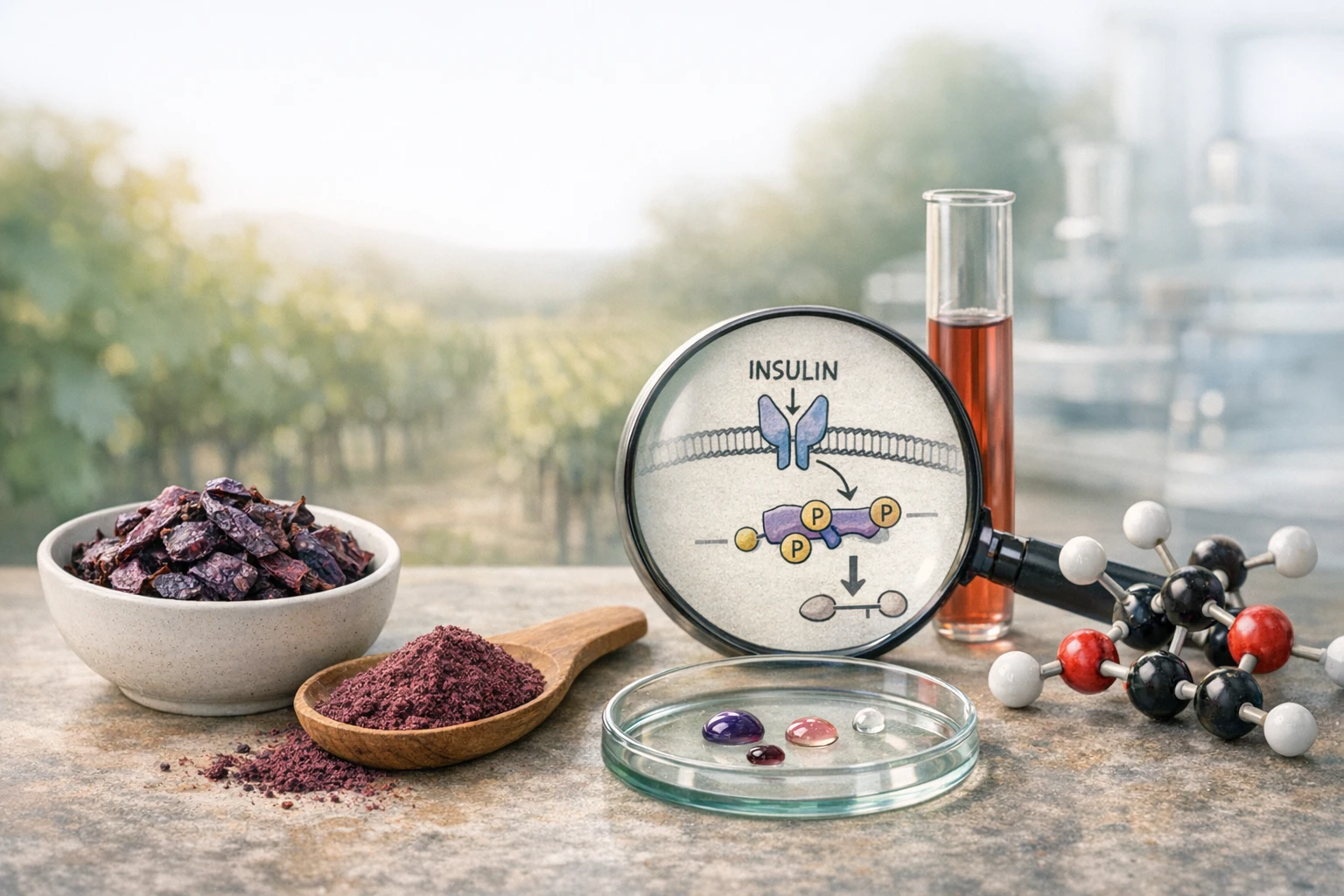
Grape skins (Vitis vinifera) and seeds contain a complex mixture of polyphenols: anthocyanins, flavanols, proanthocyanidins, and resveratrol. These compounds, in the laboratory, modulate processes relevant to glucose metabolism, such as insulin sensitivity, cell signaling, and lipid oxidation. Concentrated extracts (commonly called GSE when referring to seeds, or with commercial or research names for skins) have been studied for the prevention and treatment of type 2 diabetes due to their antioxidant and anti-inflammatory activity. In experimental models, some skin extracts, such as the preparation called ACH09, have reduced hyperglycemia and signs of insulin resistance by improving key proteins in the insulin pathway. These data justify the interest, but do not automatically imply clinical efficacy in humans [1][2].
Preclinical evidence: what laboratory and animal experiments show
Experiments on cells and animals document effects consistent with a potential antidiabetic action. Grape skin extracts have activated components of the insulin pathway (e.g., IRS-1, PI3K, Akt) and increased the expression of glucose transporters, with a reduction in hyperglycemia in experimental diabetic models [2][1]. Other studies with seed extracts or proanthocyanidins have shown the ability to modulate enzymes related to carbohydrate metabolism and to reduce inflammation and oxidative stress in metabolic tissues, effects plausibly relevant for the protection of pancreatic and vascular cells [5]. These results are useful for understanding possible mechanisms, but translation to humans requires caution: doses, bioavailability, and formulation can change the effect observed in the laboratory [1][2][5].
Clinical evidence: human studies and summary of reviews
The clinical literature is varied: there are individual controlled clinical studies and meta-analyses that have analyzed the impact of grape seed or skin extracts on glycemia, lipids, and inflammation. A meta-analysis of randomized trials on grape seed extract reported a moderate reduction in fasting glycemia and some lipids and inflammatory markers, but the effect on HbA1c and major clinical outcomes is uncertain [3]. A crossover trial in people at risk of T2D showed no improvements in glycemia but reduced blood pressure, suggesting organ-specific or microbiota-metabolite context-dependent effects [6]. Other small studies in subjects with diabetes found reductions in some biomarkers (e.g., fructosamine, hsCRP) after short treatments, despite limitations in size and duration [4]. Overall, systematic reviews acknowledge plausibility and some positive signals, but emphasize the heterogeneity of formulations and the need for larger and standardized trials [3][7][8].
PRACTICAL SECTION
What it means in practice
For the reader: grape skins and seeds are natural sources of compounds with biological potential useful for metabolic regulation. However, current evidence does not authorize considering extracts as a sole or alternative treatment for diabetes. Some supplements show favorable effects on some parameters (fasting glycemia, inflammation, lipids, or blood pressure) in limited studies; the clinical effect on long-term outcomes is not demonstrated. If you are considering a grape-based supplement, it is advisable to discuss it with your doctor: guidance is needed on dosage, possible interactions with medications (for example, with hypoglycemic agents), and product quality. In practical terms, maintaining the recommended lifestyle (balanced diet, physical activity, weight control) remains the cornerstone of diabetes prevention and management. Grape extracts can be the subject of research or complementary use under clinical supervision, but they do not replace validated therapies.
KEY POINTS TO REMEMBER
- Preclinical evidence supports antidiabetic effects of grape skin and seed extracts through multiple mechanisms [1][2][5].
- Meta-analyses suggest modest reductions in fasting glycemia and inflammatory markers after supplementation with grape seed extract, but with heterogeneity among studies [3].
- Clinical trials are often small, short-term, and use different formulations; some show no effect on primary glycemic parameters [6][4].
- Safety appears good in most studies, but product quality and possible interactions require medical consultation.
Limitations of the evidence
It is necessary to clearly distinguish between observations, biological plausibility, and causal proof. In vitro and animal studies provide useful insights into mechanisms, but do not prove clinical efficacy in humans; they are therefore considered observations or preclinical evidence [1][2]. Available clinical studies present common methodological limitations: small number of participants, short duration, different standards of formulations (extracts, concentrations, and production processes not always comparable), and multiple biological objectives that complicate interpretation. Meta-analyses synthesize these data but remain constrained by the quality of the included studies and often show high heterogeneity [3][7]. Other limitations include the variability of polyphenol bioavailability, the influence of the gut microbiota on the production of active metabolites, and the lack of data on long-term clinical outcomes (e.g., mortality, micro- or macrovascular complications). For these reasons, any statement about efficacy must remain cautious and viewed as a hypothesis supported by partial data, not as definitive proof.
Editorial conclusion
Research on grape skin and seed extracts offers interesting and biologically plausible signals for the control of hyperglycemia and inflammatory processes associated with diabetes. However, translation into clinical recommendations is premature: human evidence is heterogeneous and often limited. More robust studies are still needed to define standard formulations, effective dosages, treatment duration, and long-term safety. In the meantime, the established approach to diabetes prevention and control — based on diet, physical activity, weight control, and validated pharmacological therapies — remains central. Grape extracts can be considered a subject of study or, in some cases, a complement evaluated with a doctor, but not an autonomous therapeutic solution.
Editorial note
This update was prepared using peer-reviewed scientific literature and systematic reviews. The article maintains an institutional informative language and does not promote commercial products or propose therapeutic changes without medical consultation. For personal clinical insights, consult your doctor or diabetology specialists.
SCIENTIFIC RESEARCH
- Supplementation with Vitis vinifera L. skin extract improves insulin resistance and prevents hepatic lipid accumulation and steatosis in high‑fat diet–fed mice. Nutrition Research. DOI: https://doi.org/10.1016/j.nutres.2017.05.007. [Used for preclinical evidence on ACH09 and glycemic improvement].
- Vitis vinifera L. grape skin extract activates the insulin‑signalling cascade and reduces hyperglycaemia in alloxan‑induced diabetic mice. Journal of Pharmacy and Pharmacology. DOI: https://doi.org/10.1111/j.2042-7158.2011.01395.x. [Preclinical study on insulin mechanisms].
- Asbaghi O, Nazarian B, Reiner Ž, et al. The effects of grape seed extract on glycemic control, serum lipoproteins, inflammation, and body weight: a systematic review and meta‑analysis of randomized controlled trials. Phytotherapy Research. 2020;34(2):239–253. DOI: https://doi.org/10.1002/ptr.6518. [Meta‑analysis on GSE and metabolic parameters].
- Effects of grape seed extract in Type 2 diabetic subjects at high cardiovascular risk: a double blind randomized placebo controlled trial. Diabetic Medicine. DOI: https://doi.org/10.1111/j.1464-5491.2009.02727.x. [RCT that reported improvements in some biomarkers in 4 weeks].
- Grape seed‑derived procyanidins decrease dipeptidyl‑peptidase 4 activity and expression. Journal of Agricultural and Food Chemistry. DOI: https://doi.org/10.1021/jf3010349. [Enzymatic mechanism relevant for glycemic control].
- Grohmann M, Walker A, Russell W, et al. A grape seed and bilberry extract reduces blood pressure in individuals at risk of developing type 2 diabetes: the PRECISE study. Frontiers in Nutrition. 2023; DOI: https://doi.org/10.3389/fnut.2023.1139880. [Crossover trial that evaluated metabolic and blood pressure outcomes].
- Liu K, Zhou R, Wang B, Mi MT. Effect of resveratrol on glucose control and insulin sensitivity: a meta‑analysis of randomized controlled trials. American Journal of Clinical Nutrition. 2014;99(6):1510–1519. DOI: https://doi.org/10.3945/ajcn.113.082024. [Meta‑analysis on resveratrol and glycemic parameters].
- Resveratrol supplementation and type 2 diabetes: a systematic review and meta‑analysis. Critical Reviews in Food Science and Nutrition. 2021. DOI: https://doi.org/10.1080/10408398.2021.1875980. [Updated review on resveratrol and diabetes].
- Grape Seed Proanthocyanidins Protect Pancreatic β Cells Against Ferroptosis via the Nrf2 Pathway in Type 2 Diabetes. Biological Trace Element Research. 2024. DOI: https://doi.org/10.1007/s12011-024-04093-9. [Experimental study on proanthocyanidins and β‑cell protection].