Updated and contextualized version of an article originally published on May 30, 2014
The article retains its original focus by presenting it through a scholarly and accessible perspective, supported by verifiable references.
Authors
- Dr. A. Colonnese – Nutrition biologist
- Roberto Panzironi –Independent researcher
Note editoriali
- First publication: May 30, 2014
- Last update: April 18, 2026
- Version: 2026 narrative revision
Initial editorial note
This article was published in a previous version and has been updated according to scientific and informative criteria to offer information to the general public. It is for informational purposes only and does not replace medical advice: for personalized advice, consult a healthcare professional.
IN BRIEF
- Flaxseeds are a concentrated source of soluble fiber, lignans (precursors of metabolites with estrogen-like activity), and alpha-linolenic acid (ALA), a plant-based omega-3.
- Systematic reviews suggest favorable effects on blood pressure and some metabolic markers, but results vary by dose, form (whole vs. ground vs. oil), and duration.
- There is limited but suggestive evidence of favorable alterations in breast cancer biomarkers; the translation into reduced cases or mortality is not definitively proven.
- Flax mucilage can improve intestinal transit and influence gut microbiota composition; tolerability is generally good if accompanied by adequate fluid intake.
Abstract: what does science say?
Flaxseeds (Linum usitatissimum) contain three main components of interest for public health: soluble fiber (mucilage), lignans (secoisolariciresinol diglucoside and microbial metabolites), and short-chain omega-3 fatty acids (ALA). Clinical literature, consisting of randomized trials and meta-analyses, shows consistent but moderate effects on blood pressure and variable results on glycemia, lipids, and body weight. Studies on tumor markers in women with breast cancer have found favorable biological changes, but do not allow definitive inferences on long-term clinical outcomes. The effects depend strongly on the form of intake (whole seeds, ground, oil, mucilage), dose, duration, and individual variability, including microbiota activity. Overall, flaxseeds represent a functional food with biological plausibility and positive signals in clinical studies, but should be considered in the context of an overall diet and with attention to the limitations of the evidence.
Nutritional composition and main properties
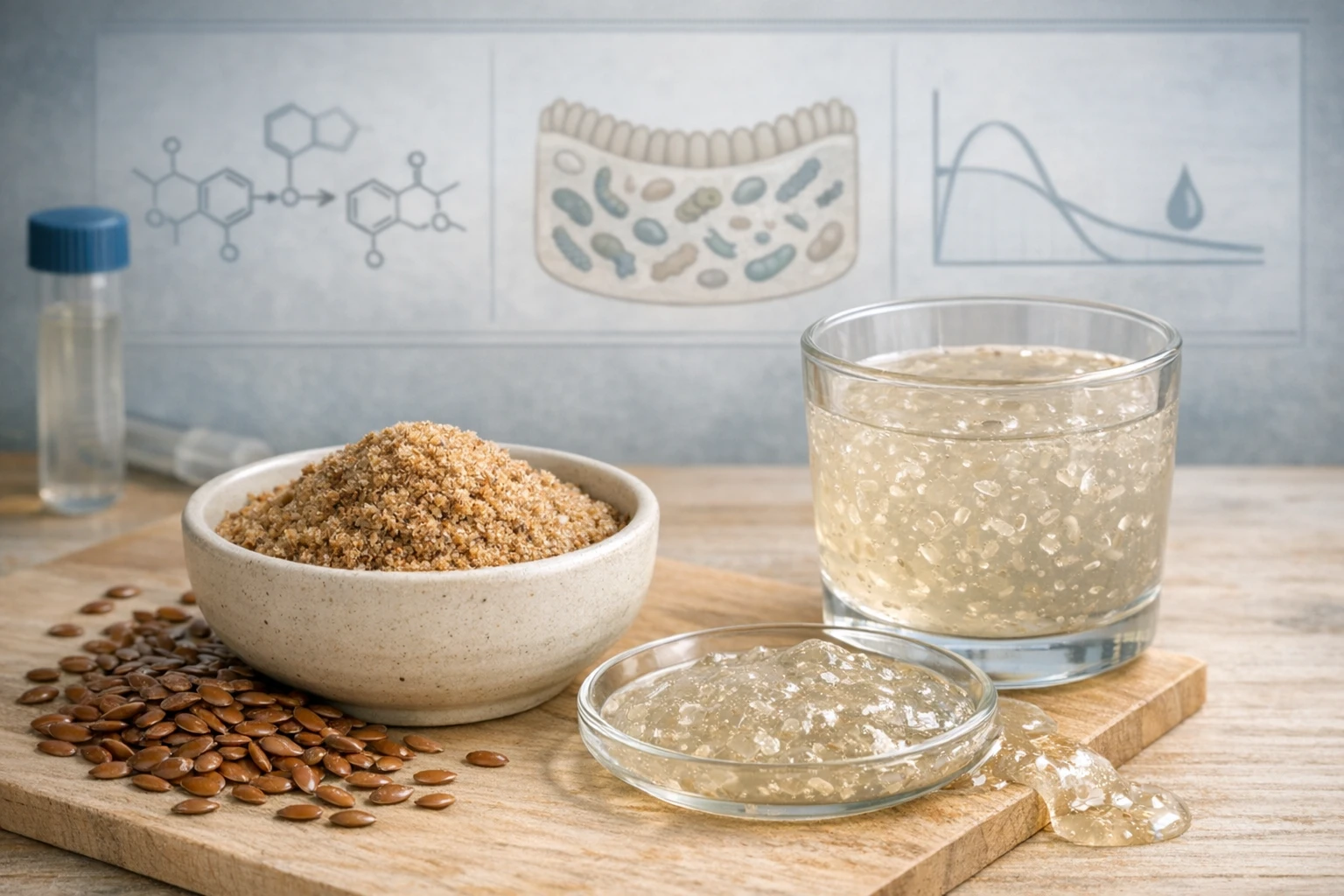
Flaxseeds are a concentrated food: they provide total fiber (a significant portion of soluble and insoluble fiber), relatively good quality protein, and a significant amount of unsaturated fats, particularly alpha-linolenic acid (ALA), a plant-based omega-3 fatty acid. They also contain lignans, including the precursor secoisolariciresinol diglucoside (SDG), which is metabolized by intestinal flora into enterolignans; these compounds have biological activity that can influence hormone-dependent pathways and inflammatory processes. Mucilages, soluble polysaccharides extracted from the seeds, form gels in the presence of water and modulate intestinal viscosity, nutrient absorption, and transit time. These characteristics combine nutritional effects (fiber, fatty acids) and phytochemical effects (lignans) that explain the biological plausibility of the potential benefits observed in clinical studies and literature reviews. [1]
Relevant biological mechanisms
The possible mechanisms through which flaxseeds can influence health are multiple and often interconnected. Mucilages increase the viscosity of intestinal content, slow down carbohydrate and lipid absorption, and promote satiety; these properties may explain modest reductions in post-prandial glycemia and variations in serum lipids. Lignans are transformed by the microbiota into enterolignans, molecules with estrogen-modulating activity and potential antioxidant and anti-inflammatory effects; these processes depend on the individual microbial profile. ALA, although only partially converted to EPA/DHA in humans, can influence the lipid profile and vascular function through lipid and endothelial modulation mechanisms. Finally, the interaction between fiber, microbiota, and metabolic products (short chain fatty acids, lignan metabolites) can play roles in immunometabolism and the regulation of inflammation at the intestinal and systemic levels. Reviews on flax mucilages and polysaccharides extensively discuss these functional properties. [6]
Evidence on chronic diseases
Cardiovascular health and blood pressure
Meta-analyses of clinical trials indicate a modest but consistent reduction in blood pressure associated with the use of flaxseeds or derived products in hypertensive subjects or those with cardiovascular risk factors. The effect appears more evident in interventions lasting longer than 8–12 weeks and when whole or ground seeds are used compared to oil supplementation alone; the effect size is clinically relevant at the population level but varies between studies. Reviews emphasize that blood pressure reduction is likely mediated by the combined action of fiber, lignans, and ALA. [2] [3]
Glycemic metabolism and metabolic risk
Evidence from randomized trials and meta-analyses suggests that supplementation with flaxseeds or mucilage can improve some glycemic control parameters (fasting glycemia, insulinemia, insulin resistance indices) especially in subjects with prediabetes or type 2 diabetes. The effects are often related to soluble fiber and induced viscosity, which slows down carbohydrate absorption; differences in results depend on dose, duration, and the studied population. Controlled clinical studies in subjects with metabolic pathology have shown modest but reproducible improvements. [4] [5]
Cancer: signals on biomarkers, not proof of reduced cases
Controlled clinical interventions in women with breast cancer have documented favorable changes in some tumor biomarkers (increased apoptosis, changes in the expression of proteins related to proliferation or hormones) after dietary flaxseed supplementation. These results are biologically plausible and consistent with preclinical data, but do not constitute proof of decreased cancer incidence or mortality. The literature recommends caution: effects on biomarkers do not necessarily translate into long-term clinical benefits. [7]
Microbiota, intestinal transit, and digestive function
Flax mucilages modify the intestinal microbial composition in controlled studies and can improve intestinal transit and regularity, with useful effects in functional constipation disorders. Clinical trials in obese populations or those with diabetes have reported changes in the microbiota associated with improved insulin sensitivity after mucilage intake; however, the causal role of the microbiota in these effects remains to be clarified. [5] [8]
Methods of consumption and safety
Flaxseeds are consumed in various forms: whole, ground (flaxseed meal), extracted oil, and lignan or mucilage extracts. Whole seeds are less digestible and can pass unaltered; to exploit their nutrients, the use of ground seeds or products that facilitate their bioaccessibility is suggested. Mucilage is obtained by soaking the seeds or through industrial processes and can be used as a functional ingredient. Oil-based supplements provide ALA but not lignans or fiber. The choice of form influences the effects: for example, benefits on glycemia and weight are linked to fiber/mucilage, while lipid effects can be influenced by ALA. Regarding safety, dietary use of flaxseeds at moderate doses is generally well tolerated; some studies report mild gastrointestinal disturbances and the importance of increasing fluid intake when fiber intake is increased. In the presence of sensitive hormonal therapies or particular conditions, it is advisable to consult a doctor before using pharmacological concentrates or high doses. [1] [9]
What it means in practice
For the general public, flaxseeds can be considered a useful functional food to include in a balanced diet. Prefer ground seeds or products that increase their bioaccessibility if the goal is to exploit available lignans and nutrients. Common applications include additions to cereals, yogurt, soups, or baked goods; mucilage can be prepared by soaking the seeds in water to obtain a gel with an emollient effect for the intestine. Avoid therapeutic promises: positive signals on blood pressure, glycemia, and constipation do not authorize the use of seeds as a substitute for pharmacological therapy. In people with specific clinical needs (hypertension, diabetes, history of cancer), always discuss use with a doctor; for fragile subjects or those with swallowing problems, the form must be chosen carefully. Finally, buy fresh seeds and store them away from light and heat to limit fatty acid oxidation. [1] [2]
KEY POINTS TO REMEMBER
- Flaxseeds contain soluble fiber (mucilage), lignans, and ALA; these components explain the biological plausibility of the observed benefits.
- Evidence from trials and meta-analyses indicates modest reductions in blood pressure and improvements in some metabolic markers; effects depend on dose, form, and duration of interventions. [2] [3]
- Clinical studies on tumor biomarkers show favorable changes, but do not prove reduced cases or mortality. [7]
- Mucilage can improve intestinal regularity and modulate the microbiota; drinking adequate fluids is important when increasing fiber intake. [5] [6]
Limitations of the evidence
Available research includes observational studies, randomized trials of varying sizes, and meta-analyses. It is important to distinguish between observational associations (which document correlations) and causal evidence established by well-conducted clinical trials. Many clinical studies on flaxseeds are short-term, with relatively small samples or with heterogeneity in the form of intake (whole seeds, ground, oil, mucilage), dose, and measured outcomes. These variables complicate syntheses and generalizability. Furthermore, effects on biomarkers (e.g., tumor proliferation, apoptosis) do not automatically equate to benefits on clinical outcomes (incidence, progression, mortality). Individual variability (microbiota, metabolic polymorphisms) and the dietary context broaden the dispersion of results. For these reasons, recommendations must be cautious and integrated into the context of overall lifestyle and individual clinical indications. [1] [4]
Editorial conclusion
Flaxseeds are a food rich in fiber, lignans, and ALA with solid biological bases and favorable signals in numerous clinical studies on blood pressure, metabolism, and intestinal function. However, the evidence does not authorize absolute therapeutic claims: the observed benefits are often moderate, depend on the form and dose, and require further long-term research on clinical outcomes. The prudent approach for the reader is to consider flaxseeds as part of a balanced diet and, in case of medical conditions, discuss their use with a doctor. Transparency of sources and critical interpretation of research remain essential elements for responsible communication on nutrition.
Editorial note
This text has been updated from previous versions to reflect recent systematic reviews and clinical trials. The article is for informational purposes only and does not replace the advice of a healthcare professional. Any future updates will be made in line with new scientific evidence.
SCIENTIFIC RESEARCH
- Dietary flaxseed as a strategy for improving human health. Nutrients. 2019. https://doi.org/10.3390/nu11051171
- Flaxseed consumption may reduce blood pressure: a systematic review and meta-analysis of controlled trials. J Nutr. 2015. https://doi.org/10.3945/jn.114.205302
- Effects of flaxseed supplements on blood pressure: a systematic review and meta-analysis of controlled clinical trial. Clin Nutr. 2015. https://doi.org/10.1016/j.clnu.2015.05.012
- Flaxseed and its products improve glycemic control: a systematic review and meta-analysis. Obes Med. 2020. https://doi.org/10.1016/j.obmed.2020.100311
- Dietary modulation of the gut microbiota – a randomised controlled trial in obese postmenopausal women. Br J Nutr. 2015. https://doi.10.1017/S0007114515001786
- Flaxseed (Linum usitatissimum) mucilage: a versatile stimuli-responsive functional biomaterial for pharmaceuticals and healthcare. Int J Biol Macromol. 2024. https://doi.org/10.1016/j.ijbiomac.2024.134817
- Dietary flaxseed alters tumor biological markers in postmenopausal breast cancer. Clin Cancer Res. 2005. https://doi.org/10.1158/1078-0432.CCR-04-2326
- Flaxseed Mucilage (IQP-LU-104) reduces body weight in overweight and moderately obese individuals: a 12-week randomized, double‑blind, placebo‑controlled study. Obes Facts. 2022. https://doi.org/10.1159/000522082
- A randomized trial of the effects of flaxseed to manage constipation, weight, glycemia, and lipids in constipated patients with type 2 diabetes. Nutr Metab (Lond). 2018. https://doi.org/10.1186/s12986-018-0273-z
Note: all listed sources have been verified via DOI resolution and correspond to the indicated title and journal.