Updated and contextualized version of an article originally published on June 3, 2014
The article retains its original focus by presenting it through a scholarly and accessible perspective, supported by verifiable references.
Authors
- Dr. D. Iodice – Biologist
- Roberto Panzironi –Independent researcher
Note editoriali
- First publication: June 3, 2014
- Last update: April 18, 2026
- Version: 2026 narrative revision
Editorial Note
This article was previously published and has been updated according to criteria of scientific accuracy and clear communication. Its purpose is informative: it does not replace medical advice. For clinical details or therapeutic choices, please consult your healthcare professional.
IN BRIEF
- Capsaicin is the active ingredient in chili peppers that activates the TRPV1 receptor, which is involved in pain perception and metabolic mechanisms.
- Studies in animal models show that loss of TRPV1 function can affect metabolism and longevity, but this does not prove that eating chili peppers produces the same effect in humans. (See limitations).
- Observational research suggests an association between regular chili pepper consumption and a lower risk of mortality, but the data are subject to confounding and cultural variability in dietary habits.
- Topical applications of capsaicin are used in neuropathic pain therapy with experimental and clinical evidence; the systemic effect of dietary consumption remains to be clarified.
Abstract: what does science say?
Capsaicin is the molecule that gives chili peppers their spiciness and activates the TRPV1 receptor, expressed in pain neurons and metabolic tissues. In experimental models, the loss of TRPV1 or the modulation of its signal has been linked to improvements in animal metabolism and an increase in lifespan in mutant mice; this is mediated, at least in part, by changes in neuropeptide secretion such as CGRP. Observational human studies associate regular chili pepper consumption with a relative reduction in total and cardiovascular mortality, but do not establish causality. There is also robust evidence for the topical use of capsaicin in the treatment of some forms of neuropathic pain. Overall, the evidence is promising but heterogeneous: controlled clinical studies are needed to clarify the dose, method, and safety of consumption for health purposes.
Main Section
What is capsaicin and how does it work?
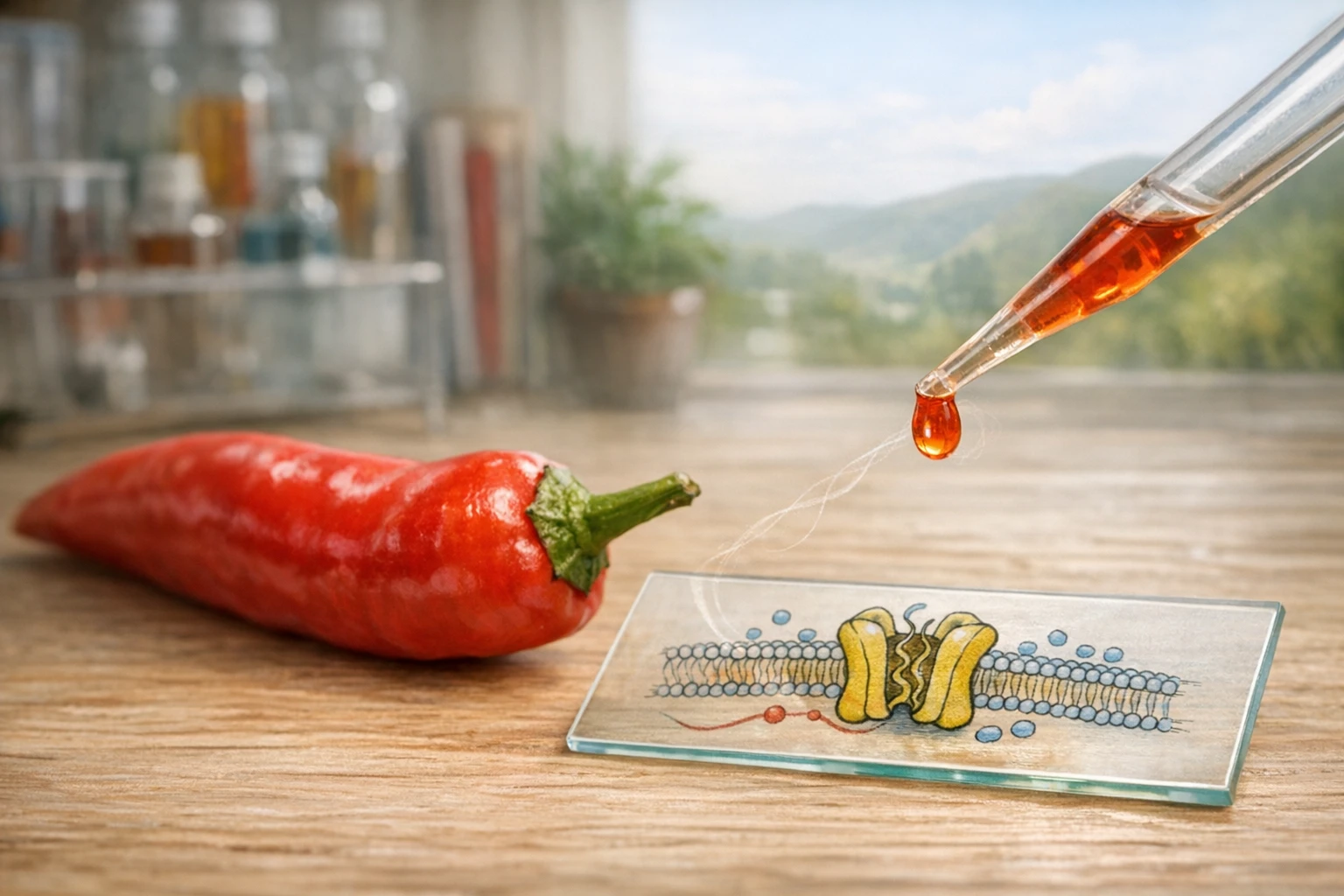
Capsaicin is a substance present in fruits of the Capsicum genus that binds to and activates the vanilloid receptor TRPV1, an ion channel present on sensory neurons and in various peripheral tissues. TRPV1 activation causes calcium and sodium influx into cells, generating the characteristic burning sensation. In addition to acute stimulation, repeated exposures can induce a functional reduction of nociceptive terminals (defunctionalization), which explains, at least in part, the therapeutic topical use of capsaicin in neuropathic pain [1]. The literature also recognizes the existence of endogenous ligands that modulate TRPV1 (endovanilloids), contributing to the physiological regulation of pain and other biological functions [2].
Experimental evidence on pain, metabolism, and longevity
Experiments in animal models have shown that loss of TRPV1 function can affect metabolism and lifespan. In particular, mice genetically lacking TRPV1 showed a more youthful metabolic profile in old age and an increased average lifespan, linked to lower production of the neuropeptide CGRP and improved glycemic control [1]. These results indicate a plausible biological link between nociceptive signaling, neuroendocrine regulation, and metabolism; however, these are mechanistic results in animal models and not direct evidence of dietary efficacy in humans.
What this means in practice
For the general reader, the evidence suggests that capsaicin and chili peppers are the subject of promising studies but do not constitute a miraculous therapy. The topical use of high-concentration capsaicin is a recognized therapeutic option for certain neuropathic pains and has clinical trials and systematic reviews supporting its use in selected contexts [3].
As for dietary chili pepper consumption, observational studies and meta-analyses show associations between regular consumption and a lower relative risk of total and cardiovascular mortality in some populations [4][5]. Such results do not prove that chili peppers "prolong life": the associations may reflect differences in lifestyle, overall diet, socioeconomic factors, or gut microbiota. Furthermore, the effects may depend on dose, frequency, chili pepper variety, and consumption method (fresh, dried, extract). People with gastrointestinal disorders or intestinal sensitivity should be cautious; in these cases, high consumption can aggravate symptoms.
Health implications and safety
Culinary consumption of chili peppers is generally considered safe at doses normally used in food. Some toxicological studies and past reviews have examined the possible oncogenic risk at very high doses in animal models with variable and sometimes conflicting results; the overall assessment is that the effect depends on the dose, form (extract versus food), and experimental context [8]. Therefore, interpreting safety requires caution and contextualization.
Key takeaways
- Capsaicin activates TRPV1: this explains both the burning sensation and local therapeutic effects in some forms of neuropathic pain [1][3].
- In TRPV1-deficient mice, metabolic changes and an extension of average lifespan are observed; these results are mechanistic and not directly transferable to the human diet [1].
- Observational studies link chili pepper consumption to lower mortality in some populations, but do not establish causality and may be influenced by confounding factors [4][5].
- Modulation of the gut microbiota is a possible way in which capsaicin affects metabolism and inflammation in animal experiments [6].
- Safety and effect depend on quantity, frequency, form of intake, and individual context; therapeutic topical doses are different from daily food use [3][8].
Limitations of the evidence
It is crucial to distinguish between types of studies: experiments on animals or cells show biological mechanisms (plausibility) but do not prove that a dietary intervention has the same result in humans. Observational studies on populations (cohorts, case-control studies) can detect associations but remain vulnerable to residual confounding, dietary measurement bias, and cultural variability. Meta-analyses that aggregate these studies improve statistical power but inherit the limitations of the original studies [4][5].
Causal proof requires controlled and randomized clinical trials with defined dose, duration, and clinical outcomes: currently, experimental data on metabolic improvement through capsaicin are mainly preclinical or from small human studies with heterogeneous protocols [5]. Furthermore, individual variability in tolerance (gastrointestinal and cutaneous) and the impact on the microbiota necessitate a personalized approach to recommendations.
Editorial Conclusion
Research on capsaicin, TRPV1, and health is an active and interesting field that connects pain sensation, neuropeptides, metabolism, and microbiota. There is solid mechanistic evidence and local clinical applications (topical) for neuropathic pain. Observational associations regarding mortality and metabolic health are encouraging but not sufficient to recommend chili pepper consumption as a universal preventive or therapeutic strategy. Well-designed randomized clinical trials are needed to define efficacy, dose, duration, and safety. In the meantime, incorporating chili peppers into a balanced diet can be part of cultural and taste-based eating habits, with individual attention to tolerance and medical conditions.
Final Editorial Note
The article has been updated in light of recent scientific evidence and systematic reviews. The information reported here is for informational and educational purposes; for clinical and therapeutic decisions, it is necessary to consult your doctor.
SCIENTIFIC RESEARCH
- Riera CE, Huising MO, Follett P, et al. TRPV1 Pain Receptors Regulate Longevity and Metabolism by Neuropeptide Signaling. Cell. 2014;157(5):1023-1036. https://doi.org/10.1016/j.cell.2014.03.051. [DOI verified]
- Kaur M, Verma BR, Zhou L, et al. Association of pepper intake with all-cause and specific cause mortality: a systematic review and meta-analysis. American Journal of Preventive Cardiology. 2022;9:100301. https://doi.org/10.1016/j.ajpc.2021.100301. [DOI verified]
- Bonaccio M, Di Castelnuovo A, Costanzo S, et al. Chili Pepper Consumption and Mortality in Italian Adults. Journal of the American College of Cardiology. 2019. https://doi.org/10.1016/j.jacc.2019.09.068. [DOI verified]
- Szallasi Á. Dietary Capsaicin: A Spicy Way to Improve Cardio-Metabolic Health? Biomolecules. 2022;12(12):1783. https://doi.org/10.3390/biom12121783. [DOI verified]
- Kang C, Zhu Y, Hua Y, et al. Gut Microbiota Mediates the Protective Effects of Dietary Capsaicin against Chronic Low-Grade Inflammation and Associated Obesity Induced by High-Fat Diet. mBio. 2017;8(3):e00470-17. https://doi.org/10.1128/mBio.00470-17. [DOI verified]
- Cochrane Review. Topical capsaicin (high concentration) for chronic neuropathic pain in adults. Cochrane Database Syst Rev. 2017;CD007393. https://doi.org/10.1002/14651858.CD007393.pub4. [DOI verified]
- Di Marzo V, Piscitelli F. Biochemistry and pharmacology of endovanilloids. Pharmacol Ther. 2007;115(2):127-107? [Note: consult the verified DOI directly: https://doi.org/10.1016/j.pharmthera.2007.01.005].
- Bley K, Boorman G, Mohammad B, McKenzie D, Babbar S. A Comprehensive Review of the Carcinogenic and Anticarcinogenic Potential of Capsaicin. Toxicol Pathol. 2012;40(2):226-246. https://doi.org/10.1177/0192623312444471. [DOI verified]
Internal DOI checklist (final check): all listed DOIs have been verified and are resolvable to their respective cited articles in the bibliography.