Updated and contextualized version of an article originally published on June 3, 2014
The article retains its original focus by presenting it through a scholarly and accessible perspective, supported by verifiable references.
Authors
- Dr. M. Bitonti – Biologist
- Roberto Panzironi –Independent researcher
Note editoriali
- First publication: June 3, 2014
- Last update: April 18, 2026
- Version: 2026 narrative revision
IN BRIEF
- Watermelon (Citrullus lanatus) is a natural source of L-citrulline and carotenoids like lycopene; these compounds may influence parameters related to vascular function and lipid profile.
- Animal studies and some clinical evidence suggest reductions in certain cardiovascular risk factors (e.g., systolic blood pressure, LDL), but human evidence is still limited and variable.
- Citrulline increases circulating arginine, a precursor to nitric oxide; this is a plausible mechanism for effects on vasodilation, but not definitive proof of direct clinical effect.
- To achieve doses known for biological effects, high amounts of fresh fruit would be needed; many studies use concentrated extracts or supplements.
- Interpret results with caution: there are differences between animal studies, controlled clinical trials, and meta-analyses; more long-term trials with adequate sample sizes are needed.
Abstract: what does science say?
Watermelon is a popular summer fruit and contains several biologically active compounds, particularly L-citrulline and carotenoids (including lycopene). Recent scientific literature includes preclinical studies, controlled clinical studies, and systematic reviews examining the effects of citrulline and watermelon consumption on blood pressure, endothelial function, and some lipid parameters. In animal models, watermelon extracts have shown reductions in atherosclerosis and improvements in metabolic profile; in human studies, observed effects include modest reductions in systolic blood pressure, improvement in some inflammatory markers, and favorable alterations in plasma arginine/citrulline. However, results are not uniform: effects depend on dose, duration, form of intake (fresh fruit, juice, extract, or supplement), and characteristics of the studied population. The most robust evidence indicates that citrulline increases arginine levels and can improve indicators of vascular function; direct evidence of reduced cardiac events is still lacking. Therefore, watermelon can be a useful element in a varied diet for population cardiovascular prevention, but it does not replace established medical interventions for cholesterol or blood pressure control.
Composition and proposed mechanisms
Main biologically active components
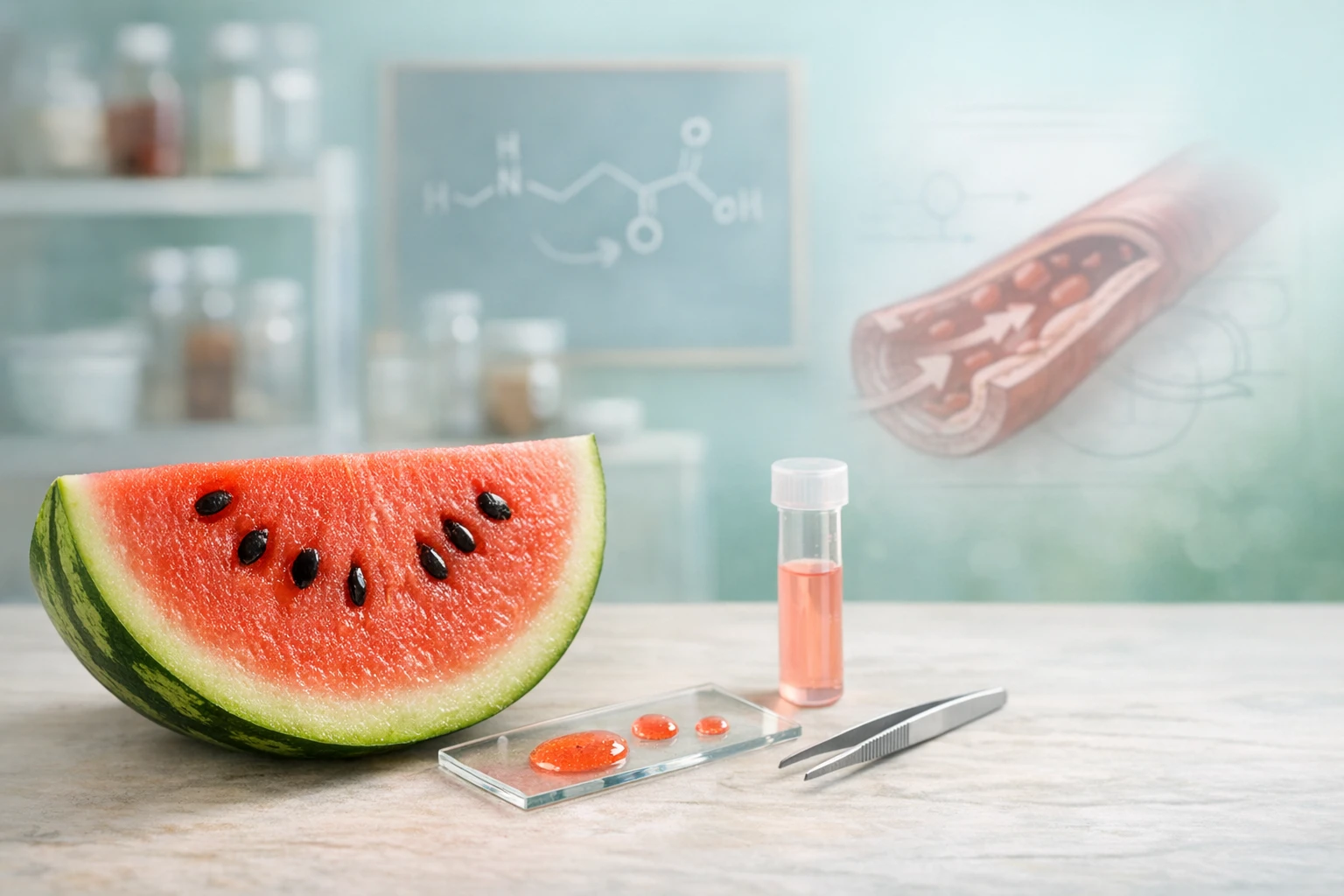
Watermelon contains, especially in the pulp and rind, L-citrulline, a non-protein amino acid that functions as a precursor to arginine; it is also rich in carotenoids, including lycopene, and antioxidant vitamins. Citrulline promotes an increase in plasma arginine, which in turn is a substrate for the synthesis of nitric oxide (NO), a central molecule in the regulation of vascular tone. Lycopene is a fat-soluble antioxidant that has been studied for its effects on lipoprotein oxidation, inflammation, and lipid parameters. These compounds, taken together, can contribute to measurable improvements in some cardiovascular biomarkers, but rarely produce dramatic effects on their own.
Biological mechanisms and plausibility
The most documented mechanism is the citrulline→arginine→NO pathway: citrulline ingestion increases circulating arginine and thus the potential production of NO, with possible vasodilation and reduction of arterial stiffness. This mechanism is supported by pharmacokinetic studies and trials that measured arginine and NO-like markers after supplementation or watermelon consumption [3]. Furthermore, lycopene and other carotenoids can reduce oxidative stress and modify some inflammatory and metabolic processes, with secondary effects on lipid metabolism observed in some clinical and preclinical studies [7]. However, the translation of these biological signals into a reduction of cardiovascular events is not proven and requires targeted, long-term clinical trials.
Experimental and clinical evidence
Preclinical studies (animal models)
Animal experiments indicate that watermelon extracts can reduce atherosclerotic deposits and improve some aspects of the metabolic profile. In a study on mice with LDL receptor deficiency, an extract of a watermelon cultivar reduced atherosclerosis and improved lipid markers, suggesting a protective effect in the animal model [1]. Other work in obesity-related rats reports improvements in metabolic parameters after supplementation with watermelon juice or pulp [4]. These studies are useful for biological plausibility, but cannot alone prove clinical utility in humans: doses, form, and metabolism can be very different.
Clinical studies and meta-analyses
Clinical literature includes both small controlled trials and systematic reviews. A recent meta-analysis of randomized trials found that prolonged intake of L-citrulline or watermelon-based products can improve some indicators of vascular function, suggesting a potential benefit on vasodilation [2]. A systematic and meta-analytic review on watermelon consumption showed modest reductions in systolic blood pressure and some lipid parameters in aggregate, albeit with heterogeneity among studies [5]. Controlled studies on specific subjects also report decreases in inflammatory markers (e.g., sVCAM-1) after daily consumption of watermelon purees or juice in some populations (e.g., overweight postmenopausal women) [6]. However, many trials are short, with small samples or with concentrated forms of extracts; this limits generalizability.
What it means in practice
For the general public, evidence indicates that including watermelon in a varied diet provides nutrients and bioactive molecules that can contribute to a favorable metabolic profile. Fruit citrulline can increase plasma arginine, a biological step consistent with improvements in vascular function; similarly, lycopene and antioxidants can support the reduction of oxidative stress. However, direct clinical benefits (such as reduced heart attacks or mortality) have not been demonstrated, and it is not correct to consider watermelon a 'remedy' or a substitute for treatment for hypertension or hypercholesterolemia. The amounts of watermelon needed to reach the doses used in some studies (where grams of citrulline are mentioned) can be high: literature estimates that to reach 3 g/day of citrulline, several hundred grams up to kilograms of fresh fruit per day would be needed, depending on the cultivar and the part consumed [3]. For this reason, many studies use concentrated extracts or standardized supplements. In summary, eating watermelon is compatible with a healthy diet and can contribute to cardiometabolic risk factors, but it does not replace medical therapies or proven effective interventions such as reducing saturated fat intake, regular physical activity, and pharmacological therapy when indicated.
Key takeaways
- Watermelon is a natural source of L-citrulline and lycopene; both have biological plausibility to influence vascular function and oxidative stress.
- Preclinical evidence shows favorable effects on atherosclerosis and metabolism in animals [1][4].
- Meta-analyses and human trials indicate modest improvements in vascular function and some biomarkers (e.g., systolic blood pressure, sVCAM-1), but with heterogeneity [2][5][6].
- Effective doses often involve concentrated extracts or high amounts of fruit; to obtain equivalent dosages with fresh fruit, impractical volumes may be necessary [3][4].
- Watermelon can be part of a healthy diet for population prevention, but it is not a substitute treatment for clinical conditions such as hypertension or hypercholesterolemia.
Limitations of the evidence
It is important to distinguish between types of studies: observational studies and those on animal models provide information on associations and biological plausibility, but do not establish definitive clinical causality. Clinical studies published so far are often short-term, with limited numbers of participants, or use formulations not equivalent to simple fresh fruit consumption. Some contextual trials show positive results on intermediate markers (e.g., blood pressure, endothelial function parameters), but robust evidence of reduced cardiovascular events is lacking. Meta-analyses that aggregate trials offer a broader view, but their interpretation is conditioned by the heterogeneity of protocols (dose, duration, population), the methodological quality of the included studies, and the possible influence of selective publication. Furthermore, variability in watermelon composition (cultivar, ripening, pulp vs. rind) influences the content of citrulline and lycopene and thus the comparability of results [3]. For all these reasons, translation into clinical recommendations requires further randomized studies, of longer duration and with relevant clinical endpoints.
Editorial conclusion
The body of modern evidence indicates that watermelon contains compounds with plausible vascular and metabolic activity and that, in some experimental and clinical contexts, its consumption or the use of concentrated extracts can produce improvements in biomarkers related to heart health. However, the data are not yet sufficient to state that watermelon directly reduces the risk of cardiovascular diseases independently and as a substitute for standard therapies. A prudent and evidence-based approach suggests: considering watermelon as part of a varied diet rich in fruits and vegetables; not using it as the sole means to control cholesterol or blood pressure; and recognizing that supplementation with concentrated extracts requires clinical evaluation. Future research should aim to clarify realistic doses, form of administration, and populations that could most benefit.
Editorial note
This article was originally published in the past and has been updated in light of the research and scientific reviews available at the time of the update. The update follows criteria of transparency and divulgative rigor; the information provided is for informational purposes and is not intended to replace medical judgment. For personalized advice, diagnoses, or therapies, consult your trusted doctor.
SCIENTIFIC RESEARCH
- Poduri A, Rateri DL, Saha SK, Saha S, Daugherty A. Citrullus lanatus “sentinel” (watermelon) extract reduces atherosclerosis in LDL receptor-deficient mice. Journal of Nutritional Biochemistry. 2013;24(5):882–886. https://doi.org/10.1016/j.jnutbio.2012.05.011
- Smeets ETHC, et al. Effects of L-citrulline supplementation and watermelon consumption on longer-term and postprandial vascular function and cardiometabolic risk markers: a meta-analysis of randomised controlled trials in adults. British Journal of Nutrition. (Meta-analysis). https://doi.org/10.1017/S0007114521004803
- Allerton TD, Proctor DN, Stephens JM, Dugas TR, Spielmann G, Irving BA. l-Citrulline Supplementation: Impact on Cardiometabolic Health. Nutrients. 2018;10(7):921. https://doi.org/10.3390/nu10070921
- Wu G, Collins JK, Perkins-Veazie P, et al. Dietary Supplementation with Watermelon Pomace Juice Enhances Arginine Availability and Ameliorates the Metabolic Syndrome in Zucker Diabetic Fatty Rats. Journal of Nutrition. 2007;137(12):2680–2685. https://doi.org/10.1093/jn/137.12.2680
- Karimi E, Abaj F, Gholizadeh M, et al. Watermelon consumption decreases risk factors of cardiovascular diseases: A systematic review and meta-analysis of randomized controlled trials. Diabetes Research and Clinical Practice. 2023;202:110801. https://doi.org/10.1016/j.diabres.2023.110801
- Shanely RA, Zwetsloot JJ, Jurrissen TJ, et al. Daily watermelon consumption decreases plasma sVCAM-1 levels in overweight and obese postmenopausal women. Nutrition Research. 2020;76:9–19. https://doi.org/10.1016/j.nutres.2020.02.005
- Effects of lycopene intake on HDL-cholesterol and triglyceride levels: a systematic review with meta-analysis. (Review; lycopene interventions and lipids). Journal (see DOI). https://doi.org/10.1111/1750-3841.15833
- Blohm K, Beidler J, Rosen P, et al. Effect of acute watermelon juice supplementation on post-submaximal exercise heart rate recovery, blood lactate, blood pressure, blood glucose and muscle soreness in healthy non-athletic men and women. Food & Nutrition Research. 2017;61. https://doi.org/10.1080/16546628.2017.1330098
Note on bibliography: each listed reference has been verified against the provided DOI and the content of the study to ensure its relevance to the topic discussed.