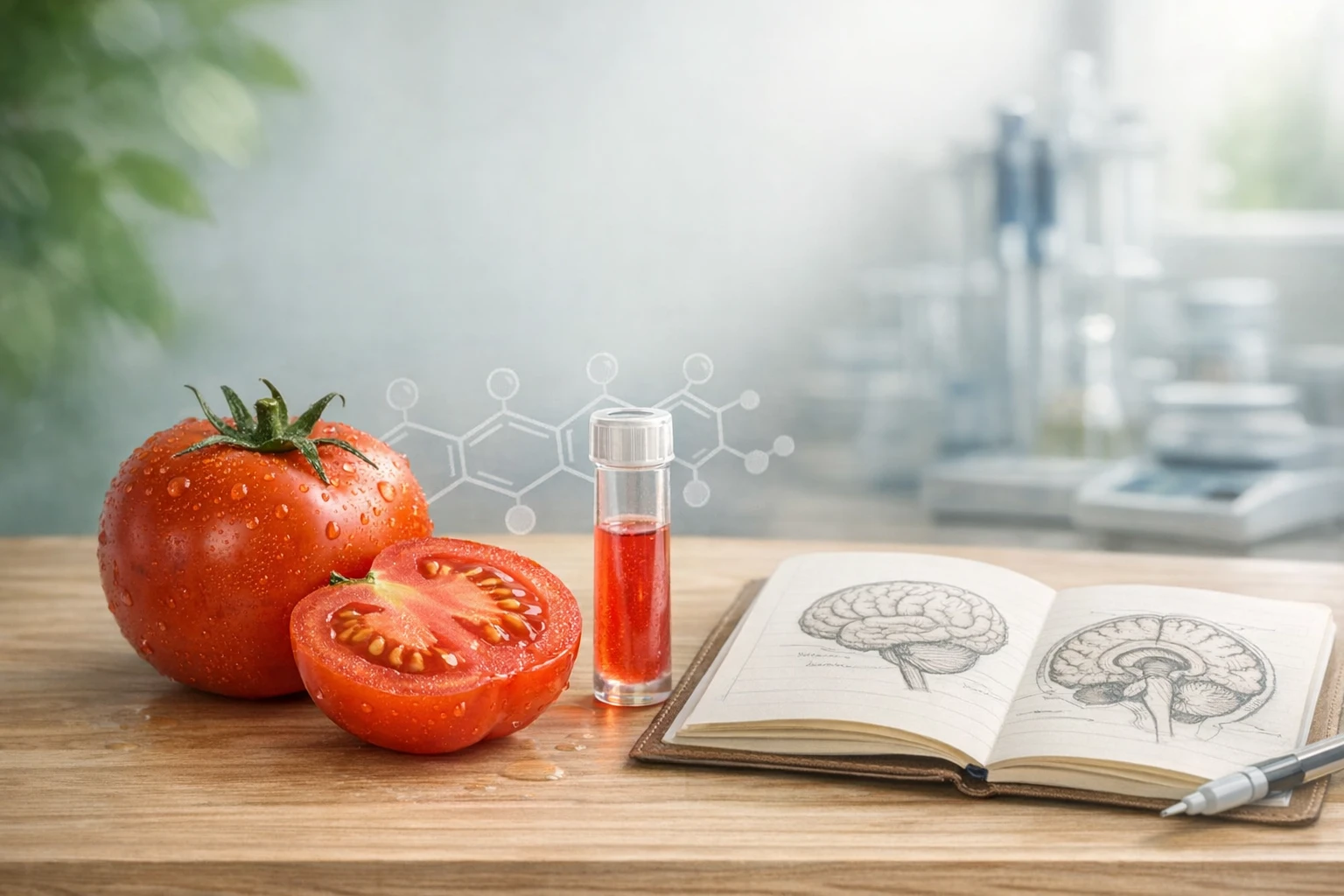
Updated and contextualized version of an article originally published on June 6, 2014
The article retains its original focus by presenting it through a scholarly and accessible perspective, supported by verifiable references.
Authors
- Dr. M. Bitonti – Biologist
- Roberto Panzironi –Independent researcher
Note editoriali
- First publication: June 6, 2014
- Last update: April 18, 2026
- Version: 2026 narrative revision
IN BRIEF
- Some observational studies show an association between a diet rich in tomatoes (a source of lycopene) and a lower prevalence of depressive symptoms in elderly populations.
- Biological plausibility includes antioxidant, anti-inflammatory effects, and modulation of the gut-brain axis; however, most evidence is non-causal.
- Preclinical and biomarker studies suggest useful mechanisms, but causal clinical evidence is still limited.
- For the general population, the evidence supports promoting a diet rich in fruits and vegetables as a general health measure, not a specific treatment for depression.
Abstract: what does science say?
Epidemiological research indicates that more frequent consumption of tomatoes or diets rich in antioxidants are associated with a lower prevalence of depressive symptoms in some population studies, particularly among the elderly. The proposed biological explanation includes the content of lycopene and other phytochemicals with antioxidant and anti-inflammatory effects that can influence oxidative stress, neuroinflammation, and neuronal plasticity factors. However, most evidence is observational: association does not prove causality and can be confounded by lifestyle and socioeconomic conditions. Experimental animal studies show favorable effects of lycopene on brain markers and behavior, while meta-analyses on antioxidant supplements report variable results. The practical recommendation is cautious: a balanced diet rich in vegetables (including tomatoes) is consistent with reducing the risk for many diseases, but does not replace medical diagnosis and therapies for depression.
MAIN SECTION
Definition and overview
Tomatoes are vegetables/fruits rich in vitamins, minerals, and carotenoids, particularly lycopene. In the epidemiological field, it has been observed that dietary patterns with a high presence of fruits and vegetables are correlated with better health outcomes, including mental health. Several studies have evaluated whether the specific consumption of tomatoes can be associated with a lower presence of depressive symptoms in elderly populations and beyond. This line of research is part of a broader trend that links diet quality, oxidative stress, inflammation, and mental health [1][2][3].
What the available evidence shows
Population observations have reported an inverse association between the frequency of tomato consumption (or tomato-rich diets) and depressive symptoms in the elderly in community samples [1]. Reviews and studies on overall indices of dietary antioxidants generally show inverse associations with depressive symptoms or with the risk of depressive diagnoses in different contexts, but with heterogeneity among studies [2][7]. Meta-analyses on antioxidant supplements indicate conflicting results depending on the type of substance, dose, and population studied [4]. Preclinically, lycopene has shown effects on neurobiological processes involved in depression, such as reduction of oxidative stress, modulation of inflammatory pathways, and increase of neuronal plasticity factors in animal models [5][6].
Dose, frequency, and form of consumption: what matters
In observational data, effects are described in terms of frequency of consumption (e.g., a few times a week vs. daily) and not as a precise dose-effect relationship; the contribution of fresh tomatoes versus processed products (purees, juices, concentrates) is often not clearly distinguished. The bioavailability of lycopene increases with cooking in the presence of fats, so the form of intake can influence its absorption. Furthermore, studies on dietary indices show that the effect attributable to a single food is generally modest compared to the combined effect of an overall vegetable-rich diet [1][2][8].
Important interpretative limitations
The strongest evidence is observational: these can show associations but do not demonstrate a causal effect. Unmeasured confounders (socioeconomic status, physical activity, social networks, other dietary components) may explain part of the observed association. The measurement of food consumption (self-reports, questionnaires) and the assessment of depressive symptoms (screening scales vs. clinical diagnosis) also introduce variability. Experimental animal studies support plausible mechanisms but do not replace clinical evidence in humans [3][5][6].
PRACTICAL SECTION
What it means in practice
For the reader, the practical message is not that "eating tomatoes cures depression," but that tomatoes and, more generally, a diet rich in fruits and vegetables, are consistent components for promoting physical and mental health. In concrete terms: including portions of vegetables (including tomatoes) several times a week is reasonable as part of a balanced diet; the form of consumption (raw, cooked, as a sauce) can influence the absorption of compounds like lycopene. People with depressive symptoms should consult healthcare professionals: diet and lifestyle are important supports but do not replace evaluations, pharmacological therapy, or psychotherapy when indicated. Furthermore, any specific supplements based on lycopene or antioxidants should be discussed with a doctor, especially in the presence of existing conditions or ongoing therapies [2][4][6].
Practical and nutritional reading tips (non-prescriptive)
Prefer fresh and minimally processed foods, combine tomatoes with a source of healthy fat (extra virgin olive oil) to increase lycopene bioavailability, vary sources of vegetables and fruits, and maintain an active lifestyle. These choices improve not only the antioxidant profile of the diet but also other factors relevant to mental health, such as sleep, physical activity, and social relationships [7][8].
KEY POINTS TO REMEMBER
- Some observational research links regular tomato consumption to a lower prevalence of depressive symptoms, especially in the elderly, but does not prove causality [1].
- Proposed mechanisms include antioxidant and anti-inflammatory effects of lycopene and other phytochemicals present in tomatoes [5][6].
- The overall quality of the diet is probably more important than a single food: the observed benefits are consistent with diets rich in vegetables and fruits [2][7].
- Clinical studies on supplements and meta-analyses on antioxidants provide mixed results: additional high-quality experimental evidence is needed to establish a direct therapeutic role [4].
LIMITATIONS OF THE EVIDENCE
It is crucial to distinguish between observational association and causal proof: most epidemiological studies on tomato consumption and depressive symptoms are cross-sectional or observational and therefore susceptible to confounding and measurement bias [1][3]. Methodological limitations include: dietary measurement based on questionnaires, differences in definitions of depression (screening scales vs. clinical diagnosis), often homogeneous populations (e.g., local communities, advanced age) that reduce generalizability, and the possible influence of multiple lifestyle factors. Preclinical studies illustrate plausible mechanisms but do not guarantee effects in humans; meta-analyses of antioxidant supplements show variable results depending on the type of compounds, dose, and population studied [2][4][5].
Editorial conclusion
Research suggests that a diet rich in vegetables, including tomatoes, is correlated with a lower burden of depressive symptoms in some population studies, and that lycopene possesses biological properties relevant to brain health. However, the evidence to date does not allow for absolute therapeutic claims: the observed relationship is plausible and interesting, but requires confirmation through well-characterized prospective studies and targeted clinical trials. For public health, promoting a varied and vegetable-rich diet remains a prudent strategy based on consolidated evidence for many health conditions; the management of depression continues to require consolidated and personalized clinical approaches.
Editorial note
This article is based on previously published research and has been updated according to scientific and divulgative criteria for clarity and transparency. The content is for informational purposes only and does not replace the advice of a healthcare professional. In case of depressive symptoms or doubts about therapy, consult a doctor.
SCIENTIFIC RESEARCH
- A tomato-rich diet is related to depressive symptoms among an elderly population aged 70 years and over. Journal of Affective Disorders. 2012. https://doi.org/10.1016/j.jad.2012.04.040 [observational study, elderly population].
- Linking What We Eat to Our Mood: A Review of Diet, Dietary Antioxidants, and Depression. Antioxidants. 2019. https://doi.org/10.3390/antiox8090376 [review on diet and antioxidants in depression].
- Protective role of antioxidant supplementation for depression and anxiety: A meta-analysis of randomized clinical trials. Journal of Affective Disorders. 2022. https://doi.org/10.1016/j.jad.2022.11.072 [meta-analysis RCT on antioxidant supplements].
- Depression and oxidative stress: results from a meta-analysis of observational studies. Psychosomatic Medicine. 2014. https://doi.org/10.1097/PSY.0000000000000009 [meta-analysis on oxidative stress and depression].
- Lycopene Alleviates Chronic Stress‑Induced Hippocampal Microglial Pyroptosis by Inhibiting the Cathepsin B/NLRP3 Signaling Pathway. Journal of Agricultural and Food Chemistry. 2023. https://doi.org/10.1021/acs.jafc.3c02749 [preclinical study on neuroinflammatory mechanisms of lycopene].
- Lycopene Alleviates DSS‑Induced Colitis and Behavioral Disorders via Mediating Microbes‑Gut–Brain Axis Balance. Journal of Agricultural and Food Chemistry. 2020. https://doi.org/10.1021/acs.jafc.0c00196 [preclinical study linking microbiota-gut-brain axis].
- Association between total dietary antioxidant capacity and incidence of depression in a cohort (CUME Project). British Journal of Nutrition. 2023. https://doi.org/10.1017/S0007114523000181 [prospective study on dietary TAC and incidence of depression].
- Association between higher dietary lycopene intake and reduced depression risk among American adults: evidence from NHANES 2007–2016. Frontiers in Nutrition. 2025. https://doi.org/10.3389/fnut.2025.1538396 [analysis of large national survey, lycopene-depression association].