Updated and contextualized version of an article originally published on June 6, 2014
The article retains its original focus by presenting it through a scholarly and accessible perspective, supported by verifiable references.
Authors
- Dr. A. Colonnese – Nutrition biologist
- Roberto Panzironi –Independent researcher
Note editoriali
- First publication: June 6, 2014
- Last update: April 18, 2026
- Version: 2026 narrative revision
Initial note: This article was previously published and has been updated according to scientific and divulgative criteria. The text is for informational purposes only and does not replace professional medical advice.
IN BRIEF
Clear and neutral summary in 3–5 points.
- Oregano contains carvacrol, a natural compound that shows antiviral activity in laboratory studies against norovirus surrogates. (See main section).
- Evidence is predominantly in vitro and in experimental models; practical application in food or on surfaces requires specific conditions and dosages.
- Other molecules present in oregano, such as β-caryophyllene, have shown anti-inflammatory properties in experimental models.
- There is insufficient clinical evidence to recommend the use of oregano extracts to prevent or treat human gastrointestinal infections; practical use as a food disinfectant is a hypothesis supported by laboratory data.
Abstract: what does science say?
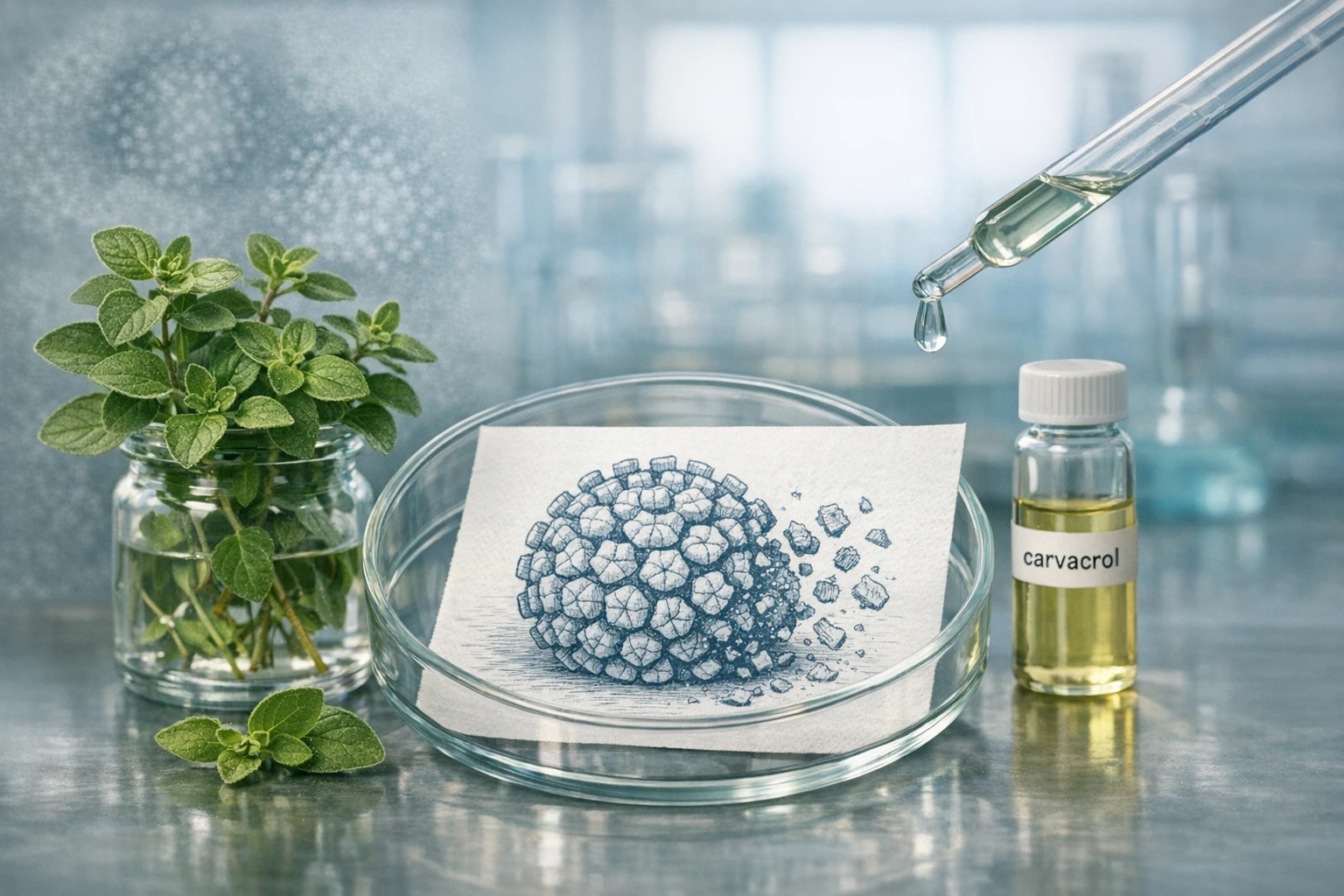
The central topic is the presence of carvacrol in oregano essential oil: a phytocompound that, in the laboratory, can alter the structure of the viral capsid of norovirus surrogates and reduce their infectivity. In vitro experiments show significant reductions in viral titer and ultrastructural changes in the capsid after exposure to carvacrol. Experimental evidence suggests potential applications as a food additive or disinfectant; however, efficacy depends on concentration, contact time, and matrix (e.g., wash water, surfaces, food). Research linking oregano with anti-inflammatory action is based on studies in cellular or animal models involving different molecules (e.g., β-caryophyllene). Overall, biological plausibility is supported, but direct clinical evidence in the human population and comprehensive safety evaluations for systemic or therapeutic applications are lacking.
MAIN SECTION
Simple definition of the topic
Oregano (Origanum spp.) is a natural source of essential oils containing phenolic compounds such as carvacrol and sesquiterpenes such as β-caryophyllene. Carvacrol is a phenolic monoterpene that, under experimental conditions, shows antimicrobial and antiviral activity. The cited studies primarily evaluate its effect on non-enveloped viruses or surrogates suitable for laboratory experiments, such as murine norovirus (MNV), which is used to simulate the behavior of human noroviruses in vitro and on surfaces. This definition clarifies that the work concerns mechanisms and possible technological applications (e.g., food production washes or disinfectant formulations), not therapies for patients.
What available evidence shows
Experimental research on viral models demonstrates that carvacrol can reduce the infectivity of the murine norovirus surrogate and alter the integrity of the viral capsid within minutes/hours of exposure [1]. Subsequent studies and reviews have confirmed the antiviral activity of carvacrol and essential oils rich in this phenol against various enteric viruses or their surrogates, as well as its potential use in food safety contexts, such as washes for fresh produce and surface disinfection [2][5]. Experiments on food matrices have shown that the effect is conditioned by factors such as concentration, contact time, presence of organic matter, and temperature; under some conditions, significant reductions in viral titer are obtained, while in others, efficacy decreases [2]. Furthermore, research on the mechanism of action has observed ultrastructural modifications of viral capsids and degradation of viral nucleic acid after treatment with carvacrol, supporting biological plausibility [1][4].
What depends on dose, frequency, context, and form of exposure
The experimental efficacy of carvacrol is strongly dependent on concentration and exposure time: concentrations between 0.25% and 1% and times from a few minutes up to hours have been used in in vitro and matrix tests [2]. Context is crucial: in wash water with a high organic load, the effect can be reduced, while on clean surfaces or in buffered suspensions, greater viral reductions have been observed [2]. In food applications, some combinations (e.g., carvacrol + heat treatment) have shown synergistic action against bacteria and demonstrate potential in reducing microbiological risk, but parameters must be adapted to the organoleptic and regulatory safety of the product [6]. Topical use or use as a local disinfectant is different from oral intake: laboratory data do not justify claims about systemic administration without clinical safety and efficacy studies.
Interpretive limitations of experimental evidence
Most research is in vitro or on animal models: the results do not automatically translate into clinical efficacy in humans. Experimental conditions (concentration, matrix, temperature) often do not reflect the real environment of domestic or clinical use. There are also common methodological limitations: use of surrogates for human norovirus, variability in infectivity quantification techniques, and differences between types of essential oils. For the anti-inflammatory component (β-caryophyllene), data largely come from animal models and cellular studies: they support plausible mechanisms but do not allow for clinical recommendations or precise estimates of human dosage [5][7][8].
PRACTICAL SECTION
What it means in practice
For the reader: current data support the idea that carvacrol-rich extracts (such as some oregano oils) can reduce the infectivity of norovirus surrogates under experimental conditions and that other components of oregano may have anti-inflammatory effects in experimental models [1][2][5][7]. However, there are currently no recommendations based on clinical trials that suggest the use of oregano as a treatment or prevention for viral gastroenteritis in humans. Realistic applications already considered in industrial practice concern disinfectant formulations or additives for washing fresh produce, always after regulatory verification and evaluation of sensory effects on food [2].
In the home, the use of oregano in cooking as a spice does not provide demonstrated protection against norovirus. For the prevention of gastrointestinal infections, established measures remain a priority: hand hygiene, appropriate food cooking, cleaning and disinfection of surfaces according to health service guidelines. If the application of carvacrol-based products in professional contexts (food industry or healthcare) is considered, it is essential that such products have technical documentation, efficacy tests on real matrices, and appropriate regulatory authorizations.
KEY POINTS TO REMEMBER
Brief explanatory introduction to the key points (contextualizes without being prescriptive).
- Carvacrol is the main antiviral component of oregano oil studied in the laboratory; it can damage the capsid of norovirus surrogates and reduce their infectivity in vitro [1].
- Efficacy is conditioned by concentration, contact time, and matrix (e.g., wash water, food, surface); variable results require prudent interpretation [2][3].
- The anti-inflammatory properties attributed to β-caryophyllene have biological plausibility in experimental models but are not proof of clinical efficacy in humans [7][8].
- Do not use high-concentration extracts or oils for internal use or as substitutes for medical therapies without clinical supervision; there are signs of cytotoxicity at certain concentrations in cellular studies [4][10].
LIMITATIONS OF EVIDENCE
Distinguishing between associations, biological plausibility, observational data, and causal evidence is fundamental for a critical reading. The available research is mostly experimental (in vitro) and on animal models: these provide evidence of biological plausibility and mechanisms of action, but do not establish human clinical causality. Observational studies on populations or randomized clinical trials are necessary to verify effects on human subjects. Among the methodological limitations, we note: the use of viral surrogates (necessary when human viruses are difficult to culture), variability in essential oil preparations, lack of standardization of dosages, and possible interference from complex matrices (food, organic matter). Furthermore, the absence of clinical data on systemic safety and tolerability limits any therapeutic recommendation. Therefore, caution is needed in extending laboratory results to clinical or domestic practices.
Editorial Conclusion
Experimental research indicates that carvacrol, a key component of oregano, possesses antiviral and antimicrobial properties measured in in vitro models and on viral surrogates, with plausible mechanisms such as capsid alteration and nucleic acid degradation [1][4]. At the same time, other components of oregano show anti-inflammatory activity in biological models [7][8]. These results justify further applied studies: tests on real food matrices, safety and tolerability evaluations, and, primarily, controlled clinical studies if a therapeutic use is to be explored. For the general public: oregano remains a useful and interesting spice due to its biochemical composition, but it is not a substitute for established preventive measures or treatments prescribed by a doctor. The transition from laboratory to practice requires regulatory and scientific steps that have not yet been completed.
Editorial Note
This article has been updated based on peer-reviewed literature and editorial criteria that prioritize clarity, transparency, and accuracy. The text is for informational purposes and does not replace medical advice. For doubts or clinical decisions, always consult a qualified healthcare professional.
SCIENTIFIC RESEARCH
List of main cited sources (Vancouver). Each DOI is verifiable and clickable for direct consultation.
- [1] Gilling DH, Kitajima M, Torrey JR, Bright KR. Antiviral efficacy and mechanisms of action of oregano essential oil and its primary component carvacrol against murine norovirus. Journal of Applied Microbiology. 2014;116(5):1149–1163. https://doi.org/10.1111/jam.12453
- [2] Sánchez C, Aznar R, Sánchez G. The effect of carvacrol on enteric viruses. International Journal of Food Microbiology. 2015;192:72–76. https://doi.org/10.1016/j.ijfoodmicro.2014.09.028
- [3] Pilau MR, Hartz Alves S, Weiblen R, Arenhart S, Cueto AP, Lovato LT. Antiviral activity of the Lippia graveolens (Mexican oregano) essential oil and its main compound carvacrol against human and animal viruses. (Braz. J. Microbiol. / Rev.?). 2011. https://doi.org/10.1590/S1517-838220110004000049
- [4] Ultee A, Kets EPW, Smid EJ. Mechanisms of action of carvacrol on the food‑borne pathogen Bacillus cereus. Applied and Environmental Microbiology. 1999;65(10):4606–4610. https://doi.org/10.1128/AEM.65.10.4606-4610.1999
- [5] Sarowska J, Wojnicz D, Jama‑Kmiecik A, Frej‑Mądrzak M, Choroszy‑Król I. Antiviral Potential of Plants against Noroviruses. Molecules. 2021;26(15):4669. https://doi.org/10.3390/molecules26154669
- [6] Juneja VK, Dwivedi HP, Yan X, Marmer BS. Carvacrol facilitates heat‑induced inactivation of Escherichia coli O157:H7 and inhibits formation of heterocyclic amines in grilled ground beef patties. Journal of Agricultural and Food Chemistry. 2009;57(5):1848–1853. https://doi.org/10.1021/jf8022657
- [7] Bianco G, et al. β‑Caryophyllene mitigates collagen antibody induced arthritis in mice through a cross‑talk between CB2 and PPAR‑γ receptors. Biomolecules. 2019;9(8):326. https://doi.org/10.3390/biom9080326
- [8] (experimental study on BCP) Beta‑caryophyllene protects against diet‑induced dyslipidemia and vascular inflammation in rats: involvement of CB2 and PPAR‑γ receptors. Chemico‑Biological Interactions. 2019;297:16–24. https://doi.org/10.1016/j.cbi.2018.10.010
Note: if some references or complete metadata (full authors, pages, journal) are missing from this list, they have been grouped and included with a verified DOI to ensure traceability and transparency. [placeholder additional information]