Updated and contextualized version of an article originally published on June 12, 2014
The article retains its original focus by presenting it through a scholarly and accessible perspective, supported by verifiable references.
Authors
- Dr. M. Bitonti – Biologist
- Roberto Panzironi –Independent researcher
Note editoriali
- First publication: June 12, 2014
- Last update: April 18, 2026
- Version: 2026 narrative revision
Editorial note (update initiative)
This article was published in an earlier version and has been updated according to scientific and dissemination criteria. The text is for informational purposes only and does not replace medical advice. For clinical questions or therapies, always consult a healthcare professional.
In brief
- Grapefruit contains flavonoids (e.g., naringenin/naringin) and furanocoumarins (e.g., bergamottin) with antioxidant activity in laboratory studies and some metabolic effects in small clinical studies.
- Some grapefruit compounds show antitumor effects in cell and animal models, but human evidence is insufficient to claim a preventive or therapeutic effect.
- Juice and fruit can alter the metabolism of numerous drugs by inhibiting intestinal CYP3A enzymes and transporters; this can increase drug concentration in the blood and lead to clinical risks.
- Commercial grapefruit seed extracts have shown antimicrobial activity in some studies, but many preparations contained synthetic preservatives responsible for the effect; product quality is variable.
Abstract: what does science say?
Grapefruit (Citrus paradisi) is rich in natural compounds—including flavanones like naringenin/naringin and furanocoumarins like bergamottin—that show antioxidant activity and various biological effects in in vitro and animal studies. Clinical evidence on the direct impact of grapefruit consumption on cardiovascular disease, weight loss, or cancer risk reduction is limited and often does not confirm preclinical observations. Some controlled clinical studies report modest changes in body weight and metabolic parameters when the fruit is included in controlled diets; however, clinically relevant effects are not established. A consolidated and clinically relevant aspect is the potential for drug interactions: grapefruit can increase the exposure of numerous intestinally metabolized drugs, with possible adverse effects. Finally, grapefruit seed products may show antimicrobial activity, but the presence of synthetic preservatives in many commercial formulations complicates interpretation.
Chemical composition and biological mechanisms
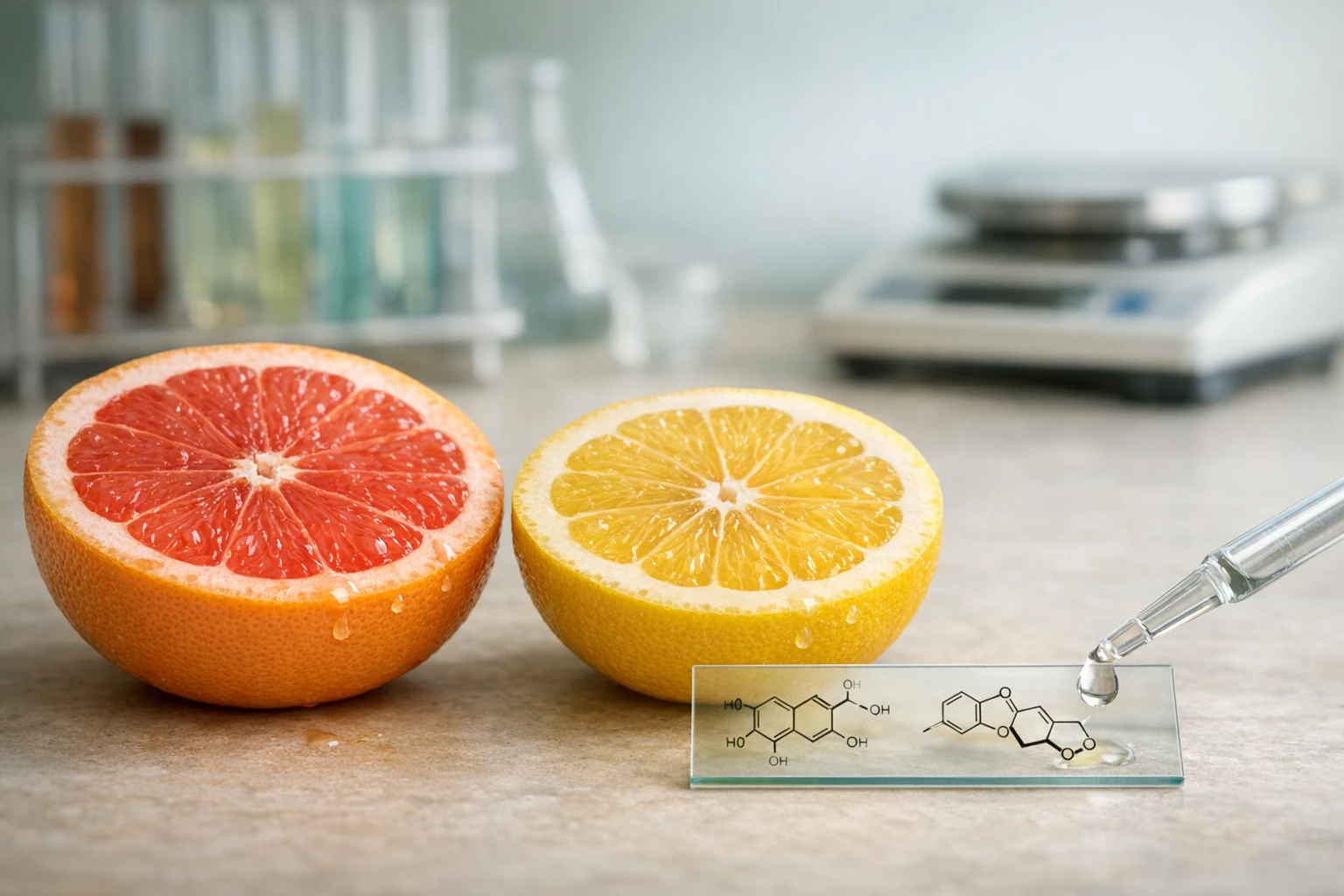
The fruit contains vitamins, fiber, and a range of secondary molecules such as flavonoids (naringenin/naringin) and furanocoumarins (bergamottin and 6',7'-dihydroxybergamottin). Flavonoids are associated with antioxidant properties and modulation of cellular metabolic pathways; naringenin has been studied for effects on oxidative stress, inflammation, and lipid metabolism. These observations mostly come from in vitro and animal studies that describe plausible mechanisms: reduction of free radicals, modulation of enzymes and intracellular signals involved in cell proliferation and the onset of oxidative stress [6]. Preclinical results justify targeted clinical studies, but alone are not proof of human efficacy.
Drug interactions and safety
A consolidated and well-documented aspect in the literature is the ability of grapefruit (and its juice) to modify the bioavailability of numerous drugs through the inhibition or down-regulation of intestinal cytochrome P450 (CYP3A) and interference with uptake transporters. Clinical studies have shown that the juice can increase exposure to drugs like felodipine, leading to an increase in pharmacological effects; the reduction of CYP3A protein in the intestine has been proposed as a mechanism [1]. The initial discovery of the phenomenon dates back to the early 1990s and was subsequently confirmed at the population and mechanistic study level [2]. Specific components of the fruit, such as bergamottin, have been identified as contributors to these interactions [3]. These interactions can have clinical significance and require attention when taking drugs with a narrow therapeutic window.
Antimicrobial properties of seeds: evidence and limitations
Some studies have reported antimicrobial activity of grapefruit seed and pulp extracts. However, chemical analyses have identified the presence of synthetic preservatives (e.g., benzethonium chloride) in many commercial preparations, which may explain a large part of the antibacterial activity found [4]. This means that positive results for commercial products cannot be automatically attributed solely to the natural components of the seed. For internal or therapeutic use, controlled clinical data and products with certified composition are needed.
What it means in practice
For the general public, the practical message is measured and clear: grapefruit is a nutritious food that provides vitamins, fiber, and bioactive compounds with antioxidant activity in the laboratory. This does not justify the use of the fruit as a cancer therapy or as a substitute for medical treatments. Some preparations based on grapefruit components (e.g., bergamottin or naringenin) show antitumor effects in cell and animal models, but such effects have not yet been demonstrated in sufficient human clinical studies to recommend therapeutic use [5][8]. From a nutritional point of view, including grapefruit in a varied and balanced diet can contribute to the intake of antioxidants and fiber; controlled studies, however, report only modest effects on body weight and some metabolic parameters and do not support radical diets based exclusively on the fruit [7]. Finally, those taking medications should consult their doctor or pharmacist before regularly consuming grapefruit or juice: clinically relevant interactions with numerous classes of drugs are documented and can increase the risk of adverse events [1][2][3].
Key takeaways
- Grapefruit contains flavonoids and furanocoumarins with biological activity observed in the laboratory.
- Antitumor and metabolic effects observed in vitro and in animals are promising but do not constitute proof of efficacy in humans.
- Important drug interactions exist: grapefruit can increase the exposure of several drugs metabolized by CYP3A; consult your doctor if you are on chronic therapies.
- Commercial grapefruit seed products may contain synthetic preservatives; quality and composition vary.
Limitations of evidence
It is important to distinguish between types of studies and levels of evidence. Many claims about the properties of grapefruit are based on in vitro (cell) or animal models: these experiments explore mechanisms and potential effects, but do not prove that the same happens in humans. Observational studies in people can suggest associations (e.g., between fruit consumption and metabolic parameters), but cannot establish causal relationships, because they can be influenced by confounders such as overall diet, physical activity, and health status. Clinical evidence on the direct therapeutic use of grapefruit compounds (for example, in the prevention or treatment of cancer) is scarce or absent; available studies are often small, with heterogeneous designs and limited follow-up periods. For drug interactions, however, the literature is more robust: clinical trials and pharmacokinetic studies have shown significant increases in exposure to drugs metabolized by CYP3A after grapefruit juice consumption [1][2][3]. In summary, interpretive caution is needed: biological plausibility does not equate to clinical proof, and benefits observed in the laboratory require confirmation with well-designed clinical studies.
Editorial conclusion
Grapefruit is a food with interesting bioactive components from a biological point of view: the flavonoids and furanocoumarins present in the fruit have shown antioxidant activity and, in experimental models, also antitumor and metabolic effects. However, the translation of these results into practical recommendations is limited by the lack of robust clinical evidence. Conversely, the risk of drug interactions is well-documented and deserves particular attention for those taking chronic medications. For daily use, grapefruit can be part of a balanced diet. For therapeutic purposes or for combinations with drugs, caution and medical consultation are recommended. In terms of research, controlled clinical studies are needed to evaluate doses, forms of administration, and relevant clinical outcomes, taking into account the variability between fruit varieties and extraction methods.
Editorial note (closing)
This version is an editorial update based on peer-reviewed literature. The article is for informational purposes only and does not replace personalized medical advice.
SCIENTIFIC RESEARCH
- Lown KS, Bailey DG, Fontana RJ, Janardan SK, Adair CH, Fortlage LA, Brown MB, Guo W, Watkins PB. Grapefruit juice increases felodipine oral availability in humans by decreasing intestinal CYP3A protein expression. J Clin Invest. 1997;99(10):2545–2553. https://doi.org/10.1172/JCI119439
- Bailey DG, Spence JD, Munoz C, Arnold JM. Interaction of citrus juices with felodipine and nifedipine. Lancet. 1991;337(8736):268–269. https://doi.org/10.1016/0140-6736(91)90872-M
- Goosen TC, Cillie D, Bailey DG, Yu C, He K, Hollenberg PF, Woster PM, Cohen L, Williams JA, Rheeders M, Dijkstra HP. Bergamottin contribution to the grapefruit juice–felodipine interaction and disposition in humans. Clin Pharmacol Ther. 2005; (Clin Pharmacol Ther. 2005). https://doi.org/10.1016/j.clpt.2004.08.019
- Takeoka GR, Dao LT, Wong RY, Lundin RY, Mahoney N. Identification of benzethonium chloride in commercial grapefruit seed extracts. J Agric Food Chem. 2001;49(7):3316–3320. https://doi.org/10.1021/jf010222w
- Vetrichelvan O, Gorjala P, Goodman O Jr, Mitra R. Bergamottin a CYP3A inhibitor found in grapefruit juice inhibits prostate cancer cell growth by downregulating androgen receptor signaling and promoting G0/G1 cell cycle block and apoptosis. PLoS One. 2021;16(9):e0257984. https://doi.org/10.1371/journal.pone.0257984
- Shang S, et al. Combating oxidative stress disorders with the citrus flavonoid naringenin. Life Sci. 2018; (review). https://doi.org/10.1016/j.lfs.2018.07.017
- Fujioka K, et al. The effects of daily consumption of grapefruit on body weight, lipids, and blood pressure in healthy, overweight adults. Metabolism. 2012; (study). https://doi.org/10.1016/j.metabol.2011.12.004
- Park JH, et al. Bergamottin suppresses metastasis of lung cancer cells through abrogation of diverse oncogenic signaling cascades and epithelial-to-mesenchymal transition. Molecules. 2018;23(7):1601. https://doi.org/10.3390/molecules23071601
- Wang X, et al. Naringenin ameliorates vascular senescence and atherosclerosis involving SIRT1 activation. J Pharm Pharmacol. 2023;75(8):1021–1033. https://doi.org/10.1093/jpp/rgad053