Updated and contextualized version of an article originally published on June 22, 2014
The article retains its original focus by presenting it through a scholarly and accessible perspective, supported by verifiable references.
Authors
- Dr. D. Iodice – Biologist
- Roberto Panzironi –Independent researcher
Note editoriali
- First publication: June 22, 2014
- Last update: April 18, 2026
- Version: 2026 narrative revision
Note: This article was previously published and has been updated according to scientific and informative criteria. The text is for informational purposes only and does not replace the advice of your treating physician.
In brief
- Cucumbers contain water, fiber, and plant compounds with antioxidant or anti-inflammatory action; some extracts show biological effects in laboratory and limited clinical studies.
- Silicon is a trace element present in many vegetables and is being studied for its role in the formation of connective tissue and collagen; human evidence is predominantly observational or experimental on cells/animals.
- In complex disorders such as fibromyalgia and chronic fatigue syndrome (CFS/ME), the biological hypothesis includes oxidative stress and low-grade inflammation; antioxidant nutritional interventions may be helpful but the evidence is not definitive.
- Consuming cucumbers as part of a varied diet rich in fruits and vegetables is plausible and safe for most people; there is no evidence that cucumbers alone cure fibromyalgia or CFS/ME.
Abstract: what does science say?
The topic concerns two interconnected statements: 1) cucumbers (Cucumis sativus) contain micronutrients and plant compounds that could help reduce oxidative and inflammatory processes; 2) dietary silicon, present in various vegetables, is involved in the physiology of connective tissue. Experimental evidence shows that cucumber extracts can have antioxidant activity and modulate inflammatory markers in vitro and in some small clinical studies on inflammatory joint conditions [1][2]. On the other hand, the literature on silicon suggests a role in collagen synthesis and bone/tissue health, but most human data is observational or derived from cellular and animal studies [5][6][7][8]. In the context of fibromyalgia and chronic fatigue syndrome, research highlights a complex picture characterized by alterations in energy metabolism, oxidative stress, and low-intensity systemic inflammation; antioxidant interventions have shown promising results in small or pioneering studies, but robust and repeated large-scale evidence is lacking [3][4]. In summary: there are plausible biological bases for a favorable effect of some compounds present in cucumbers, and silicon may be relevant for connective tissue, but there is not enough causal evidence to state that the consumption of cucumbers or silicon supplementation directly and generally improves the symptoms of fibromyalgia or CFS/ME. The conclusions depend on the dose, form of consumption (whole food vs. extract), clinical context, and individual variability.
What are cucumbers and what nutrients do they contain
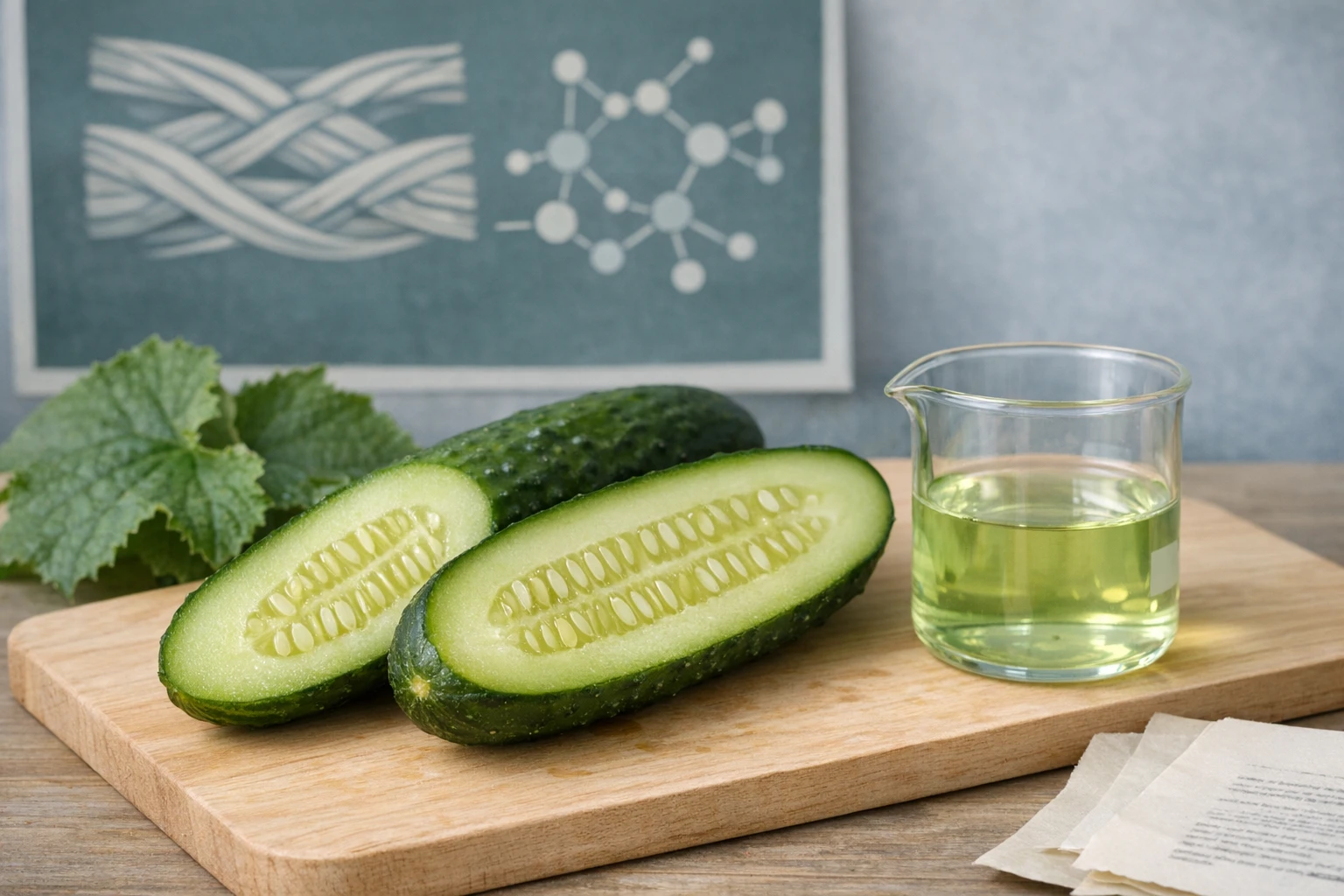
Cucumbers are the edible fruit of the Cucumis sativus plant, consumed raw or as an ingredient in soups and salads. They have a high water content and provide fiber, small amounts of vitamins (including vitamin C and K), and minerals such as potassium and magnesium. In addition, phytochemical research has identified flavonoids and other polyphenols in the peel and seeds, compounds with antioxidant capacity in experimental models. Purified extracts from parts of the cucumber contain molecules (e.g., flavonoids like quercetin in some preparations) that, in vitro, show antioxidant and antibacterial activity; these properties are relevant for hypotheses of modulation of oxidative damage and systemic inflammation, processes involved in various chronic conditions. It is important to distinguish between the consumption of fresh food (which provides moderate amounts of these compounds) and the use of concentrated extracts or supplements (which provide higher doses and for which clinical effects must be proven separately) [1][2].
Plausible biological mechanisms
Antioxidant and anti-inflammatory activity of plant compounds
Polyphenols and some glycoconjugates isolated from cucumber can reduce the production of pro-inflammatory mediators and modulate signaling pathways related to oxidative stress in cellular models. This leads to therapeutic hypotheses that a diet rich in antioxidant plant sources could attenuate the intensity of systemic oxidative stress, a phenomenon observed in patients with fibromyalgia and CFS/ME. Small clinical studies and experiments with plant extracts have recorded variations in inflammatory biomarkers, but the translation into stable and reproducible clinical benefit remains to be demonstrated [1][2][3][4].
Role of silicon in connective tissue formation
Dietary silicon (in the bioactive form as orthosilicic acid and salts) has been studied for its contribution to collagen synthesis, extracellular matrix formation, and bone mineralization in experimental models. In vitro experiments and animal studies show that silicon can stimulate type I collagen production and promote osteoblastic activity; observational studies in humans have found associations between silicon intake and bone health parameters. However, pronounced clinical intervention evidence on musculoskeletal symptoms or chronic pain is limited, so the causal link with clinical improvements in fibromyalgia is not established [5][6][7][8].
Specific clinical evidence for fibromyalgia and chronic fatigue syndrome
In studies exploring nutritional approaches in fibromyalgia and CFS/ME, the focus is often on antioxidants (e.g., CoQ10, alpha-lipoic acid, vitamin D) or overall dietary patterns. Some trials and reviews report improvements in pain, fatigue, or quality of life with antioxidant interventions in small studies or selected subgroups; however, these are preliminary findings that require multicenter confirmation and larger samples. Specifically for cucumbers, most of the available evidence concerns the anti-inflammatory and antioxidant properties of extracts and not robust evidence that food consumption directly improves fibromyalgia or CFS/ME. For this reason, practical recommendations must remain cautious and be part of a personalized clinical pathway [2][3][4].
What it means in practice
For those living with fibromyalgia or chronic fatigue syndrome, practical messages emerge from an overall dietary approach rather than from individual miracle foods. Incorporating cucumbers into a varied diet can contribute to water intake, fiber, and some antioxidant plant compounds, useful in the context of a general strategy aimed at improving nutritional status and reducing potential oxidative stress. There is no evidence to suggest that eating cucumbers alone resolves or replaces medical therapies; however, they appear to be a low-risk, low-calorie food choice, useful for increasing vegetable intake. If considering the use of cucumber or silicon extracts or supplements, it is advisable to discuss this with your doctor or dietitian: the form, dose, and possible drug interactions require professional evaluation. Finally, nutritional strategies that increase the overall intake of antioxidants and promote water balance, sleep, and gradual physical activity are currently more solid as integrated indications for symptom management [1][2][3][4][5][6].
Key points to remember
- Cucumbers contain water, fiber, and plant compounds with antioxidant/anti-inflammatory activity in laboratory studies and some small clinical studies on inflammatory conditions [1][2].
- Dietary silicon has biological bases to support collagen synthesis; however, most human evidence is observational or experimental [5][6][7][8].
- Neither cucumbers nor silicon have strong and generalizable clinical evidence to treat or resolve fibromyalgia or CFS/ME; any intervention should be discussed with a doctor [3][4].
- Preferring a varied diet rich in fruits, vegetables, adequate protein sources, and attention to hydration remains the most reasonable and supported strategy.
Limitations of the evidence
It is essential to distinguish between associations, biological plausibility, observational data, and causal evidence: many claims derive from in vitro studies, animal models, or epidemiological observations that do not establish a causal relationship. Available clinical studies on antioxidants and supplements in fibromyalgia tend to be small, with heterogeneous designs and sometimes unreplicated results. Method, dose, form of administration (whole food vs. concentrated extract), and duration are variables that influence the results. Furthermore, individual variability in patients with fibromyalgia and CFS/ME (comorbidities, ongoing therapy, nutritional status) limits the generalization of conclusions. Caution is needed: preliminary results require confirmation with randomized, controlled, and larger studies [3][4][5][6][7][8].
Editorial conclusion
Research on the properties of cucumbers and the role of silicon offers biologically plausible insights that warrant further study, especially to understand if and how these factors can influence the mechanisms underlying fibromyalgia and chronic fatigue syndrome. For the general public and for people living with these conditions, the most solid practical advice is to adopt a varied diet rich in vegetables, evaluate the use of supplements only in agreement with a doctor, and maintain a multidisciplinary approach to symptom management. Expectations must remain realistic: no single food replaces diagnosis, therapies, or specialized clinical monitoring.
Editorial note
The article has been updated to reflect available scientific literature and maintain institutional and accessible language. The information collected here is for informational purposes only and does not replace medical advice. For personalized indications, consult your reference professional.
Scientific research
- Reference on the anti-inflammatory activity of cucumber extracts: https://doi.org/10.1021/acsomega.0c02092. [Preclinical study on cucumber compounds with inflammation-modulating effect].
- Controlled clinical study on cucumber extract in joint pathology: https://doi.org/10.3390/app13010485. [Trial on extract and inflammatory biomarkers in osteoarthritis, indicative of anti-inflammatory activity].
- Observational/intervention study on a polyphenol-rich diet and fibromyalgia: https://doi.org/10.1024/0300-9831/a000253. [Associations between antioxidant intake and symptoms in fibromyalgia].
- Critical review on antioxidants in fibromyalgia (Coenzyme Q10 and others): https://doi.org/10.3390/antiox11101969. [Review on antioxidant interventions, preliminary but not conclusive results].
- Experimental study on the role of silicon in stimulating collagen synthesis in osteoblastic cells: https://doi.org/10.1007/s12011-016-0686-3. [Cellular mechanisms linking silicon and collagen].
- Review on sources, bioavailability, and safety of dietary silicon: https://doi.org/10.3390/app10186255. [Overview of food sources and bioavailable forms].
- Study on dietary silicon intake in human populations (observational data): https://doi.org/10.1079/BJN20051548. [Evaluations of dietary intake and relationships with bone parameters].
- Reference values for serum silicon and technical discussion: https://doi.org/10.1016/j.ab.2004.10.034. [Analytical methodologies and reference ranges in blood].