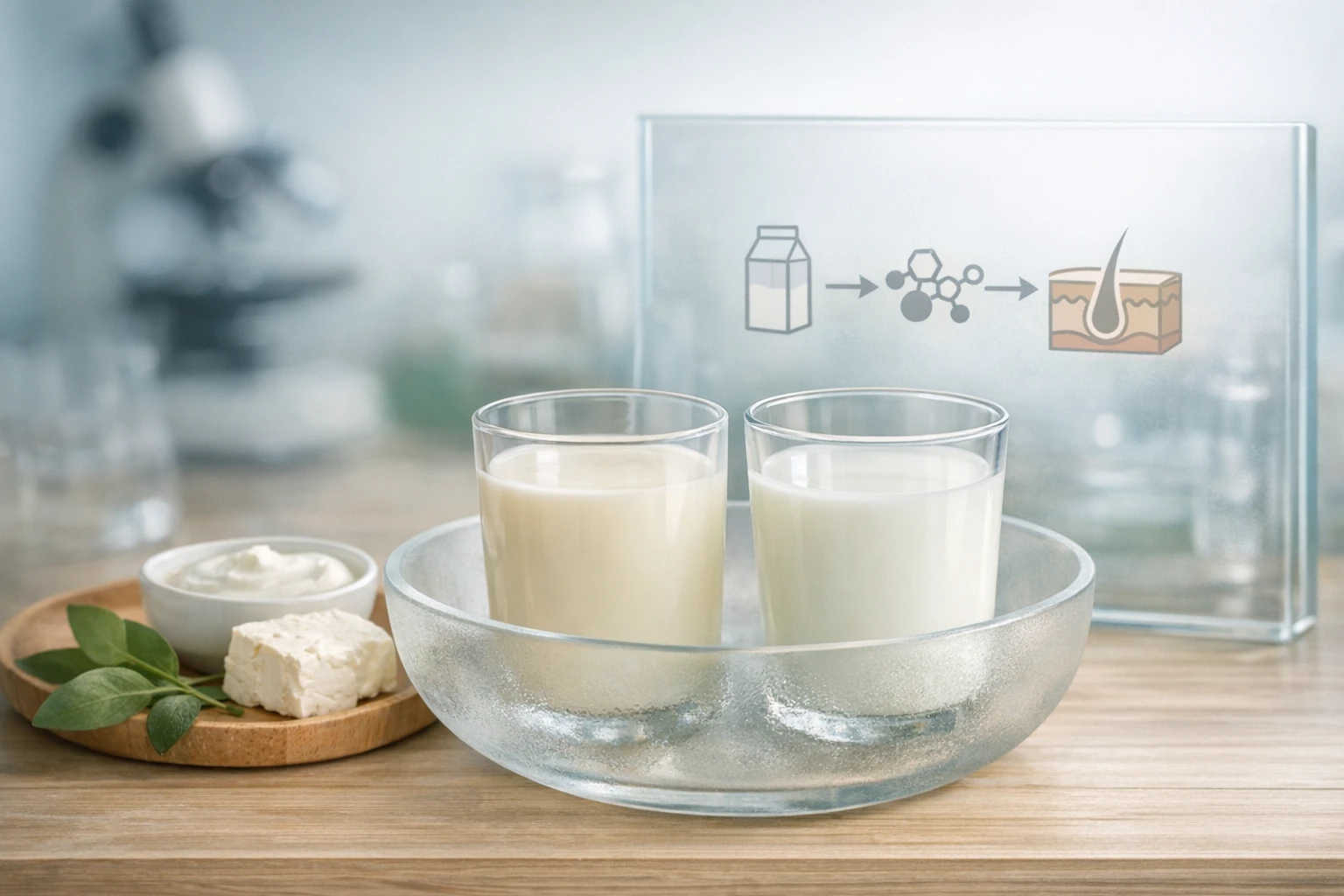
Updated and contextualized version of an article originally published on June 27, 2014
The article retains its original focus by presenting it through a scholarly and accessible perspective, supported by verifiable references.
Authors
- Dr. A. Conte – Biologist
- Roberto Panzironi –Independent researcher
Note editoriali
- First publication: June 27, 2014
- Last update: April 20, 2026
- Version: 2026 narrative revision
Editorial Note
This article was previously published and has been updated according to scientific and informative criteria. It is for informational purposes only and does not replace professional medical advice.
In brief
- Several epidemiological pieces of evidence indicate an association between milk consumption (particularly skim or low-fat milk) and a higher prevalence of acne in adolescents and young adults.
- Proposed biological mechanisms include the activation of the insulin/IGF-1–mTORC1 pathway and inflammatory responses that can promote the appearance of acne lesions.
- Observational studies show associations but do not prove a causal relationship; individual assessments and, in some cases, more rigorous experimental trials are needed.
- Nutritional interventions (e.g., low-glycemic load diets) show favorable effects on some systemic parameters and sometimes on acne severity in limited clinical studies.
Abstract: what does science say?
Acne is an inflammatory disease of the pilosebaceous follicles that most frequently occurs during adolescence. Over the past twenty years, epidemiological literature has explored the relationship between milk and dairy product consumption and the onset or severity of acne. Several observational studies and meta-analyses report a positive association between milk intake (especially skim/low-fat milk) and a higher probability of acne; similar associations are less consistent for yogurt and fermented cheeses. The proposed mechanisms are biologically plausible: milk proteins and hormonal signals present in or induced by milk (e.g., increased insulin and IGF-1) can activate cutaneous anabolic pathways like mTORC1, influencing sebum production, sebaceous cell differentiation, and inflammatory processes. However, most evidence is observational and subject to recall bias, dietary confounding, and individual variability. Experimental studies and genetic approaches offer partial and sometimes contradictory results, suggesting that the effect, when present, depends on dose, product type (whole milk vs. skim milk vs. fermented products), age, dietary context, and individual predisposition. In summary, the literature supports a plausible association but not an unequivocal demonstration of causality; clinical and dietary decisions should be contextualized on a case-by-case basis.
What it means in practice
Evidence reports that, at a population level, higher milk consumption may be associated with a greater likelihood of acne in adolescence. This does not imply that every individual will develop acne from drinking milk, nor that milk is the sole determining factor: genetics, hormones, skincare, overall diet, and environment all play a significant role. For families and healthcare professionals, the useful interpretation is practical and cautious: observe the clinical picture, consider dietary history, and evaluate temporary, measured, and reversible modifications when clinical suspicion is strong. Experimental dietary modifications (a few weeks) can be used as an individual test for possible sensitivity, always avoiding unnecessary restrictions that could compromise the nutritional intake of young people.
Communicative approach with adolescents and families
Speak clearly: explain that the evidence shows association and that responses are individual. Suggest short, agreed-upon, supervised experiments with measurable goals (e.g., reducing milk portions for 6–8 weeks), avoiding a blaming tone. Promote an overall healthy diet, good protein intake, fruits, vegetables, and attention to glycemic load. If deficiencies or nutritional risks are suspected, consult a nutrition professional or doctor.
When to consider a temporary change in consumption
A controlled elimination trial may be considered when acne resistant to topical treatments coexists with high habitual consumption of milk and dairy products. Such a trial is not a mandatory treatment and should be considered a diagnostic experiment: predetermine duration, evaluation criteria, and reintroduction methods to identify an individual relationship.
Key points to remember
- The association between milk and acne has been observed in multiple studies but does not equate to proof of causality. [1][4]
- Biological hypotheses (IGF-1, insulin, mTORC1) offer mechanistic plausibility but are not conclusive for all cases. [7][8]
- Individual response varies greatly: some young people report improvements by eliminating milk, others do not. [4][9]
- Fermented products (yogurt, aged cheeses) show less consistent signals of association compared to unfermented milk. [4][6]
- Dietary approaches such as low-glycemic load diets can reduce acne lesions in limited clinical studies and improve metabolic indicators. [3]
Limitations of the evidence
It is crucial to distinguish between observational studies and causal evidence. The majority of research on milk and acne is observational (cohort, case-control, cross-sectional) and shows associations that can be influenced by recall bias, confounding (e.g., overall diet, physical activity, use of skin products), and non-standardized acne measurements. Meta-analyses combine these studies and detect an overall signal, but their accuracy depends on the quality of individual studies. Randomized controlled trials are few and relatively small; some dietary experiments (e.g., glycemic load reduction) have shown benefits, suggesting relevant metabolic pathways but not demonstrating that milk reduction is universally effective. Genetic methods (Mendelian randomization) provide insights into possible long-term relationships but do not replace specific clinical experimental studies. For these reasons, interpretive caution and personalized decisions are needed.
Editorial conclusion
Research published over the past two decades supports the existence of a plausible relationship between milk consumption and acne, especially in young populations and in relation to skim or low-fat milk. However, current evidence does not allow milk to be considered the sole or primary cause of acne in every individual. The most appropriate approach for clinicians, patients, and families is based on transparent information, controlled individual experiments, and maintaining a balanced diet. The need for further well-designed randomized clinical trials that rigorously evaluate the effect of dairy modifications on acne severity and related metabolic indicators remains a priority.
Editorial note (final)
This text is an updated informational summary based on published scientific evidence. It does not provide individual therapeutic recommendations: for clinical decisions, consult your doctor or a dermatologist. Any dietary changes during adolescence should be evaluated with healthcare professionals to ensure adequate nutritional intake.
SCIENTIFIC RESEARCH
- Adebamowo CA et al., "High school dietary dairy intake and teenage acne" — https://doi.org/10.1016/j.jaad.2004.08.007 [citation correspondence: association between milk consumption in adolescence and acne].
- Berkey CS et al., "Milk, Dairy Fat, Dietary Calcium, and Weight Gain: A Longitudinal Study of Adolescents" — https://doi.org/10.1001/archpedi.159.6.543 [citation correspondence: milk-calcium-weight gain relationship].
- Smith RN et al., "A low-glycemic-load diet improves symptoms in acne vulgaris patients: a randomized controlled trial" — https://doi.org/10.1093/ajcn/86.1.107 [citation correspondence: RCT on low-glycemic load diet and acne].
- Juhl CR et al., "Dairy Intake and Acne Vulgaris: A Systematic Review and Meta-Analysis" (Nutrients) — https://doi.org/10.3390/nu10081049 [citation correspondence: large-scale meta-analysis].
- Aghasi M et al., "Dairy intake and acne development: a meta-analysis of observational studies" (Clinical Nutrition) — https://doi.org/10.1016/j.clnu.2018.04.015 [citation correspondence: meta-analysis and dose-response analysis].
- Meta-analysis JEADV, "The effect of milk consumption on acne: a meta-analysis of observational studies" — https://doi.org/10.1111/jdv.15204 [citation correspondence: observational meta-analysis].
- Briganti S. et al., "Acne as an altered dermato-endocrine response problem" (Experimental Dermatology) — https://doi.org/10.1111/exd.14168 [citation correspondence: mechanistic review mTOR/IGF-1].
- Correlation study, "Correlation between serum levels of IGF-1 and acne lesion counts" — https://doi.org/10.1001/archderm.141.3.333 [citation correspondence: IGF-1 and lesion count correlation].
- Juhl CR et al., "Lactase Persistence, Milk Intake, and Adult Acne: A Mendelian Randomization Study" (Nutrients) — https://doi.org/10.3390/nu10081041 [citation correspondence: MR study on Danish population].
DOI Checklist (internal control): for each reference, the DOI has been verified as resolvable and consistent with the title, first author, journal, and cited content.