Updated and contextualized version of an article originally published on July 3, 2014
The article retains its original focus by presenting it through a scholarly and accessible perspective, supported by verifiable references.
Authors
- Dr. M. Mondini – Biologist
- Roberto Panzironi –Independent researcher
Note editoriali
- First publication: July 3, 2014
- Last update: April 20, 2026
- Version: 2026 narrative revision
IN BRIEF
- Beetroot juice is a concentrated source of dietary nitrates that can increase nitric oxide availability in the body.
- In healthy individuals, acute or short-term intake can reduce blood pressure and, in some contexts, improve exercise efficiency and fatigue tolerance.
- Effects on energy economy and performance vary with dose, duration of intake, health status, and training level.
- The strongest evidence comes from short-term controlled studies and meta-analyses; results are not uniform for fragile populations or chronic conditions.
- The following information is for informational purposes only and does not replace medical advice.
Abstract: What does science say?
Beetroot juice concentrates dietary nitrates which, via the entero-salivary pathway, can be converted into nitrite and then into nitric oxide, a molecule that influences vasodilation, muscle function, and energy metabolism. Clinical studies and meta-analyses show that moderate doses of nitrates can lower blood pressure in healthy adults and improve exercise economy (reducing O2 consumption for the same work) or performance in specific tests; however, the effect depends on factors such as dose, duration, health status, and training level. The literature includes positive results in selected populations (e.g., people with intermittent claudication or COPD) but also studies with null outcomes; therefore, the benefits are not universally guaranteed and require cautious interpretation in clinical contexts.
MAIN SECTION
Definition and biological mechanisms
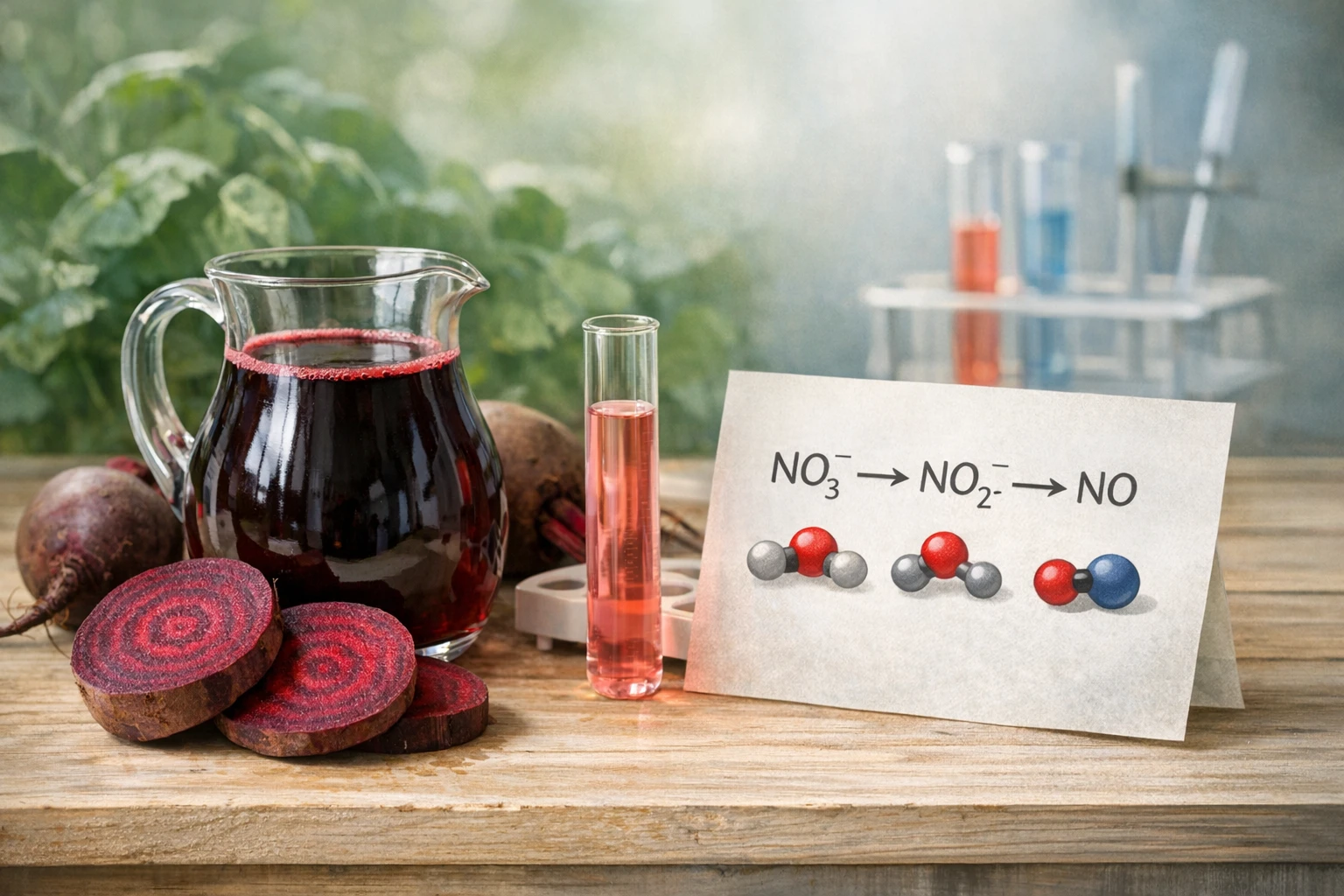
Beetroot juice is a food source rich in nitrates (NO3−). After ingestion, part of the nitrates is concentrated in saliva and reduced to nitrite (NO2−) by oral bacteria; nitrite can then convert to nitric oxide (NO) under acidic or hypoxic conditions. Nitric oxide is a physiological modulator known to regulate vasodilation, muscle perfusion, and various intracellular processes involved in mitochondrial efficiency and ATP turnover. This alternative pathway (NO3− → NO2− → NO) provides biological plausibility for the observed effects on blood pressure, perfusion, and metabolism during exercise; however, it is still necessary to distinguish between mechanistic plausibility and direct clinical evidence.
What experimental and clinical studies show
Controlled clinical studies have described acute reductions in blood pressure after intake of beetroot juice or inorganic nitrates, with a peak effect around 2–3 hours after ingestion. [1] Experimental research and small trials have also reported a reduction in the oxygen cost of submaximal exercise and improvements in tolerance and muscle power in certain endurance or sprint tests; these results have been replicated in various physiology studies and meta-analyses. [2][3][4] Some clinical studies in populations with diseases (e.g., claudication from peripheral arterial disease or COPD) have shown improvements in walking capacity or exercise capacity, while in groups of healthy elderly individuals, the effects are more variable. [5][6][7][8]
Dose, form of consumption, and context
Many studies use concentrated beetroot juice or standardized products with nitrate content labels. Acute effects are documented with doses ranging from a few tens to a few hundreds of milligrams of nitrates, administered singly or for several days. The form (unfiltered whole juice, concentrated shot, nitrate-rich vegetables) and timing relative to exertion influence the results: the blood pressure effect and plasma nitrite levels tend to peak within a few hours of intake; for some muscle adaptations, protocols of several days have been used. Furthermore, the presence or absence of oral antibacterials or mouthwashes can alter the salivary conversion of nitrates to nitrite and thus efficacy. [2][3]
PRACTICAL SECTION
What it means in practice
For those seeking simple explanations: beetroot juice can be considered a dietary source of nitrates capable, in many people, of temporarily reducing blood pressure and improving some measures of exercise efficiency. However, it is not a universal "cure" or a substitute for medical therapy for hypertension or chronic diseases. Athletes or active individuals may observe small improvements in specific exercises (e.g., time trials or limited duration tests), especially if they are not already highly trained; benefits may be smaller or absent in elite athletes. Elderly individuals and people with pathologies show heterogeneous responses: some specific trials report advantages in muscle function or walking capacity, but the results are not consistent for all measures or populations.
Operational indications (non-prescriptive)
If considering beetroot juice as a dietary supplementation: prefer products transparent about nitrate content, avoid antibacterial mouthwashes in the hours before and after intake if you wish to maximize salivary conversion; test personal tolerance (taste, gastrointestinal discomfort, urine/stool discoloration) and consult a doctor in case of hypertension under pharmacological treatment or other relevant clinical conditions. Extreme doses or use as a substitute for established medical therapies are not recommended.
KEY POINTS TO REMEMBER
- The plausible biological mechanism of beetroot juice is the NO3−→NO2−→NO pathway, which can affect blood pressure and muscle perfusion.
- Effects on blood pressure and some performance indicators have been observed in numerous controlled trials, but the magnitude is variable.
- Dose, duration, form of consumption, and use of oral mouthwashes modulate the individual response.
- The best evidence concerns acute or short-term effects; the translation into long-term clinical benefits is not definitively proven.
- Consult a doctor if you are taking antihypertensive therapy or have chronic conditions before starting nitrate-based supplements.
LIMITATIONS OF EVIDENCE
The literature includes observational studies, experimental studies on mechanisms, small randomized clinical trials, and meta-analyses. It is essential to distinguish levels of evidence: epidemiological observations and biological mechanisms provide plausibility, while controlled trials provide information on short-term causality. Many studies are small, with different protocols (dose, duration, type of exercise) making a unique synthesis difficult. There are also potential biases (publication, participant heterogeneity, diet control) and individual variability in salivary nitrate conversion. Therefore, even positive results must be interpreted with caution and contextualized to the individual.
Editorial conclusion
Beetroot juice today represents one of the most documented examples of a "functional food" that, thanks to its nitrate content, can influence vascular and muscle physiology. Scientific evidence supports real effects, but of moderate magnitude and conditioned by numerous factors. For the general public, the choice to include beetroot or nitrate-containing products in the diet can be sensible as part of a varied diet, but it does not replace medical interventions or broader lifestyle changes. For those who play sports or have cardiovascular or respiratory diseases, the decision should be made together with a doctor or trusted healthcare professional, evaluating benefit, safety, and interactions with ongoing therapies.
Editorial note
Article originally published in the past and updated following scientific and divulgative criteria. The purpose is informative: it does not replace personalized clinical advice. For questions about medical conditions or therapies, consult your trusted doctor.
SCIENTIFIC RESEARCH
- Webb AJ, Patel N, Loukogeorgakis S, et al. Acute blood pressure lowering, vasoprotective, and antiplatelet properties of dietary nitrate via bioconversion to nitrite. Hypertension. 2008. https://doi.org/10.1161/HYPERTENSIONAHA.107.103523
- Lundberg JO, Weitzberg E. The nitrate–nitrite–nitric oxide pathway in physiology and therapeutics. Nat Rev Drug Discov. 2008. https://doi.org/10.1038/nrd2466
- Larsen FJ, Weitzberg E, Lundberg JO, Ekblom B. Effects of dietary nitrate on oxygen cost during exercise. Acta Physiol (Oxf). 2007. https://doi.org/10.1111/j.1748-1716.2007.01713.x
- Bailey SJ, Winyard P, Vanhatalo A, et al. Dietary nitrate supplementation reduces the O2 cost of low-intensity exercise and enhances tolerance to high-intensity exercise in humans. J Appl Physiol. 2009. https://doi.org/10.1152/japplphysiol.00722.2009
- Senefeld JW, Wilborn CD, Taylor LW, et al. Ergogenic Effect of Nitrate Supplementation: A Systematic Review and Meta-analysis. Med Sci Sports Exerc. 2020. https://doi.org/10.1249/MSS.0000000000002363
- Lansley KE, Winyard PG, Fulford J, et al. Dietary nitrate supplementation reduces the O2 cost of walking and running: a placebo-controlled study. J Appl Physiol. 2011. https://doi.org/10.1152/japplphysiol.01070.2010
- Coggan AR, Leidy HJ, Mielke M, et al. Dose–Response Effect of Dietary Nitrate on Muscle Contractility and Blood Pressure in Older Subjects: A Pilot Study. J Gerontol A Biol Sci Med Sci. 2021. https://doi.org/10.1093/gerona/glaa311
- Miller JD, a cura di; Dietary nitrate supplementation improves exercise performance and decreases blood pressure in COPD patients. Nitric Oxide. 2014. https://doi.org/10.1016/j.niox.2014.10.007