Updated and contextualized version of an article originally published on July 12, 2014
The article retains its original focus by presenting it through a scholarly and accessible perspective, supported by verifiable references.
Authors
- Dr. M. Bitonti – Biologist
- Roberto Panzironi –Independent researcher
Note editoriali
- First publication: July 12, 2014
- Last update: April 20, 2026
- Version: 2026 narrative revision
IN BRIEF
- Coriander (Coriandrum sativum) contains phenols and terpenes with documented antioxidant activity in many laboratory studies.
- Extracts and essential oil show in vitro antimicrobial activity and protective effects in animal models of oxidative and metabolic damage.
- Animal research indicates that coriander extracts can attenuate damage induced by lead or methylmercury, but clinical evidence in humans is insufficient to support 'detoxification' claims.
- Biological properties depend on the plant part (leaves, seeds, oil), extraction method, dose, and experimental context.
- For food use, coriander can contribute to an intake of antioxidant compounds; for medical treatments or chelation, it is necessary to consult professionals and rely on clinical evidence.
Abstract: what does science say?
Coriander (Coriandrum sativum) is a plant used as food and in traditional medicine. In vitro and animal model studies show that extracts of leaves, seeds, and essential oil contain phenolic and terpenic compounds (e.g., linalool) that exert antioxidant activity, antimicrobial properties, and metabolic modulation. In animals, some preparations attenuate oxidative stress, improve metabolic parameters, and reduce brain damage associated with exposure to metals like lead or methylmercury. However, most evidence comes from laboratory experiments or animal models; robust clinical evidence in humans confirming pharmacological efficacy or that dietary consumption produces metal "cleansing" effects is lacking. The observed effects depend heavily on the form (fresh leaves, aqueous or ethanolic extracts, essential oil), doses, and duration of exposure. For this reason, claims about systemic detoxification must be interpreted with caution and placed in the context of available experimental evidence.
Main section
Chemical composition and main classes of compounds
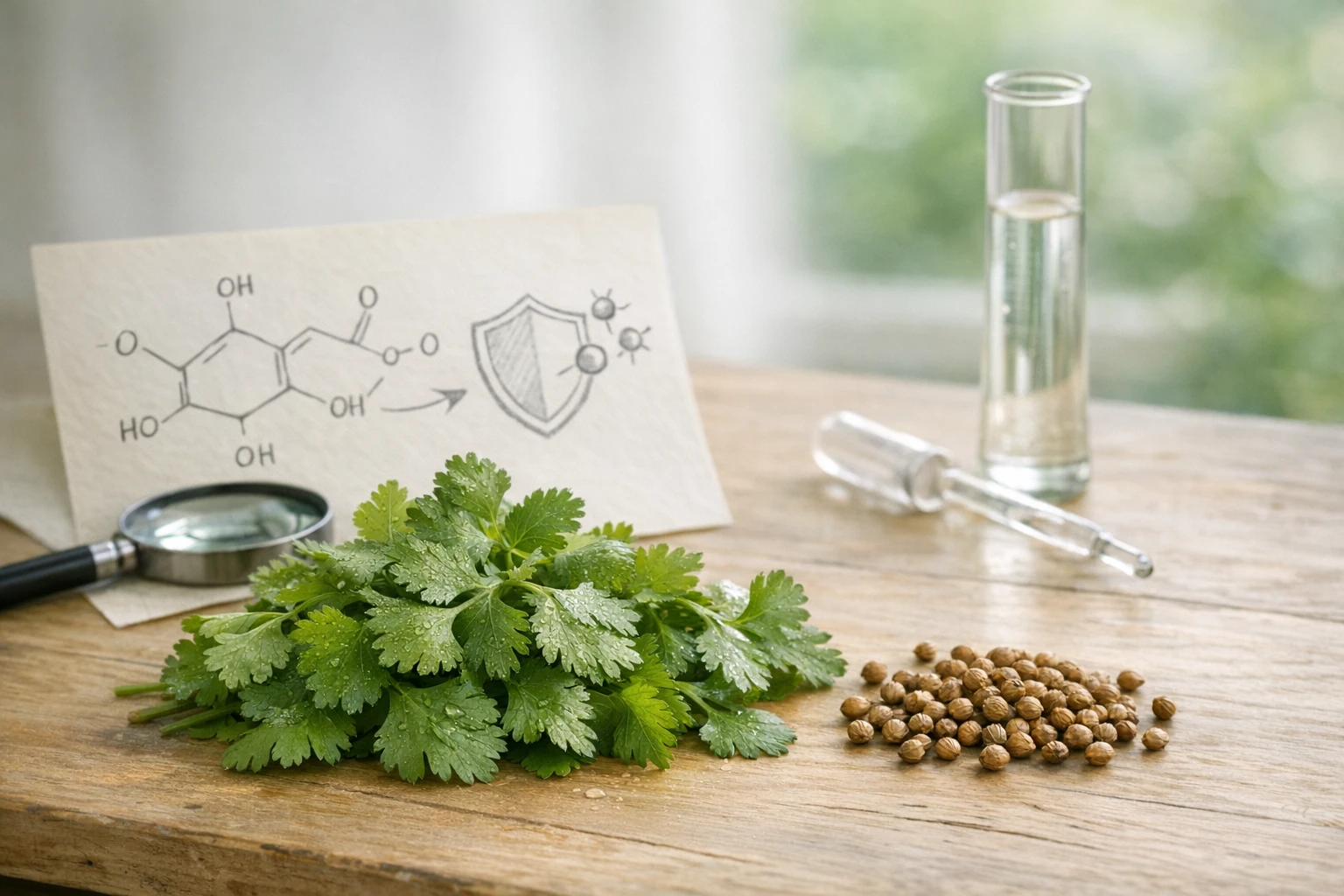
Coriander contains a range of secondary metabolites: phenolic compounds (phenolic acids, flavonoids), essential oils rich in monoterpenes (including linalool), and polysaccharides. Chemical analyses of aqueous and organic extracts show that leaves tend to contain more total phenols than seeds, while seeds are an important source of essential oil with a high percentage of linalool. These chemical elements explain, at least in part, the activity in in vitro antioxidant tests and some biological properties observed in experimental models. [1] [2]
Antioxidant activity and plausible mechanisms
Standard in vitro assays (DPPH, ABTS, lipid peroxidation inhibition) show that coriander extracts can neutralize free radicals and limit lipid oxidation. The results correlate with the total phenolic content; compounds like phenolic acids and flavonoids are considered responsible for the antioxidant activity. Such activities may explain the protective effects observed in animal tissues exposed to oxidative stress (e.g., in kidney, liver, and brain). [1] [2]
Antimicrobial activity and effects of essential oil
The essential oil and some extracts have shown antimicrobial activity against various laboratory microorganisms; studies indicate in vitro efficacy against Candida fungi and foodborne pathogenic bacteria like Campylobacter. These results are interesting for food applications or as a source of natural antimicrobial compounds, but translation to clinical uses requires specific trials. [3] [4]
PRACTICAL SECTION
What it means in practice
For the public, this means that including coriander in the diet provides antioxidant and aromatic compounds that can contribute to the nutritional quality of a meal. Studies suggest possible benefits on metabolism, inflammation, and oxidative stress, especially in well-defined experimental conditions; however, these effects depend on the form of consumption (fresh leaves, seeds, concentrated extracts, oil) and the dose. Evidence of efficacy in animal models does not equate to clinical evidence in humans: there are currently no medical recommendations based on RCTs that support the use of coriander as a therapy to remove heavy metals or treat metabolic diseases. Anyone considering the use of concentrated extracts for therapeutic purposes should consult a healthcare professional. [5] [6] [7]
Consumption methods and safety
Culinary use of coriander (fresh leaves or seeds as a spice) is generally considered safe in healthy populations. Essential oils and concentrated extracts have a different safety profile: they can cause allergic reactions, drug interactions, or toxic effects at high doses. Furthermore, chemical composition varies with variety, cultivation method, and extraction; therefore, effects observed in the laboratory are not automatically replicable using common food products. [1] [8]
KEY POINTS TO REMEMBER
- Coriander contains phenols and terpenes with well-documented antioxidant activity in vitro. [1] [2]
- Extracts and oil may have antimicrobial activity in the laboratory; practical application requires further study. [3] [4]
- In animal models, some extracts attenuate damage from lead or methylmercury; these results do not prove systemic chelation efficacy in humans. [6] [7]
- Favorable metabolic effects (e.g., on hepatic lipid accumulation or glycemic parameters) have been observed in animal models; human RCTs are needed to confirm clinical relevance. [5] [8]
- Form, dose, and context are determining factors for the biological effect; food use and therapeutic use are different categories.
LIMITATIONS OF EVIDENCE
The literature on Coriandrum sativum is extensive but predominantly consists of in vitro and animal studies. Observational or experimental studies in animal models can show biological associations and plausible mechanisms (antioxidation, enzymatic modulation, reduction of inflammatory markers), but they do not automatically demonstrate causality in humans. Many experiments use concentrated extracts or protocols not comparable to normal culinary use; dosage, administration route, and duration vary greatly among studies. Methodological quality is heterogeneous: some works are well-controlled, others have design limitations, sample size, or do not clarify the chemical composition of the extract used. Furthermore, for claims about the 'removal' of heavy metals, most robust evidence concerns removal from aqueous solutions or mitigation of tissue damage in animal models, not clinical evidence of systemic chelation in humans. Interpreting the evidence requires caution and a clear distinction between biological plausibility and clinical proof.
Editorial conclusion
Coriander is a plant with a chemical profile rich in active compounds that justify scientific interest in its antioxidant, antimicrobial, and metabolic potential. Experimental evidence suggests possible applications but does not support absolute claims of systemic 'detoxification' in humans. For the consumer, coriander remains a useful food to enrich the diet; for therapeutic applications or chelation interventions, controlled clinical studies are needed. Public communication must maintain clarity on the level of evidence and encourage consultation with qualified professionals when considering concentrated products or alternative treatments.
EDITORIAL NOTE
This article was originally published in the past and updated according to scientific and divulgative criteria to reflect current academic literature. It is for informational purposes only and does not replace medical advice. For clinical or therapeutic decisions, consult a healthcare professional.
SCIENTIFIC RESEARCH
- Wangensteen H, Samuelsen AB, Malterud KE. Antioxidant activity in extracts from coriander. Food Chemistry. 2004;88(2):293-297. https://doi.org/10.1016/j.foodchem.2004.01.047
- Melo EA de A, Mancini Filho J, Guerra NB. Characterization of antioxidant compounds in aqueous coriander extract (Coriandrum sativum L.). LWT - Food Science and Technology. 2004; (LWT). https://doi.org/10.1016/j.lwt.2004.03.011
- Oliveira ALO et al. Coriandrum sativum L. essential oil: antifungal activity and mode of action on Candida spp. PLoS ONE. 2014. https://doi.org/10.1371/journal.pone.0099086
- Yoneyama Y et al. Potential of Coriander (Coriandrum sativum) Oil as a Natural Antimicrobial Compound in Controlling Campylobacter jejuni in Raw Meat. Bioscience, Biotechnology, and Biochemistry. 2010;74(1):31–35. https://doi.org/10.1271/bbb.90409
- Gray AM, Flatt PR. Insulin-releasing and insulin-like activity of the traditional anti-diabetic plant Coriandrum sativum (coriander). British Journal of Nutrition. 1999;81(3):203–209. https://doi.org/10.1017/S0007114599000392
- Hydroalcoholic seed extract of Coriandrum sativum (Coriander) alleviates lead-induced oxidative stress in different regions of rat brain. Biological Trace Element Research. 2014. https://doi.org/10.1007/s12011-014-9989-4
- Rodrigues KE et al. Aqueous Coriandrum sativum L. extract promotes neuroprotection against motor changes and oxidative damage in rat progeny after maternal exposure to methylmercury. Food and Chemical Toxicology. 2019;133:110755. https://doi.org/10.1016/j.fct.2019.110755
- Gu M.J., et al. Coriandrum sativum L. Leaf Extract Ameliorates Metabolic Dysfunction-Associated Steatotic Liver Disease by Modulating the AMPK Pathway in High Fat-Fed C57BL/6 Mice. Nutrients. 2024;16(23):4165. https://doi.org/10.3390/nu16234165
- Olusola O. et al. Sensitivity of Coriandrum sativum extract on bacterial pathogens isolated from digestive system of rabbits, and its role on in vitro cecal gas production and fermentation. Microbial Pathogenesis. 2018. https://doi.org/10.1016/j.micpath.2018.06.020
- Jin W. et al. Isolation, In Vitro Antioxidant Capacity, Hypoglycemic Activity and Immunoactivity Evaluation of Polysaccharides from Coriandrum sativum L. Antioxidants. 2025;14(2):149. https://doi.org/10.3390/antiox14020149