Updated and contextualized version of an article originally published on July 12, 2014
The article retains its original focus by presenting it through a scholarly and accessible perspective, supported by verifiable references.
Authors
- Dr. A. Colonnese – Nutrition biologist
- Roberto Panzironi –Independent researcher
Note editoriali
- First publication: July 12, 2014
- Last update: April 20, 2026
- Version: 2026 narrative revision
Michigan Medical School: Research Shows Ginger's Efficacy Against Colon Cancer
IN BRIEF
- Pilot clinical studies suggest that ginger extracts can modify certain biological markers linked to inflammation and colonic tissue proliferation.
- Human results are preliminary: effects on PGE2, some proliferation markers, and enzymatic proteins have been observed in small controlled trials.
- Biological plausibility is supported by preclinical data (cells and animal models) on gingerols and shogaols, but the translation to cancer risk reduction is not proven.
- The evidence does not authorize therapeutic recommendations: larger, longer studies with definitive clinical endpoints are needed.
Abstract: What does science say?
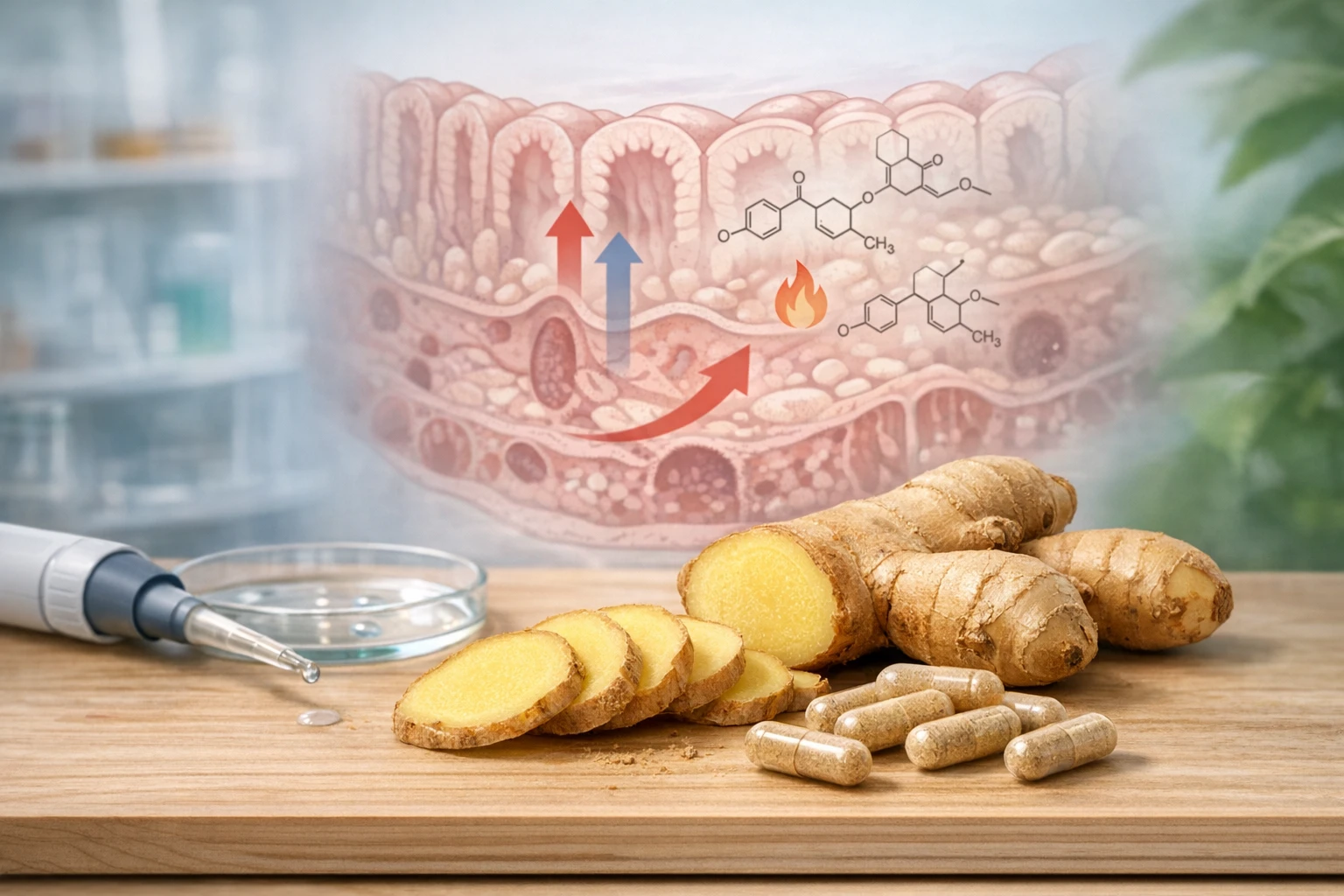
Ginger (Zingiber officinale) is a spice widely studied for its anti-inflammatory and antioxidant properties. Experimental studies indicate that components such as gingerols and shogaols act on pathways involved in inflammation, apoptosis, and cell proliferation, processes relevant in the genesis of colorectal carcinoma. Small randomized controlled clinical studies have evaluated standardized ginger supplements (typically 2 g/day for 28 days) by measuring tissue or metabolic markers (e.g., prostaglandins, proliferation signals, enzymatic expression). Some markers were found to be reduced in subgroups, while others showed no consistent changes. Overall, human evidence is limited by small numbers, short durations, and intermediate endpoints; biological plausibility is good, but proof that ginger reduces the risk of colorectal cancer in humans is not established. Therefore, ginger remains a promising candidate for further trials, not a consolidated therapy or preventive measure.
What is ginger and its active components?
Ginger root contains a mixture of non-volatile and volatile compounds; among the main ones are gingerols (6-, 8-, 10-gingerol) and shogaols, substances responsible for the pungent taste and many biological activities. These phytocompounds show in vitro anti-inflammatory properties (inhibition of COX/LOX and modulation of NF-κB), pro-apoptotic effects, and the ability to interfere with cell growth pathways. In animal models, ginger formulations have reduced the incidence and multiplicity of experimentally induced adenomas, providing strong mechanistic plausibility for the prevention of colonic damage. However, concentrations, bioavailability, and metabolites produced in humans differ from experimental models, requiring caution in interpretation.
What short-term clinical evidence shows
Small controlled studies in healthy adults or those at increased risk (typical samples: 20–30 participants) administered 2 g/day of ginger extract for approximately 28 days and evaluated tissue markers via rectal or colonic mucosal biopsies. Some measures, such as the percentage change in PGE2 or proliferation/apoptosis markers, were found to be modified in certain subgroups; other eicosanoids or proteins showed no consistent changes. These outcomes are intermediate indicators and do not directly measure clinical events (polyps or cancer). The studies highlight tolerability and absence of severe short-term toxicity but do not allow definitive conclusions on preventive efficacy.
What this means in practice
For readers: the data suggest that controlled intake of ginger extracts can influence certain biological pathways associated with inflammation and proliferation in the colorectal mucosa. However, this modification of biomarkers is not equivalent to a demonstration that ginger actually prevents colon cancer. The relevant clinical studies are small, short-term, and use intermediate endpoints, so the evidence remains exploratory. If a person consumes ginger in their diet (cooking, herbal teas, small amounts), there are no strong indications that this poses a risk; at the same time, it is not correct to consider ginger as a proven measure of cancer prevention. Anyone taking anticoagulants, antiplatelet drugs, or with relevant medical conditions should discuss this with their doctor before starting high-dose supplements, given the possible antiplatelet effect of some preparations.
In the clinical and public health context, the priority remains adherence to recommended screenings (e.g., colonoscopy, fecal test when indicated), a balanced diet, and lifestyles with proven preventive effects. Ginger can be the subject of controlled experimentation as a candidate agent, but it should not replace established diagnostic or therapeutic measures.
[Key evidence: reduction of PGE2 in pilot clinical trials; results on cell proliferation in small controlled studies; short-term tolerability]. [1][2][3][9]
Safety, doses, and available forms
The cited clinical trials typically used 2 g/day of standardized extract for 28–30 days; this choice stems from pharmacokinetic studies and previous pilot trials. In the short term, supplementation was generally well tolerated, with mild adverse events (gastrointestinal disturbances, unpleasant taste). However, high doses or combinations with medications (anticoagulants, antiplatelet agents, some antidiabetics) require caution. Product quality and standardization of gingerol/shogaol content vary among commercial preparations, affecting bioavailability and biological effect; therefore, results from a specific trial are not automatically transferable to any supplement available on the market. [1][3][5]
KEY POINTS TO REMEMBER
- Pilot clinical studies exist that show changes in colonic biomarkers after supplementation with ginger extract, but these are intermediate endpoints, not demonstrated reductions in tumors or polyps. [1][2]
- Biological plausibility is supported by in vitro and animal data: gingerols and shogaols modulate inflammation, proliferation, and apoptosis. [7][8][6]
- Human results are not consistent and depend on dose, duration, studied population, and measurement method. [3][4]
- Short-term supplementation is generally well tolerated; caution with drugs that modulate coagulation. [1][3]
- Future research must include larger, longer trials with clinical endpoints and standardized products to draw conclusions useful for practice. [5][6]
Limitations of the evidence
It is essential to distinguish between types of evidence: observational studies, in vitro experimental studies, animal models, and clinical trials. Studies in cell cultures and animals provide important plausible mechanisms but do not prove that an intervention reduces cancer risk in humans; published human trials are limited in size, short-term, and use biomarkers instead of clinical outcomes (adenomas or carcinoma). These limitations imply that current observations must be interpreted with caution and as a basis for further research, not as definitive proof of preventive efficacy.
Methodologically, many ginger studies face common problems: small samples, high biological variability, possible errors in normalizing measurements (e.g., normalization to protein or arachidonic acid for eicosanoids), and different extract formulations. Furthermore, heterogeneity among commercial products makes it difficult to compare results and transfer evidence to real-world contexts. [5][6][7]
Difference between observational studies and causal evidence
Observational studies can find associations between dietary consumption and reduced disease risk, but they do not establish causality due to possible confounding factors (lifestyle, overall diet, socioeconomic factors). Randomized controlled trials are the paradigm for inferring causality but, for cancer prevention, require large sample sizes and prolonged follow-up to observe rare clinical events. Pilot trials on ginger have used intermediate endpoints (biomarkers) useful for mechanistic hypotheses but insufficient to establish a clinical protective effect. [5][6]
Editorial Conclusion
Research conducted at the University of Michigan and other groups shows that ginger is a biologically plausible agent for influencing pathways related to inflammation and proliferation in the colonic mucosa. Small controlled clinical studies have reported effects on some biomarkers, with good short-term tolerability. However, the data are not sufficient to state that ginger prevents colorectal cancer in the population. The correct approach for the next step is the development of larger trials, standardized products, and clinical outcome measures. In the meantime, for the general public, culinary ginger remains a food with possible benefits; the use of high-dose supplements should be discussed with a doctor, especially in the presence of concomitant drug therapies or relevant clinical conditions.
Editorial Note
This article was previously published and updated according to scientific and divulgative criteria to reflect available evidence. The information is for informational purposes only and does not replace personalized medical advice. For clinical decisions, it is advisable to consult your doctor or a specialist.
SCIENTIFIC RESEARCH
The numbered bibliography follows, with verified and clickable DOIs.
- Zick SM, Turgeon DK, Vareed SK, et al. Phase II study of the effects of ginger root extract on eicosanoids in colon mucosa in people at normal risk for colorectal cancer. Cancer Prev Res (Phila). 2011;4(11):1929–1937. https://doi.org/10.1158/1940-6207.CAPR-11-0224
- Citronberg J, Bostick R, Ahearn T, et al. Effects of ginger supplementation on cell‑cycle biomarkers in the normal‑appearing colonic mucosa of patients at increased risk for colorectal cancer: results from a pilot, randomized, and controlled trial. Cancer Prev Res (Phila). 2013;6(4):271–281. https://doi.org/10.1158/1940-6207.CAPR-12-0327
- Zick SM, Turgeon DK, Ren J, et al. Pilot clinical study of the effects of ginger root extract on eicosanoids in colonic mucosa of subjects at increased risk for colorectal cancer. Mol Carcinog. 2015;54(9):908–915. https://doi.org/10.1002/mc.22163
- Jiang Y, Turgeon DK, Wright BD, et al. Effect of ginger root on cyclooxygenase‑1 and 15‑hydroxyprostaglandin dehydrogenase expression in colonic mucosa of humans at normal and increased risk of colorectal cancer. Eur J Cancer Prev. 2013;22(5):455–460. https://doi.org/10.1097/CEJ.0b013e32835c829b
- Rahmani AH, Shabrmi FM, Aly SM. Active ingredients of ginger as potential candidates in the prevention and treatment of diseases via modulation of biological activities. BioMed Res Int. 2015;2015:142979. https://doi.org/10.1155/2015/142979
- Lechner JF, Stoner GD. Gingers and their purified components as cancer chemopreventative agents. Molecules. 2019;24(16):2859. https://doi.org/10.3390/molecules24162859
- Mahmoud NN, Carothers AM, Grunberger D, et al. Chemopreventive efficacy of ginger, a naturally occurring anti‑carcinogen, in DMH‑induced colon cancer in rats. Cancer Chemother Pharmacol. 2005;55(3):216–224. https://doi.org/10.1016/j.cccn.2005.02.018
- Hu S, Ma J, Chen J, et al. Cysteine‑conjugated metabolites of ginger components, shogaols, induce apoptosis through oxidative stress‑mediated p53 pathway in human colon cancer cells. J Agric Food Chem. 2014;62(46):11060–11070. https://doi.org/10.1021/jf501351r
- Prakash A, Rubin N, Staley C, et al. Effect of ginger supplementation on the fecal microbiome in subjects with prior colorectal adenoma. Sci Rep. 2024;14:2988. https://doi.org/10.1038/s41598-024-52658-4