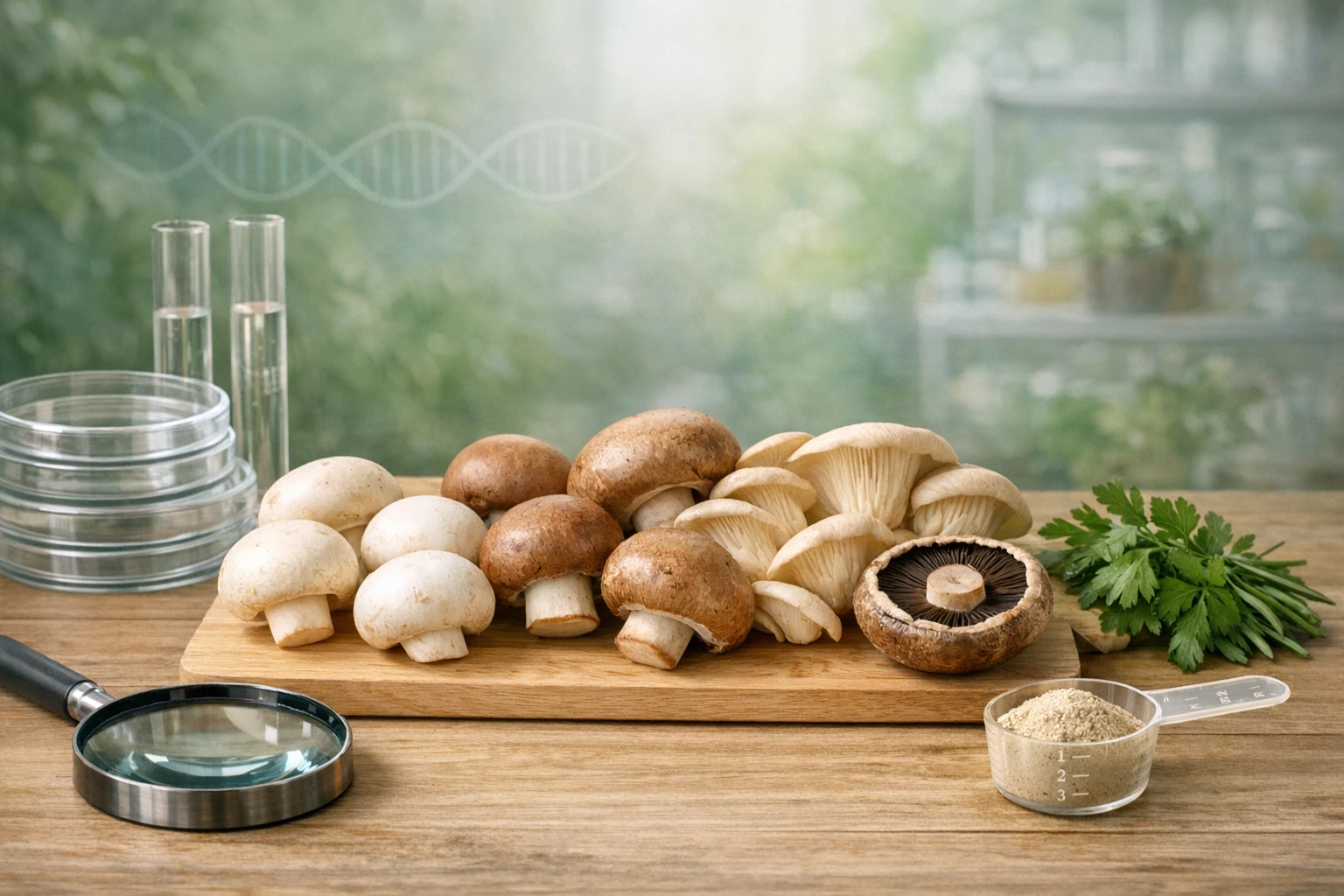
Updated and contextualized version of an article originally published on July 24, 2014
The article retains its original focus by presenting it through a scholarly and accessible perspective, supported by verifiable references.
Authors
- Dr. D. Iodice – Biologist
- Roberto Panzironi –Independent researcher
Note editoriali
- First publication: July 24, 2014
- Last update: April 21, 2026
- Version: 2026 narrative revision
Editorial note: this article was previously published and has been updated according to scientific and divulgative criteria. The text is for informational purposes only and does not replace medical advice. Always consult a healthcare professional for personalized clinical choices.
IN BRIEF
- Edible mushrooms provide nutrients and bioactive compounds such as ergothioneine, glutathione, B vitamins, vitamin D (if UV-exposed), and beta-glucans.
- Observational data suggest associations between mushroom consumption and reduced risk of certain cancers and mortality, but do not prove direct causality.
- Experiments on beta-glucans and mushroom-based supplements or foods show modest effects on metabolic and immunological markers, depending on dose and form of consumption. [5][6]
- Most contraindications concern unidentified wild mushrooms; for people with autoimmune diseases, the immune stimulation of beta-glucans requires caution and clinical evaluation.
Abstract: what does science say?
Edible mushrooms are low-calorie foods rich in micronutrients and biologically active molecules (antioxidants like ergothioneine and glutathione, beta-glucans, vitamins, and minerals). Available evidence includes observational studies linking mushroom consumption to a lower incidence of certain cancers and a modest reduction in mortality, along with short-term clinical studies showing favorable effects on post-prandial metabolic markers when meals are enriched with mushroom powders or isolated compounds. The effect depends on key variables: mushroom species, dose, form of consumption (fresh, cooked, powdered, or irradiated for vitamin D), duration of use, and characteristics of the studied population. The main limitations are the predominantly observational nature of much research, the heterogeneity of interventions, and the scarce causal evidence; larger and longer controlled clinical studies are needed to confirm long-term benefits.
Nutritional composition and active components
Edible mushrooms provide dietary fiber, B vitamins, potassium, and minerals like selenium, as well as soluble and insoluble cell wall compounds (beta-glucans) and unique antioxidants such as ergothioneine and glutathione. Chemical characterization studies have shown that many cultivated species are significant sources of ergothioneine and glutathione, both linked to measurable antioxidant capacity in the laboratory. [1] Vitamin D quantities in mushrooms vary: natural content can be low but increases if mushrooms are exposed to UV light or treated with radiation, generating bioavailable vitamin D2. [7] The physicochemical characteristics of beta-glucans (length, branching) influence their biological activity and fermentation by the gut microbiota. [2]
Evidence on cancer prevention and biological plausibility
Several observational analyses and meta-analyses link higher mushroom consumption to a reduced overall incidence of certain cancers and lower mortality rates in relevant cohorts. However, associations do not imply proof of causality: they could reflect overall dietary patterns or residual confounding factors. [3][4] Biological plausibility includes antioxidant activity (protection from oxidative stress) and immunomodulatory actions of fungal polysaccharides; some experimental studies also show inhibitory effects on cell proliferation in preclinical models. The most effective dose, exposure, and species for a possible protective effect still need to be clarified.
Evidence on metabolism, diabetes, and weight control
Beta-glucans and mushroom fiber can reduce post-prandial glycemic response, modulate intestinal hormones (like GLP-1), and influence satiety; these effects have been observed in experiments on meals fortified with Pleurotus powders, with improvements in acute metabolic markers. [8] Analogous viscous and fermentable properties of beta-glucans derived from other sources (oats, barley) support a possible role in improving glycemic control and lipid profiles, but the effect depends on dose, molecular weight, and administration form. [6]
Safety, contraindications, and practical issues
In food consumption, the main concern is the collection or ingestion of poisonous species: correct identification remains essential. For the consumption of cultivated edible mushrooms, contraindications are rare. Extracts or supplements rich in beta-glucans can modulate the immune system; in subjects with autoimmune diseases, theoretical immune stimulation requires individual clinical evaluation. In addition, environmental contamination (heavy metals, toxic compounds) can vary by species and collection area, so attention to origin is recommended. [4]
What it means in practice
For the public: regularly including edible mushrooms in a varied diet can contribute to the intake of useful nutrients (selenium, potassium, B vitamins, choline) and bioactive compounds (ergothioneine, beta-glucans) that have demonstrated plausible biological effects. This is not a cure or a preventive guarantee, but a potentially useful nutritional complement within healthy dietary patterns. To increase the vitamin D content in mushrooms, some commercial products are exposed to UV light after harvesting; consuming them can increase vitamin D2 intake documented in clinical trials. [7] For people with autoimmune conditions or taking immunomodulatory therapies, it is advisable to consult a doctor before using extracts or preparations with high concentrations of beta-glucans. Finally, to reduce the risks associated with wild mushrooms, prefer certified products or controlled cultivation/marketing.
KEY POINTS TO REMEMBER
- Mushrooms are low-energy foods rich in micronutrients and specific antioxidant compounds like ergothioneine. [1]
- Observational data suggest associations between mushroom consumption and lower risk of certain diseases, including a modest effect on overall mortality; causality is not established. [3][8]
- Beta-glucans and mushroom fiber show favorable effects on acute metabolic parameters and the microbiota, but long-term clinical effects remain to be confirmed. [2][6][8]
- The vitamin D present in mushrooms increases if they are exposed to UV light: clinical studies document an increase in 25-OH-vitamin D levels after consumption of enriched mushrooms. [7]
- Avoid consuming unidentified mushrooms; those with autoimmune diseases or taking medications sensitive to immune activation should consult their doctor before using high-dose extracts. [6]
Limitations of the evidence
The main limitations of available research concern the predominance of observational studies, the variability in defining and measuring exposure (different species, portions, cooking or treatment methods), and the heterogeneity of the outcomes evaluated. Observational studies can identify associations but not establish a causal relationship: the possibility of residual confounding (e.g., healthier lifestyle among mushroom consumers) remains real. Existing clinical interventions are often short, with limited sample sizes or surrogate biological endpoints; a solid series of long-term randomized trials testing clinically relevant outcomes is still lacking. Therefore, interpretation must be cautious and contextualized: promising results justify further research, not definitive conclusions.
Editorial conclusion
Edible mushrooms provide a unique combination of nutrients and bioactive molecules that make a positive contribution to metabolic health and protection against some oxidative damage plausible. Epidemiological evidence suggests favorable associations with cancer risk and mortality, and smaller, controlled studies show consistent biological effects, especially related to beta-glucans and specific mushroom antioxidants. However, the strength of the evidence has not yet reached the level necessary for therapeutic recommendations or preventive claims. For the public, it remains reasonable to include mushrooms as part of a varied and balanced diet, preferring identified and quality products, and consulting a doctor in case of particular clinical conditions or the use of concentrated extracts. Scientific interest is growing: extensive clinical studies and long-term interventions will be needed to clarify the concrete role of mushrooms in the prevention of chronic diseases.
EDITORIAL NOTE
This article is an updated summary of available literature and scientific knowledge. It has been prepared to provide general information and is not intended to replace personalized assessments by qualified healthcare professionals.
SCIENTIFIC RESEARCH
- Kalaras MD, Richie JP, Calcagnotto A, Beelman RB. Mushrooms: a rich source of the antioxidants ergothioneine and glutathione. Food Chem. 2017;233:429–433. https://doi.org/10.1016/j.foodchem.2017.04.109
- Del Rio D, et al. Edible mushrooms and β‑glucans: impact on human health. Nutrients. 2021;13:2195. https://doi.org/10.3390/nu13072195
- Ba DM, Ssentongo P, Beelman RB, Muscat J, Gao X, Richie JP Jr. Higher mushroom consumption is associated with lower risk of cancer: a systematic review and meta‑analysis of observational studies. Adv Nutr. 2021. https://doi.org/10.1093/advances/nmab015
- Lee DH, Yang M, Keum N, Giovannucci EL, Sun Q, Chavarro JE. Mushroom consumption and risk of total and site‑specific cancer in two large U.S. prospective cohorts. Cancer Prev Res (Phila). 2019;12(8):517–526. https://doi.org/1158/1940-6207.CAPR-19-0101
- Piskov S, et al. Fortifying a meal with oyster mushroom powder beneficially affects postprandial GLP‑1, NEFAs and hunger sensation in adults with impaired glucose tolerance: a randomized controlled crossover trial. Eur J Nutr. 2022;61:687–701. https://doi.org/10.1007/s00394-021-02674-1
- Skendi A, et al. Effects of fungal beta‑glucans on health – a systematic review of randomized controlled trials. Food Funct. 2021. https://doi.org/10.1039/D1FO00122A
- Cardwell G, et al. Bioavailability of vitamin D2 from enriched mushrooms in prediabetic adults: a randomized controlled trial. Eur J Clin Nutr. 2014;68:1154–1160. https://doi.org/10.1038/ejcn.2014.157
- Ba DM, Gao X, et al. Prospective study of dietary mushroom intake and risk of mortality: results from continuous NHANES 2003–2014 and a meta‑analysis. Nutrition Journal. 2021;20:80. https://doi.org/10.1186/s12937-021-00738-w
- Paul BD, Snyder SH. Ergothioneine: a stress vitamin with anti‑ageing, vascular and neuroprotective roles? Antioxidants & Redox Signaling. 2022;36(16–18):1306–1317. https://doi.org/10.1089/ars.2021.0043
DOI checklist internally verified for all references listed above.