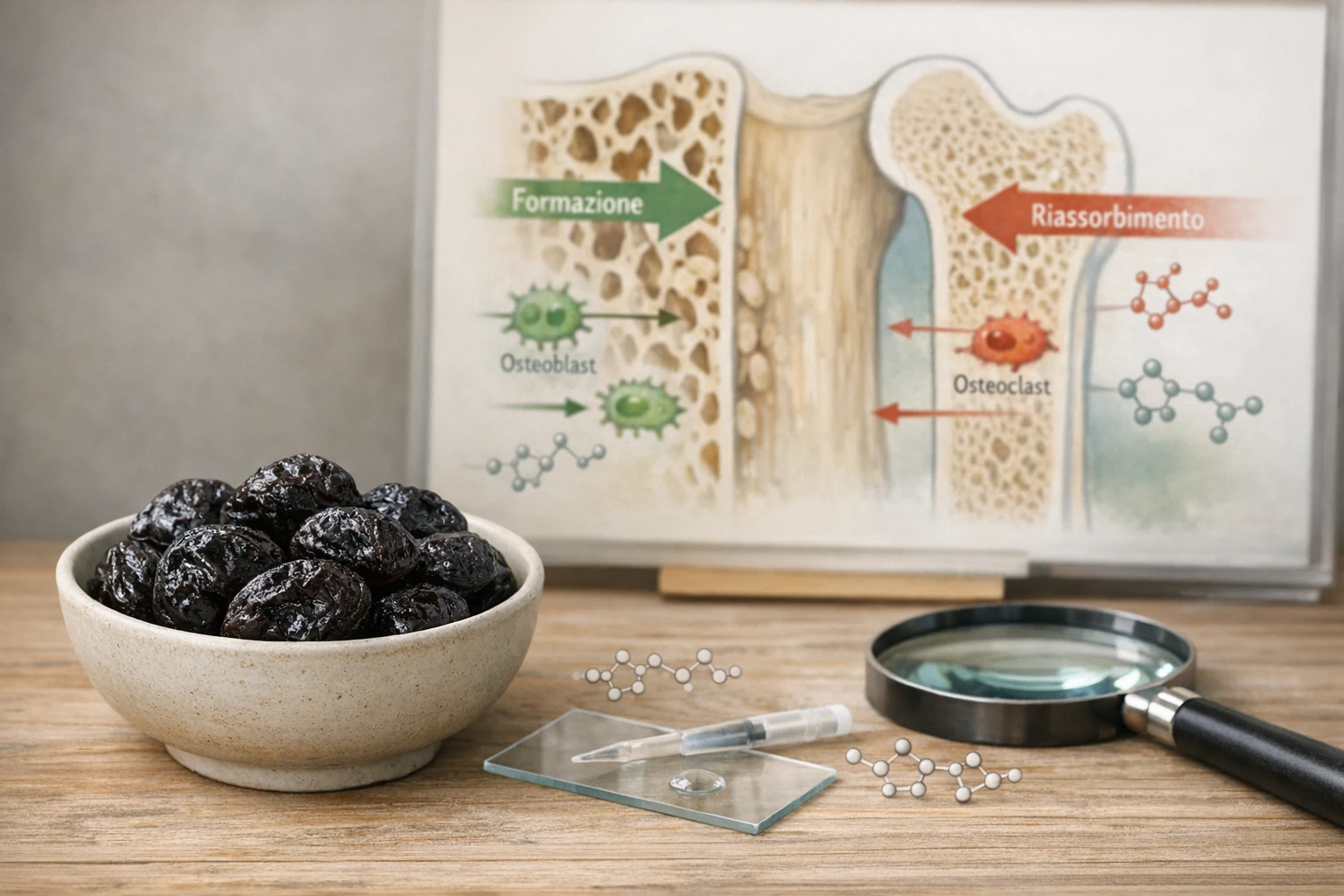
Updated and contextualized version of an article originally published on May 6, 2014
The article retains its original focus by presenting it through a scholarly and accessible perspective, supported by verifiable references.
Authors
- Dr. M. Bitonti – Biologist
- Roberto Panzironi –Independent researcher
Note editoriali
- First publication: May 6, 2014
- Last update: April 18, 2026
- Version: 2026 narrative revision
Initial note
This article was previously published and has been updated according to scientific and divulgative criteria. The goal is to inform: it does not replace medical consultation. The information gathered here summarizes available experimental and clinical evidence and indicates limits and contexts of application.
In brief
- Some randomized clinical trials indicate that daily consumption of dried plums can slow bone loss in postmenopausal women and improve certain biomarkers of bone turnover.
- Evidence includes trials lasting 3–12 months and dose studies; possible mechanisms include reduced bone resorption and anti-inflammatory/antioxidant actions.
- Results appear more consistent for the spine and parts of the forearm; longer studies with clinical endpoints (fractures) are needed to confirm the overall protective effect.
- The choice to include dried plums in the diet is an interesting dietary strategy but does not replace medical therapies for osteoporosis; any changes should be discussed with a doctor.
Abstract: what does science say?
Dried plums (commonly referred to as prunes) have been the subject of both experimental and clinical studies for their potential effect on skeletal health. In laboratory and animal models, effects that promote bone formation and inhibit osteoclastic resorption are observed; in some controlled clinical trials on postmenopausal women, increases or maintenance of bone mineral density (BMD) in specific sites (spine, forearm) and reductions in resorption biomarkers have been reported.
Biological plausibility stems from multiple components: mineral content (e.g., potassium, boron), phytochemicals (polyphenols), antioxidant action, and possible modulation of the gut microbiota. However, the observed effects vary depending on dose, duration, population (age, degree of bone loss), and nutritional context (calcium and vitamin D intake). Available clinical evidence supports a favorable association in selected populations, but does not constitute definitive proof of long-term fracture prevention. It is therefore appropriate to consider dried plums as a possible nutritional element with potential benefits for bones, to be evaluated in the overall context of lifestyle and specific therapies.
What it means in practice
For adults, particularly postmenopausal women with mild bone loss (osteopenia), including dried plums in the diet can be a reasonable and practical dietary measure. In clinical trials, the most frequently used quantity was about 100 g per day (corresponding to ~8–12 prunes, depending on size), with some studies showing effects even with reduced doses such as 50 g per day. However, daily consumption of prunes in these quantities can have digestive side effects (for example, increased intestinal transit) and provides calories and sugars; hence the need to evaluate their inclusion in the individual energy balance.
It is important to emphasize that dried plums are not a pharmacological therapy for osteoporosis. For those with established osteoporosis or a high risk of fractures, specific therapeutic indications (medications, calcium/vitamin D supplementation, physical exercise) must be evaluated by a doctor. The prudent practice is to discuss their adoption with your doctor or a dietitian, especially if you are undergoing pharmacological treatments or have concomitant medical conditions.
Clinical evidence and plausible mechanisms
Main clinical studies
Randomized clinical trials conducted on postmenopausal women show results that support a favorable effect of dried plums on BMD and bone turnover biomarkers. A 1-year randomized comparison showed that 100 g/day of dried plums improved or maintained spinal and some peripheral BMD compared to a dried apple control; the study also reported reductions in resorption markers (e.g., TRAP-5b) and the inflammatory protein CRP [1]. Subsequent trials explored lower doses (50 g/day) and suggested that even moderate amounts can prevent BMD loss in the short term [4]. Short-term crossover studies observed trends in the reduction of resorption markers with moderate prune consumption [8]. These results indicate a consistency of measurable biological effects, but most studies have limited duration and do not directly evaluate the incidence of fractures.
Plausible biological mechanisms
The possible biological pathways explain the plausibility of the observed effects. Studies on cells and animal models show that prune polyphenols can inhibit osteoclastogenesis (the formation of bone resorbers) by modulating signals such as NFATc1 and MAPK pathways, as well as reducing inflammatory expressions that promote resorption [6][7]. At the same time, some data indicate an increase in bone formation indicators (IGF‑1, ALP) in animal models and in blood samples obtained after prune consumption [5][6]. Further work suggests a role for the gut microbiota and short-chain metabolites in mediating the benefit on bone mineralization, although this line of research is still emerging [7]. Therefore, the final effect observed in clinical trials could derive from a combination of antioxidant, anti-inflammatory action, microbiota modulation, and micronutrient intake.
Dose, duration, and form of consumption
In clinical trials, the tested quantities generally range from 50 g/day to 100 g/day, for periods ranging from a few weeks (crossover studies) to 12 months. One study indicated that 50 g/day may be comparable to the 100 g/day dosage in preventing BMD loss over 6 months [4]. Consumption has typically been of whole dried prunes; extracts or fractions (isolated polyphenols) show effects in animal models but are not yet sufficiently evaluated in clinical trials with bone density endpoints measured with DXA [7]. Therefore, if dietary adoption is considered, the form used in clinical research is the whole dried prune and the relevant duration for measurable effects is on the order of months rather than days or weeks.
Key points to remember
Summarizing the main messages emerging from the analysis of the evidence:
- There are randomized clinical trials showing a favorable effect of dried plums on BMD and bone resorption biomarkers in postmenopausal women. [1][4]
- The mechanisms are likely multiple: antioxidant and anti-inflammatory action, phenolic compounds that modulate osteoclasts and osteoblasts, and a possible role of the microbiota. [6][7]
- The most frequent doses studied are 50 g and 100 g per day; detectable effects require weeks-months of intake. [4][1]
- The evidence does not replace pharmacological therapy in people with osteoporosis at high risk of fracture; longer studies with clinical outcomes (fractures) are needed to judge the long-term impact. [5]
- Consider potential gastrointestinal side effects, caloric intake, and interactions with existing diet/therapies before significantly changing your diet.
Limitations of the evidence
It is essential to distinguish between different types of studies. Observational studies can show associations, while randomized controlled studies are more suitable for evaluating a causal effect; however, even RCTs limited by duration, sample size, or endpoints do not provide definitive proof of fracture prevention. Many of the studies on dried plums have a short-medium duration (months) and measure variations in BMD or biomarkers, not the incidence of clinical fractures. Furthermore, the quantity of fruit consumed in trials (e.g., 100 g/day) may not be sustainable or recommendable for all people, due to calories and sugars.
Other methodological limitations include the risk of bias in participant selection, partial control of background nutritional variables (calcium and vitamin D intake), variability in the nutritional composition of prunes (origin, variety, drying process), and the lack of trials on populations other than postmenopausal women. For these reasons, practical recommendations should be cautious and integrated with other preventive measures (physical activity, adequate calcium/vitamin D intake, control of risk factors). [5]
Editorial conclusion
Research suggests that dried plums are a food of interest for bone health, with clinical evidence showing positive effects on BMD and bone turnover biomarkers in postmenopausal women. Plausible mechanisms are consistent and supported by experimental studies, but limitations remain regarding study duration and the lack of data on long-term clinical outcomes such as fractures. The most prudent approach is to consider dried plums as part of a varied and balanced diet that includes other known preventive measures for bone health. Patients with high risk or with an already diagnosed disease should consult their doctor for an integrated therapeutic strategy.
Editorial note
The article is an informative update based on peer-reviewed literature. The information does not constitute personalized therapeutic indication. For individual choices, consult healthcare professionals.
Scientific research
- Hooshmand S, Chai SC, Saadat RL, Payton ME, Brummel-Smith K, Arjmandi BH. Comparative effects of dried plum and dried apple on bone in postmenopausal women. British Journal of Nutrition. 2011. https://doi.org/10.1017/S000711451100119X
- Arjmandi BH et al. Dried plums improve indices of bone formation in postmenopausal women. Journal of Women's Health & Gender-Based Medicine. 2002. https://doi.org/10.1089/152460902753473471
- Hooshmand S, Brisco JR, Arjmandi BH. The effect of dried plum on serum levels of RANKL, osteoprotegerin and sclerostin in osteopenic postmenopausal women: a randomized controlled trial. British Journal of Nutrition. 2014. https://doi.org/10.1017/S0007114514000671
- Hooshmand S et al. The effect of two doses of dried plum on bone density and bone biomarkers in osteopenic postmenopausal women: a randomized, controlled trial. Osteoporosis International. 2016;27:2271–2279. https://doi.org/10.1007/s00198-016-3524-8
- Arjmandi BH, Johnson SA, Campbell SC, et al. Bone-Protective Effects of Dried Plum in Postmenopausal Women: Efficacy and Possible Mechanisms. Nutrients. 2017;9:496. https://doi.org/10.3390/nu9050496
- Rendina I, Freedman LP, et al. Dietary dried plum increases bone mass, suppresses proinflammatory cytokines and promotes attainment of peak bone mass in male mice. Journal of Nutritional Biochemistry. 2016. https://doi.org/10.1016/j.jnutbio.2016.04.007
- Smith BJ, Bu SY, et al. Dried Plum Polyphenolic Extract Combined with Vitamin K and Potassium Restores Trabecular and Cortical Bone in an Osteopenic Model. Journal of Functional Foods. 2018. https://doi.org/10.1016/j.jff.2017.12.057
- Al‑Dashti YA, Holt RR, Carson JG, Keen CL, Hackman RM. Effects of Short-Term Dried Plum (Prune) Intake on Markers of Bone Resorption and Vascular Function in Healthy Postmenopausal Women: A Randomized Crossover Trial. Journal of Medicinal Food. 2019. https://doi.org/10.1089/jmf.2018.0209