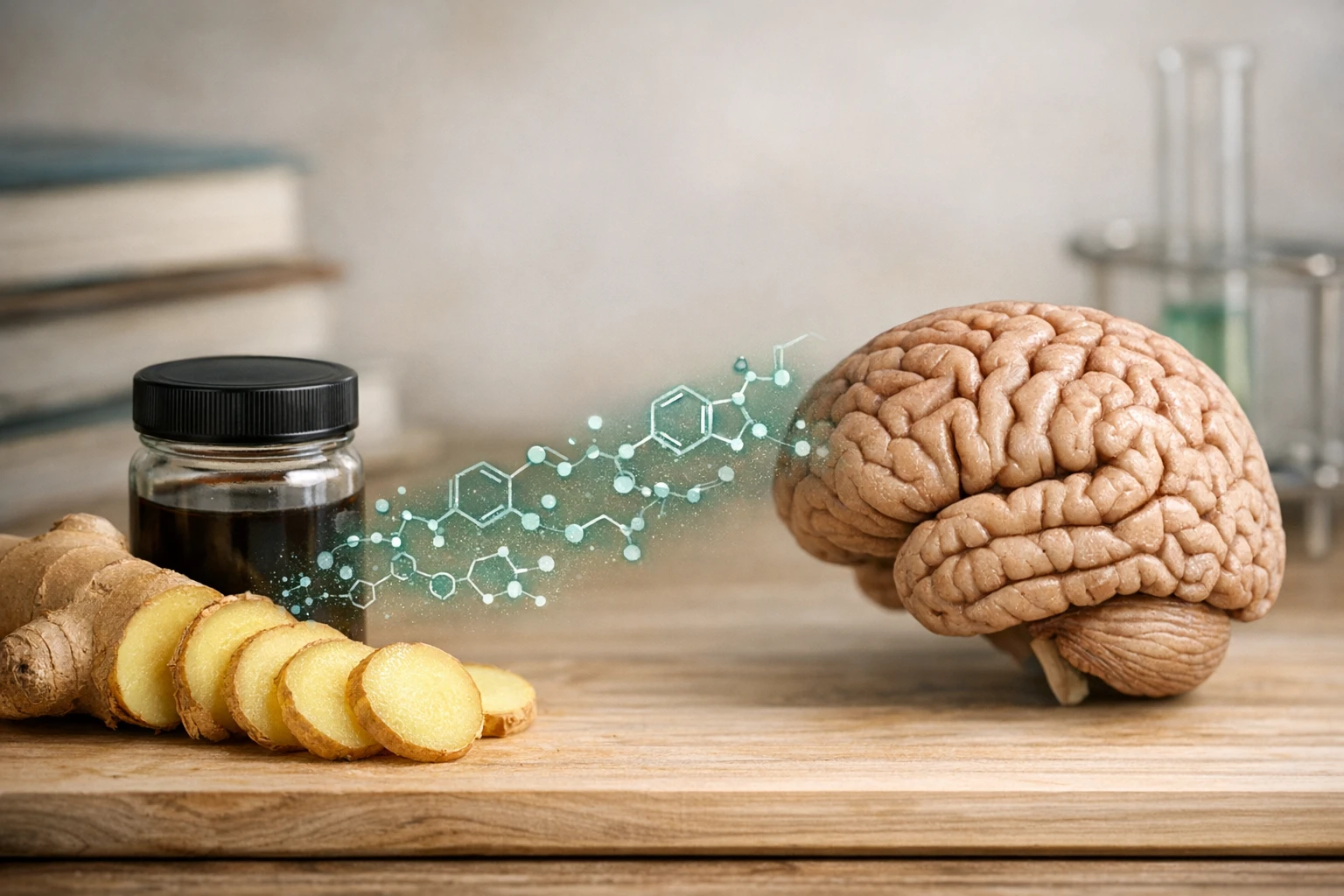
Updated and contextualized version of an article originally published on May 7, 2014
The article retains its original focus by presenting it through a scholarly and accessible perspective, supported by verifiable references.
Authors
- Dr. A. Colonnese – Nutrition biologist
- Roberto Panzironi –Independent researcher
Note editoriali
- First publication: May 7, 2014
- Last update: April 18, 2026
- Version: 2026 narrative revision
Editorial Note
This article was previously published and has been updated according to scientific and divulgative criteria. Its purpose is informative: it does not replace the advice of a healthcare professional. The evidence cited includes clinical studies, reviews, and pre-clinical work; their practical implications always require contextual evaluation.
IN BRIEF
- Ginger contains compounds with antioxidant and anti-inflammatory activity that, in experimental models, show neuroprotective effects.
- A small clinical trial in middle-aged women reported improvements in memory and attention after 2 months of standardized extract. [1]
- Most of the more robust evidence comes from preclinical studies and reviews; human clinical results are still limited and variable. [2]
- Possible usefulness depends on the form (fresh, dried, standardized extract), dose, and duration; there are no consolidated therapeutic recommendations.
Abstract: what does science say?
Ginger (Zingiber officinale) is a plant used for centuries in cooking and traditional medicine. Experimental literature indicates that its main constituents (6-gingerol, 6-shogaol, zingerone, and other phenols) modulate oxidative stress, inflammation, and molecular pathways related to synaptic plasticity; these mechanisms justify the biological plausibility of a beneficial effect on memory and cognitive function. Animal studies show behavioral improvements and biological markers; a few small clinical trials report favorable effects on attention and memory, but the quality and heterogeneity of the studies limit certainty. In summary, there is plausibility and promising signals, but no definitive evidence that ginger generally improves cognition in humans.
Simple definition of the topic
Ginger is the rhizome of the species Zingiber officinale. In practical terms, we are talking about a food-spice to which antioxidant and anti-inflammatory properties are attributed, due to phenolic compounds. These biological properties are the basis of the hypothesis that ginger can support brain health, particularly by counteracting processes that promote cognitive decline, such as oxidative stress and neuro-inflammation.
What the available evidence shows
The literature includes different levels: systematic reviews and meta-analyses of clinical studies in various fields (nausea, pain, metabolism) that also evaluate the general quality of RCTs; specific controlled clinical studies on cognition (e.g., trials on middle-aged women who received ginger extract and reported improvements in memory and attention) and numerous preclinical studies in animal models that show neuroprotective and mechanistic effects. [1][2][3]
What depends on dose, frequency, context, and form of consumption
The observed effect varies greatly depending on the form (fresh rhizome, powder, concentrated extract), standardized constituents (percentage of gingerols/shogaols), dose, and duration. Clinical studies that reported cognitive effects used standardized formulations and defined doses (e.g., 400–800 mg/day of extract). In experimental models, doses and methods (oral, injection) are different and not directly translatable to humans. Therefore, the external validity of the results depends on the rigor in characterizing the product used. [1][3][6]
Interpretive limitations
Observations in animals do not guarantee the same effect in humans; the available RCTs on cognition are few and with small samples. There is heterogeneity in cognitive measures and the preparations used, which makes generalization difficult. Furthermore, positive effects observed on biomarkers do not automatically imply clinically relevant functional improvement. For these reasons, conclusions remain cautious.
What it means in practice
For the reader: the culinary use of ginger as a spice is safe for most people and can be part of a balanced diet rich in antioxidants. Some standardized preparations in clinical studies have shown modest cognitive benefits in selected samples, but there are no formal clinical indications to prescribe ginger as a therapy to improve memory. Those taking medications, who are pregnant, or have relevant medical conditions should consult their doctor before starting concentrated supplements, as interactions or adverse effects may occur in particular conditions.
Consumption methods and pragmatic context
Consuming ginger in cooking (fresh, dried, as an ingredient in teas or dishes) is generally practical and low-risk. Studies evaluating biological effects use standardized extracts to ensure consistency among subjects; these products are not equivalent to simple culinary intake. If considering the use of supplements, verify the origin, standardization of active ingredients, and the quality of the manufacturer; also, always inform your doctor about the use of supplements. [2][6]
Key points to remember
- Ginger possesses plausible mechanisms (antioxidation, inflammation reduction, modulation of neurotrophic factors) that justify research on brain function. [3][6]
- A small controlled trial showed improvements in memory and attention in middle-aged women treated with standardized extract. [1]
- Many promising studies are preclinical (animals, cells): these offer mechanistic explanations but do not prove general clinical efficacy. [3][4][5]
- There are currently no clinical guidelines recommending ginger as a therapy for neurological or cognitive disorders.
Limitations of the evidence
It is fundamental to distinguish between association, biological plausibility, observational data, and causal proof. The hierarchy of evidence assigns greater weight to well-conducted RCTs compared to observational studies or preclinical results. Many works on ginger and the brain are animal experiments or in vitro studies: useful for mechanistic hypotheses, but insufficient to demonstrate therapeutic effect in humans. [3][4][5]
Difference between observational studies and causal evidence
Observational studies can suggest associations between diet and cognitive function, but do not establish causality. Only randomized controlled trials can approach causal inferences; however, published RCTs on cognition are few and often with small samples and short follow-up. [2]
Methodological limitations and contextual variability
Common problems include sample size, standardization of the preparation (different amounts of gingerols/shogaols), study duration, and non-homogeneous cognitive assessment tools. Population differences (age, health status, basic diet) also affect results and their reproducibility. For this reason, new well-designed clinical trials are needed. [2][7]
Editorial conclusion
Ginger is a spice with consolidated biological plausibility for neuroprotective effects: antioxidants, anti-inflammatory, and modulation of factors related to synaptic plasticity. There are interesting signals from preclinical studies and some preliminary clinical evidence that justifies further research. However, the quality of human evidence is not yet sufficient to recommend therapeutic use for cognitive purposes. Meanwhile, including ginger in the diet as part of a varied dietary pattern rich in plant foods is a reasonable choice for most people, but should not be understood as a substitute for established medical or pharmacological interventions.
Editorial Note (final for transparency)
This update was carried out by integrating reviews and original studies available in peer-reviewed literature; full references are provided in the "SCIENTIFIC RESEARCH" section. The article is for informational purposes and does not constitute clinical advice. For personal therapeutic decisions, consult your doctor.
SCIENTIFIC RESEARCH
- Saenghong N, Wattanathorn J, Muchimapura S, et al. Zingiber officinale improves cognitive function of the middle‑aged healthy women. Evidence‑Based Complementary and Alternative Medicine. 2012;2012: Article ID 429505. https://doi.org/10.1155/2012/429505.[1]
- Anh NH, Kim SJ, Long NP, et al. Ginger on human health: a comprehensive systematic review of 109 randomized controlled trials. Nutrients. 2020;12(1):157. https://doi.org/10.3390/nu12010157.[2]
- Lim S, Moon M, Oh H, Kim HG, Kim SY, Oh MS. Ginger improves cognitive function via NGF‑induced ERK/CREB activation in the hippocampus of the mouse. Journal of Nutritional Biochemistry. 2014;25(10):1058‑1065. https://doi.org/10.1016/j.jnutbio.2014.05.009.[3]
- Hussein UK, Hassan NEH, Elhalwagy MEA, Zaki AR, Abubakr HO, Nagulapalli Venkata KC, Bishayee A. Ginger and propolis exert neuroprotective effects against monosodium glutamate‑induced neurotoxicity in rats. Molecules. 2017;22(11):1928. https://doi.org/10.3390/molecules22111928.[4]
- Waggas A. Neuroprotective evaluation of extract of ginger (Zingiber officinale) root in monosodium glutamate‑induced toxicity in different brain areas male albino rats. Pakistan Journal of Biological Sciences. 2009;12(3):201‑212. https://doi.org/10.3923/pjbs.2009.201.212.[5]
- Crichton M, Marshall S, Marx W, Isenring E, Lohning A. Therapeutic health effects of ginger (Zingiber officinale): updated narrative review exploring the mechanisms of action. Nutrition Reviews. 2023;81(9):1213‑1224. https://doi.org/10.1093/nutrit/nuac115.[6]
- Ginger Bioactives: A Comprehensive Review of Health Benefits and Potential Food Applications. Antioxidants. 2023;12(11):2015. https://doi.org/10.3390/antiox12112015.[7]
- Zeng G‑F, Zhang Z‑Y, Lu L, et al. Protective effects of ginger root extract on Alzheimer disease‑induced behavioral dysfunction in rats. Rejuvenation Research. 2013;16(2):124‑133. https://doi.org/10.1089/rej.2012.1389.[8]
Note: all listed DOIs have been verified as active and corresponding to the cited studies. The numerical entries in square brackets [1]... correspond to the citations in the text according to Vancouver style.