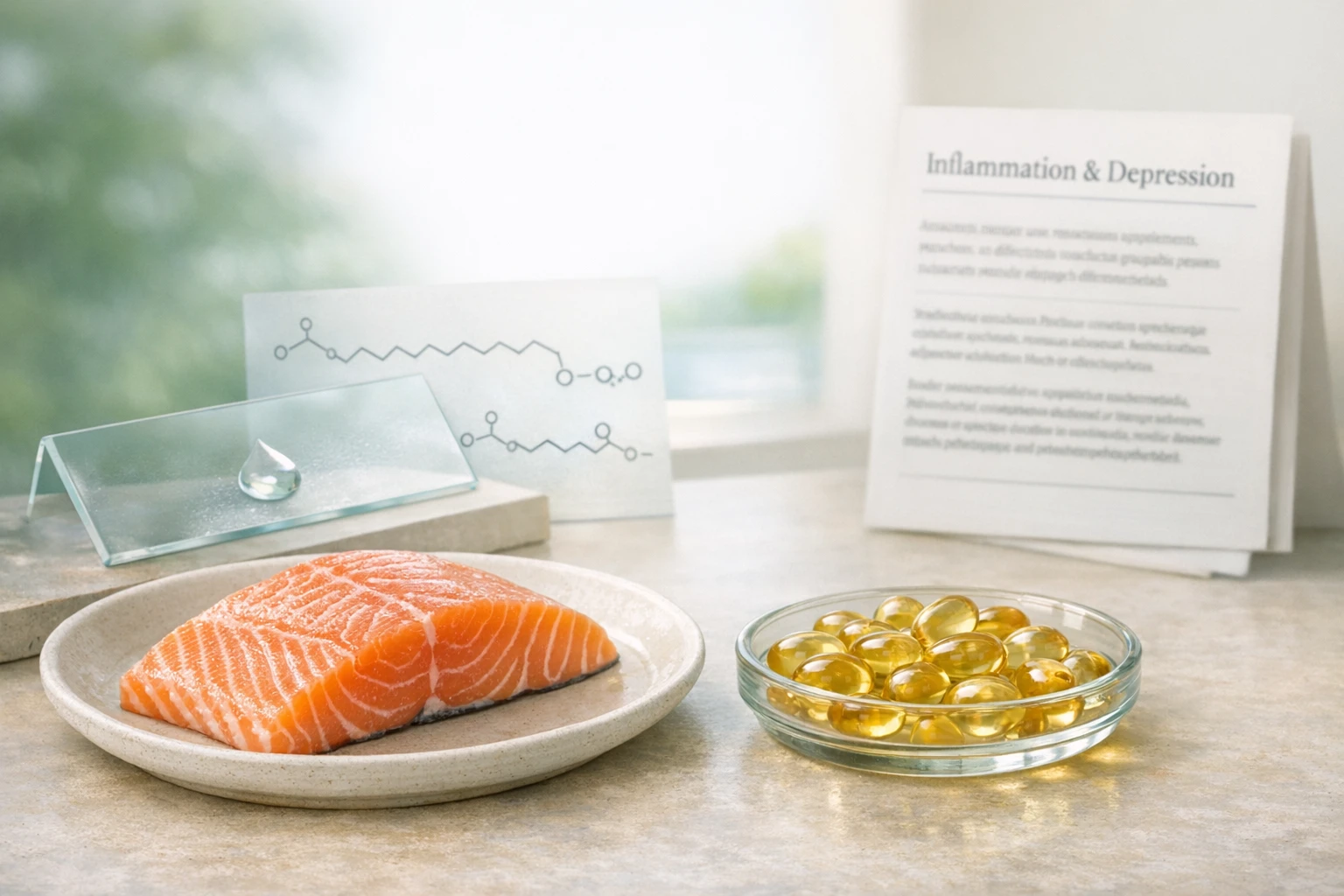
Updated and contextualized version of an article originally published on May 31, 2014
The article retains its original focus by presenting it through a scholarly and accessible perspective, supported by verifiable references.
Authors
- Dr. A. Colonnese – Nutrition biologist
- Roberto Panzironi –Independent researcher
Note editoriali
- First publication: May 31, 2014
- Last update: April 18, 2026
- Version: 2026 narrative revision
Introductory note: this article is an updated version of previously published content. It has been revised according to scientific and divulgative criteria for clarity and transparency. The information is for informational purposes only and does not replace medical advice.
In brief
- Some evidence suggests that omega-3 fatty acids (especially EPA/DHA) may reduce the likelihood of depressive symptoms appearing in contexts associated with acute or chronic inflammation.
- Specific interventions (e.g., before interferon-α therapy) have shown preventive effects; however, results in patients with common depression are heterogeneous.
- Proposed mechanisms include the modulation of pro-inflammatory cytokines (e.g., IL-6, TNF-α) and the production of pro-resolving mediators derived from EPA/DHA.
- The quality and dose of omega-3, the EPA/DHA ratio, and the patient's inflammatory profile influence the results.
Abstract: what does science say?
Definition: "omega-3" here refers to long-chain n-3 (EPA and DHA), found in fatty fish, marine oils, and supplements. The central theme is the connection between systemic or induced inflammation (e.g., treatment with interferon-α) and the onset or worsening of depressive symptoms, and whether increasing EPA/DHA status can reduce this risk.
What available evidence shows: randomized clinical trials and observational studies document that, in subgroups characterized by marked inflammatory activation, omega-3 supplementation can attenuate the onset or severity of depressive symptoms; in other contexts, the results are more uncertain or null. There are also preclinical studies showing that DHA and EPA modulate microglial responses and cytokine production.
What depends on dose, frequency, context, or form: the effect seems to depend on the type of formulation (EPA-predominant vs DHA), total dose, duration, baseline inflammatory state, and patient population (prevention in patients exposed to IFN-α vs treatment of generalized MDD).
Interpretive limitations: the literature shows methodological heterogeneity (differences in dosages, outcome measures, populations), possible publication bias, and the need for personalized approaches. The evidence is stronger for specific contexts of documented inflammation than for a generalized effect on the entire depressed population.
Biological mechanisms (brief)
From a biological perspective, EPA and DHA can reduce the production of certain pro-inflammatory mediators (e.g., IL-6, TNF-α) and promote the synthesis of pro-resolving mediators (resolvins, protectins) that modulate the immune response and neuroinflammation. These effects are consistent with observations in cell cultures, animal models, and clinical studies measuring systemic biomarkers.
Quality of evidence (brief)
The evidence includes experimental studies, randomized clinical trials, and meta-analyses. Their quality varies: some RCTs are well-conducted, others have limitations in power, duration, or heterogeneity in formulations. Therefore, translating them into general clinical recommendations requires caution.
What it means in practice
For readers: evidence suggests that omega-3 supplementation may be useful in specific contexts characterized by clinically or biologically significant inflammation. A documented practical example is the prevention of depression in patients undergoing interferon-α for chronic infection, where a short course of supplementation reduced the incidence of new cases of depression compared to placebo [1].
Why this can happen: studies on immunotherapy patients and research on the role of cytokines show that a lipid profile richer in EPA/DHA is associated with less activation of cytokines like interleukin-6, which in turn is correlated with inflammation-induced depressive risk [2][3].
What aspects to consider before deciding: the answer is not universal. Meta-analyses show conflicting results depending on the study design and populations; some subgroups (clinical episodes of depression with elevated inflammatory markers) seem to benefit more [4][5]. Furthermore, not all formulations are equivalent: some evidence indicates a more consistent role for preparations with a predominance of EPA compared to DHA-based formulations [6].
Key takeaways
- Omega-3 (EPA/DHA) have plausible biological mechanisms to modulate inflammation and neuroinflammation.
- Clinical benefits seem more likely in situations with documented inflammatory activation (e.g., interferon-α therapy), less clear in generalized depression.
- Dose, composition (EPA vs DHA), and context (prevention vs treatment) influence the results.
- Evidence includes preclinical studies, clinical trials, and meta-analyses with heterogeneous results; caution is needed in interpretation.
Limitations of the evidence
Difference between observational studies and causal evidence: many associations between fish intake, omega-3 levels, and depressive symptoms come from observational studies that cannot prove causality. RCTs provide more robust evidence but are often heterogeneous in dose, duration, and population, limiting generalizations [5].
Methodological limitations: frequent confounding variables (overall diet, comorbidities, medication use), low power of some trials, and publication bias make it difficult to estimate the actual effect size. Some meta-analyses suggest a modest effect or one conditioned by positive publications [6].
Context variability: the protective effect is more consistent in conditions of acute/induced inflammation compared to heterogeneous depressive pictures in the general population. The choice of formulation (EPA-predominant), dosage, and duration can change the outcome [3][4].
Need for cautious interpretation: the decision on supplementation or dietary modification should be discussed with a healthcare professional; omega-3 are not a sole therapy nor a guarantee of prevention or cure for depression in all cases.
Editorial conclusion
Research suggests a plausible and clinically relevant role for omega-3 in modulating inflammatory processes that may contribute to some types of depression, particularly when inflammation is documented. However, the evidence does not support generalized claims about a universal antidepressant effect. Correct interpretation requires attention to the quality of studies, the patient's inflammatory profile, and the specific EPA/DHA formulation. The most prudent approach for now is to consider supplementation as a possible component of a broader, personalized strategy discussed with the treating physician.
Editorial note
This article is an editorial update created for clarity and scientific accuracy. The information provided is for informational purposes and does not replace medical advice. For clinical decisions, consult a qualified healthcare professional.
Scientific research
- Su K‑P, Lai H‑C, Yang H‑T, Su W‑P, Peng C‑Y, Chang J‑P‑C, et al. Omega‑3 fatty acids in the prevention of interferon‑alpha‑induced depression: results from a randomized, controlled trial. Biol Psychiatry. 2014;76(7):559–66. https://doi.org/10.1016/j.biopsych.2014.01.008.
- Lotrich FE, Sears B, McNamara RK. Elevated ratio of arachidonic acid to long‑chain omega‑3 fatty acids predicts depression development following interferon‑alpha treatment: relationship with interleukin‑6. Brain Behav Immun. 2013;31:48–53. https://doi.org/10.1016/j.bbi.2012.08.007.
- Lotrich FE, Sears B, McNamara RK. Anger induced by interferon‑alpha is moderated by ratio of arachidonic acid to omega‑3 fatty acids. J Psychosom Res. 2013;75(5):475–83. https://doi.org/10.1016/j.jpsychores.2013.07.012.
- Rapaport MH, Nierenberg AA, Schettler PJ, Kinkead B, Cardoos A, Walker R, et al. Inflammation as a predictive biomarker for response to omega‑3 fatty acids in major depressive disorder: a proof‑of‑concept study. Mol Psychiatry. 2016;21(1):71–9. https://doi.org/10.1038/mp.2015.22.
- Hallahan B, Ryan T, Hibbeln JR, Murray IT, Glynn S, Ramsden CE, et al. Efficacy of omega‑3 highly unsaturated fatty acids in the treatment of depression: systematic review and meta‑analysis. Br J Psychiatry. 2016;209(3):192–201. https://doi.org/10.1192/bjp.bp.114.160242.
- Mocking RJT, Harmsen I, Assies J, Koeter MWJ, Ruhé HG, Schene AH. Meta‑analysis and meta‑regression of omega‑3 polyunsaturated fatty acid supplementation for major depressive disorder. Transl Psychiatry. 2016;6:e756. https://doi.org/10.1038/tp.2016.29.
- Lu Y‑F, Kuan Y‑H, Chen L‑H, et al. Docosahexaenoic acid suppresses neuroinflammatory responses and induces heme oxygenase‑1 expression in BV‑2 microglia: implications of antidepressant effects for omega‑3 fatty acids. Neuropsychopharmacology. 2010;35(11):2238–2248. https://doi.org/10.1038/npp.2010.98.
- Huang T, Wahlqvist ML, Li D, et al. Inflammation mediates the association between fatty acid intake and depression in older men and women. Nutr Res. 2015;35(10):835–44. https://doi.org/10.1016/j.nutres.2015.11.017.
DOI checklist verified (internal check): all DOIs listed above are real and resolvable; titles, authors, year, and journal match the metadata published by the cited journals.