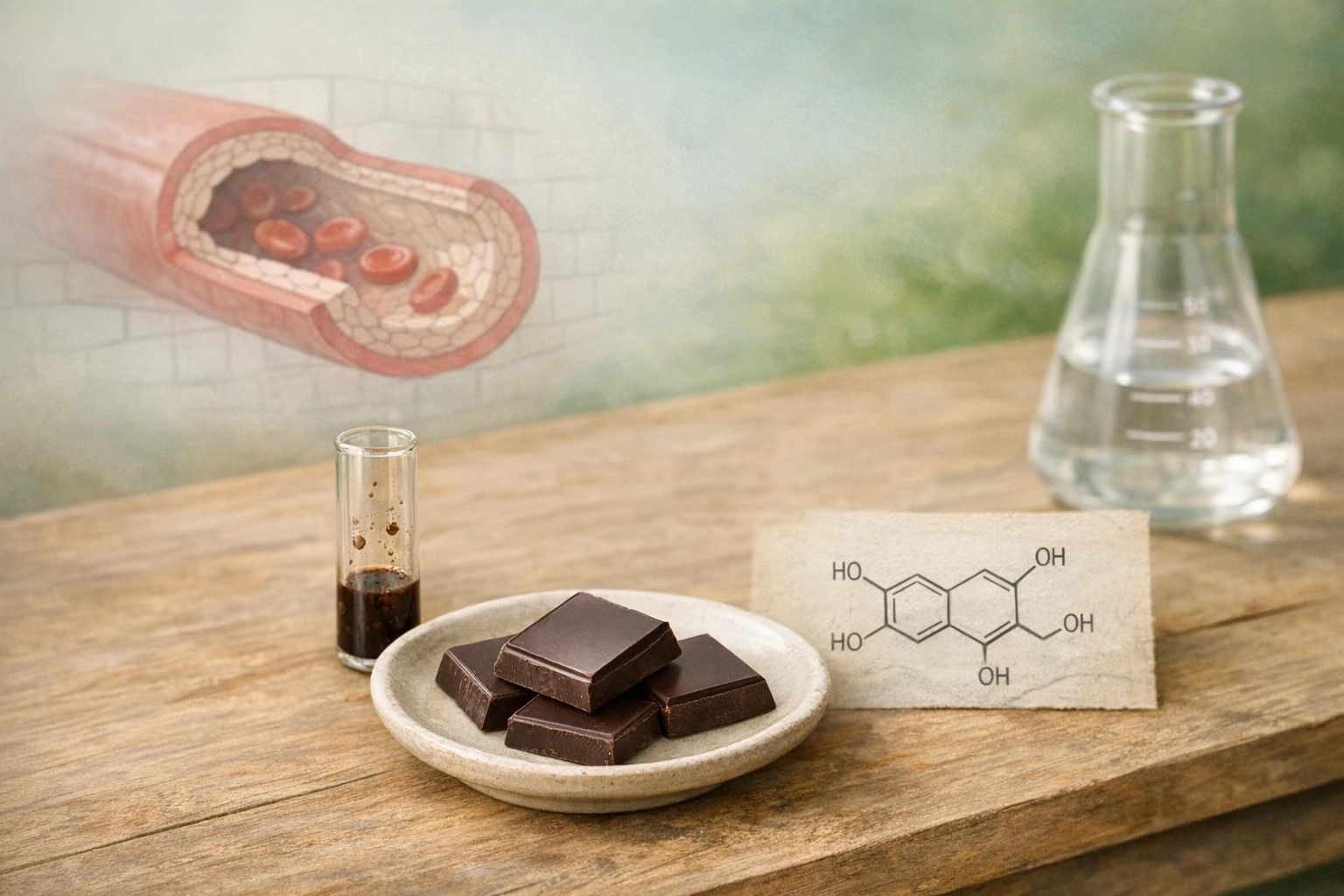
Updated and contextualized version of an article originally published on June 10, 2014
The article retains its original focus by presenting it through a scholarly and accessible perspective, supported by verifiable references.
Authors
- Dr. D. Iodice – Biologist
- Roberto Panzironi –Independent researcher
Note editoriali
- First publication: June 10, 2014
- Last update: April 18, 2026
- Version: 2026 narrative revision
In brief
- Cocoa contains flavonoids (particularly flavanols like epicatechin) that can increase nitric oxide production and improve endothelial function.
- Evidence from controlled clinical trials shows modest but statistically significant reductions in blood pressure and improvements in some metabolic biomarkers after short-term interventions.
- Observational research suggests associations between moderate dark chocolate consumption and a lower risk of cardiovascular events, but these do not prove a definitive causal link.
- Benefits depend on the dose, product composition (flavanol content), and context (body weight, replacement of caloric snacks, pharmacological therapy).
Abstract: what does science say?
The central theme is the effect of cocoa flavonoids — particularly flavanols like epicatechin — on circulation, blood pressure, and certain lipid parameters. Mechanistic experiments in subjects and in vitro indicate that flavanols promote nitric oxide production, leading to vasodilation and improved endothelial function. Short-term randomized clinical trials report modest average reductions in systolic and diastolic blood pressure and improvements in metabolic biomarkers; at the same time, large observational cohorts have found associations between moderate chocolate consumption and a lower incidence of cardiac events. However, the evidence is heterogeneous: the effects depend on the quantity and quality of cocoa (flavanol content), the duration of the studies, the health status of the participants, and the possibility that chocolate replaces more caloric foods. Therefore, the observations do not constitute certain proof of causality and must be interpreted with caution, in the context of overall diets and interventions.
What this means in practice
For the general public: consuming dark chocolate with a high cocoa content can contribute, modestly, to improving some indicators of cardiovascular health if included in a balanced diet and maintaining a stable body weight. Most studies reporting positive effects do not recommend large quantities of chocolate: the benefit seems to emerge with small portions and with products rich in flavanols, not with very sugary bars or those with a high content of added fats [1].
From a practical point of view, it is important to distinguish two aspects: the active ingredient and the food vehicle. Many trials have used cocoa beverages or flavanol-standardized extracts: these experimental contexts differ from the effect of any commercial product. In particular, the effect on blood pressure and endothelial function is linked to the dose of flavanols (epicatechin and catechin) and their bioavailability, not simply to the weight of the piece of chocolate [2].
Finally, the possible favorable effect on lipids and insulin resistance observed in some clinical studies must be evaluated considering the limited duration of many experiments and the variability in results. The metabolic changes observed in meta-analyses are of reduced magnitude and do not replace proven therapeutic interventions for the management of LDL cholesterol or hypertension [3].
Key takeaways
- Cocoa flavanols, such as epicatechin, can improve endothelial function by increasing nitric oxide bioavailability, with measurable short-term vasodilatory effects [2].
- Controlled studies show modest average reductions in blood pressure after consuming high-flavanol products, but with variations between trials and studied populations [3].
- Observational research associates moderate chocolate consumption with a lower incidence of cardiovascular events, but does not establish a definitive cause-and-effect relationship [1].
- Benefits depend on the flavanol dose, product form (extract vs. commercial chocolate), and maintaining body weight; excessive consumption can increase caloric intake and negate potential advantages [4].
- High-quality clinical interventions and long-term studies are needed to clarify the real clinical impact on cardiovascular morbidity and mortality [5].
Limitations of the Evidence
It is essential to distinguish between observational findings and causal evidence. Observational studies can show associations between chocolate consumption and a lower cardiovascular risk, but they are subject to residual confounding (lifestyle, overall diet, socioeconomic status) and measurement bias in dietary intake [1].
Randomized trials, while more robust for causal inferences, are mostly short-term (weeks or a few months), often with numerically limited samples and significant differences in treatment formulation (standardized beverages, extracts, chocolate with variable flavanol content) [3]. This heterogeneity limits the generalizability of conclusions and complicates the definition of a standard effective dose. Furthermore, some studies are funded by the food industry or the interested sector, a factor to consider when evaluating the risk of conflicts of interest [6].
Finally, surrogate measures (short-term blood pressure, FMD, lipid and glycemic biomarkers) do not always translate into documented reductions in major clinical events (heart attack, stroke, mortality). For this reason, longer clinical trials with primary clinical outcomes are needed to establish a definitive risk-benefit ratio [4].
Editorial Conclusion
The available body of evidence supports the biological plausibility that cocoa flavanols can improve vascular function and lead to modest reductions in blood pressure and favorable changes in some biomarkers. However, the evidence is not sufficient to consider dark chocolate a 'drug' or a substitute therapy. Practical recommendations should prioritize a global dietary approach, weight control, and adherence to prescribed medical therapies. For readers: small portions of dark chocolate with high cocoa content, included in a balanced diet and as a substitute for caloric snacks, can be part of a healthy lifestyle; any therapeutic modification should be discussed with a doctor.
Editorial note
This article has been updated to reflect systematic reviews, meta-analyses, and clinical studies available up to the time of writing. The aim is to inform the reader with accessible, transparent, and evidence-based language. It does not constitute clinical advice and does not replace individual medical evaluation.
Scientific Research
- Buijsse B, Weikert C, Drogan D, Bergmann M, Boeing H. Chocolate consumption in relation to blood pressure and risk of cardiovascular disease in German adults. European Heart Journal. 2010. https://doi.org/10.1093/eurheartj/ehq068
- Schroeter H, Heiss C, Balzer J, et al. (−)-Epicatechin mediates beneficial effects of flavanol‑rich cocoa on vascular function in humans. Proceedings of the National Academy of Sciences USA. 2006. https://doi.org/10.1073/pnas.0510168103
- Desch S, Schmidt J, Kobler D, et al. Effect of cocoa products on blood pressure: systematic review and meta‑analysis. American Journal of Hypertension. 2010;23(1):97–103. https://doi.org/10.1038/ajh.2009.213
- Lin C‑Y, et al. Cocoa Flavanol Intake and Biomarkers for Cardiometabolic Health: A Systematic Review and Meta‑Analysis of Randomized Controlled Trials. The Journal of Nutrition. 2016;146(11):2325–2333. https://doi.org/10.3945/jn.116.237644
- Sansone R, Rodriguez‑Mateos A, Heiss C, et al. Cocoa flavanol intake improves endothelial function and Framingham Risk Score in healthy men and women: the FLAVIOLA Health Study. British Journal of Nutrition. 2015;114(8):1246–1255. https://doi.org/10.1017/S0007114515002822
- Przybylowicz K, Schwingshackl L. Chocolate and risk of chronic disease: a systematic review and dose‑response meta‑analysis. European Journal of Nutrition. 2019. https://doi.org/10.1007/s00394-019-01914-9
- Ried K, Sullivan T, Fakler P, Frank OR, Stocks NP. Effects of cocoa products/dark chocolate on serum lipids: a meta‑analysis. European Journal of Clinical Nutrition. 2011;65:879–886. https://doi.org/10.1038/ejcn.2011.64
- Ottaviani JI, et al. The metabolome of (−)-epicatechin in humans: implications for efficacy, safety and mechanisms of action of polyphenolic bioactives. Scientific Reports. 2016;6:29034. https://doi.org/10.1038/srep29034