Updated and contextualized version of an article originally published on June 19, 2014
The article retains its original focus by presenting it through a scholarly and accessible perspective, supported by verifiable references.
Authors
- Dr. M. Bitonti – Biologist
- Roberto Panzironi –Independent researcher
Note editoriali
- First publication: June 19, 2014
- Last update: April 18, 2026
- Version: 2026 narrative revision
IN BRIEF
- Soy is a widely used plant-based protein source, both as an ingredient and as a base for meat-mimicking products.
- Clinical evidence shows modest and contextual effects: some isoflavone extracts can slightly reduce hot flashes, while direct cardiovascular benefits are limited.
- Some natural components of soy (phytates, trypsin inhibitors) can interfere with nutrient absorption if consumed in unprocessed forms; many industrial processes reduce these components.
- Concerns related to industrial processes (solvent residues, added ingredients) and allergenicity exist, but depend on production, quality control, and exposure doses.
Abstract: what does science say?
Soy and its derivatives have been used for decades as a meat alternative and as a protein ingredient in processed foods. The literature shows that some soy compounds (isoflavones) have measurable biological effects: in clinical studies, they can, on average, reduce the frequency and severity of menopausal hot flashes with moderate and variable effects. Evidence of cardiovascular benefits directly attributable to soy alone or protein isolates is weak and conflicting; overall dietary factors play an important role. Natural components of soy, such as phytates and enzyme inhibitors, can reduce the bioavailability of some minerals if not neutralized by processing or home preparation. Some concerns relate to the use of solvents for extraction, the presence of additives in industrial formulations, and the allergenic potential in predisposed individuals. Ultimately, risks and benefits depend on the form of soy (minimally processed traditional food vs. highly processed isolate), the dose, and the overall nutritional context; the evidence is mostly observational or short-to-medium term clinical and requires cautious interpretation.
Soy composition and industrial processes (what goes into the product)
Soy (Glycine max) is rich in proteins, oils, carbohydrates, and phenolic compounds (isoflavones). Traditional soy-based foods — such as tofu, tempeh, miso, and soy milk — are derived from cooking or fermentation processes that generally reduce so-called "antinutrients" (phytates, trypsin inhibitors) and improve digestibility. In industrial products that mimic meat, isolated or concentrated proteins obtained through extraction and separation are often used: these operations include defatting (oil removal) and physical-chemical processes to obtain a clear and neutral protein ingredient.
The most common technique for oil extraction is the use of organic solvents (historically n-hexane) followed by solvent recovery procedures; mechanical methods and emerging "greener" solvents also exist. Some industrial processes may also add flavorings, salt, sweeteners, and colorings to make the product more palatable. The presence and impact of process residues, as well as the quality of added ingredients, depend on company practices and regulatory controls in the country of production [7].
Biological effects and main areas of interest
Isoflavones and menopausal symptoms
Soy isoflavones (genistein, daidzein, glycitein) are phyto-compounds with weak estrogen-like activity. Meta-analyses of clinical studies show that isoflavone supplements can, on average, reduce the frequency and severity of hot flashes compared to placebo, with modest average effects and differences between formulations and dosages. The magnitude of the effect depends on the dose, duration, and type of preparation; the evidence is not uniform, and individual response varies considerably [2].
Cardiovascular health
Observational studies have previously suggested associations between high consumption of soy-based foods and a lower incidence of cardiovascular diseases in some populations. However, critical reviews and scientific documents from major societies suggest that the direct effects of soy protein alone or isoflavones on major cardiovascular risk factors are limited and inconsistent. Any observed benefits may derive from an overall dietary pattern (higher fiber intake, lower saturated fat content) rather than from a single soy component [1].
Male reproductive function
Some observational studies in infertility clinics have reported associations between higher consumption of soy-based foods and lower sperm concentration; such studies are observational in nature and do not establish causality. The results require confirmation and do not automatically imply similar effects for the entire male population: many environmental, dietary, and methodological factors influence semen quality [3].
Allergenicity
Soy is recognized as one of the main food sources of allergy in many geographical areas. The prevalence of soy allergy is lower than that of milk or peanuts in the adult population, but it is significant in children in some contexts. Reactions vary from mild to severe symptoms and require a dedicated clinical approach in sensitized individuals [8].
Antinutrients: phytates and enzyme inhibitors
Soybeans contain phytates, which can bind minerals such as iron and zinc and reduce their absorption in conditions of a monotonous and unbalanced diet; they also contain trypsin inhibitors which, if not denatured, can reduce the digestive efficiency of proteins. Many cooking techniques, fermentation, and industrial processes reduce or eliminate these components, but the final bioavailability depends on the form of consumption and the meal composition [6].
Process residues and solvents
The use of organic solvents in the food industry is a consolidated practice for obtaining high-yield isolated proteins. Industrial and environmental research has analyzed the presence of residues and technological alternatives; emerging more sustainable methods and regulations establishing maximum acceptable limits for some residues exist. It is important to distinguish between theoretical risk (possibility that residues exist) and concrete risk (measured exposures compared to toxicological limits) [7].
What it means in practice
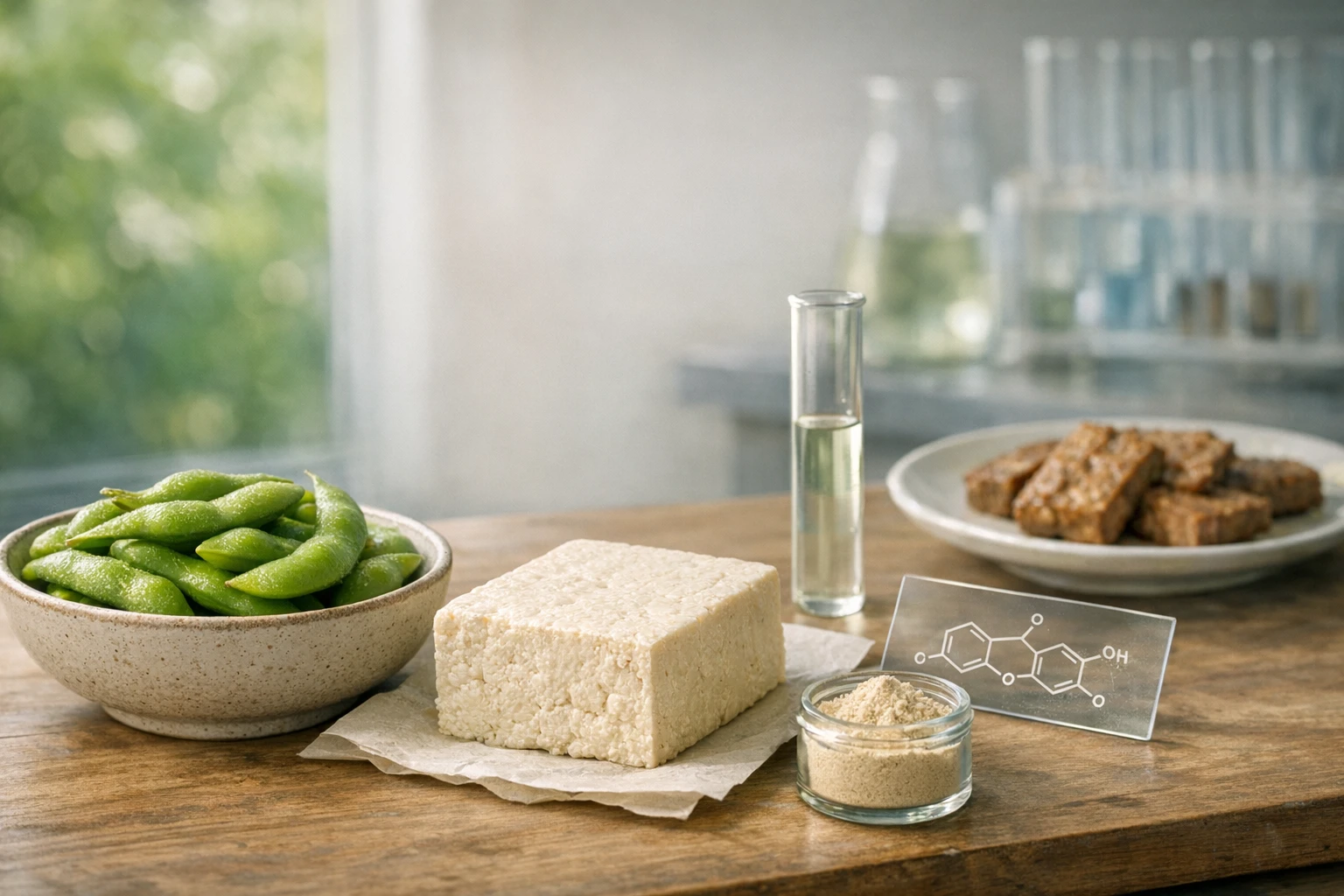
For consumers seeking meat alternatives, the choice should be made considering three main factors: the form of soy (traditional vs. highly processed isolate), the overall quality of the product (added ingredients, salt and fat content), and the context of the total diet. Minimally processed soy foods (tofu, tempeh, edamame) offer proteins and nutrients with fewer processed elements and, usually, with a reduced presence of active antinutrients thanks to cooking or fermentation.
Commercial meat substitutes can be useful for reducing red meat and saturated fat intake, but it is advisable to read labels: some products contain salt, flavorings, additives, or very high percentages of isolated protein. For individuals with specific clinical conditions (thyroid disease, allergies, reproductive problems under medical supervision) or for women with a personal history of hormone-dependent cancer, a personalized consultation with their doctor or a nutritionist is recommended.
KEY POINTS TO REMEMBER
- Soy is a versatile protein source: the risk/benefit profile varies greatly depending on the form and degree of processing of the product.
- Isoflavones can have modest effects on some symptoms (e.g., hot flashes), but they are neither a universal solution nor a proven therapy for chronic diseases. [see clinical evidence]
- Antinutrients like phytates and trypsin inhibitors can reduce mineral absorption or protein digestibility in the absence of processes that inactivate them.
- Risks related to process residues or additives depend on the production chain; choosing products from controlled supply chains reduces uncertainty.
- In case of known allergy, soy must be avoided; for most of the population, soy can be part of a balanced diet.
Limitations of the evidence
Many claims about soy come from observational studies that show associations but do not prove causality. Clinical studies also often use varying dosages, preparations, and durations, making it difficult to generalize results. Extraction methods and the food matrix (whole food vs. extract) influence biological effects, as do individual characteristics (gut microbiota, isoflavone metabolism, endocrine conditions). Important parts of the debate arise from industry-sponsored research or small studies with methodological limitations; for this reason, cautious interpretation is necessary, and systematic reviews and authoritative guidelines should be preferred to guide choices.
Editorial conclusion
Soy is a food with potential and limitations. It is neither a panacea nor a universal danger: its health effects depend on the form of consumption, the dose, and the dietary and personal context. Current evidence shows modest effects in some areas (e.g., hot flashes) and limited or inconsistent evidence in others (e.g., cardiovascular prevention). Concerns about antinutrients and process residues are reasonable but manageable with informed dietary practices and product choices. For complex individual decisions, consulting a healthcare professional remains the most prudent choice.
SCIENTIFIC RESEARCH
- American Heart Association. Soy protein, isoflavones, and cardiovascular health: an American Heart Association science advisory. Circulation. 2006. https://doi.org/10.1161/CIRCULATIONAHA.106.171052. [1]
- Taku K., Melby M.K., Kronenberg F., Kurzer M.S., Messina M. Extracted or synthesized soybean isoflavones reduce menopausal hot flash frequency and severity: systematic review and meta-analysis. Maturitas. 2012. https://doi.org/10.1016/j.maturitas.2012.03.006. [2]
- Clinical study on soy and seminal parameters in an infertility clinic. Human Reproduction. 2008. https://doi.org/10.1093/humrep/den243. [3]
- EFSA Panel on Food Additives and Nutrient Sources added to Food (ANS). Risk assessment for peri- and post-menopausal women taking food supplements containing isolated isoflavones. EFSA Journal. 2015. https://doi.org/10.2903/j.efsa.2015.4246. [4]
- Review on trypsin inhibitors and inactivation processes in soy products. Journal of Agricultural and Food Chemistry. https://doi.org/10.1021/acs.jafc.5c11364. [5]
- Review on phytates and interactions with minerals (iron, zinc). International Journal of Food Science and Technology. 2002. https://doi.org/10.1046/j.1365-2621.2002.00640.x. [6]
- Study and discussion on extraction solvents (hexane) and sustainable alternatives for oil and protein extraction. ACS Sustainable Chemistry & Engineering. 2020. https://doi.org/10.1021/acssuschemeng.0c09252. [7]
- Review on milk and soy allergy, epidemiology and clinical management. Pediatric Clinics. 2011. https://doi.org/10.1016/j.pcl.2011.02.005. [8]
[If some complete references or technical aspects are missing in this update, they are reported as placeholders: [supplementary details: to be verified]]