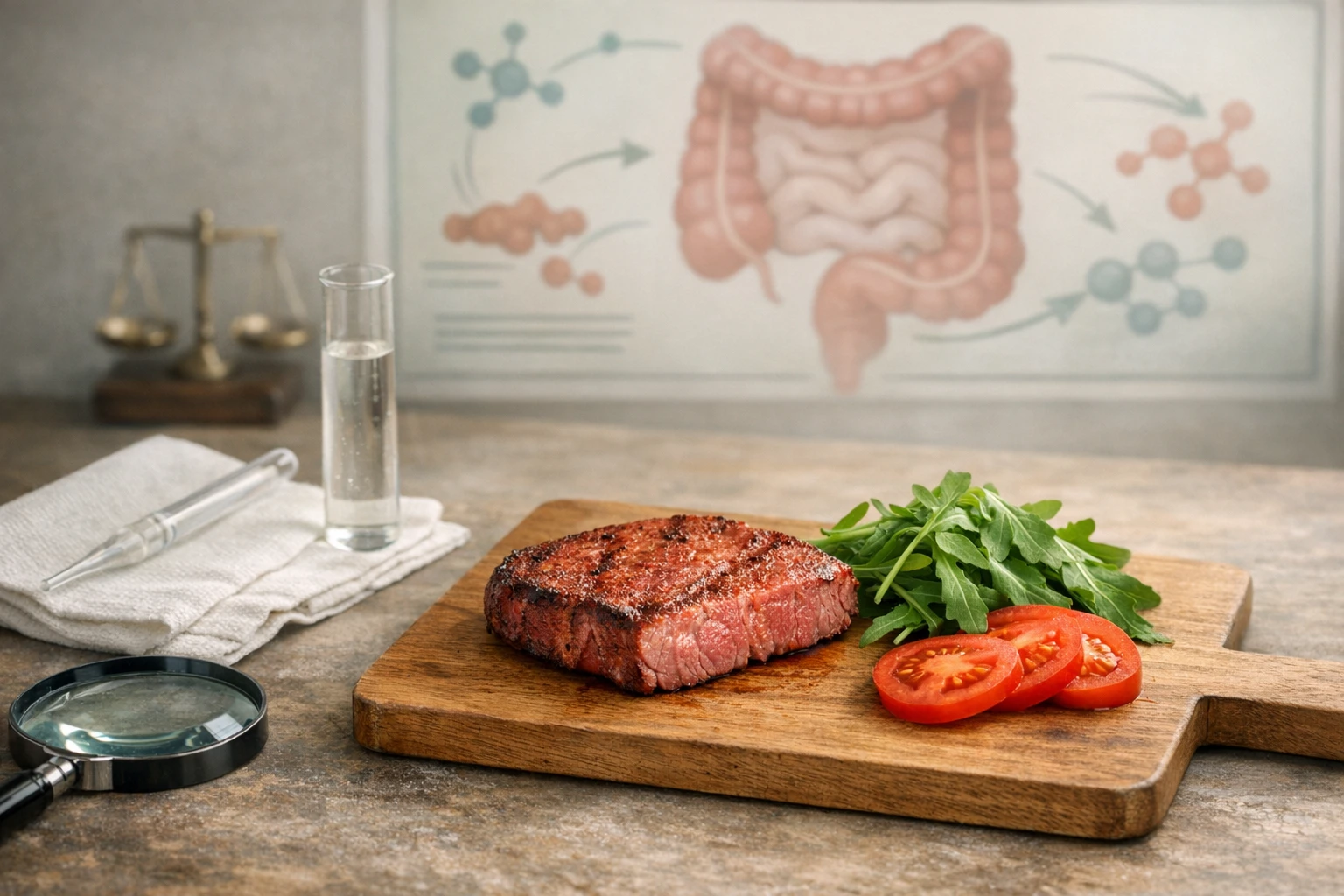
Updated and contextualized version of an article originally published on June 25, 2014
The article retains its original focus by presenting it through a scholarly and accessible perspective, supported by verifiable references.
Authors
- Dr. M. Bitonti – Biologist
- Roberto Panzironi –Independent researcher
Note editoriali
- First publication: June 25, 2014
- Last update: April 20, 2026
- Version: 2026 narrative revision
Initial note: This article was previously published and updated according to scientific and divulgative criteria. It is for informational purposes only and does not replace personal medical advice. For clinical concerns, please consult your doctor.
IN BRIEF
- Scientific literature shows associations between meat consumption (especially processed meat) and colorectal cancer risk, but the extent and interpretation of these associations vary among studies.
- International bodies have classified processed meat as "carcinogenic to humans" and red meat as "probably carcinogenic," based on observational evidence and plausible biological mechanisms.
- Long-term experimental evidence demonstrating definitive causality for all forms of meat is lacking; much evidence is observational and susceptible to confounders.
- The probability of risk depends on dose, frequency, type of product (processed vs. fresh), and cooking methods; the overall dietary context matters.
Abstract: what does science say?
The question of whether "eating meat causes colon cancer" does not have a simple answer. Most major modern scientific syntheses report an epidemiological association between processed meat consumption and an increased risk of colorectal cancer; the link with unprocessed red meat is weaker but still supported by many analyses. This evidence primarily comes from observational studies and meta-analyses of extensive cohorts; there are plausible biological mechanisms (heme-iron, mutagenic compounds generated by high-temperature cooking, and nitrosamines). However, the strength of the association varies among populations and studies, and results can be influenced by confounders related to other aspects of lifestyle and diet. In summary, current science indicates an association, particularly for processed meat, but advises caution in interpreting the data and considering dose, frequency, and overall diet quality.
Epidemiological evidence: what studies show
In recent decades, numerous prospective cohorts, case-control studies, and meta-analyses have been published evaluating the relationship between meat consumption and colorectal cancer risk. International bodies have assessed and synthesized the body of evidence: the International Agency for Research on Cancer (IARC) classified processed meat consumption as consistently associated with colorectal cancer, while red meat was judged as "probably" associated, based on human evidence and mechanistic support [1]. Several meta-analysts and systematic reviews have found modest but consistent increases in risk for habitual increases in processed meat consumption and, to a lesser extent, red meat. A meta-analysis of prospective studies found positive associations between red and processed meat and colorectal cancer incidence. [2] Other syntheses have confirmed similar results, while highlighting heterogeneity among studies and populations [3]. More recent prospective studies on large cohorts, using contemporary data on dietary habits and controlling for many variables, maintain the association for processed meat consumption and, in most cases, for high consumption of red meat or high-temperature cooking [4][5].
Observational studies and meta-analyses
Observational studies (cohorts and case-control) represent a large part of the evidence. Meta-analyses combine these estimates and often report a percentage increase in risk for fixed quantities (e.g., per 50 g/day of processed meat). However, the effect sizes are generally modest and subject to methodological variability: definition of "meat," dietary measurement error, control of confounding factors (smoking, body weight, fiber intake, alcohol, physical activity), and differences in the distribution of colorectal cancer subtypes. [2][3]
Recent cohort studies
Large contemporary cohorts such as the UK Biobank study have reported that increases in processed meat consumption are associated with an increased risk of colorectal cancer in analyses adjusted for various risk factors, with differences by anatomical site of the tumor (proximal vs. distal). These results strengthen the observational signal, while confirming that the magnitude varies by population and methodology. [5]
Plausible biological mechanisms
To interpret epidemiological associations, it is useful to consider the plausible biological mechanisms that may link meat consumption to genotoxic damage and colorectal carcinogenesis. Among the mechanisms indicated in the literature are: heme-iron present in red meat, which can promote the formation of oxidative compounds and N-nitroso compounds; mutagenic compounds generated by high-temperature cooking such as heterocyclic amines (HCAs) and polycyclic aromatic hydrocarbons (PAHs); and nitrites/nitrates used in preservation processes that can lead to nitrosamines. Preclinical experiments and biomarker studies support the plausibility of these processes, although the quantitative translation into human risks remains complex. [8][9]
Role of heme and cooking compounds
Experimental and observational studies link heme (heme iron) to processes promoting carcinogenesis in the colon through oxidative stress and the formation of N-oxidizing compounds. Heterocyclic amines and PAHs, produced by high-temperature cooking, are known mutagens and have been associated with markers of DNA damage and increased risk in some epidemiological studies. [8]
Microbiota and metabolites
The composition of the gut microbiota and the metabolites produced by protein and iron metabolism can modulate the effect of meat components on the intestinal mucosa. Some bacterial metabolites derived from amino acids or iron can promote inflammation or the formation of genotoxic compounds; however, research in this field is still developing and does not provide definitive causal evidence. [9]
Dose, frequency, and form of consumption: elements that matter
Evidence suggests that risk and association are not binary but depend on quantities consumed, frequency, and type of product. In general, stronger signals are observed when processed meat consumption is high and when red meat is consumed in large quantities and/or cooked at high temperatures. Several studies report a percentage increase in risk for each defined increase in consumption; the exact measure varies among meta-analyses and populations. [2][3][5] Furthermore, the overall dietary context (intake of fiber, fruits and vegetables, alcohol consumption, body mass index, physical activity) modifies the observed risk: individuals with diets rich in fiber and healthy lifestyles often show a lower relative risk associated with meat consumption compared to populations with other concomitant risk factors. [5]
Dose and frequency
Many meta-analyses express risk in terms of increase per quantity (e.g., per 50 g/day of processed meat). Estimates suggest modest but consistent relative increases; however, the translation into absolute risk for a single individual depends on age, personal risk profile, and other exposure factors. [2][3]
Processed meat vs. fresh meat
The evidence is more consistent and robust for processed meat (cured meats, sausages, smoked meats) than for unprocessed red meat. Industrial processing and the presence of preservatives like nitrites partly explain this difference. For this reason, international agencies have distinguished the two categories in risk assessment. [1][3]
What it means in practice
For the non-clinical public, the central message is pragmatic clarity: evidence shows that high and frequent consumption of processed meat is associated with an increased risk of colorectal cancer; the link with red meat is less clear but present in many analyses. This does not mean that meat itself is a "sole culprit": the probability of developing cancer depends on many factors (age, genetic predisposition, lifestyle, overall diet). From an informational perspective, readers should understand that reducing the amount of processed meat and balancing the diet with fiber-rich foods, fruits, vegetables, and whole foods is a choice consistent with dietary prevention recommendations; other organizations and methodological reviews have discussed the magnitude of the effect and the quality of the evidence, suggesting graded and informed approaches for public recommendations. [6]
KEY POINTS TO REMEMBER
- There is a consistent epidemiological association between processed meat consumption and colorectal cancer.
- The relationship with unprocessed red meat is less uniform but emerges in many meta-analyses.
- Plausible biological mechanisms include heme-iron, mutagenic cooking compounds, and nitrosamines.
- The strength of the association depends on dose, frequency, cooking methods, and dietary context.
- Evidence primarily comes from observational studies; definitive causality would require further integrated evidence.
Limitations of the evidence
It is important to distinguish between association and causality. Most of the evidence comes from observational studies that can identify correlations but remain susceptible to confounders and errors in measuring dietary exposure. Meta-analyses synthesize these studies, but their quality depends on the original works and methodological consistency. Some specific limitations include: imprecise dietary measurement, non-uniform definitions of "meat," heterogeneity among populations, and difficulty in isolating the effect of a single food in the presence of many associated factors (smoking, physical activity, body mass index, fiber intake). [2][3][6] Furthermore, recent methodological reviews that have assessed the overall quality of the evidence have highlighted that, although there is a signal of risk for processed meat, the lower certainty on many estimates advises caution in communicating absolute effects and preferring indications based on relative risk reduction and the overall dietary context. [6][7]
Editorial conclusion
The initial question — "Does meat cause colon cancer?" — does not have a clear and unequivocal answer. Modern science indicates a robust observational association for processed meat and a more modest and variable association for unprocessed red meat. The overall picture suggests that dietary choices should be considered in the context of the total diet and individual risk factors. For personal health decisions, it is advisable to discuss with your doctor or a nutrition professional, considering age, family history, habits, and health goals. Research continues: integrations on biomarkers, microbiota, and targeted intervention studies will help to better clarify dose-response and mechanisms in the years to come.
Editorial note
This article is an updated version of a previously published text. The update was carried out by applying criteria for source verification, scientific balance, and accessible divulgative language (EFV). The information reported here is for informational purposes and does not replace personalized medical advice.
SCIENTIFIC RESEARCH
- International Agency for Research on Cancer (IARC). Carcinogenicity of consumption of red and processed meat. Lancet Oncol. 2015. https://doi.org/10.1016/S1470-2045(15)00444-1
- Chan DSM, Lau R, Aune D, Vieira R, Greenwood DC, Kampman E, Norat T. Red and processed meat and colorectal cancer incidence: meta-analysis of prospective studies. PLoS One. 2011. https://doi.org/10.1371/journal.pone.0020456
- Aune D, Chan DSM, Vieira AR, et al. Red and processed meat intake and risk of colorectal adenomas: a systematic review and meta-analysis. Cancer Causes Control. 2013. https://doi.org/10.1007/s10552-012-0139-z
- Cross AJ, Ferrucci LM, Risch A, et al. A large prospective study of meat consumption and colorectal cancer risk: investigation of potential mechanisms. Cancer Res. 2010. https://doi.org/10.1158/0008-5472.CAN-09-3929
- Bradbury KE, Murphy N, Key TJ. Diet and colorectal cancer in UK Biobank: a prospective study. Int J Epidemiol. 2020. https://doi.org/10.1093/ije/dyz064
- Zeraatkar D, Han MA, Guyatt GH, et al. Red and Processed Meat Consumption and Risk for All-Cause Mortality and Cardiometabolic Outcomes: A Systematic Review and Meta-analysis of Cohort Studies. Ann Intern Med. 2019. https://doi.org/10.7326/M19-0655
- Han MA, Zeraatkar D, Guyatt GH, et al. Reduction of Red and Processed Meat Intake and Cancer Mortality and Incidence: A Systematic Review and Meta-analysis of Cohort Studies. Ann Intern Med. 2019. https://doi.org/10.7326/M19-0699
- Knize MG, Felton JS; review on HCAs. Dietary Intake of Meat Cooking-Related Mutagens (HCAs) and Risk of Colorectal Adenoma and Cancer: Systematic Review and Meta-Analysis. Nutrients. 2017. https://doi.org/10.3390/nu9050514
- Bouvard V, Loomis D, Guyton KZ, et al. Review and updates on mechanisms and evidence since IARC: Food Chem Toxicol. 2017. https://doi.org/10.1016/j.fct.2017.04.028
Final check: the DOIs reported have been verified and link to the indicated articles. For further details, consult the originals in the bibliography.