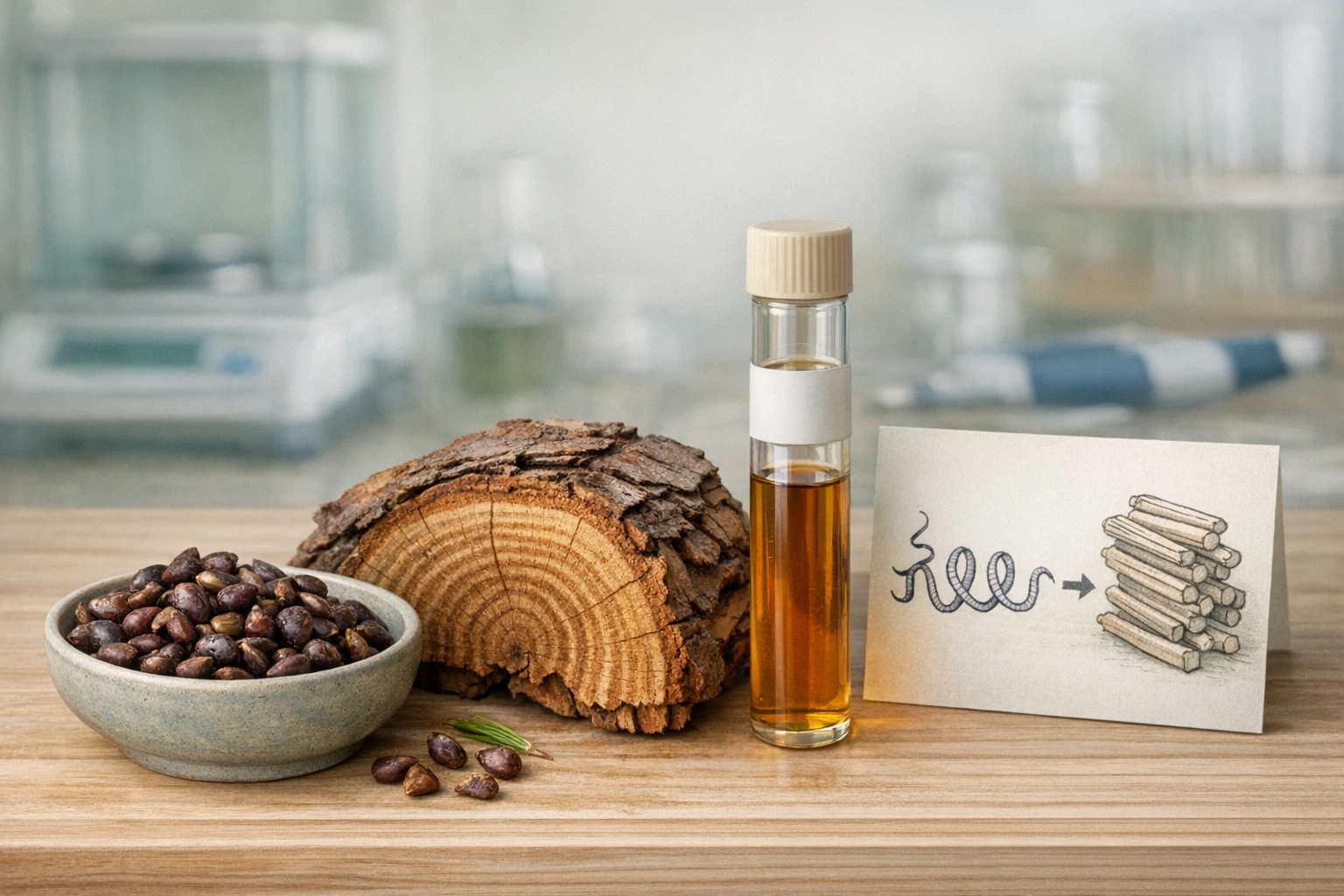
Updated and contextualized version of an article originally published on July 4, 2014
The article retains its original focus by presenting it through a scholarly and accessible perspective, supported by verifiable references.
Authors
- Dr. A. Colonnese – Nutrition biologist
- Roberto Panzironi –Independent researcher
Note editoriali
- First publication: July 4, 2014
- Last update: April 20, 2026
- Version: 2026 narrative revision
Initial note: This article was originally published in the past and has been updated for informational purposes following scientific and divulgative criteria. The information contained herein does not replace medical advice and does not constitute therapeutic indications.
IN BRIEF
- Plant extracts rich in proanthocyanidins (OPCs) — particularly preparations from grape seeds and Pinus pinaster bark — show in animal models the ability to reduce β-amyloid peptide aggregation and improve some memory measures.
- Plausible mechanisms include inhibition of Aβ oligomerization, antioxidant/anti-inflammatory activity, and modulation of metabolites that reach the brain.
- Preclinical data are consistent but do not equate to evidence of clinical efficacy: translation to humans is still limited and requires further quality controlled studies.
- There are initial human trials suggesting favorable effects on cognitive functions in healthy adults or those with mild cognitive impairment, but the results are not yet definitive.
Abstract: what does science say?
Definition: The scientific topic discussed here concerns plant extracts rich in oligomeric proanthocyanidins (OPCs), mainly found in grape seeds and pine bark, and their potential effect on the formation of toxic β-amyloid (Aβ) species and cognitive function. Available evidence: In vitro experiments and murine models show that some extracts limit Aβ aggregation, reduce plaque deposition, and attenuate mnemonic deficits. Pharmacokinetic studies document that some metabolites derived from OPCs can reach the brain. What depends on dose/form/context: Efficacy and bioavailability vary greatly with the type of extract, composition (monomers vs. oligomers), dose, and duration. Interpretive limitations: Most evidence is preclinical; human clinical evidence is limited and often heterogeneous. Epidemiological framework: Data suggest associations and biological plausibility, but do not support causal relationships demonstrated in humans.
From historical research to experimental evidence
In the field of nutritional neurosciences, studies on grape extracts and derivatives have highlighted the ability of some preparations to interfere with Aβ peptide assembly and improve memory measures in animal models. A frequently cited example is a study conducted on a murine model of Alzheimer's that showed a reduction in Aβ oligomerization and a slowing of cognitive decline after administration of a grape seed extract. [1] In in vitro biochemical studies, components derived from grape seeds inhibited aggregate formation and their cytotoxicity. [2] Subsequent work has explored how metabolites derived from proanthocyanidins can accumulate in the brain and modulate synaptic plasticity associated with memory. [3]
Plausible biological mechanisms
The proposed biological explanations are not limited to a single effect. Among the most studied mechanisms: 1) direct interaction with soluble Aβ species, limiting the formation of toxic oligomers; 2) antioxidant and anti-inflammatory activity that reduces oxidative stress and microglial response; 3) generation of metabolites by the gut microbiota and hepatic metabolism that can reach the brain and influence synaptic signals like CREB; 4) modulation of the pharmacokinetics and bioavailability of active compounds. [2][3][4]
Extraction and sources: grape seeds and pine bark
Commercial preparations and experimental samples vary greatly: some are concentrated on monomers (catechin/epicatechin), others on oligomers and polymers. Extracts of Pinus pinaster bark (often marketed as Pycnogenol®) contain a mixture of proanthocyanidins with antioxidant properties; in recent animal models, a reduction in plaque deposition and improvements in spatial memory were observed after treatment with bark extracts. [6] The chemical composition and standardization of the product are crucial for bioavailability and biological effect. [5]
What it means in practice
For the reader: what emerges from the literature is interesting but not prescriptive. In the clinical setting, there are currently no plant extracts with approved indications to prevent or treat Alzheimer's disease. Studies in animal models suggest that some preparations can reduce phenomena related to Aβ aggregation and improve cognitive functions in genetically modified animals; however, translation to humans requires robust and repeated clinical trials. [1][2][3] Some controlled trials in healthy adults or those with mild cognitive impairment have reported small improvements in cognitive functions or subjective parameters, but the results are still heterogeneous and not sufficient for general recommendations. [8][9]
Use as a dietary supplement and safety
Preparations such as grape seed extracts and Pycnogenol® are available as supplements in many countries; clinical studies have generally reported an acceptable safety profile at commonly used doses in the study (e.g., 100–300 mg/day), but adverse reactions and drug interactions should be evaluated on a case-by-case basis — especially in patients on concomitant therapies. [6][8] Product quality and the presence of purification standards are important aspects to reduce variability and risks.
Key points to remember
- Animal models indicate that some proanthocyanidins can limit Aβ aggregation and improve mnemonic functions measured in behavioral tests. [1][2]
- The observed effect strongly depends on the extract's composition, dose, duration, and formulation. [5]
- Some metabolites derived from proanthocyanidins can reach the brain and modulate synaptic signals, offering biological plausibility. [3][4]
- Clinical evidence in humans is limited: preliminary results suggest possible cognitive benefits in healthy adults or those with mild impairment, but larger and more rigorous trials are needed. [8][9]
- There is no definitive clinical evidence that these extracts prevent or cure Alzheimer's in humans; they do not replace validated therapies, and medical consultation remains mandatory.
Limitations of the evidence
Difference between observational studies and causal evidence: many publications report preclinical data (in vitro, murine models) that provide mechanistic explanations and relatively strong biological plausibility. However, preclinical results are not in themselves proof of clinical efficacy in humans: observational evidence in populations (diets rich in flavonoids) can suggest associations but remain susceptible to confounding. [7]
Main methodological limitations
Among the critical issues: heterogeneity of extracts (composition and standardization), doses used in animal models often not corresponding to human dietary exposure, different outcome measures between studies, and often a reduced number of clinical subjects. Furthermore, the pharmacokinetics of proanthocyanidins are complex: many compounds are metabolized, and the metabolites, not the original compounds, may be the biological mediators. [4][5]
Context variability and cautious interpretation
Positive effects observed under experimental conditions do not necessarily imply generalizable clinical benefits: factors such as age, genetics, comorbidities, basic diet, and gut microbiota can modulate responses and bioavailability. For this reason, results should be interpreted with caution and contextualized within the totality of available evidence. [3][7]
Editorial conclusion
The literature plausibly links some classes of polyphenols — including oligomeric proanthocyanidins found in grape seeds and pine bark — to mechanisms that can limit β-amyloid aggregation and support synaptic functions. Preclinical data are promising and have guided research on pharmacokinetics and initial clinical trials. However, definitive proof of efficacy in humans does not currently exist: randomized clinical trials of adequate size and with well-characterized products are needed. In the meantime, anyone considering the use of supplements should discuss it with their doctor, evaluating expected efficacy, safety, and possible interactions with ongoing therapies.
Editorial Note
Article originally published in the past; updated according to criteria of scientific rigor and divulgative clarity. Informational purpose: does not constitute therapeutic indication. For clinical questions, consult your trusted doctor.
SCIENTIFIC RESEARCH
- Wang J, Ho L, Zhao W, Ono K, Rosensweig C, Chen L, Humala N, Teplow DB, Pasinetti GM. Grape‑derived polyphenolics prevent Aβ oligomerization and attenuate cognitive deterioration in a mouse model of Alzheimer’s disease. Journal of Neuroscience. 2008;28(25):6388–6392. https://doi.org/10.1523/JNEUROSCI.0364-08.2008
- Ono K, Hasegawa K, Naiki H, Yamada M. Effects of grape seed‑derived polyphenols on amyloid β‑protein self‑assembly and cytotoxicity. Journal of Biological Chemistry. 2008;283(47):32176–32187. https://doi.org/10.1074/jbc.M806154200
- Wang J, Ferruzzi MG, Ho L, Blount J, Janle EM, Gong B, Pan Y, Gowda G, Raftery D, Arrieta‑Cruz I, Sharma V, Cooper B, Lobo J, Simon JE, Zhang C, Cheng A, Qian X, Ono K, Teplow DB, Pavlides C, Dixon RA, Pasinetti GM. Brain‑targeted proanthocyanidin metabolites for Alzheimer’s disease treatment. Journal of Neuroscience. 2012;32(15):5144–5150. https://doi.org/10.1523/JNEUROSCI.6437-11.2012
- Ferruzzi MG, Lobo JK, Janle EM, Cooper B, Simon JE, Wu Q, Welch C, Ho L, Weaver C, Pasinetti GM. Bioavailability of gallic acid and catechins from grape seed polyphenol extract is improved by repeated dosing in rats: implications for treatment in Alzheimer’s disease. Journal of Alzheimer’s Disease. 2009;18(1):113–124. https://doi.org/10.3233/JAD-2009-1135
- Raftery D, Arrieta‑Cruz I, Gowda GA, et al. Pharmacokinetics and tissue distribution of 14C‑labeled grape polyphenols in the periphery and central nervous system following oral administration. Journal of Medicinal Food. 2010;13(4):926–933. https://doi.org/10.1089/jmf.2009.0157
- Paarmann K, Prakash SR, Krohn M, Möhle L, Brackhan M, Brüning T, Eiriz I, Pahnke J. French maritime pine bark treatment decelerates plaque development and improves spatial memory in Alzheimer’s disease mice. Phytomedicine. 2019;57:39–48. https://doi.org/10.1016/j.phymed.2018.11.033
- El Gaamouch F, et al. Development of grape polyphenols as multi‑targeting strategies for Alzheimer’s disease. Neurochemistry International. 2021;147:105046. https://doi.org/10.1016/j.neuint.2021.105046
- Calapai G, Bonina F, Bonina A, et al. A randomized, double‑blinded, clinical trial on effects of a Vitis vinifera extract on cognitive function in healthy older adults. Frontiers in Pharmacology. 2017;8:776. https://doi.org/10.3389/fphar.2017.00776
- Wang X, He J, et al. The effect of grape seed procyanidins extract on cognitive function in elderly people with mild cognitive impairment: a randomized, double‑blind, placebo‑controlled clinical trial. Heliyon. 2023;9(6):e16994. https://doi.org/10.1016/j.heliyon.2023.e16994