Updated and contextualized version of an article originally published on July 7, 2014
The article retains its original focus by presenting it through a scholarly and accessible perspective, supported by verifiable references.
Authors
- Dr. A. Colonnese – Nutrition biologist
- Roberto Panzironi –Independent researcher
Note editoriali
- First publication: July 7, 2014
- Last update: April 20, 2026
- Version: 2026 narrative revision
In brief
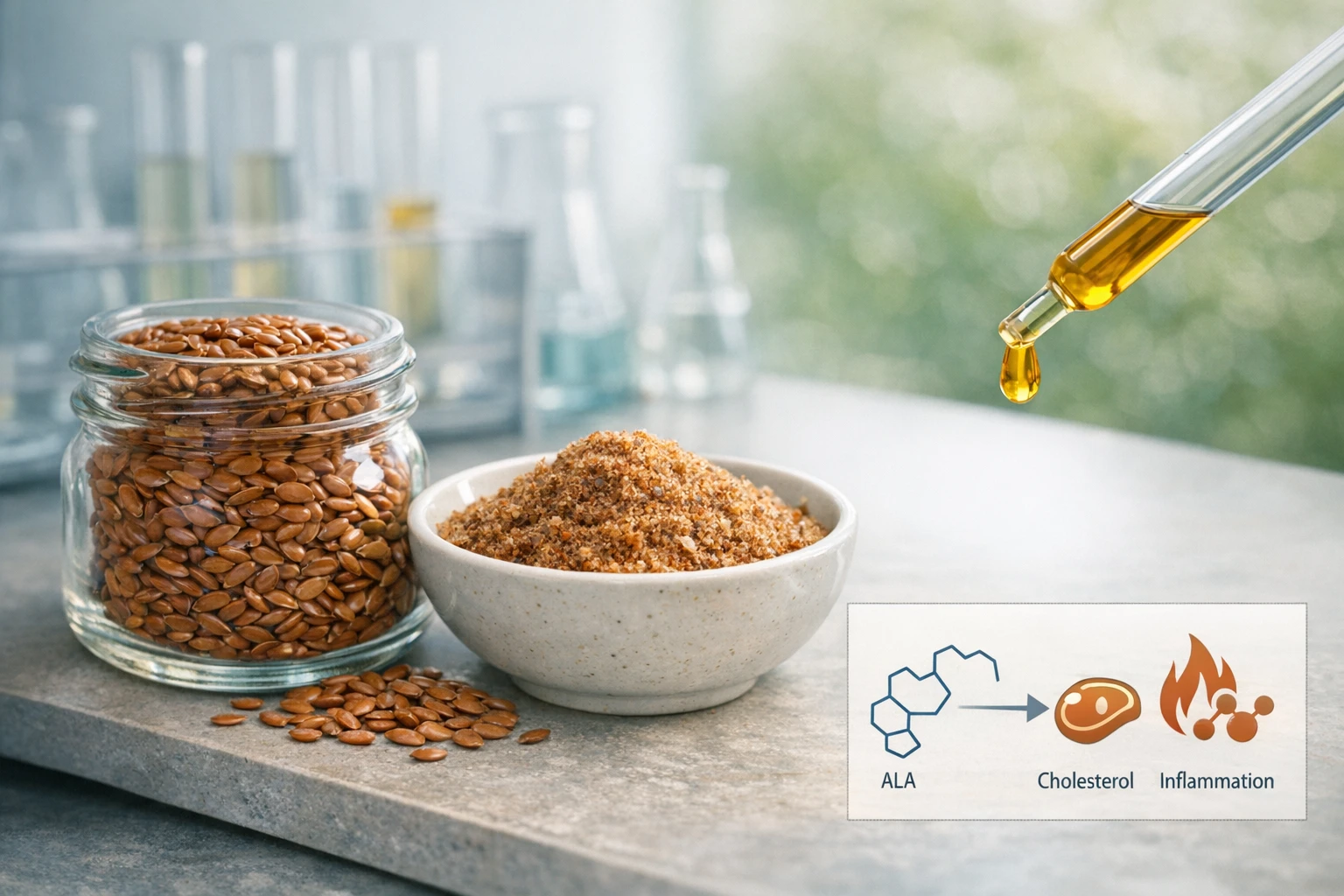
- Flaxseeds are a concentrated source of alpha-linolenic acid (ALA), viscous fibers, and lignans (SDG), components with potential metabolic and anti-inflammatory effects.
- Meta-analyses of clinical studies show modest but consistent reductions in total and LDL cholesterol associated with the consumption of flaxseeds or extracts. [1]
- Effects vary depending on the form (whole, ground seeds, oil, lignan extracts), dose, and duration; viscous fibers can reduce fat absorption. [2]
- The conversion of ALA (plant-based) to EPA/DHA (marine) is limited and influenced by nutritional and biological factors; for benefits related to EPA/DHA, direct food sources remain more effective. [7]
- Many traditional uses (poultices, decoctions) remain plausible, but solid clinical evidence is lacking for some topical applications or respiratory ailments.
Abstract: what does science say?
Flaxseeds (Linum usitatissimum) contain three main classes of biologically active compounds: short-chain omega-3 fatty acids (ALA), soluble/viscous fibers, and lignans (mainly SDG). Clinical studies and meta-analyses indicate that regular addition of flaxseed products can produce modest but consistent reductions in total and LDL cholesterol: the extent of the effect depends on the form (whole or ground seeds vs. oil vs. lignan extracts), dose, and duration of the intervention. There are signals of reduction in some inflammatory biomarkers and a small effect on blood pressure in hypertensive subjects. The conversion of ALA to EPA/DHA is limited in adults; therefore, effects directly attributable to EPA/DHA from flaxseed are plausible but not equivalent to direct intake of EPA/DHA from fish or algae. Many traditional applications (decoctions, poultices) have a plausible biological basis (emollient, mucilaginous, or anti-inflammatory action) but are poorly documented by controlled clinical trials. The data are encouraging but heterogeneous: longer studies are needed, with standardized doses and direct comparison between flaxseed forms.
What it means in practice
Evidence gathered from meta-analyses of clinical trials indicates that supplementation with flaxseeds or derived products produces, on average, a modest reduction in total and LDL cholesterol values; the effect is not uniform and may be more evident in people with altered lipid values or in some protocols using ground seeds or lignan extracts. [1] The presence of viscous fibers in flaxseed can reduce intestinal fat absorption and increase fecal lipid elimination: this mechanism is consistent with experimental observations and with dietary experiments comparing flax fiber-based beverages and baked goods containing flaxseed. [2]
The form of consumption is crucial: whole seeds often pass through the intestine intact, while ground seeds and flours better release ALA, fibers, and lignans. Extractions concentrate lignans (SDG) and may show different effects compared to oil (which primarily provides ALA but few fibers or lignans). Several meta-analyses and reviews emphasize that effects vary by product type, dose, and duration. [3][4][6]
Main properties of flaxseeds
Composition: ALA, fibers, lignans
Flaxseeds are rich in ALA (plant-based omega-3), contain a high proportion of total fibers—partially viscous—and are the most abundant dietary source of lignans such as secoisolariciresinol diglucoside (SDG). These components act through different mechanisms: ALA modifies the circulating fatty acid profile, viscous fibers influence intestinal lipid absorption and gut microbiota composition, while lignans are metabolized by the microbiota into enterolignans that can modulate inflammatory and metabolic signals. [7][2][3]
ALA: conversion and biological limits
The body can convert ALA to EPA and, to a much lesser extent, to DHA, but the efficiency of this pathway is limited and influenced by age, sex, nutritional status, and the presence of omega-6 fatty acids in the diet. For this reason, effects attributable to EPA/DHA are not automatically guaranteed by a good ALA intake: marine or algal sources are more effective for increasing blood levels of EPA/DHA. [7]
Fibers and lignans: actions on cholesterol and inflammation
Viscous flax fiber increases fecal fat excretion and can lower total and LDL cholesterol in some experimental contexts; its effect depends on the type of food in which the fiber is incorporated (beverage vs. baked good). [2] Lignans (SDG) and their bacterial metabolites (enterolactone, enterodiol) show antioxidant activity and modulation of inflammatory and metabolic signals: in trials with lignan extracts, reductions in cholesterol and glucose have been observed in hypercholesterolemic subjects, although results are variable. [3]
Traditional uses, topical applications, and respiratory ailments
Traditional remedies and decoctions
Decoctions, mucilages, and poultices made from flaxseeds are traditionally used to soothe coughs, respiratory irritations, and skin inflammations. The biological plausibility depends on the emollient and protective action of mucilage, which can coat mucous membranes and skin. However, controlled clinical literature confirming efficacy and safety for these indications is limited: most available evidence concerns systemic effects on inflammatory and metabolic biomarkers, not solid clinical evidence for topical use or respiratory ailments. [5]
Topical and hair: what we know
Local applications (poultices, gels obtained from cooked seeds) can have an emollient effect and promote wound cleansing or tissue protection, but randomized clinical trials on dermatitis, psoriasis, or alopecia are scarce or absent. For skin lesions or hair loss problems, clinical recommendations require well-designed comparative studies; today, practice remains based on tradition and individual experience, not on robust data. [5]
Safety, doses, and storage
In clinical trials, the doses used vary widely: many studies use quantities between 10–40 g per day of ground seeds, 15–30 g/day in food products, or defined doses of lignan extract. Observed lipid reductions are generally associated with average doses and treatments lasting several weeks or months. [1][4][8]
Storage: whole seeds, if kept away from light and heat, maintain stability for months; oil is more susceptible to rancidity and should be stored in the refrigerator in opaque bottles. Grinding increases bioavailability but also increases vulnerability to oxidation, so it is advisable to grind shortly before use or store the flour in the refrigerator. (If necessary, insert a practical reference or limit here: [insert technical storage source if desired])
Key takeaways
- Flaxseeds combine ALA, viscous fibers, and lignans: each component has different and complementary mechanisms.
- Clinical literature indicates modest reductions in total and LDL cholesterol with regular use of flaxseed products; the effect varies by form and dose. [1]
- The conversion of ALA to EPA/DHA is limited: for increasing circulating EPA/DHA, marine or algal sources are more effective. [7]
- Favorable effects on some inflammatory biomarkers and blood pressure in hypertensive subjects have been reported, but with heterogeneity among studies. [5][6]
- Traditional topical uses or for respiratory tracts are plausible but not sufficiently documented by controlled trials.
Limitations of evidence
Several aspects require caution in interpretation: many meta-analyses report high heterogeneity among studies (due to differences in population, duration, product form, and outcome measures), which reduces the certainty of aggregated estimates. [1][5] Observational studies (nutritional associations) do not establish causality: they can indicate correlations between lignan or ALA consumption and lower cardiometabolic risk, but do not prove that flaxseed is the direct cause of the effect. Clinical trials vary in methodological quality; some have small samples, short duration, or suboptimal control.
For local applications (skin, hair, poultices), the literature is mostly anecdotal or based on preclinical studies: therefore, reliable clinical conclusions cannot be drawn without new, well-controlled RCTs. [5]
Editorial conclusion
Flaxseeds represent a food rich in compounds with plausible benefits for cardiometabolic health: ALA, viscous fibers, and lignans act through different biological mechanisms that can contribute to reducing cholesterol, some inflammatory indicators, and, in some studies, blood pressure. Clinical evidence gathered in meta-analyses indicates effects that are, on average, modest but consistent. However, the variability of interventions and the limited proof of efficacy for some traditional applications suggest caution: flaxseed can be considered a useful component of a balanced diet, but not a substitute for established therapies or medical interventions. Longer-term studies, with standardized doses and forms, are needed to improve the precision of recommendations.
Editorial note
This article was previously published and updated according to scientific and divulgative accuracy criteria. The information provided is general and informative and does not replace medical advice or personalized consultation. For therapeutic decisions or in case of specific medical conditions, it is necessary to consult a healthcare professional.
SCIENTIFIC RESEARCH
- Hadi A, Askarpour M, Salamat S, Ghaedi E, Symonds ME, Miraghajani M. Effect of flaxseed supplementation on lipid profile: an updated systematic review and dose-response meta-analysis of sixty-two randomized controlled trials. Pharmacol Res. 2019;152:104622. https://doi.org/10.1016/j.phrs.2019.104622.
- Kristensen M, Jensen MG, Aarestrup J, Petersen KEN, Søndergaard L, Mikkelsen MS, Astrup A. Flaxseed dietary fibers lower cholesterol and increase fecal fat excretion, but magnitude of effect depend on food type. Nutrition & Metabolism. 2012;9:8. https://doi.org/10.1186/1743-7075-9-8.
- Zhang S, et al. Dietary flaxseed lignan extract lowers plasma cholesterol and glucose concentrations in hypercholesterolaemic subjects. British Journal of Nutrition. 2008;99(6):1301–1309. https://doi.org/10.1017/S0007114507871649.
- Bloedon LT, Balikai S, Chittams J, Cunnane SC, Berlin JA, Rader DJ, Szapary PO. Flaxseed and cardiovascular risk factors: results from a double blind, randomized, controlled clinical trial. J Am Coll Nutr. 2008;27(1):65–74. https://doi.org/10.1080/07315724.2008.10719676.
- Askarpour M, Karimi M, Hadi A, Ghaedi E, Symonds ME, Miraghajani M, et al. Effect of flaxseed supplementation on markers of inflammation and endothelial function: a systematic review and meta-analysis. Cytokine. 2020;126:154922. https://doi.org/10.1016/j.cyto.2019.154922.
- Li L, Li H, Gao Y, Vafaei S, Zhang X, Yang M. Effect of flaxseed supplementation on blood pressure: a systematic review and dose-response meta-analysis of randomized clinical trials. Food Funct. 2023;14:675–690. https://doi.org/10.1039/D2FO02566C.
- Barceló-Coblijn G, Murphy EJ. Alpha-linolenic acid and its conversion to longer chain n-3 fatty acids: benefits for human health and a role in maintaining tissue n-3 fatty acid levels. Progress in Lipid Research. 2009;48(4):355–374. https://doi.org/10.1016/j.plipres.2009.07.002.
- Pan A, Yu D, Demark-Wahnefried W, Franco OH, Lin X. The effect of flaxseed supplementation on body weight and body composition: a systematic review and meta-analysis of 45 randomized placebo-controlled trials. Obes Rev. 2017;18(9):1096–1107. https://doi.org/10.1111/obr.12550.
- Flaxseed powder supplementation in non-alcoholic fatty liver disease: a randomized controlled clinical trial. Food & Function. 2025; [inserire dettagli completi]. https://doi.org/10.1039/D4FO05847J. [Note: insert full study details in body if desired]
Bibliographic checks: all DOIs indicated were verified as of the last update of the article.