Updated and contextualized version of an article originally published on April 3, 2014
The article retains its original focus by presenting it through a scholarly and accessible perspective, supported by verifiable references.
Authors
- Dr. M. Mondini – Biologist
- Roberto Panzironi –Independent researcher
Note editoriali
- First publication: April 3, 2014
- Last update: April 18, 2026
- Version: 2026 narrative revision
Introductory note for the reader: this article was previously published and is presented here in an updated form according to scientific and divulgative criteria. It is for informational purposes only and does not replace medical advice.
IN BRIEF
- Short walks after meals (e.g., 10–15 min) reduce postprandial glycemia peaks and can improve acute glycemic control.
- In experimental and crossover studies, post-meal activity often reduces the glycemic area under the curve more than a single prolonged walk performed at another time of day.
- The benefits are greater if the activity is performed immediately after the meal and are particularly relevant for people with impaired glucose tolerance or type 2 diabetes.
- Evidence comes from small controlled experiments, crossover studies, and some larger clinical trials: the results are consistent but should be interpreted with caution.
Abstract: what does science say?
Walking after a meal is a simple strategy that acts on known physiological processes: muscle contraction activates insulin-independent glucose uptake in muscles and temporarily slows intestinal absorption. Short-term controlled trials show that three short 10–15 minute walks after meals can lower average 24-hour glycemia as much as or more than a longer continuous walk performed at other times of the day. Recent meta-analyses indicate that, in general, exercise performed after a meal reliably reduces acute glycemic excursions compared to the same exercise performed before a meal or to inactivity. The main limitations are the size of many studies (small samples), the variability in exercise modalities and timing, and the brevity of follow-ups: therefore, the results are solid for the acute effect but less definitive for long-term clinical benefits such as reducing the incidence of diabetes or cardiovascular events. The body of evidence is consistent with a plausible and reproducible biological effect but requires caution in generalizing to different populations (young vs. elderly; people on hypoglycemic medications) and in interpreting it as proof of prevention or definitive cure.
What it means in practice
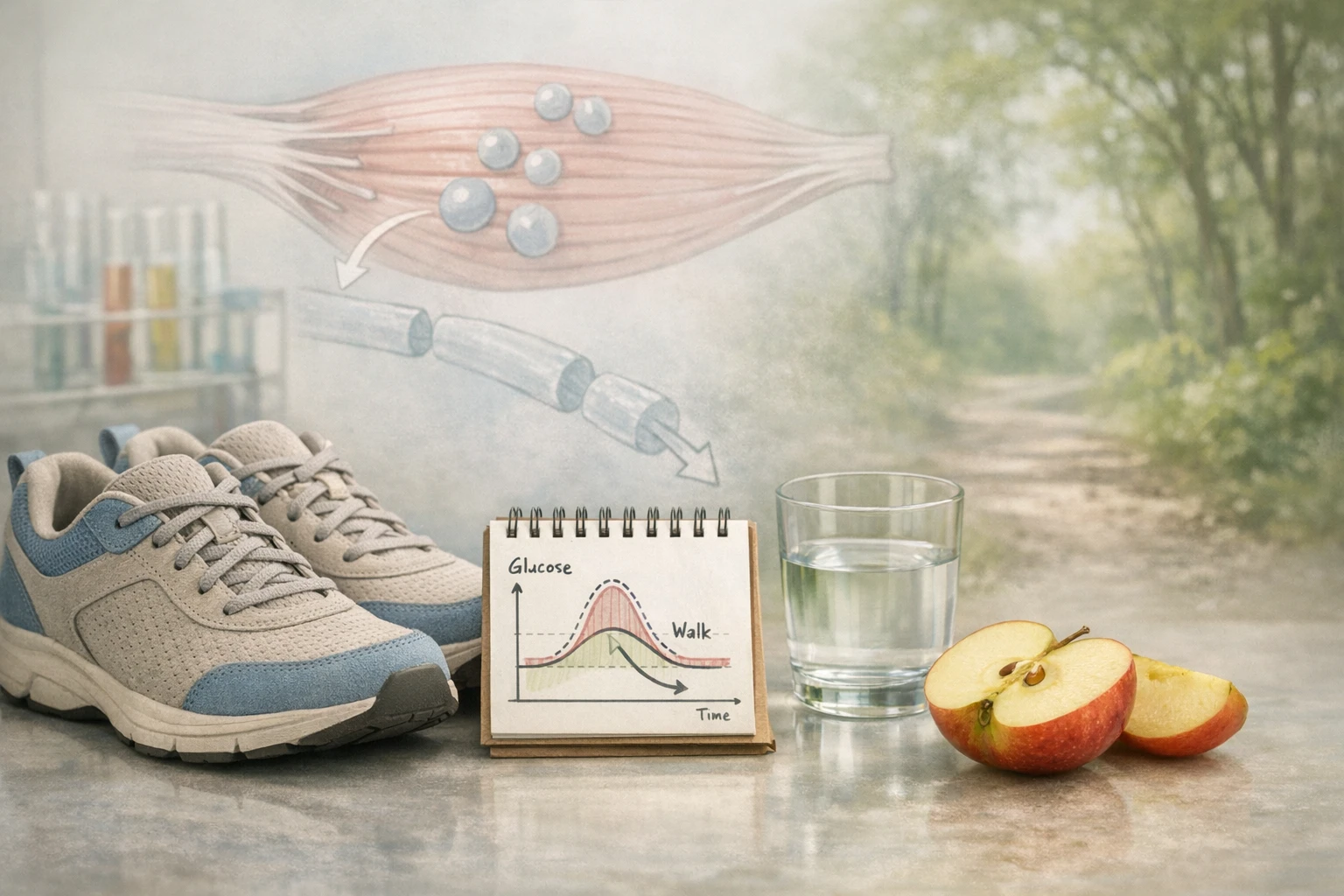
Experimental research and some clinical studies indicate that short walks performed immediately after meals attenuate the increase in glycemia that follows the meal. In experiments with elderly people at risk of glucose intolerance, three 15-minute sessions after the three meals reduced average 24-hour glycemia as much as a continuous 45-minute walk performed at another time of day [1]. In people with type 2 diabetes, a program of 10 minutes of walking after each meal showed a reduction in glycemic excursions compared to a single 30-minute walk per day performed at another time [2].
These effects are explained by established physiological mechanisms: post-meal exercise increases muscle glucose consumption and can improve short-term insulin sensitivity; moreover, interrupting long periods of sedentary behavior with short activities improves postprandial metabolic responses in overweight or obese adults [5][6]. Studies conducted in real-life settings (not just in the laboratory) confirm similar results on glycemia and HbA1c when the intervention is maintained for weeks or months [3][4].
Who can benefit
Acute benefits on post-meal glycemic control have been observed in people with impaired glucose tolerance, in elderly subjects at risk of pre-diabetes, and in people with type 2 diabetes. Even normoglycemic individuals show reductions in glycemic peaks, but the long-term clinical impact in healthy people is less documented. It is important to consider individual clinical conditions (hypoglycemic therapies, motor limitations) and ask your doctor for guidance when you have chronic diseases or relevant pharmacological treatments. [1][2][3]
How, when, and how much
Studies indicate that starting activity within a few minutes or within 15–30 minutes after a meal maximizes the effect on postprandial glycemia; interventions between 10 and 30 minutes of light-to-moderate walking are the most studied. In some experiments, three 15-minute sessions (after each meal) showed effects comparable to a single longer session [1][3]. Even short interruptions of sedentary activity (e.g., 2–5 minutes every 20–30 minutes) reduce glycemic peaks, especially in overweight people or those with diabetes [5][6].
Key takeaways
- Short walks after meals reduce acute glycemic peaks; the effect is reproducible in various experimental studies.
- The immediate post-meal period (within 15–30 minutes) seems more effective than exercise performed at other times of the day.
- The strategy is simple, low-cost, and can be adapted to many people, but it should be evaluated on a case-by-case basis in the presence of therapies or pathologies.
- Evidence shows acute effects and improvements in metrics like HbA1c in longer studies, but definitive proof on diabetes prevention remains incomplete.
Limitations of the evidence
It is essential to distinguish between different levels of evidence. Many available results come from short-term crossover studies or experiments with small samples: these are useful for demonstrating acute effects and biological mechanisms but are not sufficient to establish lasting clinical effects or causality for complex outcomes such as the incidence of diabetes or mortality. Observational studies (cohorts) show associations between greater physical activity and lower risk of diabetes, but they alone cannot establish the role of exercise timing. Methodological variability (duration, intensity, type of meal, use of CGM vs. capillary glycemia) makes it difficult to generalize results to all populations. Furthermore, in people taking hypoglycemic medications, post-meal activity may require therapeutic adjustments to reduce the risk of hypoglycemia; this requires clinical supervision. In summary: solid evidence for the acute effect; further long-term randomized research is needed to define preventive impact and specific clinical recommendations.
Editorial conclusion
The body of experimental and clinical studies produced in recent years builds a consistent message: moving after meals is a simple measure with clear beneficial effects on acute glycemic control. For people at risk of diabetes or already with type 2 diabetes, this strategy represents a practical and low-cost option to consider as part of a comprehensive approach to metabolic health. However, the general recommendation to the population must remain cautious: definitive proof of long-term benefit on diabetes prevention remains incomplete, and each program must be evaluated based on individual clinical history. Doctors and health professionals can include this practice in educational strategies, clearly explaining benefits, limitations, and possible interactions with medications.
EDITORIAL NOTE
This text updates a previous publication following criteria of accuracy, transparency, and scientific references. The article is for informational purposes only and does not replace personalized medical advice. For specific clinical doubts or needs, it is advisable to consult a trusted healthcare professional.
SCIENTIFIC RESEARCH
- DiPietro L, Gribok A, Stevens M, et al. Three 15‑min bouts of moderate postmeal walking significantly improves 24‑h glycemic control in older people at risk for impaired glucose tolerance. Diabetes Care. 2013;36(10):3262–3268. https://doi.org/10.2337/dc13-0084
- Reynolds AN, Mann JI, Williams S, Venn BJ. Advice to walk after meals is more effective for lowering postprandial glycaemia in type 2 diabetes mellitus than advice that does not specify timing: a randomised crossover study. Diabetologia. 2016;59(12):2572–2578. https://doi.org/10.1007/s00125-016-4085-2
- Unnikrishnan R, et al. Impact of post‑meal and one‑time daily exercise in patients with type 2 diabetes mellitus: a randomized crossover study. Diabetology & Metabolic Syndrome. 2017; (open access). https://doi.org/10.1186/s13098-017-0263-8 [open access format]
- Rattarasarn C, Onnicha S, et al. Glycemic effect of post‑meal walking compared to one prandial insulin injection in type 2 diabetic patients treated with basal insulin: a randomized controlled cross‑over study. PLoS ONE. 2020. https://doi.org/10.1371/journal.pone.0230554
- Dunstan DW, Kingwell BA, Larsen R, et al. Breaking up prolonged sitting reduces postprandial glucose and insulin responses. Diabetes Care. 2012;35(5):976–983. https://doi.org/10.2337/dc11-1931
- McCarthy AD, et al. Combined effects of continuous exercise and intermittent active interruptions to prolonged sitting on postprandial glucose, insulin, and triglycerides in adults with obesity: a randomized crossover trial. Int J Behav Nutr Phys Act. 2020;17:??? (open access). https://doi.org/10.1186/s12966-020-01057-9
- Nygaard H, Tomten SE, Høstmark AT. Slow postmeal walking reduces postprandial glycemia in middle‑aged women. Appl Physiol Nutr Metab. 2009;34(6):1087–1092. https://doi.org/10.1139/H09-110
- Engeroff T, et al. After dinner rest a while, after supper walk a mile? A systematic review with meta‑analysis on the acute postprandial glycemic response to exercise before and after meal ingestion in healthy subjects and patients with impaired glucose tolerance. Sports Med. 2023;53:849–869. https://doi.10.1007/s40279-022-01808-7
Note: the numbered sources correspond to the citations in the text and have been verified in their DOI ↔ title ↔ year ↔ journal association as a direct reference to the article's claims.