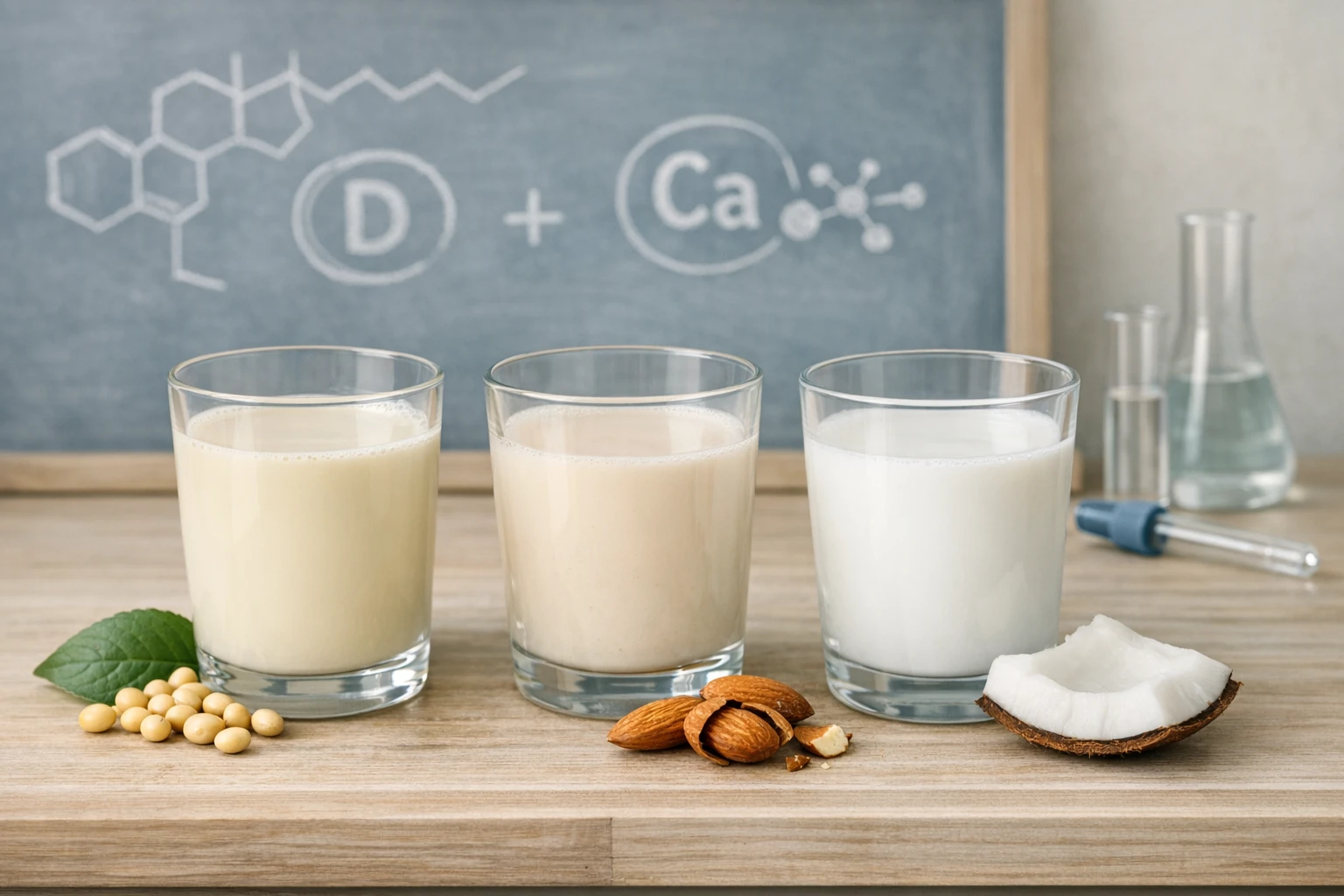
Updated and contextualized version of an article originally published on July 24, 2014
The article retains its original focus by presenting it through a scholarly and accessible perspective, supported by verifiable references.
Authors
- Dr. A. Conte – Biologist
- Roberto Panzironi –Independent researcher
Note editoriali
- First publication: July 24, 2014
- Last update: April 20, 2026
- Version: 2026 narrative revision
IN BRIEF
- Plant-based beverages (soy, almond, coconut) are not equivalent to cow's milk in terms of protein, calcium, and other micronutrients; many are fortified but variability is wide.
- Soy is the alternative with the protein profile closest to cow's milk; almond and coconut generally have less protein and micronutrients per serving.
- For lactose intolerance or cow's milk allergy, nutritionally adequate options exist, but for infants and young children, unfortified plant-based beverages are not recommended as the sole source of nutrition.
- The presence and bioavailability of calcium, vitamin D, and iodine in plant-based beverages depend heavily on the formulation and production process.
Abstract: what does science say?
"Cow's milk alternatives" refer to plant-based beverages (soy, almond, coconut, oat, rice, etc.) or "lactose-free" beverages derived from animal milk with lactose removed. Available evidence shows that the nutritional profile of these beverages varies greatly: soy is the option most similar to milk in terms of protein, while almond and coconut offer less protein and, often, fewer minerals. Many beverages are fortified with calcium and vitamins; however, the quantity, chemical form, and bioavailability can differ from product to product. For infants and young children, pediatric guidelines recommend caution: some plant-based beverages are not suitable as the sole source of nutrition in the first 12–24 months. Practical recommendations depend on age, nutritional status, presence of allergies, dietary habits, and the choice of fortified products. The main limitations of the evidence are the prevalence of observational studies, the great heterogeneity of commercial products, and the variability in fortification and nutrient bioavailability.
Main Section
What is an "alternative milk" and how does it differ from cow's milk?
Plant-based beverages are made from different raw materials (seeds, legumes, nuts, or cereals) and have intrinsically different compositions compared to cow's milk. Cow's milk naturally contains high-quality protein, bioavailable calcium, and, in fortified products, vitamin D; it also provides B vitamins and other minerals. Plant-based beverages can be unfortified or fortified; when fortified and appropriately formulated, they can help meet some nutritional needs, but not all formulations achieve the same nutritional quality [1][2].
Overview of evidence on composition and use in pediatric age
Specialized literature on cow's milk alternatives for infancy and early childhood highlights that, while suitable products exist for older children, plant-based beverages are not recommended as complete milk substitutes for infants and, in general, for children under 24 months without adequate professional advice [2][3]. This is because the protein, energy, and micronutrient intake (calcium, vitamin D, iodine, vitamin B12) may be insufficient if an inadequately formulated beverage is used. Pediatric guidelines and systematic reviews emphasize the need to choose specific products or supplement the diet when cow's milk is excluded [2][7].
Fortification: opportunities and biological limits
Fortification with calcium, vitamin D, and other vitamins is common in plant-based beverages, but the mere numerical presence on the label does not guarantee functional equivalence with cow's milk. Experimental studies have shown that formulation can influence the bioaccessibility of vitamin D and calcium, with possible effects on their intestinal assimilation [5]. Furthermore, replacing cow's milk with plant-based beverages can reduce iodine intake in populations where milk is a significant source of this micronutrient, unless the products are explicitly fortified with iodine [6].
Practical Section
What this means in practice for those choosing a milk alternative
Choosing a plant-based beverage requires attention to the label: checking the protein content per serving, the presence and quantity of added calcium and vitamin D, the presence of added sugars, and any declaration regarding the presence of iodine. For healthy adults consuming a varied diet, a fortified plant-based beverage can be part of a balanced diet; for groups with special needs (pregnancy, lactation, young children, athletes), it is important to evaluate the overall nutrient balance and, if necessary, plan targeted supplementation or dietary choices [4][3].
What this means in practice for children and adolescents
For children under 12 months, the recommendation is not to use plant-based beverages instead of breast milk or appropriate pediatric formulas; after the first year, some fortified beverages (e.g., fortified soy) may be considered, but not all alternatives are suitable as a primary milk source for young children. It is essential that the child's growth and development are monitored by healthcare professionals, and in case of cow's milk exclusion, that possible deficiencies (protein, calcium, vitamin D, iodine, vitamin B12) are evaluated and supplemented [2][3][7].
Key takeaways
- Not all plant-based beverages are equal: soy tends to offer the protein profile most similar to cow's milk; almond and coconut are generally lower in protein.
- Fortification can fill some gaps (calcium, vitamin D) but varies by brand and product; reading labels is essential [4].
- Replacing cow's milk with plant-based beverages can reduce iodine intake at the population level, an aspect to consider especially during pregnancy and for children [6].
- For infants and children under 24 months, plant-based beverages are usually not suitable as the sole source of nutrition; consult a healthcare professional before changing their use [2][7].
Limitations of the evidence
The main limitations of the literature are: wide heterogeneity of commercial products (recipes, processes, fortifications), prevalence of observational studies over RCTs on long-term outcomes, and variability in nutrient bioavailability measures. Much evidence uses average composition data or dietary modeling and does not always reflect actual individual consumption. Consequently, observed associations (e.g., reduced iodine intake when milk is replaced) are plausible at the epidemiological level but do not automatically indicate a universal clinical effect without considering the rest of the diet and individual differences [5][6][9].
Editorial conclusion
Plant-based beverages represent valid options for those who avoid animal products or have lactose intolerance; however, they cannot be considered equivalent to cow's milk regardless. In all practical cases, it is necessary to evaluate the specific composition of the chosen product, prioritize unsweetened and fortified versions when the goal is to replace milk as a source of calcium and vitamin D, and seek professional advice for infants, young children, and particular clinical situations. Science suggests prudence, label transparency, and nutritional standardization policies for this rapidly expanding market [4][2][5].
Editorial note
Article updated according to scientific and divulgative criteria. The text is for informational purposes only and does not replace personalized medical advice. For clinical or nutritional decisions, always consult a qualified healthcare professional.
SCIENTIFIC RESEARCH
- Verduci E, D’Elios S, Cerrato L, et al. Cow’s Milk Substitutes for Children: Nutritional Aspects of Milk from Different Mammalian Species, Special Formula and Plant-Based Beverages. Nutrients. 2019;11:1739. https://doi.org/10.3390/nu11081739
- Plant-Based Milk Alternatives in Child Nutrition. Foods. 2023;12:1544. https://doi.org/10.3390/foods12071544
- Proposed Nutrient Standards for Plant-Based Beverages Intended as Milk Alternatives. Frontiers in Nutrition. 2021;8:761442. https://doi.org/10.3389/fnut.2021.761442
- Fortification of Plant-Based Milk with Calcium May Reduce Vitamin D Bioaccessibility: An In Vitro Digestion Study. Journal of Agricultural and Food Chemistry. 2021. https://doi.org/10.1021/acs.jafc.1c01525
- Iodine fortification of plant-based dairy and fish alternatives: the effect of substitution on iodine intake based on a market survey in the UK. British Journal of Nutrition. 2023. https://doi.org/10.1017/S0007114522001052
- Plant-Based Beverages in the Diets of Infants and Young Children. JAMA Pediatrics. 2021;175(6). https://doi.org/10.1001/jamapediatrics.2020.5840
- Cow’s milk alternatives for children with cow’s milk allergy and beyond. Paediatrics & Child Health. 2023. https://doi.org/10.1093/pch/pxac076
- Reasonableness of Enriching Cow’s Milk with Vitamins and Minerals. Foods. 2022;11:1079. https://doi.org/10.3390/foods11081079