Updated and contextualized version of an article originally published on August 15, 2014
The article retains its original focus by presenting it through a scholarly and accessible perspective, supported by verifiable references.
Authors
- Dr. M. Mondini – Biologist
- Roberto Panzironi –Independent researcher
Note editoriali
- First publication: August 15, 2014
- Last update: April 20, 2026
- Version: 2026 narrative revision
IN BRIEF
- Eggplants contain anthocyanins in their skin (including nasunin) and phenols such as chlorogenic acid, compounds that explain part of their biological properties.
- Experimental evidence and some clinical trials indicate potential effects on oxidative stress, vascular function, and metabolism, but most evidence is not yet definitive.
- Benefits depend on quantity, form of consumption (with or without skin), variety, and overall dietary context; there is no evidence that eggplant is a therapy for diseases.
- For people predisposed to kidney stones or with severe iron deficiency, it is prudent to moderate consumption and discuss it with a doctor in specific clinical cases.
Abstract: what does science say?
Eggplants (Solanum melongena) are vegetables rich in fiber, water, and phenolic compounds; the characteristic purple color of the skin is linked to anthocyanins (including nasunin), while the pulp tissue often contains chlorogenic acid and other phenols. Laboratory and animal model studies show antioxidant activity, modulation of inflammation, and possible protective effects at cardiovascular and neuronal levels; some clinical trials and meta-analyses on anthocyanins may suggest benefits on vascular function and cognition, but the quality and heterogeneity of the studies do not allow these results to be automatically transferred to daily nutrition. The effect depends on the dose, preparation method, eggplant variety, and the individual's health status. In summary: the purple color signals bioactive compounds useful for health, but their real impact in the human diet requires prudent interpretation and further controlled research.
What eggplants contain: composition and main molecules
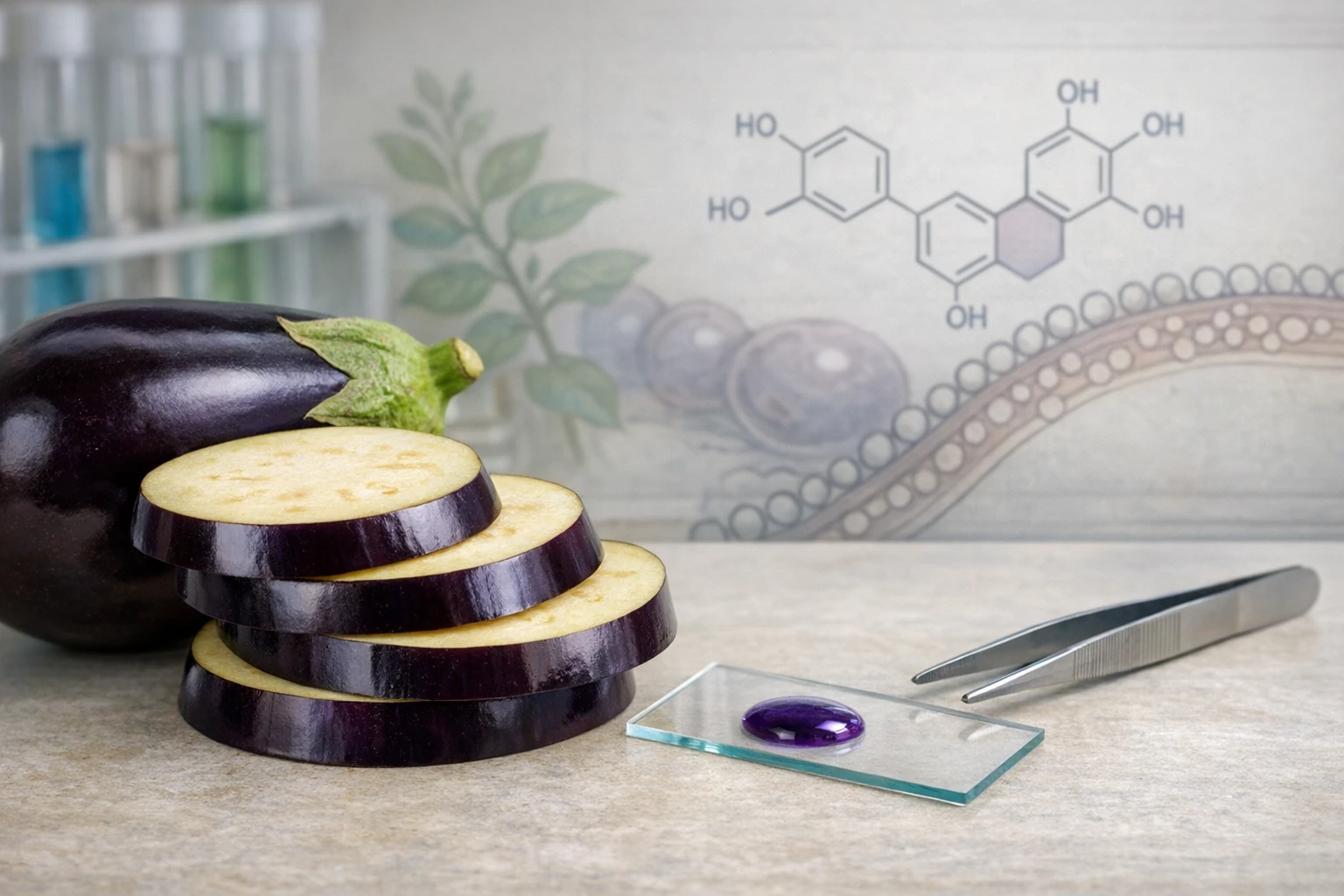
The chemical composition of eggplants varies by cultivar, part of the fruit (skin vs. pulp), cultivation conditions, and ripening. In general, the skin of purple varieties is rich in delphinidin-type anthocyanins and their derivatives; the pulp, on the other hand, contains more hydroxycinnamic phenols such as chlorogenic acid. These compounds contribute to the antioxidant capacity measured in vitro and to various sensory and nutritional properties [1].
The dietary fiber present mainly in the skin contributes to satiety and the regulation of intestinal transit; minerals such as potassium and vitamins (e.g., vitamin C) are present in varying quantities and complete the nutritional profile of the vegetable [1]. The quantity and bioavailability of phytochemicals change with cooking: some practices can increase the availability of certain phenols, while others can reduce their total content [1].
Anthocyanins and nasunin: biological mechanisms
Anthocyanins are water-soluble pigments that, in addition to giving the purple color, exert antioxidant activity and can interact with metals (e.g., iron chelation) and inflammatory pathways. Nasunin, a particular derivative present in eggplant skin, has been studied for its ability to protect lipids and cell membranes from oxidation and for cytoprotective activities observed in experimental models [2]. These actions are plausible as molecular mechanisms, but their translation into clinical effects requires well-controlled human studies [2].
Chlorogenic acid and other phenols: metabolism and potential cardiovascular effects
Chlorogenic acid is an abundant phenol in the pulp of many eggplants and in other food sources (e.g., green coffee). In vitro experiments and animal studies indicate that it can modulate glucose metabolism, influence enzymes involved in lipid metabolism, and have antioxidant and anti-inflammatory effects [4][5]. Some clinical trials with chlorogenate-rich extracts show slight changes in metabolic parameters; however, results between studies are heterogeneous and depend on dose and duration [4].
Available evidence: what experimental and clinical studies show
The experimental literature on eggplants includes chemical studies, research on cellular and animal models, and some indirect clinical trials on isolated compounds. At the preclinical level, eggplant extracts have reduced ischemia damage in animal heart models and shown antioxidant and anti-apoptotic activity in tissues exposed to oxidative stress [3]. These data are useful for understanding mechanisms but are not evidence of clinical efficacy in humans.
Human interventions evaluating the effects of anthocyanins in general or food mixtures rich in these compounds have produced indicative results: meta-analyses and reviews show modest improvements in vascular function and some cognitive domains associated with anthocyanin intake, with, however, wide variability between studies in terms of population, dose, and duration [6][7].
Regarding chlorogenic acid, clinical trials and reviews report modest effects on blood pressure and some glycemic indices, but the results are not uniform, and clinical relevance remains to be confirmed [5][4]. The observed effects depend on the dose of the extract or compound and often on the simultaneous presence of other substances (e.g., caffeine), which can modulate the outcome.
What it means in practice
For the general public, the evidence supports the idea that including colorful fruits and vegetables—including purple eggplants—is part of a varied diet that can contribute to well-being. The purple color is a simple indicator of some bioactive substances (anthocyanins) but not of therapeutic efficacy. Consuming eggplants with the skin, where possible, increases the intake of anthocyanins and fiber; short cooking or grilling can preserve or, in some cases, concentrate certain compounds, while prolonged boiling tends to decrease soluble phenols.
In practical terms, eggplants are a low-energy option that enriches the dish with fiber, potassium, and phenolic compounds. To obtain benefits attributable to phytochemicals, it is important to include them within an overall healthy eating pattern (variety of vegetables, whole grains, lean proteins). They are not substitutes for medical therapies for metabolic, cardiovascular, or neurodegenerative diseases; in the presence of particular clinical conditions, it is advisable to consult a healthcare professional.
Key points to remember
- The purple color of the skin indicates the presence of anthocyanins (e.g., nasunin) associated with antioxidant activity in the laboratory.
- Chlorogenic acid, more present in the pulp, is linked to metabolic mechanisms observed in experimental studies and some clinical trials.
- Many promising results come from preclinical studies or interventions on compound mixtures; the translation to definitive clinical effects in humans is limited.
- Consuming eggplants as part of a varied diet is consistent with nutritional guidelines; avoid absolute therapeutic claims.
Limitations of the evidence
It is important to distinguish between observational associations, experimental evidence, and randomized clinical trials. Much of the evidence on eggplants and phenolic components comes from in vitro or animal studies that clarify mechanisms but do not guarantee the same effect in humans. Clinical studies on anthocyanins or chlorogenates often use concentrated extracts or different sources (berries, green coffee, supplements) and do not always evaluate eggplant as an isolated food; this limits the direct applicability of the results to daily eggplant consumption.
Methodologically, reviews highlight heterogeneity among trials (dose, duration, populations), small sample sizes, and potential publication bias. For this reason, conclusions remain cautious: signals of benefit can be identified, but good quality randomized clinical trials focused on eggplant as a food are needed to confirm the effects observed on biomarkers and health outcomes.
Editorial conclusion
Purple eggplants are nutritious foods with bioactive compounds recognized by research for their antioxidant and biochemical properties. The scientific literature offers biological reasons to consider these vegetables useful in a varied and balanced diet but does not provide definitive evidence for treatments or therapeutic effects. Practical indications are to include eggplants (preferably with skin when suitable for the recipe) as part of a healthy diet. For individual clinical decisions or specific medical conditions, consultation with a doctor or nutrition professional is always recommended.
Editorial note
Article published in a previous version and updated according to scientific and dissemination criteria. The text is for informational purposes only and does not replace personalized medical advice. For clinical and therapeutic questions, consult a healthcare professional.
SCIENTIFIC RESEARCH
- Niño‑Medina G, Urías‑Orona V, Muy‑Rangel MD, Heredia JB. Structure and content of phenolics in eggplant (Solanum melongena) — a review. South African Journal of Botany. 2017;111:161–169. https://doi.org/10.1016/j.sajb.2017.03.016
- Gallo M, Meccariello R, Pannone S, et al. Nasunin, an Amazing Chemical Constituent in Eggplants (Solanum melongena L.): A Review of Its Major Properties and Health-Promoting Effects. ACS Food Science & Technology. 2023. https://doi.org/10.1021/acsfoodscitech.3c00582
- Habib S, et al. Cardioprotective properties of raw and cooked eggplant (Solanum melongena L). Food & Function. 2011;2:718–725. https://doi.org/10.1039/C1FO10048C
- Mansour A, Mohajeri‑Tehrani MR, Samadi M, et al. Effects of supplementation with main coffee components including caffeine and/or chlorogenic acid on hepatic, metabolic, and inflammatory indices in patients with non-alcoholic fatty liver disease and type 2 diabetes: a randomized, double‑blind, placebo‑controlled, clinical trial. Nutrition Journal. 2021;20:35. https://doi.org/10.1186/s12937-021-00694-5
- Onakpoya IJ, et al. The effect of chlorogenic acid on blood pressure: a systematic review and meta‑analysis of randomized clinical trials. Journal of Human Hypertension. 2015;29:77–81. https://doi.org/10.1038/jhh.2014.46
- Del Rio D, et al. The effect of anthocyanin‑rich foods or extracts on vascular function in adults: a systematic review and meta‑analysis of randomised controlled trials. Nutrients. 2017;9(8):908. https://doi.org/10.3390/nu9080908
- Micek A, Godos J, Giampieri F, et al. The effect of anthocyanins and anthocyanin‑rich foods on cognitive function: a meta‑analysis of randomized controlled trials. GeroScience. 2025. https://doi.org/10.1007/s11357-025-02008-7 (ORCID for Giuseppe Caruso: https://orcid.org/0000-0003-1571-5327)
- Del Rio D, et al. Effect of anthocyanins on gut health markers, Firmicutes‑Bacteroidetes ratio and short‑chain fatty acids: a systematic review via meta‑analysis. Scientific Reports. 2023;13:28764. https://doi.org/10.1038/s41598-023-28764-0