Updated and contextualized version of an article originally published on April 23, 2014
The article retains its original focus by presenting it through a scholarly and accessible perspective, supported by verifiable references.
Authors
- Dr. A. Colonnese – Nutrition biologist
- Roberto Panzironi –Independent researcher
Note editoriali
- First publication: April 23, 2014
- Last update: April 18, 2026
- Version: 2026 narrative revision
Initial note: This article was previously published and updated according to scientific and divulgative criteria. It provides general information and does not replace medical advice.
In brief
- Turmeric (Curcuma longa) contains curcumin, a compound studied for its anti-inflammatory and antioxidant properties.
- Numerous reviews and meta-analyses indicate favorable effects on some biomarkers of inflammation, joint pain, and metabolic parameters, but methodological quality varies.
- The oral bioavailability of curcumin is low; approaches such as combination with piperine or innovative formulations improve absorption.
- Anticancer evidence largely comes from preclinical studies; clinical trials are limited and do not allow for therapeutic recommendations.
Abstract: what does science say?
Turmeric is a traditional spice whose main studied component is curcumin. Scientific literature shows that curcumin possesses plausible biological activities: modulation of inflammatory pathways, antioxidant action, and effects on cellular pathways involved in proliferation and apoptosis. In randomized clinical trials and meta-analyses, improvements have been observed in some biomarkers of inflammation (e.g., CRP), painful symptoms in osteoarthritis, and metabolic indicators, although the extent and quality of evidence are heterogeneous. A recurring limitation is the poor oral bioavailability of the natural molecule; for this reason, formulations and strategies (piperine, nano-formulations) have been developed to increase its biological effect. Anticancer evidence remains mostly preclinical and does not allow for the assertion of a definite preventive or therapeutic effect in humans. Therefore, curcumin is an interesting and promising research subject, but it should be interpreted with caution and contextualized with respect to the dose, form, and type of population studied.
Main section
What are turmeric and curcumin?
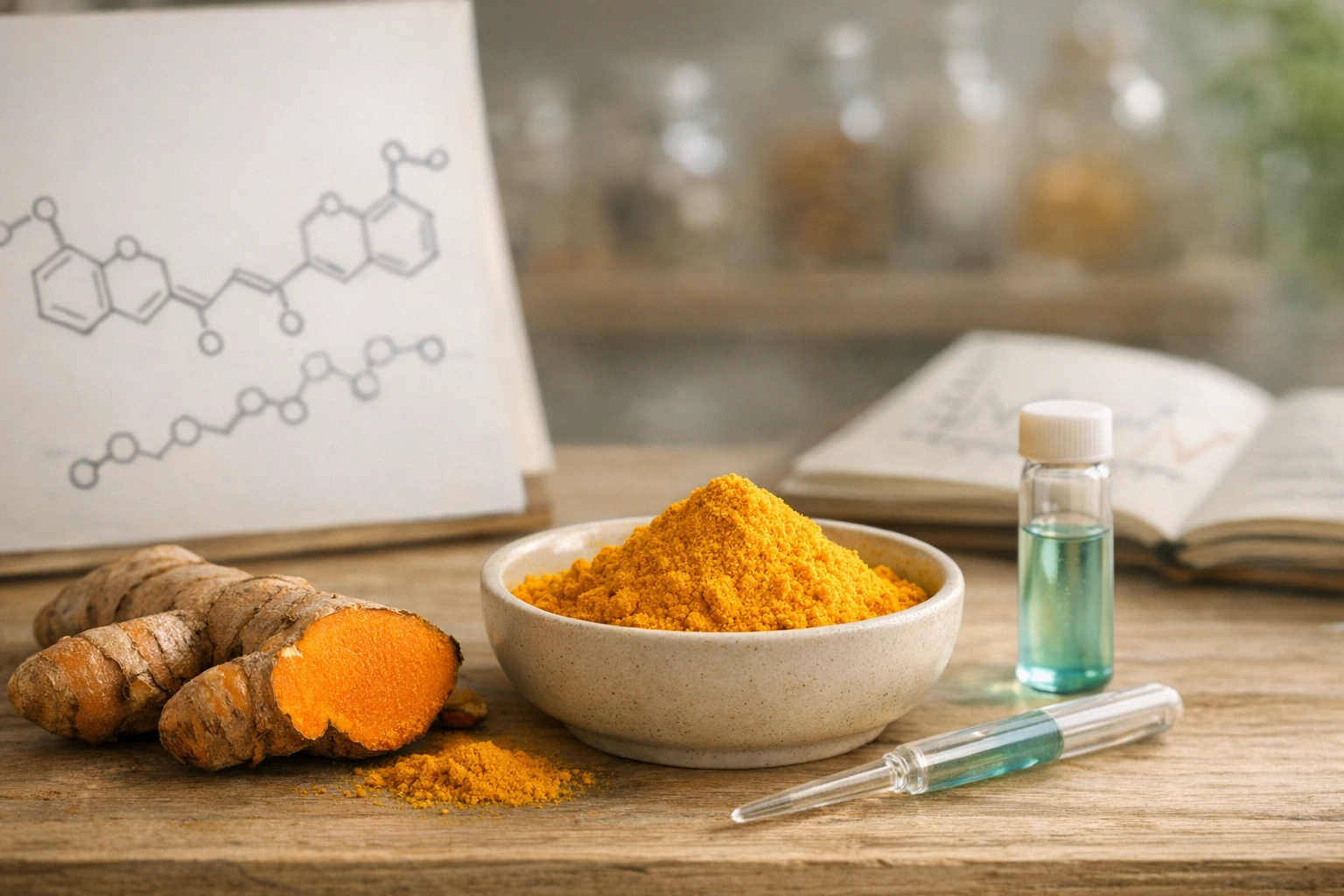
Turmeric is the root of Curcuma longa, used as a spice and food coloring. The fraction of greatest interest consists of "curcuminoids," of which curcumin is the most studied component. Recent reviews synthesize available clinical and experimental studies, indicating a wide spectrum of biological effects attributed to these compounds, from inflammation control to the modulation of oxidative stress and metabolism. However, these editorial syntheses also highlight the methodological limitations of the evidence and the variability of commercially available products. [1]
Plausible biological mechanisms and physiological relevance
Curcumin interacts with many molecular pathways: it reduces the activation of pro-inflammatory factors, acts as a modulator of cytokines (e.g., IL-6, TNF-α), and influences endogenous antioxidant systems. These mechanisms explain the biological plausibility of anti-inflammatory and antioxidant effects observed in clinical meta-analyses. The aggregated evidence shows mediated reductions in some inflammatory biomarkers in controlled studies, although variability between studies is high and the overall clinical impact depends on doses, duration, and formulation. [5] [8]
Clinical evidence: what do trials and reviews show?
In recent years, numerous reviews and meta-analyses have been published synthesizing trials on the use of curcumin in different conditions. Some consolidated results concern pain relief and improved functionality in osteoarthritis, reported by a meta-analysis of randomized studies that found improvements comparable to some anti-inflammatory drugs in terms of short-term symptoms. [3] A broad and updated review of clinical trials aggregated over 100 RCTs on various outcomes (metabolic, inflammatory, and oxidative), finding statistically significant effects on some measures such as fasting glycemia, CRP, and HDL cholesterol, but with variable certainty of evidence. [4] Regarding oncology, clinical evidence is limited and often preliminary; dedicated reviews conclude that preclinical data are promising, but do not replace robust clinical studies to define efficacy and safety in anticancer therapy. [6]
Bioavailability and formulations: why form matters
Orally administered curcumin has limited absorption and rapid metabolism, factors that reduce the blood concentrations achieved after administration of the spice or unformulated extract. Pioneering studies have shown that piperine (a component of black pepper) can significantly increase the bioavailability of curcumin in healthy volunteers, a figure often cited as a reference in reviews. [2] In recent years, formulations (phospholipids, micronization, nano-formulations, or co-crystals) have been developed to improve absorption; some of these solutions have shown promise in preclinical models and in some experimental studies, especially in topical applications or for specific uses such as wound healing. [7]
What it means in practice
For the general public: the culinary use of turmeric as a spice is safe and contributes to the nutritional and sensory profile of foods. Experimental and clinical evidence suggests that curcumin, in concentrated form or as an improved formulation, can influence inflammatory biomarkers and lead to temporary benefits in conditions such as osteoarthritis or some metabolic parameters; however, such effects do not equate to a cure or proven prevention for complex diseases like cancer. The observable practical effect substantially depends on the dose, duration, and form of curcumin used. Strategies to increase absorption exist (piperine, technological formulations), but must be considered in light of evidence and safety: for example, piperine can modify the metabolism of some drugs. Therefore, before using concentrated extracts or combinations with piperine in the presence of pharmacological therapies, it is advisable to consult a doctor or pharmacist. [2] [4]
Key takeaways
- Turmeric is rich in curcuminoids; curcumin is the most studied compound for its anti-inflammatory and antioxidant activities.
- Meta-analyses show favorable effects on some biomarkers (CRP, IL-6) and joint symptoms, but the quality of evidence is heterogeneous. [5] [3]
- The oral bioavailability of unformulated curcumin is low; piperine and advanced formulations improve absorption but can influence drug interactions. [2]
- Anticancer results are mostly preclinical: there is currently no robust clinical evidence to recommend curcumin as an anticancer therapy. [6]
- In topical applications and for wound healing, innovative formulations show potential in experimental models, with clinical translation still limited. [7]
Limitations of evidence
It is important to distinguish between types of studies and levels of evidence: observational studies indicate associations and are useful for generating hypotheses; experimental studies (in vitro, animal) show mechanisms but do not automatically predict clinical effects in humans; clinical evidence comes from RCTs and meta-analyses, which, however, can differ greatly in methodological quality, sample size, doses, and formulations. Many curcumin trials are short-term, use different dosages, and sometimes employ proprietary formulations that are not comparable. Furthermore, high statistical heterogeneity in meta-analyses reduces the certainty of conclusions and necessitates a cautious interpretation of results. Interaction with drugs, especially when using piperine or formulations that alter metabolism, is an additional clinical confounding factor that requires medical attention. [4] [2] [8]
Editorial conclusion
Turmeric and curcumin represent a useful example of how a substance of traditional use can become the subject of modern research. There is biological plausibility and a body of studies suggesting benefits on inflammation, oxidative stress, and joint symptoms; however, full clinical translation requires more robust studies, with standardized dosages, comparable formulations, and adequate follow-up. Currently, curcumin does not replace established medical therapies: its plausible role is that of an adjuvant in particular contexts, always evaluated with attention to interactions and the quality of the product used. Readers interested in integrating curcumin into their diet or therapy should consult healthcare professionals for a personalized evaluation. [4] [6]
Editorial note
This article has been updated to reflect recent reviews and meta-analyses. It is for informational and educational purposes; it does not replace personalized clinical advice. For questions about drug interactions or the use of supplements, consult your trusted doctor.
Scientific research
Below are the main sources cited in the text (order of appearance). DOI links are provided for transparency and verification.
- Synthetic review on turmeric and curcumin. https://doi.org/10.3390/foods6100092
- Study on bioavailability with piperine. https://doi.org/10.1055/s-2006-957450
- Meta-analysis on turmeric extracts and osteoarthritis. https://doi.org/10.1089/jmf.2016.3705
- Broad review and meta-analysis of RCTs (103 studies). https://doi.org/10.1002/ptr.8340
- Umbrella meta-analysis on inflammatory biomarkers. https://doi.org/10.1371/journal.pone.0265689
- Systematic review on the use of curcumin in oncology (supportive/therapeutic contexts). https://doi.org/10.1186/s12885-020-07256-8
- Nano-formulation and wound healing (experimental model). https://doi.org/10.1038/am.2017.31
- GRADE-assessed review on antioxidant and anti-inflammatory effects (dose–response). https://doi.org/10.1016/j.cyto.2023.156144
Editorial contacts and bibliographic verification requests: [placeholder for editorial data]