Updated and contextualized version of an article originally published on May 5, 2014
The article retains its original focus by presenting it through a scholarly and accessible perspective, supported by verifiable references.
Authors
- Dr. A. Colonnese – Nutrition biologist
- Dr. D. Iodice – Biologist
- Roberto Panzironi –Independent researcher
Note editoriali
- First publication: May 5, 2014
- Last update: April 18, 2026
- Version: 2026 narrative revision
This article was previously published and has been updated according to scientific and divulgative criteria. The text is intended to inform: it does not replace medical advice. For personal questions, consult your doctor or specialist.
In brief.
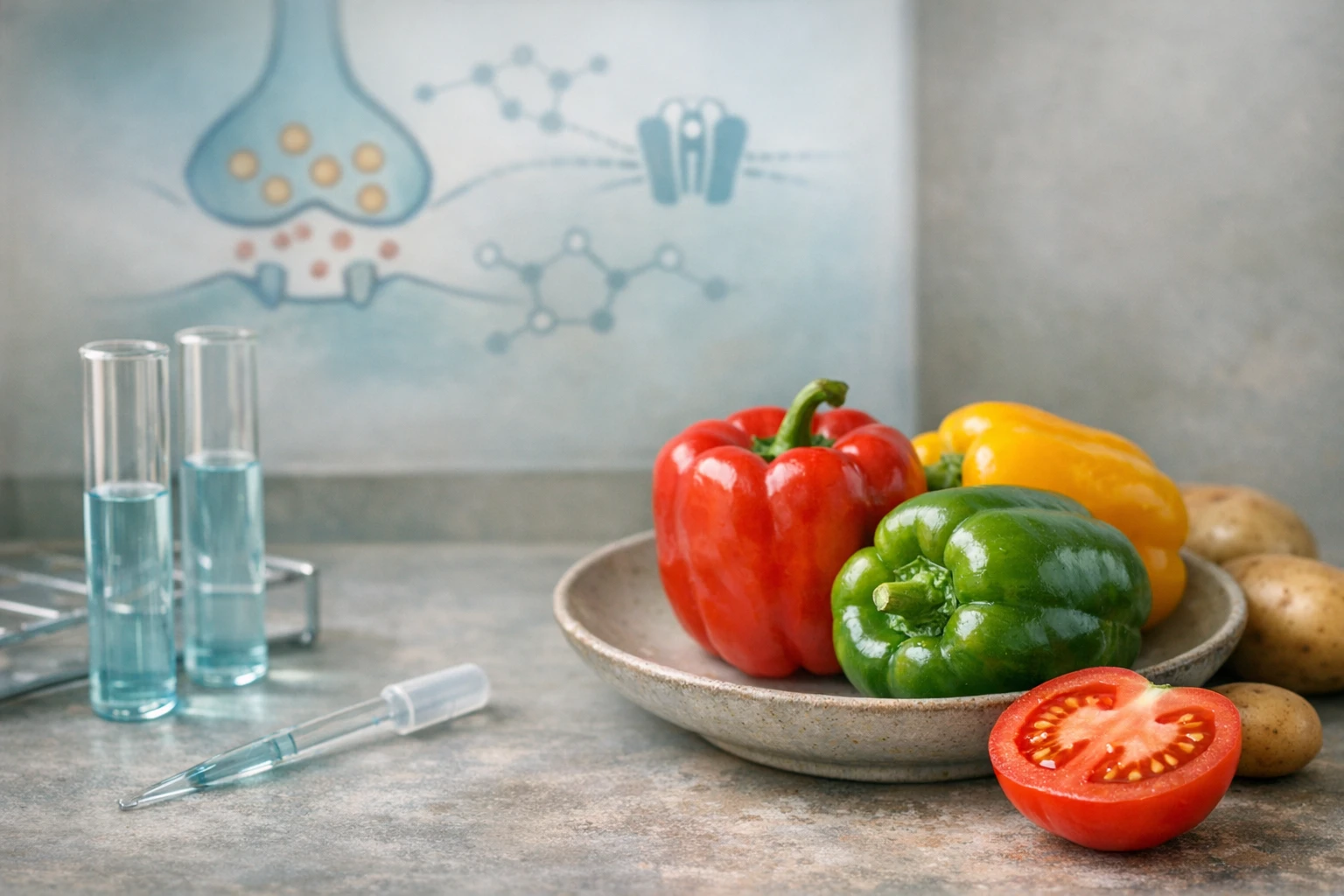
- Epidemiological studies suggest an inverse association between tobacco exposure and the risk of Parkinson's disease; specific research has explored whether traces of nicotine present in some vegetables of the Solanaceae family (peppers, tomatoes, potatoes) may contribute to this relationship.
- A case-control study based in the Seattle region found a lower probability of Parkinson's among regular consumers of edible solanaceae. [1]
- Proposed biological mechanisms include modulation of nicotinic receptors, anti-inflammatory effects, and reduction of α-synuclein accumulation in experimental models, but clinical evidence is conflicting. [6][5]
- A large clinical trial with nicotine patches did not demonstrate a protective effect on the clinical progression of the disease in patients with early Parkinson's. [4]
Abstract: what does science say?
The question of whether consuming peppers, tomatoes, or other vegetables from the Solanaceae family reduces the risk of developing Parkinson's disease arises from the epidemiological observation of an inverse association between tobacco use and Parkinson's incidence. Some observational studies have attempted to verify whether traces of nicotine and other alkaloids present in these foods could explain part of this effect. Current evidence shows statistical associations but does not prove causality: experimental data in cells and animals support biological plausibility, while clinical trials with systemic nicotine administration have not confirmed efficacy in slowing clinical progression. Significant limitations exist: residual confounding, possible reverse causation effects, differences in the form and dose of exposure, and individual variability. Research remains open and requires further well-designed observational studies, biomarkers, and targeted trials.
What are "dietary nicotine" and Solanaceae?
Nicotine is a natural alkaloid produced by plants of the Solanaceae family, which includes tobacco but also edible species such as peppers, tomatoes, potatoes, and eggplants. In food plants, the concentration of nicotine is extremely low compared to tobacco: we are talking about micrograms per gram or less, quantities that are thousands of times lower than those absorbed by smoking a cigarette. This distinction is crucial for evaluating any biological effect: the form of exposure (active inhalation of smoke, use of tobacco products, food consumption), the absorbed dose, and the frequency determine the systemic and cerebral impact. Furthermore, Solanaceae contain other bioactive compounds (e.g., anatabine) that can interact with inflammatory or oxidative pathways; therefore, hypothesizing an exclusive role for dietary nicotine is premature. The interpretation of the literature must always differentiate between the measured presence in food, bioavailability after digestion, and mechanistic plausibility derived from experimental studies.
Epidemiological evidence on the association between Solanaceae, tobacco, and Parkinson's disease
Several decades of epidemiological work show an inverse association between tobacco consumption and the risk of Parkinson's disease: cohort studies and meta-analyses report a relative risk reduction in smokers compared to non-smokers. [2][3] One possible interpretation is that components of tobacco — nicotine or other compounds — may exert protective effects on the dopaminergic system; an alternative is the so-called "reverse causation": people in the prodromal phase of the disease may reduce the use of substances like tobacco for behavioral or olfactory reasons. To explore the hypothesis of dietary nicotine, Searles Nielsen and colleagues conducted a case-control study in the Seattle region comparing habitual consumption of bell peppers, tomatoes, tomato juice, and potatoes between new cases of Parkinson's and controls. The study reported an association between the consumption of edible Solanaceae and a lower risk of Parkinson's, suggesting a possible role for dietary nicotine or other constituents of Solanaceae. [1] However, observational studies are susceptible to confounding and measurement errors in dietary consumption; therefore, the results should be interpreted with caution.
Plausible biological mechanisms
Nicotinic receptors and neuroprotection
Nicotine acts on nicotinic acetylcholine receptors (nAChRs), which are also present in the dopaminergic pathways involved in Parkinson's disease. The activation of specific nAChR subtypes can modulate dopamine release, microglial inflammatory response, and intracellular neuronal survival pathways (e.g., PI3K/Akt). Experimental studies show that nAChR stimulation can reduce neurotoxicity in animal models of dopaminergic damage, providing mechanical plausibility for a protective effect. [6]
Effects on α‑synuclein and inflammation
One hypothesis is that nicotine or related compounds may limit α‑synuclein aggregation or reduce neuroinflammation that promotes dopaminergic degeneration. Preclinical data indicate reductions in α‑synuclein accumulation in cells and animal models exposed to nicotine, but the translation of these mechanisms into human clinical benefits has not been demonstrated. [6][7]
What do experimental studies and clinical trials show?
In vitro experiments and animal models (MPTP, 6-OHDA) have frequently shown protective effects of nicotine when administered before or during exposure to dopaminergic toxins, supporting the idea that nicotine or nicotinic agonists may modulate neurodegenerative processes. [7][8] However, clinical translation is uncertain: controlled trials that administered nicotine via patch to patients with early Parkinson's did not document a slowing of disease progression and, in some cases, did not show significant benefits. The largest multicenter controlled trial with a nicotine patch (NIC-PD) did not demonstrate efficacy in stopping clinical progression in patients treated for 52 weeks. [4] These results highlight the gap between preclinical evidence and clinical outcomes and emphasize the importance of the form, dose, and timing of exposure.
What it means in practice
For the reader: the data do not justify recommendations to start smoking or using nicotine-based products to prevent Parkinson's disease. Tobacco smoking causes cancer, cardiovascular and respiratory diseases and cannot be recommended. The observed association between smoking and a lower risk of Parkinson's remains a research point, not a basis for public health interventions. Consuming peppers, tomatoes, and other vegetables from the Solanaceae family as part of a varied diet is reasonable for general nutritional reasons, but there is insufficient evidence to consider their consumption a specific preventive measure against Parkinson's. Any future clinical trials will need to define the form, dose, timing, and target populations (e.g., subjects in the prodromal phase identified through biomarkers) before evaluating possible interventions based on nicotinic or less toxic derivatives.
Key points to remember
- The inverse association between tobacco use and Parkinson's risk is robust at an epidemiological level but does not prove causality. [2][3]
- Some vegetables from the Solanaceae family contain traces of nicotine; a case-control study found a lower probability of Parkinson's among regular consumers of these vegetables. [1]
- Experimental data suggest plausible mechanisms (nicotinic receptors, reduction of inflammation, effect on α-synuclein), but uncertainty remains in clinical translation. [6][7]
- Clinical trials with systemic nicotine administration have not confirmed a protective effect on the clinical progression of Parkinson's. [4]
- Tobacco use for this purpose is not indicated; any therapeutic approaches will need to be evaluated in controlled clinical studies with attention to the risk/benefit ratio.
Limitations of the Evidence
It is crucial to distinguish between observational associations and causal evidence: case-control or cohort studies can indicate correlations but are vulnerable to confounding (e.g., lifestyle, environmental exposures), selection bias, and reverse causation. Dietary measures based on questionnaires may contain memory errors. In experimental models, protection is often observed with doses and administration methods not equivalent to human dietary intake. Clinical trials conducted so far have varied in dose, route of administration, and duration, and have not shown efficacy in slowing clinical progression; the possibility that nicotine acts within a prodromal time window not yet identified remains open. Therefore, any interpretation requires caution and further well-designed studies, ideally with exposure and disease biomarkers.
Editorial Conclusion
The relationship between the consumption of certain vegetables from the Solanaceae family, dietary nicotine, and the risk of Parkinson's disease is an interesting scientific topic that warrants further investigation. Current evidence combines epidemiological signals, preclinical biological plausibility, and inconclusive clinical results. At present, there is no basis for preventive recommendations based on nicotine or the targeted consumption of certain vegetables regarding Parkinson's risk. The priority remains rigorous research: observational studies with improved exposure measurement, translational mechanistic studies, and clinical trials targeting perfectly characterized populations. In the meantime, promoting balanced diets and quitting tobacco remain recommendations consistent with general public health.
Editorial Note
This article has been updated to reflect research subsequent to the original study cited. The purpose is informational; it is not intended to prescribe therapies or therapeutic modifications. For clinical decisions, it is recommended to consult your doctor.
SCIENTIFIC RESEARCH
- [1] Searles Nielsen S, Franklin GM, Longstreth WT, Swanson PD, Checkoway H. Nicotine from edible Solanaceae and risk of Parkinson disease. Ann Neurol. 2013. https://doi.org/10.1002/ana.23884
- [2] Ritz B, Ascherio A, Checkoway H, et al. Pooled analysis of tobacco use and risk of Parkinson disease. Arch Neurol. 2007;64(7):990–997. https://doi.org/10.1001/archneur.64.7.990
- [3] Hernán MA, Takkouche B, Caamaño‑Isorna F, Gestal‑Otero JJ. A meta‑analysis of coffee drinking, cigarette smoking, and the risk of Parkinson's disease. Ann Neurol. 2002;52(3):276–284. https://doi.org/10.1002/ana.10277
- [4] Oertel WH, Müller HH, Unger MM, et al. Transdermal nicotine treatment and progression of early Parkinson's disease. NEJM Evidence. 2023;2:EVIDoa2200311. https://doi.org/10.1056/EVIDoa2200311
- [5] Quik M, Perez XA, Bordia T. Nicotine as a potential neuroprotective agent for Parkinson’s disease. Mov Disord. 2012;27(8):947–957. https://doi.org/10.1002/mds.25028
- [6] (Experimental mechanism) Studies showing nicotine prevents α‑synuclein accumulation and related cellular protection. Neurobiol Dis. 2019. https://doi.org/10.1016/j.nbd.2019.04.017
- [7] (MPTP models) Nicotine, but not cotinine, partially protects dopaminergic neurons against MPTP‑induced degeneration in mice. Brain Res. 2001. https://doi.org/10.1016/S0006-8993(00)03198-X
- [8] (6‑OHDA models) Nicotine, but neither selective α4β2 nor α7 agonists, protects against partial 6‑OHDA lesions in rats. Neuropharmacology. 2006. https://doi.org/10.1016/j.neuropharm.2006.04.015