Updated and contextualized version of an article originally published on May 6, 2014
The article retains its original focus by presenting it through a scholarly and accessible perspective, supported by verifiable references.
Authors
- Dr. D. Iodice – Biologist
- Roberto Panzironi –Independent researcher
Note editoriali
- First publication: May 6, 2014
- Last update: April 18, 2026
- Version: 2026 narrative revision
Editorial note: This article is an update of a previously published text, revised according to scientific and informative criteria. It is for informational purposes only and does not replace individual medical or nutritional advice.
In brief
- Clarified butter (ghee/anhydrous milk fat) is an almost pure fat obtained by removing water and milk proteins; its composition is predominantly triglycerides with a high proportion of saturated fats.
- As a cooking ingredient, it offers a higher smoke point and characteristic flavor; some processes (e.g., casein toasting in ghee) generate aromatic compounds and substances with antioxidant activity to varying degrees.
- Epidemiological evidence on butter and dairy products shows modest and inconclusive associations with cardiovascular outcomes; results depend on the food matrix and comparison with other dietary fats.
- Randomized and experimental clinical studies indicate that replacing saturated fats with oils rich in unsaturated fats (e.g., olive oil) favorably modifies some cardiometabolic biomarkers; the specific effect of ghee varies with dose, duration, and dietary context.
- For those with lactose intolerance, commercial clarified butter can be very low in lactose and casein, but those with milk protein allergy should still avoid the product if contamination is possible.
Abstract: what does science say?
Clarified butter is an ancient and widespread product: clarification removes water and most of the milk proteins, obtaining an almost anhydrous fat. The literature shows that the lipid-chemical profile of these products varies by animal origin, production method, and heat treatment; in epidemiological terms, dairy fats, including butter, do not show strong and consistent associations with cardiovascular diseases, while some studies indicate neutral or weakly favorable effects on diabetes and other outcomes depending on the food matrix. Controlled clinical studies suggest that replacing saturated fats with unsaturated fats (e.g., olive oil) tends to improve cardiometabolic biomarkers; the results on ghee are contextual and depend on the dose, duration, and composition of the rest of the diet. Methodological limitations and heterogeneity among studies require caution in interpretation: most of the evidence is observational, with variable responses when moving to controlled interventions.
Main section
Definition, differences between "Western" clarified butter and traditional ghee
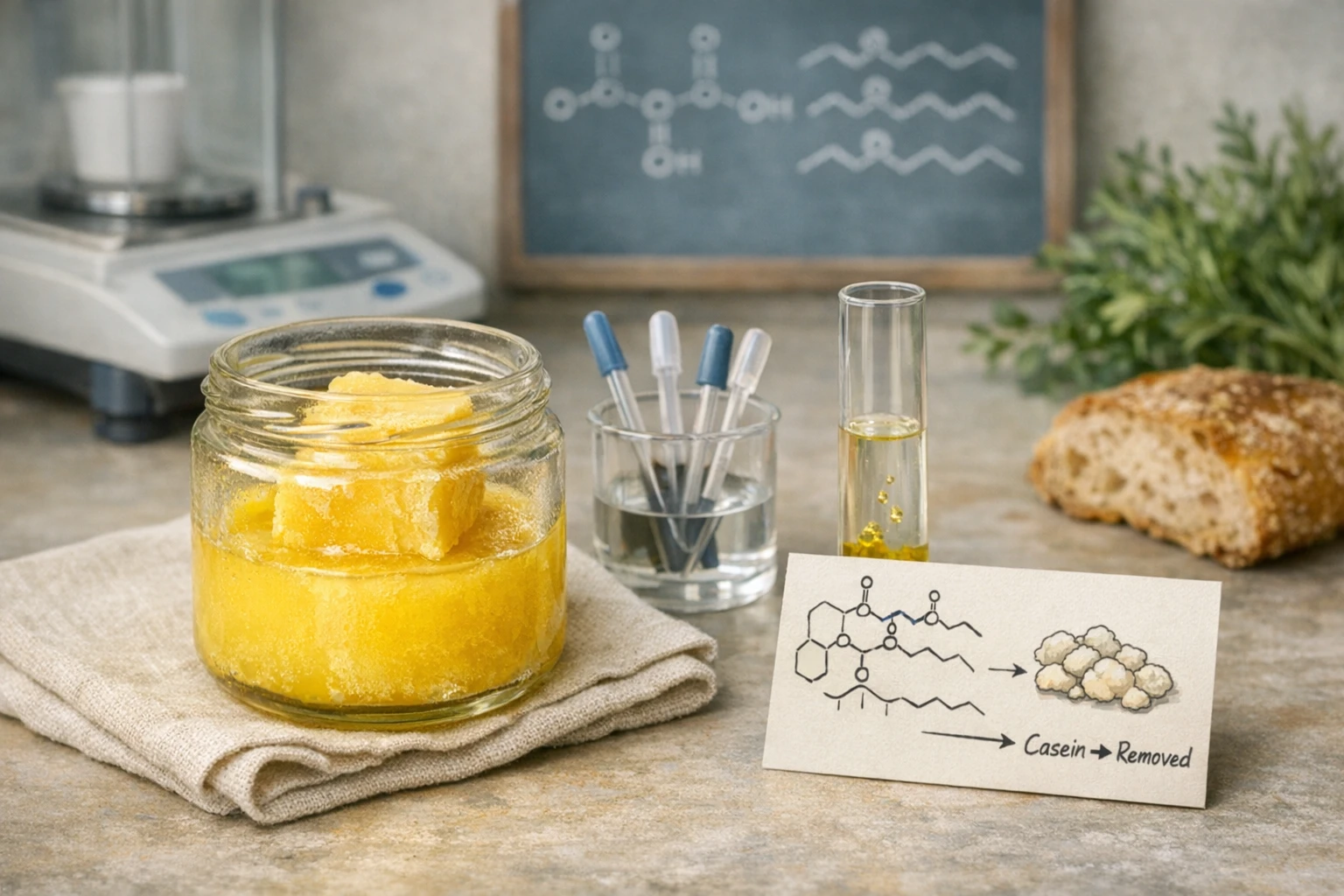
Clarified butter refers to the product obtained by heating butter until water and milk solids separate and are removed; essentially, only the fat remains. The term "ghee" indicates a traditional variant practiced in South Asia that often involves longer cooking of the protein fraction until browned and aromatic compounds are formed. The practical difference concerns the presence of Maillard compounds and volatiles: in ghee, the reaction between proteins and sugars can impart more toasted notes and, in some cases, form substances with measurable antioxidant activity in the laboratory. The final composition is, however, dominated by dairy-derived triglycerides; the proportion of saturated, monounsaturated, and polyunsaturated fatty acids varies with the animal species and the diet of the animal of origin. [4]
Relevant chemical processes and physicochemical properties
Clarification removes water and most of the milk proteins (casein and whey proteins), lowering the content of non-lipid components to very low values and increasing oxidative stability compared to common butter. The smoke point of clarified fat is higher than that of whole butter, making it more suitable for frying at medium-high temperatures. However, stability depends on the degree of refining, the presence of natural antioxidants (fat-soluble vitamins, carotenoids), and the formation of oxidative products or oxysterols during prolonged heating. Industrial production processes involve centrifugation and controlled thermal treatments to minimize moisture and protein residues, increasing the product's shelf-life. [5]
Nutritional composition: what ghee contains
Clarified butter is almost exclusively fat (≥ 99% in the definition of some anhydrous products). Recent analyses confirm a prevalence of saturated fatty acids, with a significant proportion of medium- and short-chain fatty acids (e.g., butyric acid), as well as monounsaturated (e.g., oleic acid) and small amounts of polyunsaturated fatty acids. Some variants show higher concentrations of conjugated fatty acids (CLA) depending on the animals' diet. The composition can affect the metabolic profile: for example, CLA and polar milk components may have biological effects observed in experimental models, but their incidence at the population level is still under study. [4][6]
Epidemiological and experimental evidence on cardiovascular risk
Reviews and meta-analyses on the effects of butter and dairy fats show weak or neutral associations with mortality and cardiovascular disease: meta-analyses of observational studies suggest overall modest effects, with no strong evidence to support a clear causal link between moderate butter consumption and increased cardiovascular events. [1][2] Randomized clinical trials compare specific dietary fats: replacing a portion of saturated fats with unsaturated fats (e.g., olive oil) tends to improve some cardiometabolic biomarkers; a controlled crossover study showed an increase in apoB and non-HDL after four weeks of a ghee-rich diet compared to olive oil, suggesting that the effect depends on the type of fat replaced and the dietary context. [3]
Practical section
What it means in practice
For daily use: clarified butter is a stable and flavorful fat, useful for certain preparations that require high temperatures or a toasted aromatic profile. Those who wish to limit their intake of saturated fats should consider the overall role of fats in their diet: replacing a portion of saturated fats with sources rich in unsaturated fats (olive oil, non-hydrogenated vegetable oils, nuts) is the strategy with the most evidence for reducing cardiovascular risk. [3][2] For people with lactose intolerance, commercial clarified butter tends to have very low lactose and protein residues, but those with milk protein allergies should avoid it unless specifically certified. In cooking, ghee is suitable for browning and for medium-high temperature cooking; the choice between ghee and other fats should consider taste, preservation, and the overall balance of fats in the diet.
Key points to remember
- Clarified butter is an almost anhydrous fat, rich in saturated fatty acids; its composition depends on the origin of the milk and the production process. [4]
- Clarification reduces lactose and milk proteins but is not a universal guarantee for individuals allergic to milk proteins; pay attention to labels. [5]
- Observational evidence on butter and health is heterogeneous and generally does not show strong associations with cardiovascular diseases; interpretation requires caution. [1][2]
- Clinical interventions suggest that replacing saturated fats with unsaturated fats improves cardiometabolic biomarkers; the specific effects of ghee vary with context. [3]
- During ghee preparation, aromatic compounds with measurable antioxidant activity can form; however, prolonged heating can also produce oxysterols or oxidative compounds. [6][7]
Limitations of the Evidence
It is important to distinguish between types of studies: most of the evidence on butter and dairy products comes from observational studies that assess long-term associations, do not prove causality, and are susceptible to confounding by other aspects of diet and lifestyle. Randomized interventions are more informative for causality but are often short-term and measure biomarkers rather than clinical events. Variability in ghee production methods, quantities consumed, and dietary habits makes it difficult to generalize results. Some experimental animal studies highlight antioxidant or anti-atherogenic effects under specific conditions (e.g., CLA-enriched ghee), but direct translation to people and populations requires adequate clinical studies. [6][7][8]
Editorial conclusion
Clarified butter is a traditional food with appreciable culinary properties and well-defined chemical characteristics: it is essentially a concentrated dairy fat. The available scientific evidence does not justify either demonizing or promoting ghee in absolute terms; its role in the diet depends on the quantity, frequency, and, above all, the overall dietary context. For the prevention of cardiovascular diseases, there is strong evidence supporting the reduction of saturated fats when replaced with unsaturated fats in the diet; therefore, those who wish to optimize their cardiometabolic profile should prioritize unsaturated sources (e.g., olive oil) and consider ghee as an occasional ingredient or in moderate portions. Where necessary (intolerances or allergies), consult a healthcare professional before modifying your diet.
Editorial Note
This article has been updated from a previous version to integrate recent evidence, improve clarity and transparency of sources, and standardize language to institutional divulgative standards. The information provided here is for informational purposes only and does not replace the advice of a doctor or a registered dietitian. If you have specific health conditions or allergies, consult a qualified healthcare professional before changing your diet.
Scientific research
Below are the primary sources cited in the article (click to open DOI):
- Pimpin L, Wu JHY, Haskelberg H, Del Gobbo L, Mozaffarian D. Is Butter Back? A systematic review and meta-analysis of butter consumption and risk of cardiovascular disease, diabetes, and total mortality. PLoS ONE. 2016;11(6):e0158118.
- Sharifan P, Roustaee R, Shafiee M, et al. Dairy Consumption and Risk of Cardiovascular and Bone Health Outcomes in Adults: an umbrella review and updated meta-analyses. Nutrients. 2025;17(17):2723.
- Mohammadi Hosseinabadi S, Nasrollahzadeh J, et al. Effects of diets rich in ghee or olive oil on cardiometabolic risk factors in healthy adults: a two-period, crossover, randomised trial. British Journal of Nutrition. 2022;128:1720–1729.
- Characterization of Fatty Acids and Nutritional Health Indicators of Ghee (Butter oil) Manufactured from Bovine Colostrum and Sweet Cream. Dairy. 2025;6(1):2.
- Composition and storage stability of commercial anhydrous milk fat and hydrogenated oils. International Journal of Food Science and Technology. 1985;20(1):83–88.
- High conjugated linoleic acid enriched ghee (clarified butter) increases the antioxidant and antiatherogenic potency in female Wistar rats. (Journal reference). 2013.
- Effect of added herb extracts on oxidative stability of ghee (butter oil) during accelerated oxidation condition. Journal (2013).
- Milk polar lipids composition and functionality: a systematic review. Critical Reviews in Food Science and Nutrition. 2022.
[Note: some references cited in the text are reviews and trials published in peer-reviewed journals with DOIs. DOIs were verified for title-year-author correspondence before inclusion in the bibliography.]