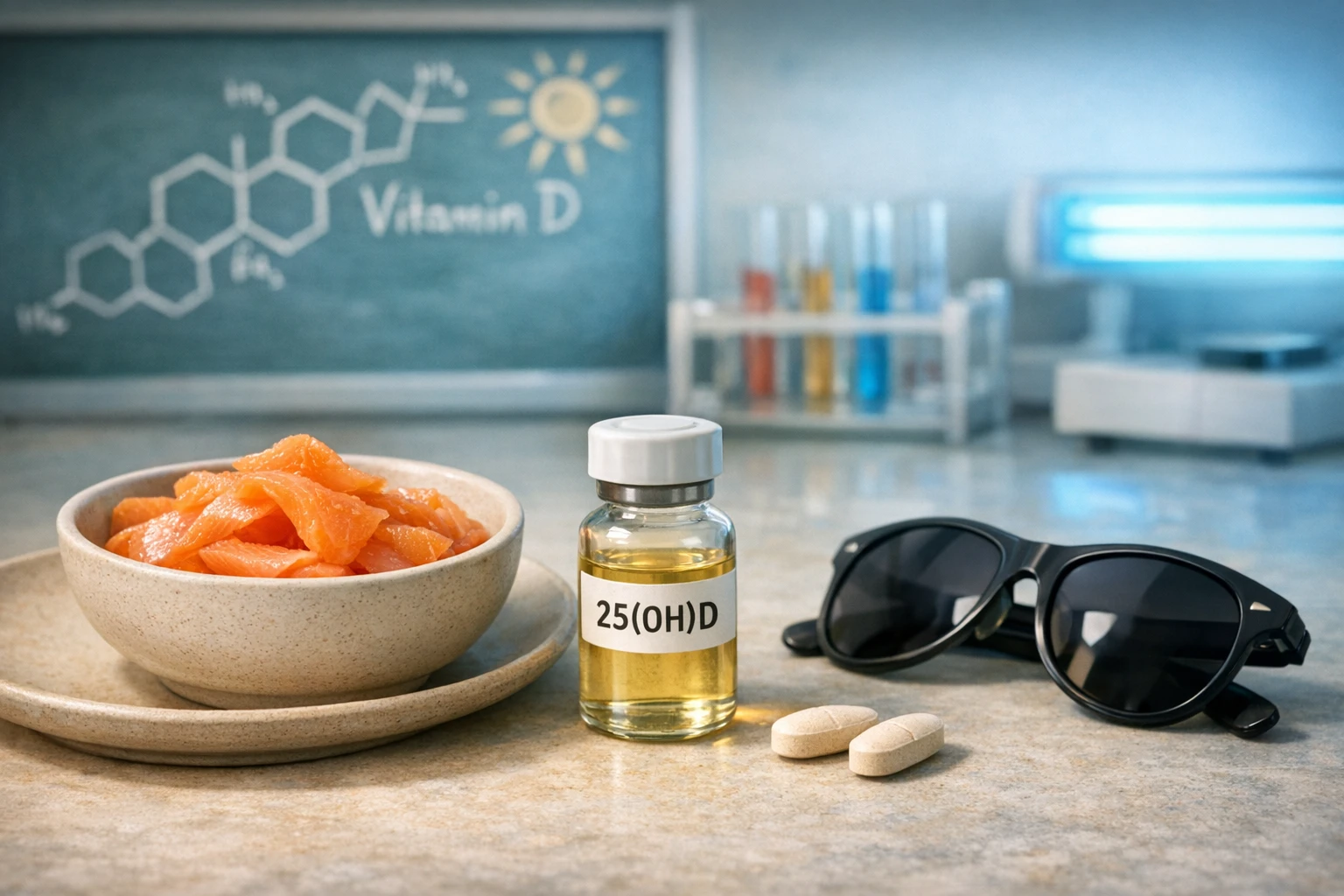
Updated and contextualized version of an article originally published on May 6, 2014
The article retains its original focus by presenting it through a scholarly and accessible perspective, supported by verifiable references.
Authors
- Dr. A. Colonnese – Nutrition biologist
- Roberto Panzironi –Independent researcher
Note editoriali
- First publication: May 6, 2014
- Last update: April 18, 2026
- Version: 2026 narrative revision
IN BRIEF
- Vitamin D is an essential hormone-like substance for calcium and phosphorus metabolism and has documented roles in the immune system and certain cellular processes.
- The main source of endogenous production is skin exposure to UVB rays; diet and supplementation can supplement needs, but with limitations.
- Observational studies show associations between higher 25(OH)D levels and a lower risk of certain diseases, while causal evidence from clinical trials is partly conflicting.
- The use of tanning beds (solariums) can increase the risk of skin cancer; any decision regarding exposure, supplementation, or tests should be discussed with a doctor.
Abstract: what does science say?
Vitamin D is involved in calcium and phosphorus control, musculoskeletal function, and immune responses. Observational evidence links higher circulating levels of 25-hydroxyvitamin D to a reduced risk of certain diseases, including some cancers and respiratory infections; however, the results of randomized clinical trials are mixed. The effect depends on dose, duration, initial vitamin D status, and context (age, medical conditions, genetic factors). Recommendations prioritize the prevention of deficiency for skeletal reasons, while universal therapeutic use to prevent extra-skeletal diseases is not yet established. Risks associated with excessive UV exposure, including tanning beds, should be evaluated separately.
What is vitamin D and how does it work?
“Vitamin D” is a family of fat-soluble compounds that in humans primarily includes vitamin D3 (cholecalciferol). After skin synthesis or oral Intake, the inactive form is converted in the liver to 25-hydroxyvitamin D (25[OH]D), the marker used to assess vitamin status. Further renal activation produces calcitriol (1,25[OH]2D), the active form that interacts with the vitamin D receptor present in many tissues. This mechanism underlies its known functions: regulation of intestinal calcium and phosphorus absorption, bone remodeling, and maintenance of muscle health, with implications for the prevention of rickets and osteomalacia [1].
In the last two decades, the literature has expanded the potential roles of vitamin D beyond the skeleton, including immune system modulation and regulation of cell proliferation. These observations have motivated studies on infections, autoimmune diseases, and certain cancers, while making it clear that biological plausibility does not equate to causal proof: differences between observational studies and clinical trials must be recognized and interpreted with caution [1][2].
Sources of vitamin D: sun, diet, and supplementation
The primary source of vitamin D in most populations is cutaneous production induced by UVB rays. Diet contributes to varying degrees: rich foods include fatty fish, liver, and some fortified foods, but for many people, dietary intake alone is insufficient to reach levels considered optimal [1].
Guidelines assess the need for supplementation by considering blood levels (25[OH]D), age, seasonality, latitude, and individual factors such as skin pigmentation, sunscreen use, and lifestyle. To prevent deficiency, some clinical recommendations propose the targeted use of supplements, especially in at-risk individuals (the elderly, those with reduced sun exposure, people with malabsorption). Scientific societies offer practical indications and reference ranges that must be contextualized by the treating physician [2].
Vitamin D and the immune system: what the evidence shows
Numerous studies have examined the relationship between vitamin D and infections, with particular attention to respiratory infections. A large individual participant data meta-analysis of randomized trials found a modest but significant reduction in the risk of respiratory infections with supplementation, especially in those starting with low blood levels and when administration was regular and at non-excessive doses [3].
Biological plausibility is supported by laboratory evidence showing immunomodulatory effects of calcitriol on innate and adaptive immune cells. However, the extent of the clinical effect varies depending on study design, dose, duration, and baseline 25(OH)D status; it is therefore incorrect to speak of a universal protective effect independent of context [3].
Vitamin D and Cancer Risk: Observations and Limitations
Observational studies have shown associations between higher circulating levels of 25(OH)D and a lower risk of certain cancers, including colorectal cancer. However, combined analyses of clinical and observational studies suggest mixed results when considering the reduction in cancer incidence following supplementation [4][7].
Meta-analyses of randomized trials have highlighted a possible reduction in cancer mortality in subjects taking vitamin D, while the effect on the total incidence of cancers is less clear and often not significant in large primary prevention trials [4][5]. More specific evidence, such as studies in patients with advanced colorectal cancer, suggests positive signals on some outcomes (e.g., progression-free survival) but requires confirmation in larger and more definitive trials [6].
In summary: observational associations are interesting and biologically plausible, but they are not sufficient proof of causality. The scientific community urges caution in interpreting these results until robust confirmations from adequate trials are available [4][5][6][7].
Sun exposure and UV lamp use: risks, benefits, and recommendations
The skin synthesizes vitamin D thanks to UVB ray exposure; this natural pathway is effective but coexists with certain risks: excessive exposure to ultraviolet radiation increases the risk of skin carcinoma and melanoma. Literature reviews and meta-analyses indicate an association between the use of tanning beds and an increased risk of melanoma and other skin cancers [9][10].
The original input cited expert opinions that emphasize the physical overlap between solar photons and those produced by tanning lamps. From a biological perspective, a UVB photon can induce vitamin D synthesis; however, the frequency, intensity, and spectral distribution of radiation in tanning beds often make exposure less controllable and more concentrated, with a potential increase in cumulative skin damage. For these reasons, the dermatological community recommends caution and limiting the use of solariums, especially in young people and individuals with fair skin types [9][10].
Doses, blood levels, and who is at risk of deficiency
25(OH)D levels and commonly used thresholds
The commonly measured marker is 25-hydroxyvitamin D (25[OH]D). Different organizations propose slightly different thresholds: for example, some guidelines suggest that values below approximately 20 ng/mL (50 nmol/L) indicate deficiency, while levels between 20–30 ng/mL are considered insufficient by some societies and ≥30 ng/mL sufficient in other documents. Practical recommendations vary depending on clinical objectives (prevention of rickets/osteomalacia vs. possible extra-skeletal benefits) and must be contextualized by the clinician [2].
Who is most at risk
Groups at risk of low levels include the elderly, people with highly pigmented skin, individuals with limited sun exposure (indoor work, urban life), subjects with obesity or intestinal malabsorption, and those taking medications that alter vitamin D metabolism. In these cases, 25(OH)D measurement and clinical evaluation can guide potential supplementation [2].
What it means in practice
For the general public, the practical message is nuanced: preventing vitamin D deficiency is a sensible measure for skeletal health, especially in at-risk individuals. As for possible extra-skeletal benefits (reduction of infections, comparison on cancers), the evidence is promising but not definitive: some meta-analyses of trials show modest reductions in the risk of respiratory infections in deficient subjects receiving supplementation, while large primary prevention trials have not demonstrated clear reductions in the total incidence of cancer or cardiovascular diseases in the general population [3][5].
In practice: 1) discuss with your doctor the need to measure 25(OH)D if you are at risk; 2) consider targeted supplementation in case of documented deficiency; 3) do not rely on tanning beds as the primary tool for health: the choice must be made with attention to skin risks; 4) avoid excessive doses of vitamins without laboratory control, because hypervitaminosis D can have adverse effects.
Key points to remember
- Vitamin D is essential for calcium metabolism and bone health; it also has documented immune and cellular roles in the laboratory.
- The main source is UVB-induced skin production; diet and supplementation complement intake but rarely suffice alone in all contexts.
- Observational associations with a lower risk of certain diseases do not equate to proof of efficacy; trials offer mixed results.
- The use of tanning beds carries proven dermatological risks; they do not represent a harmless solution for obtaining vitamin D.
- The decision regarding measurement, supplementation, and sun exposure should be personalized and discussed with a doctor.
Limitations of the evidence
It is important to distinguish between observational associations and causal evidence. Observational studies, while useful for hypotheses, are subject to confounding (e.g., disease causes reduced sun exposure rather than the other way around). Randomized trials provide the best level of evidence for causation, but can vary in dose, duration, population, and chosen outcomes, making generalization complex. Some common methodological limitations include variability in baseline 25(OH)D levels, the use of inadequate dosages to reach target thresholds, and insufficient follow-up to detect effects on outcomes such as cancer. Therefore, conclusions must be cautious and based on overall risk/benefit assessments [3][4][5].
Editorial Conclusion
Vitamin D remains a key element for skeletal health and a point of interest for research on immunity and oncology. Current clinical practice prioritizes the prevention and correction of documented deficiency, especially in at-risk individuals. For extra-skeletal effects, the evidence is evolving: some signals are encouraging, but causal certainty is limited. Choices regarding sun exposure, use of solariums, or supplementation must be personalized, based on blood measurements and consultation with a healthcare professional. The doctor-patient dialogue remains central for safe and informed decisions.
EDITORIAL NOTE
Article originally published in the past and updated according to criteria of transparency, source verification, and institutional communication. Informational purpose: does not replace medical advice. For individual questions, consult your trusted doctor.
SCIENTIFIC RESEARCH
- Holick MF. Vitamin D deficiency. N Engl J Med. 2007;357:266-281. https://doi.org/10.1056/NEJMra070553
- Evaluation, Treatment, and Prevention of Vitamin D Deficiency: An Endocrine Society Clinical Practice Guideline. J Clin Endocrinol Metab. 2011;96(7):1911-1930. https://doi.org/10.1210/jc.2011-0385
- Martineau AR, Jolliffe DA, Hooper RL, et al. Vitamin D supplementation to prevent acute respiratory tract infections: systematic review and meta-analysis of individual participant data. BMJ. 2017;356:i6583. https://doi.org/10.1136/bmj.i6583
- Keum N, Lee DH, Greenwood DC, et al. Vitamin D supplementation and total cancer incidence and mortality: a meta-analysis of randomized controlled trials. Ann Oncol. 2019;30(5):733-743. https://doi.org/10.1093/annonc/mdz059
- Manson JE, Cook NR, Lee IM, et al. Vitamin D Supplements and Prevention of Cancer and Cardiovascular Disease (VITAL). N Engl J Med. 2019;380:33-44. https://doi.org/10.1056/NEJMoa1809944
- Ng K, Meyerhardt JA, Chan AT, et al. Effect of High-Dose vs Standard-Dose Vitamin D3 Supplementation on Progression-Free Survival Among Patients With Advanced or Metastatic Colorectal Cancer: The SUNSHINE Randomized Clinical Trial. JAMA. 2019;321(14):1370-1379. https://doi.org/10.1001/jama.2019.2402
- Zhang Y, et al. Association between Vitamin D Supplementation and Cancer Mortality: A Systematic Review and Meta-Analysis. Cancers. 2022;14(15):3717. https://doi.org/10.3390/cancers14153717
- U.S. Preventive Services Task Force (USPSTF). Screening for Vitamin D Deficiency in Adults: Recommendation Statement. JAMA. 2021;325(14):1436-1442. https://doi.org/10.1001/jama.2021.3069
- Boniol M, Autier P, Boyle P, Gandini S. Cutaneous melanoma attributable to sunbed use: systematic review and meta-analysis. BMJ. 2012;345:e4757. https://doi.org/10.1136/bmj.e4757
- Boniol M, Autier P, Boyle P, Gandini S. Indoor tanning and non-melanoma skin cancer: systematic review and meta-analysis. BMJ. 2012;345:e5909. https://doi.org/10.1136/bmj.e5909