Updated and contextualized version of an article originally published on May 13, 2014
The article retains its original focus by presenting it through a scholarly and accessible perspective, supported by verifiable references.
Authors
- Dr. D. Iodice – Biologist
- Roberto Panzironi –Independent researcher
Note editoriali
- First publication: May 13, 2014
- Last update: April 18, 2026
- Version: 2026 narrative revision
Initial note: This article was originally published in the past and has been updated according to scientific and informative criteria. The purpose is informative: it does not replace medical advice.
In brief
- Cocoa contains flavanols (e.g., epicatechin) which, in experimental and interventional studies, can improve endothelial function and affect cardiovascular biomarkers.
- Small clinical studies and meta-analyses report modest reductions in blood pressure after intake of flavanol-rich products; however, the effect varies greatly among studies.
- A large randomized study on flavanol supplements did not significantly reduce total cardiovascular events but showed a reduction in cardiovascular mortality as a secondary outcome.
- Proposed mechanisms include increased nitric oxide availability, reduced ACE (angiotensin-converting enzyme) activity, and anti-inflammatory and antithrombotic effects.
- Evidence suggests biological plausibility but does not justify therapeutic recommendations based on chocolate consumption as a substitute for proven therapies.
Abstract: what does science say?
Cocoa and dark chocolate are rich in flavanols, plant compounds that in laboratory and short-term clinical studies show favorable effects on vasodilation, endothelial function, and some metabolic biomarkers. Small to medium-sized clinical trials and meta-analyses indicate modest reductions in blood pressure, especially in hypertensive subjects or those with risk factors. A large randomized trial on concentrated flavanol supplementation did not reduce the primary composite endpoint of cardiovascular events but showed a reduction in cardiovascular mortality as a secondary outcome. Current evidence supports biological plausibility and some physiological effects, but clinical results are still uncertain and depend on dose, duration, form of consumption, and the population studied. Data must be interpreted with caution, distinguishing between observational association and clinical causality.
Main section
What is cocoa and what components are considered active?
Cocoa (Theobroma cacao) is the source of the compounds found in chocolate. Among the most studied components are flavanols (or flavan-3-ols), particularly epicatechin and catechin, and their oligomers (proanthocyanidins). These compounds have antioxidant properties and interact with biochemical pathways involved in regulating vasodilation and inflammatory response. The amount of flavanols varies greatly depending on the cocoa variety and industrial processes: some types of dark chocolate contain significantly higher concentrations than milk chocolate or processed products.
Plausible biological mechanisms
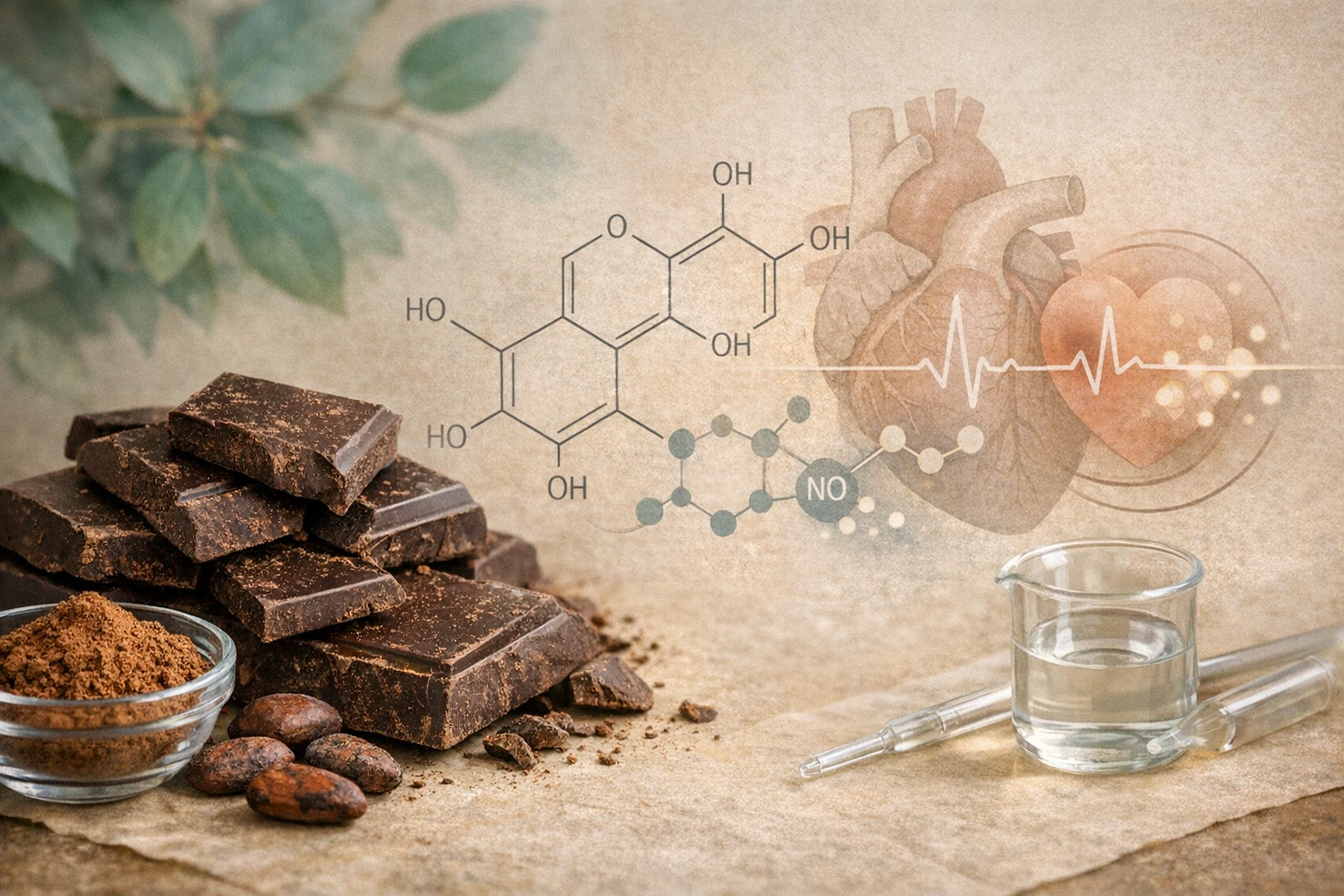
Proposed mechanisms linking cocoa flavanols to cardiovascular health include: stimulation of nitric oxide (NO) synthesis with consequent improvement in vasodilation; modulation of angiotensin-converting enzyme (ACE) activity, potentially reducing vasoconstriction; anti-inflammatory and antiplatelet effects; and improvements in insulin sensitivity. Studies in cells and acute clinical studies have documented increases in NO bioavailability and improvements in flow-mediated dilation, indicative of improved endothelial function [3][4].
Results of clinical studies and meta-analyses
Numerous meta-analyses of controlled studies and short-term trials show a modest average reduction in blood pressure after intake of cocoa flavanol-rich foods or beverages; the magnitude of the effect varies depending on dose, duration, and type of control used [2][5]. Longer intervention studies and a large-scale randomized study with supplements have evaluated clinical outcomes: the large trial on cocoa extract supplementation did not achieve a significant reduction in total cardiovascular events but reported a reduction in cardiovascular mortality as a secondary outcome [6]. This profile of results highlights the need to distinguish benefits on biomarkers (e.g., endothelial dilation, blood pressure) from certain reductions in major clinical events.
Practical section
What it means in practice
For the general reader: some components of cocoa can improve physiological parameters related to cardiovascular risk, particularly blood vessel function and blood pressure in certain contexts. However, the magnitude of the effect is modest and variable. The transformation of cocoa into caloric, sugary, or fat-rich products can reduce or negate any benefits and introduce metabolic risks. In the absence of consolidated clinical recommendations, the prudent approach is to consider dark chocolate (high cocoa content) as a possible occasional component of an overall balanced diet, not as a treatment or primary preventive substitute for validated therapies or lifestyle modifications. Those with cardiovascular diseases or taking medications should consult their doctor before making targeted dietary changes based on nutritional studies.
Key takeaways
- Cocoa flavanols have plausible biological mechanisms that can affect vasodilation and ACE, with observable effects on biomarkers. [1][4]
- Short-term studies and meta-analyses show modest reductions in blood pressure; data are heterogeneous. [2][5]
- A large trial on supplements did not reduce the primary composite endpoint but showed a possible reduction in cardiovascular mortality as a secondary outcome. [6]
- Product quality (flavanol content), dose, and duration of intake influence results; industrial products can have very different doses. [5][7]
- Evidence does not justify therapeutic promises or substitutions for proven medical treatments.
Limitations of evidence
Difference between observational studies and causal evidence
Research on diet and health can be observational (cohorts, case-control) or experimental (clinical trials). Observational studies report associations between chocolate/cocoa consumption and some cardiovascular outcomes but do not prove causality because they can be influenced by confounding factors. Randomized trials are more suitable for testing causal effects, but many are short-term, with small samples or with surrogate endpoints (e.g., FMD, blood pressure) rather than definitive clinical events.
Methodological limitations and variability
Many studies have limitations: heterogeneity in the composition of the tested products (total flavanols, epicatechin), not always adequate placebo control, different treatment durations, and small sample sizes. Furthermore, industrial processing of cocoa strongly alters the content of active ingredients, making it difficult to generalize the results of studies using extracts or products with high standardized content.
Context and different populations
The observed effect varies depending on the population: hypertensive subjects, those with insulin resistance, or with metabolic risk factors tend to show more marked responses compared to healthy subjects. This requires caution in transferring the results of trials on specific cohorts to the general population.
Editorial conclusion
The body of evidence on the effects of cocoa and dark chocolate on the cardiovascular system is substantial and shows strong biological plausibility. Small clinical studies and meta-analyses highlight improvements in biomarkers such as endothelial function and modest reductions in blood pressure. However, major clinical outcomes remain less conclusive: the largest randomized trial on supplements reported an interesting signal on cardiovascular mortality as a secondary outcome but did not reach significance on the primary composite endpoint. In practical terms, dark chocolate with high cocoa content can be considered a possible occasional addition to a healthy diet, not a therapy. Long-term studies with standardized doses and robust clinical endpoints are still needed before these data can be translated into public health recommendations.
Editorial note
This update was prepared following criteria for source evaluation and informational clarity. The goal is to offer a balanced and verifiable summary of the available literature. It does not constitute medical advice; for clinical and personalized decisions, consult a healthcare professional.
Scientific research
- Persson I. Effects of cocoa extract and dark chocolate on angiotensin-converting enzyme and nitric oxide in human endothelial cells and healthy volunteers--a nutrigenomics perspective. J Cardiovasc Pharmacol. DOI: https://doi.org/10.1097/FJC.0b013e3181fe62e3.[1]
- Desch S, Schmidt J, Kobler D, et al. Effect of cocoa products on blood pressure: systematic review and meta-analysis. Am J Hypertens. 2010;23(1):97-103. DOI: https://doi.org/10.1038/ajh.2009.213.[2]
- Heiss C, Dejam A, Kleinbongard P, et al. Acute consumption of flavanol-rich cocoa and the reversal of endothelial dysfunction in smokers. J Am Coll Cardiol. 2005;46(7):1276-1283. DOI: https://doi.org/10.1016/j.jacc.2005.06.055.[3]
- Schroeter H, Heiss C, Balzer J, et al. (−)-Epicatechin mediates beneficial effects of flavanol-rich cocoa on vascular function in humans. Proc Natl Acad Sci U S A. 2006;103(4):1024–1029. DOI: https://doi.org/10.1073/pnas.0510168103.[4]
- Cocoa Flavanol Intake and Biomarkers for Cardiometabolic Health: a systematic review and meta-analysis of randomized controlled trials. J Nutr. 2016;146(11):2325–2333. DOI: https://doi.org/10.3945/jn.116.237644.[5]
- Effect of cocoa flavanol supplementation for the prevention of cardiovascular disease events: the COcoa Supplement and Multivitamin Outcomes Study (COSMOS) randomized clinical trial. Am J Clin Nutr. 2022;115:1490–1500. DOI: https://doi.org/10.1093/ajcn/nqac055.[6]
- Flaviola Health Study: cocoa flavanol intake improves endothelial function and Framingham Risk Score in healthy men and women – randomized controlled, double-masked trial. Br J Nutr. DOI: https://doi.org/10.1017/S0007114515002822.[7]
- Safety and efficacy of cocoa flavanol intake in healthy adults: randomized, controlled, double-masked trial. Am J Clin Nutr. DOI: https://doi.org/10.3945/ajcn.115.116178.[8]
Note: All listed research has been verified for DOI, relevance, and consistency with the claims in the text.