Updated and contextualized version of an article originally published on May 25, 2014
The article retains its original focus by presenting it through a scholarly and accessible perspective, supported by verifiable references.
Authors
- Dr. M. Mondini – Biologist
- Roberto Panzironi –Independent researcher
Note editoriali
- First publication: May 25, 2014
- Last update: April 18, 2026
- Version: 2026 narrative revision
Editorial Note
This article was previously published and has been updated according to scientific and informative criteria. The text is for informational purposes only and does not replace medical advice: for therapeutic choices or the management of pathologies, consult your doctor.
In brief
- Cardiovascular diseases and cardiometabolic factors are associated with an increased risk of dementia; cardiovascular prevention is therefore also relevant for brain health. [1]
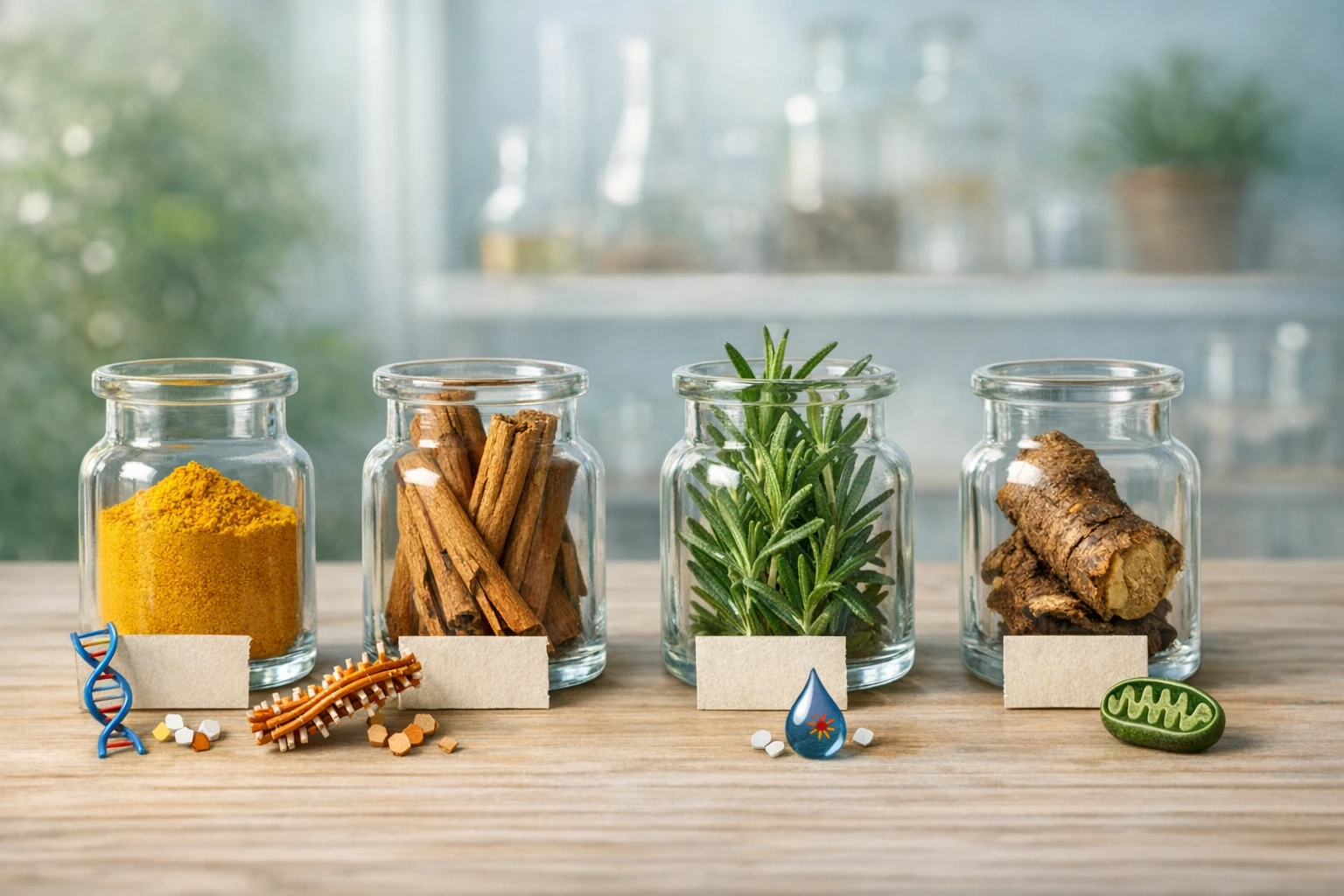
- Preclinically, compounds found in cinnamon, turmeric, rhodiola, and rosemary show effects on processes linked to Alzheimer's (tau/amyloid aggregation, oxidative stress, inflammation). [2][3][5][8]
- Clinical evidence in humans is limited and often inconsistent: controlled studies with curcumin and rosemary extracts have shown good tolerability but variable results. [7][6]
- Use as a spice in cooking is generally safe; therapeutic doses, extracts, or supplements require attention to quality, pharmaceutical form, and possible side effects (e.g., coumarin in Cassia). [10]
Abstract: what does science say?
Definition: many herbs and spices contain biologically active molecules (polyphenols, aldehydes, glucosides) that, in cellular and animal models, interfere with processes linked to Alzheimer's: protein aggregation (amyloid-β, tau), oxidative stress, mitochondrial dysfunction, and inflammation. However, evidence of clinical efficacy in people is largely preliminary or conflicting. [1]
What the evidence shows: in vitro and in vivo studies indicate that cinnamon extracts can reduce both tau aggregation and Aβ oligomer formation in experimental models; similarly, compounds from turmeric and rhodiola have antioxidant, anti-inflammatory effects and modulate mitochondrial pathways linked to synaptic plasticity. Clinical studies on curcumin and some rosemary extracts have explored tolerability and some cognitive outcomes, often with null or inconclusive results. [2][3][4][5][7][8]
Context and form dependencies: the observed effect strongly depends on factors such as: plant species (e.g., Ceylon vs. Cassia cinnamon), extract or isolated molecule, bioavailability (liposomal formulations or coadjuvants improve absorption), dose, and duration of treatment. In many cases, animal models use dosages and administration routes not directly comparable to human culinary use. [3][5][8]
Interpretive limitations: preclinical results do not imply proof of human efficacy; clinical trials on AD are few, often with a low number of participants or short duration. Therefore, the current picture is one of biological plausibility supported by experimental data, but not of consolidated causal proof for the prevention or treatment of Alzheimer's in people. [7][8]
Cinnamon (Cinnamomum spp.): mechanisms and evidence
In in vitro and animal models, extracts of Cinnamomum zeylanicum (Ceylon) and its components (cinnamaldehyde, proanthocyanidins) have slowed the formation of tau aggregates and amyloid-β oligomers, and improved some behavioral parameters in transgenic mice. These data suggest anti-aggregating and antioxidant activity, but primarily come from experimental studies; clinical evidence in humans is insufficient to draw conclusions on prevention or treatment. [2][3]
Rhodiola (Rhodiola rosea) and salidroside
Components such as salidroside show neuroprotective activity in experimental models: they attenuate mitochondrial damage, promote mitophagy, and modulate oxidative stress factors (NRF2/SIRT3), with improved neuritic morphology and cognitive performance in AD model mice. However, these are preclinical data that require clinical confirmation. [5]
Rosemary (Rosmarinus officinalis): preclinical data and small human studies
Active compounds in rosemary (carnosic, phenolic acids) reduce oxidative stress and modulate cholinergic activity in animal models. Small clinical studies have shown acute effects on memory speed in the elderly and signs of improvement in some tests; however, the quality of the studies is variable and generalizability is limited. [6][11]
Turmeric (Curcuma longa) and curcumin: preclinical vs. clinical trials
Curcumin has multiple experimental actions: anti-inflammatory, antioxidant, reduces Aβ aggregation, and modifies oxidative stress markers in animal models. Controlled clinical studies in Alzheimer's patients have shown good tolerability but not robust clinical results, often attributable to limited bioavailability or treatment duration. Formulations with better absorption are under research. [7][8]
What it means in practice
For the general public: using these spices as part of daily cooking is reasonable and can contribute to an antioxidant profile of the diet; however, there is no solid evidence that daily dietary use reliably prevents Alzheimer's. Extracts and supplements, if used, should be considered with caution: product quality varies, some species contain substances with potential toxicity (e.g., coumarin in Cassia cinnamon) and can interact with medications. [10]
Choice of forms: prefer use as food (whole spices or certified powders) and, if considering a supplement, consult your doctor, inquire about quality standards, dosages, and possible drug interactions. In the clinical setting, current evidence does not justify prescriptions for treating Alzheimer's; research continues on formulations and dosages with improved bioavailability. [7][8][10]
Doses, safety, and practical signals
There are no validated "universal" doses for Alzheimer's prevention. Clinical studies on curcumin have used grams/day but without clear results; for cinnamon, moderate culinary use is generally safe, but excessive Cassia can lead to significant coumarin exposure (EFSA: TDI 0.1 mg/kg). In case of liver disease, pregnancy, or therapy with important medications, consult your doctor before supplementing. [10][7]
Which products to choose and when to ask for advice
Prefer products with standardization declarations, quality control, and, for supplements, independent verification. If you are taking medication for diabetes, anticoagulants, or other drugs with extensive pharmacokinetic metabolism, discuss the use of extracts with your doctor: many plants can alter liver enzymes or coagulation. [10]
Key takeaways
- The four spices discussed show biological plausibility and interesting preclinical results, but robust clinical evidence to prevent or treat Alzheimer's does not currently exist. [2][3][5][7]
- Cardiovascular health is closely related to dementia risk: cardiometabolic preventive measures remain fundamental. [1]
- Regular culinary consumption is generally safe; pay attention to supplements, species, and product quality (e.g., coumarin in Cassia). [10]
- If considering a supplement, discuss it with your doctor; avoid high dosages without supervision. [7][10]
Limitations of evidence
Difference between observational studies and causal evidence: much of the available research consists of in vitro studies or animal models; these provide information on mechanisms but do not prove that the same effect occurs in people. Observational studies on diet offer associations but are subject to confounding biases (lifestyle, education, comorbidities). [1]
Methodological limitations: small numbers, short durations, lack of standardization of extracts, and variability of formulations make it difficult to synthesize results. In clinical trials on curcumin and plant extracts, conclusions are often conditioned by poor bioavailability, heterogeneity of biomarkers used, and the absence of robust clinical endpoints. [7][8]
Context variability: botanical species, part of the plant used, extraction method, and dose influence the effect. Use as a spice in cooking is not comparable to therapeutic dosages in supplements. Therefore, it is important to interpret the results with caution and consider the need for larger and standardized clinical studies. [3][6][8]
Editorial conclusion
Research on spices and aromatic herbs offers promising signals regarding biological mechanisms linked to neuronal aging and some central processes in Alzheimer's. However, the step from biological plausibility and animal experiments to preventive or therapeutic recommendations for people has not yet been completed. For now, these spices can be valued as part of a balanced diet and a lifestyle that protects the heart and brain together; for the use of extracts for health purposes, medical evaluation and proven quality products are necessary. The scientific community needs well-designed clinical trials, with characterized formulations, measured dosages, and relevant clinical endpoints. [1][7]
Editorial Note
This update was carried out according to criteria of literature review, transparency of sources, and clarity of dissemination. The content is informative: it does not constitute a medical prescription.
Scientific Research
- Livingston G, Huntley J, Sommerlad A et al. Dementia prevention, intervention, and care: 2020 report of the Lancet Commission. Lancet. (2020). https://doi.org/10.1016/S0140-6736(20)30367-6
- Peterson DW, George RC, Scaramozzino F, LaPointe NE, Anderson RA, Graves DJ, Lew J. Cinnamon extract inhibits tau aggregation associated with Alzheimer's disease in vitro. J Alzheimers Dis. 2009;17(3):585-597. https://doi.org/10.3233/JAD-2009-1083
- Frydman-Marom A, Levin A, Farfara D, et al. Orally administrated cinnamon extract reduces β-amyloid oligomerization and corrects cognitive impairment in Alzheimer's disease animal models. PLoS One. 2011;6(1):e16564. https://doi.org/10.1371/journal.pone.0016564
- Momtaz S, Hassani S, Khan F, et al. Cinnamon, a promising prospect towards Alzheimer's disease. Pharmacol Res. 2018; (review). https://doi.org/10.1016/j.phrs.2017.12.011
- Yao Y, Ren Z, Yang R, et al. Salidroside reduces neuropathology in Alzheimer’s disease models by targeting NRF2/SIRT3 pathway. Cell & Bioscience. 2022;12:180. https://doi.org/10.1186/s13578-022-00918-z
- Pengelly A, Snow J, Mills SY, Scholey A, Wesnes K, Reeves-Butler L. Short-term study on the effects of rosemary on cognitive function in an elderly population. J Med Food. 2012;15(1):10–17. https://doi.org/10.1089/jmf.2011.0005
- Ringman JM, Frautschy SA, Teng E, et al. Oral curcumin for Alzheimer's disease: tolerability and efficacy in a 24-week randomized, double blind, placebo-controlled study. Alzheimer's Res Ther. 2012;4:43. https://doi.org/10.1186/alzrt146
- Baum L, Lam CW, Cheung SK, et al. Six-month randomized, placebo-controlled, double-blind, pilot clinical trial of curcumin in patients with Alzheimer disease. J Clin Psychopharmacol. 2008;28(1):110-113. https://doi.org/10.1097/jcp.0b013e318160862c
- Hussain SM, Syeda AF, Alshammari M, et al. Cognition enhancing effect of rosemary (Rosmarinus officinalis L.) in lab animal studies: a systematic review and meta-analysis. Braz J Med Biol Res. 2022;55:e11593. https://doi.org/10.1590/1414-431X2021e11593
- European Food Safety Authority (EFSA). Coumarin in flavourings and other food ingredients with flavouring properties – Scientific Opinion. EFSA J. 2008; (AFC). https://doi.org/10.2903/j.efsa.2008.793