Updated and contextualized version of an article originally published on May 25, 2014
The article retains its original focus by presenting it through a scholarly and accessible perspective, supported by verifiable references.
Authors
- Dr. A. Conte – Biologist
- Roberto Panzironi –Independent researcher
Note editoriali
- First publication: May 25, 2014
- Last update: April 18, 2026
- Version: 2026 narrative revision
Editorial note: This article has been previously published and updated according to scientific and informative criteria. It is for informational purposes only and does not replace professional medical advice. For persistent or severe problems, it is recommended to consult a doctor.
In brief
- Cramps are sudden, painful muscle contractions; the causes are often multifactorial and not always related to single nutrient deficiencies.
- Evidence on magnesium supplements and other minerals is conflicting: systematic reviews and randomized trials show limited and inconsistent results.
- For exercise-related cramps, the dominant theory favors alterations in neuromuscular control, with a variable role of hydration and electrolytes.
- Some topical remedies and non-pharmacological practices (stretching, localized massage, certain complementary therapies) can alleviate symptoms, but the quality of evidence varies.
- If cramps are frequent, intense, or accompanied by other symptoms (persistent weakness, sensory alterations, palpitations), it is advisable to evaluate the situation with a healthcare professional.
Abstract: what does science say?
Cramps are involuntary muscle contractions, short-lived but often intense. The most common categories are nocturnal leg cramps, exercise-associated muscle cramps (EAMC), and cramps associated with medical conditions (e.g., during pregnancy or in some chronic diseases).
Updated literature shows that the effectiveness of mineral supplements (especially magnesium) is uncertain: systematic reviews find conflicting results, and randomized trials of variable quality do not demonstrate a consistent benefit in the general population. For pregnancy, a meta-analysis of randomized trials found no pronounced effects in favor of oral magnesium supplementation.
For exercise-related cramps, the most robust evidence indicates that altered neuromuscular control and local fatigue are important; hydration and electrolytes can play a role in some contexts (e.g., heat cramps or during very sweaty activities), but do not explain all cases.
Topical remedies and practices such as nocturnal stretching, massages, localized application of heat, or some complementary therapies can reduce pain and frequency in some individuals; however, the benefits are mostly modest and depend on the type of cramp and the clinical context.
Main limitations: heterogeneity of studies, subjective measurements of episodes, variable doses and forms of supplements, and often a lack of adequately controlled trials for many traditional remedies.
What it means in practice
For those who experience occasional cramps, the practical approach, based on current evidence, is multimodal and individual. First, evaluate obvious triggers: intense physical activity, climatic changes (heat), medications that can promote cramps (e.g., some diuretics), or known medical conditions that alter electrolytes.
In most cases, there is no single 'miracle cure'. Magnesium supplementation is widely used, but systematic reviews conclude that evidence of efficacy is controversial and not consistently confirmed in the general population [1]. A good quality clinical trial showed no significant differences between magnesium and placebo for nocturnal cramps [2].
For physically active individuals, preventing excessive muscle fatigue through adequate training, progressively introducing intensity and duration, can reduce the incidence of cramps. In situations of exercise in hot environments or with high sweat loss, a beverage containing carbohydrates and electrolytes can delay the onset of cramps, although it does not guarantee total protection [6].
Finally, for local remedies (massages, heat application, essential oils) and for evening stretching, there are signs of subjective benefit for many patients, but the strength of the evidence is variable and does not replace medical evaluation if cramps are frequent or severe [5][10].
Diet and nutrients that affect cramps
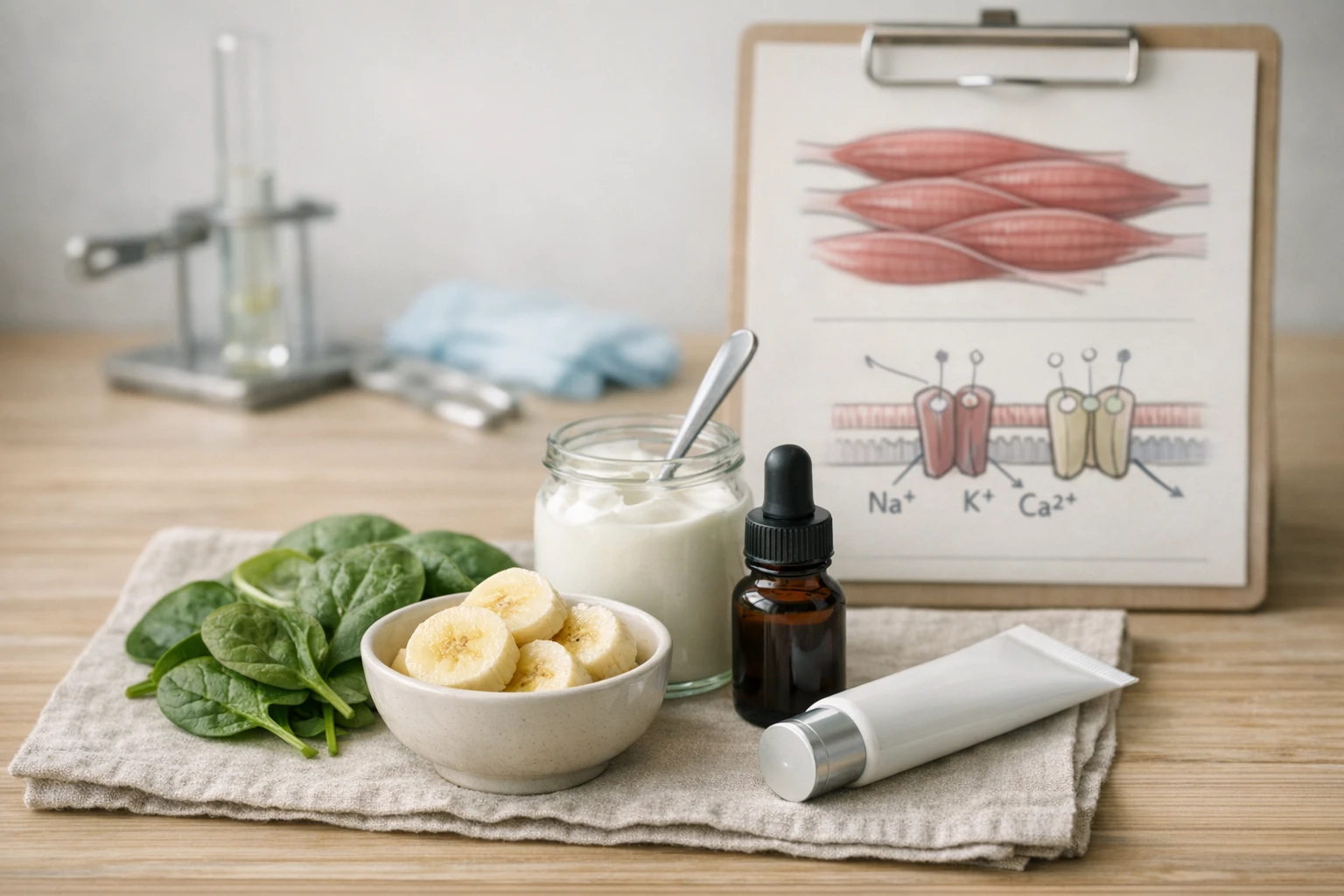
A balanced diet that provides adequate amounts of minerals such as magnesium, potassium, and calcium is reasonable for general muscle health. However, the direct relationship between the consumption of specific foods (e.g., bananas) and the prevention of cramps is not supported by robust evidence that applies to the entire population.
Magnesium is often cited as a remedy: systematic reviews and clinical literature show heterogeneous results. In summary, for the general population, there is no consistent evidence that systematic oral supplementation reliably reduces the frequency of cramps, while some observational studies and small trials suggest possible benefits in selected subgroups [1][2].
Potassium is essential for muscle function: marked deficiencies (hypokalemia) can cause weakness and cramps, but in the general population, it has not been shown that increasing dietary potassium reduces idiopathic cramps. Clinical causes of hypokalemia (diuretic use, vomiting, diarrhea, kidney disease) require specific medical diagnosis and treatment.
Practical conclusion: prefer a varied diet (green leafy vegetables, legumes, fruit, dairy products if tolerated, fish, eggs) to ensure a good intake of minerals. The use of supplements should be evaluated on a case-by-case basis and, if considered, monitored by a doctor, especially in the presence of kidney diseases or concomitant drug therapies.
Magnesium, potassium, and calcium: what studies say
Major works and reviews conclude that magnesium supplementation does not have a clear and consistent effect on nocturnal or activity-related cramps in the general population [1][2]. For pregnancy, a meta-analysis of RCTs found no significant reduction in cramp frequency with oral magnesium [3].
For potassium, clinical literature shows that severe hypokalemia can manifest with cramps; however, idiopathic cramps are not systematically associated with serum potassium levels outside the normal range. Before correcting potassium with supplements, laboratory and clinical context should be evaluated.
Hydration and beverages: what is useful
In conditions of heavy sweating and prolonged exertion, beverages containing carbohydrates and electrolytes can delay the onset of cramps and prolong exercise capacity; however, they do not completely prevent neuromuscular fatigue cramps [6].
For most people, regularly drinking water and maintaining good hydration is a prudent measure. Avoiding excessive sugary or alcoholic beverages is advisable for general health, but there is no evidence to completely prohibit moderate coffee consumption in relation to cramps.
Topical remedies, herbs, and supplements: evidence and limitations
Many traditional remedies are used to relieve cramps: essential oils (lavender, rosemary), herbal compresses (chamomile, mallow), poultices such as those based on mustard, or preparations containing capsaicin (Cayenne pepper). Clinical evidence varies: some therapies show an analgesic effect in general musculoskeletal conditions, but for cramps specifically, controlled data are scarce.
For example, literature on topical capsaicin reports usefulness in musculoskeletal pain and osteoarthritis, with meta-analyses documenting a reduction in pain in some contexts; however, these results do not automatically imply efficacy for acute or nocturnal cramps [8][9].
Aromatherapy with lavender and some massage applications can reduce anxiety and pain perception in post-operative and acute settings; some randomized studies show positive effects on pain and anxiety, but there is no strong and generalizable evidence for the prevention of nocturnal cramps [11].
Capsaicin, coconut oil, and Cayenne pepper
Capsaicin is an active ingredient with demonstrated analgesic action for some forms of local pain; studies and meta-analyses report benefits in osteoarthritis and chronic local pain, but its application for cramps is mostly anecdotal and not well-studied [8][9].
The topical use of an ointment based on oil and spices (such as coconut oil + Cayenne pepper) is a traditional practice: it can provide local sensory relief, but its long-term efficacy and safety (skin irritation, reactions) are not well characterized in controlled trials.
Lavender, passionflower, and chamomile
Herbs like passionflower and chamomile have sedative properties and can promote general relaxation; some RCTs indicate that lavender by inhalation or massage reduces anxiety and pain perception in specific clinical settings, but direct evidence on cramp control is weak [11].
These remedies can be considered as complementary, low-invasiveness measures, especially when the goal is to improve sleep or reduce muscle tension before sleeping. The absence of interactions or contraindications with medications in use should always be verified.
Prevention and non-pharmacological interventions
Non-pharmacological strategies with more robust evidence include specific calf stretching before sleep (if cramps are nocturnal) and training programs that avoid acute muscle fatigue. Some trials show reductions in cramp frequency with stretching and other simple physical practices [5][10].
Local massages, heat application, relaxation techniques, and adopting nocturnal postures that avoid long positions with shortened muscles can reduce the risk. For cramps associated with physical activity, adequate workload planning and fatigue monitoring are essential.
When to consult a doctor
A doctor should be consulted if cramps are: very frequent or worsen despite conservative measures; accompanied by persistent weakness, sensory alterations, marked swelling; associated with systemic disorders (dyspnea, palpitations); or if they have occurred concurrently with the start of new medications (e.g., diuretics). In these cases, a clinical examination and laboratory tests may be useful to evaluate electrolytes, kidney function, and other possible underlying causes.
Key points to remember
- Cramps are common and often have multiple causes; they do not always indicate a mineral deficiency.
- Magnesium supplementation is not consistently proven effective for all types of cramps; however, some individuals may perceive individual benefit. [1][2]
- For exercise-related cramps, neuromuscular control and local fatigue are central factors; hydration and electrolytes play a situational role. [4][5][6]
- Topical remedies and herbs can offer symptomatic relief, but evidence is limited and often specific to contexts other than acute cramps.
- In the presence of warning signs or if cramps compromise quality of life, medical attention is necessary.
Limitations of evidence
The main limitations of the literature are: the prevalent heterogeneity of populations and definitions of cramp; the often subjective measurement of frequency and severity; the variability in the forms and doses of tested supplements; and the scarcity of high-quality trials for many complementary therapies. It is important to distinguish observational studies (which show associations) from causal evidence derived from randomized trials.
Many reviews emphasize the need for more rigorous studies, with standardized outcomes and adequate follow-up, to reliably evaluate nutritional interventions, targeted hydration, and topical remedies. Until then, recommendations remain cautious and individualized.
Editorial conclusion
Muscle cramps remain a widespread problem with an often complex etiological picture. Modern research calls for a nuanced approach: a correct lifestyle and adequate physical activity planning are fundamental; supplementation and natural remedies can be useful for some individuals but are not a universal solution; finally, medical evaluation remains necessary for atypical or severe cases. Evidence-based medicine requires further quality studies to clarify the role, dose, and target of intervention for every possible remedy.
Editorial note
This content is updated with peer-reviewed scientific sources. It is for informational purposes and does not replace personalized medical evaluation. If you are taking medications or suffer from chronic conditions, consult your doctor before starting supplements or complementary therapies.
Scientific research
- Magnesium for skeletal muscle cramps. Cochrane Database Syst Rev. 2020. https://doi.org/10.1002/14651858.CD009402.pub2
- Roguin Maor N, et al. Effect of Magnesium Oxide Supplementation on Nocturnal Leg Cramps: A Randomized Clinical Trial. JAMA Intern Med. 2017;177(5):617-623. https://doi.org/10.1001/jamainternmed.2016.9261
- Liu J, Song G, Zhao G, Meng T. Effect of oral magnesium supplementation for relieving leg cramps during pregnancy: a meta-analysis of randomized controlled trials. Taiwan J Obstet Gynecol. 2021;60(4):609-614. https://doi.org/10.1016/j.tjog.2021.05.006
- Miller KC, McDermott BP, Yeargin SW, Fiol A, Schwellnus MP. An Evidence-Based Review of the Pathophysiology, Treatment, and Prevention of Exercise-Associated Muscle Cramps. J Athl Train. 2021;57(1):5-15. https://doi.org/10.4085/1062-6050-0696.20
- Schwellnus MP, Nicol J, Laubscher R, Noakes TD. Serum electrolyte concentrations and hydration status are not associated with exercise associated muscle cramping. Br J Sports Med. 2004;38:488-492. https://doi.org/10.1136/bjsm.2003.007021
- Jung AP, Bishop PA, Al-Nawwas A, Dale RB. Influence of Hydration and Electrolyte Supplementation on Incidence and Time to Onset of Exercise-Associated Muscle Cramps. J Athl Train. 2005;40(2):71-75. https://doi.org/10.1136/bmjsem-2018-000478 (related articles and discussion on hydration and EAMC)
- Fain O, et al. Treatment of Nocturnal Leg Cramps: A Crossover Trial of Quinine vs Vitamin E. Arch Intern Med. 1992;152(9):1877–1880. https://doi.org/10.1001/archinte.1992.00400210099016
- Bley K, et al. Harnessing the therapeutic potential of capsaicin and its analogues in pain and other diseases. Front Pharmacol. 2016;7:538. https://doi.org/10.3389/fphar.2016.00538
- Werneke M, et al. Efficacy and safety of topical capsaicin in the treatment of osteoarthritis pain: systematic review and meta-analysis. Phytother Res. 2023. https://doi.org/10.1002/ptr.8223
- Howell J, et al. Therapeutic strategies for muscle cramps: a systematic review and meta-analysis. Muscle Nerve. 2019;60(5):598-603. https://doi.org/10.1002/mus.26650