Updated and contextualized version of an article originally published on May 26, 2014
The article retains its original focus by presenting it through a scholarly and accessible perspective, supported by verifiable references.
Authors
- Dr. A. Conte – Biologist
- Roberto Panzironi –Independent researcher
Note editoriali
- First publication: May 26, 2014
- Last update: April 20, 2026
- Version: 2026 narrative revision
[H1 placeholder not included in the body text as requested]
IN BRIEF
- A mechanism called "protein leverage" suggests that humans strongly regulate protein intake and may eat more calories when the diet is relatively low in protein.
- Experimental and animal studies show that reductions in the energy percentage from protein can lead to an increase in total energy intake. [1][2][3]
- High-protein diets can reduce hunger and support fat mass loss in the short term, but sustainability and long-term effects vary and require cautious interpretation. [5][6]
- Food quality (e.g., ultra-processed foods with low protein density) and dietary context influence the phenomenon; there are no universal solutions. [7]
Abstract: what does science say?
Synthetic definition: the "protein leverage hypothesis" proposes that human appetite prioritizes protein intake over carbohydrates and fats. When the percentage of energy provided by protein decreases, people tend to eat more until a protein target is reached, potentially increasing total caloric intake.
Main evidence: controlled human experiments and animal studies show that lowering the energy share from protein (for example, from ~15–25% to ~10%) can increase caloric intake over several days. Other experimental studies indicate that increasing the protein share reduces hunger and can promote fat loss in hypocaloric programs.
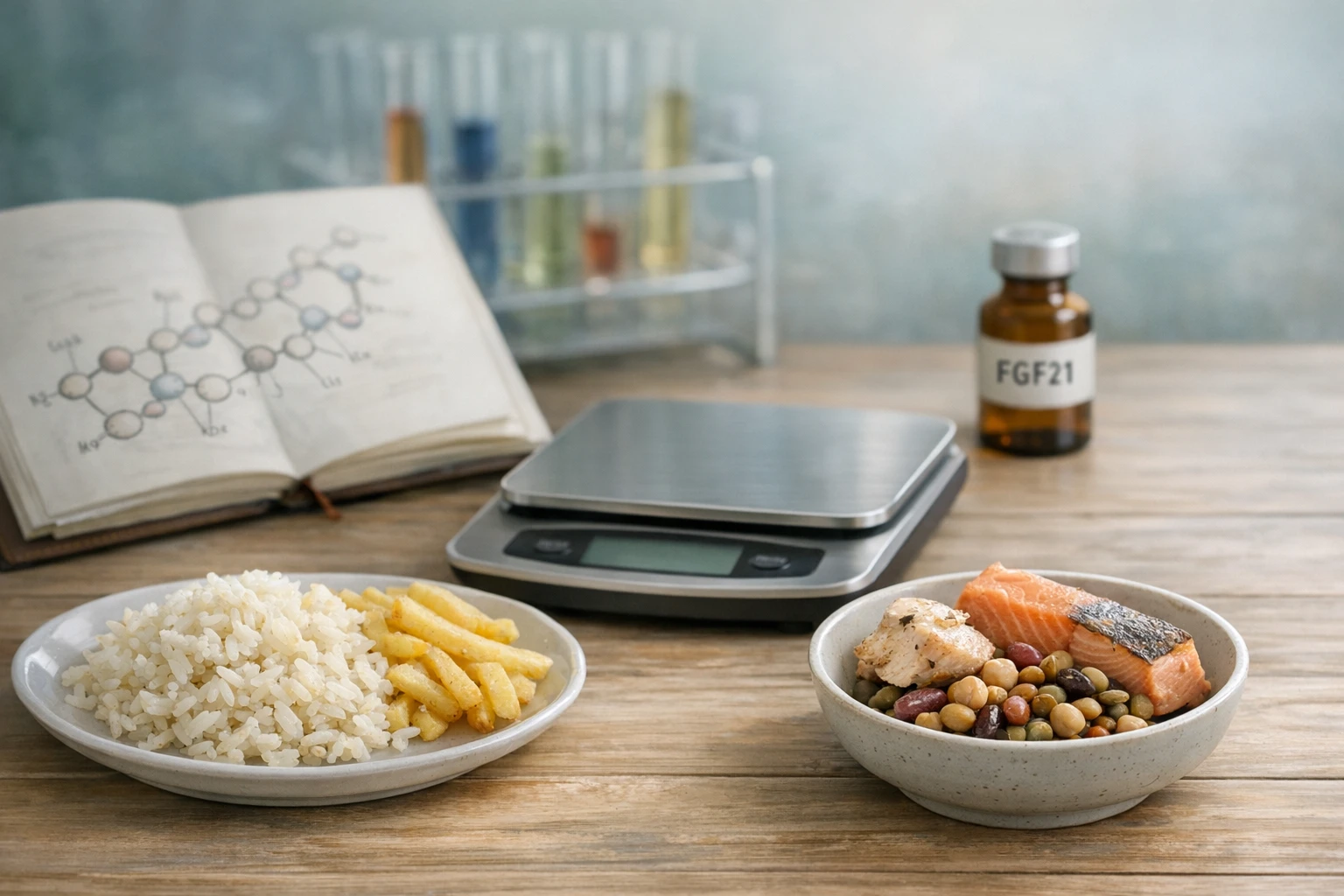
Dependencies and context: the effect depends on the protein density of the diet (percentage of energy), the availability and variety of foods, protein quality (animal vs. plant sources), and the observation time. Metabolic signals, such as FGF21, have also been linked to variations in protein intake.
Interpretive limits: much evidence comes from short studies, controlled conditions, or animal models; the results do not automatically imply a direct and persistent causal relationship in real life. Caution is needed when applying the results to individual recommendations.
What it means in practice
Evidence suggests that a diet that, due to its composition or food quality, offers a low percentage of energy from protein can promote an increase in spontaneous caloric intake. This does not mean that protein is the only factor: overall energy density, the presence of ultra-processed foods, eating habits, and the environment also matter. [1][2][3][7]
For the general public, the practical message is moderate: maintaining a balanced diet, with protein sources adequate for age and health status, can help regulate satiety and reduce the risk of consuming excess calories. In subjects following caloric reduction programs, a relatively higher protein content (within reasonable limits) can preserve lean mass and improve body composition, at least in the short term. [5][6]
Important: food choices must be contextualized at an individual level (age, metabolic status, preferences, health limitations). This is not about prescribing very high-protein diets for everyone, but about considering overall protein quality and protein density when planning meals.
Key takeaways
- There is a strong specific appetite for protein that can influence total calorie consumption under ad libitum diet conditions. [1][2]
- Reducing the energy percentage from protein can lead to increased caloric intake within a few days. [2][4]
- High-protein diets show short-term benefits on satiety and body composition, but sustainability and long-term effects are variable. [5][6]
- The presence of ultra-processed foods with low protein density can amplify the problem at a population level. [7]
- Interpret evidence with caution: animal and controlled experimental studies are informative but not entirely transferable to the complexity of daily life.
Limitations of the evidence
Difference between observation and causality
Many epidemiological analyses show associations between dietary patterns and body weight, but do not establish causality. Controlled experiments provide mechanistic signals, but are often short and conducted under conditions different from real life. [1][2][5]
Methodological limitations and variability
Clinical studies vary in duration, sample size, definition of "high" or "low" protein content, and protein sources used. These differences make it difficult to generalize results and estimate long-term effects. Some controlled trials have monitored participants for a few days or weeks, while the adaptive response over months or years may differ. [3][6]
Context and food quality
The phenomenon of "eating more to reach the protein target" is influenced by the availability of high-energy-density, low-protein-density foods (e.g., ultra-processed snacks). At a population level, changes in the food system can make protein dilution of diets more likely. [7]
Editorial conclusion
Scientific literature supports the idea that protein intake regulation is an important factor in appetite control and that too low a protein energy proportion can promote increased caloric intake in contexts of food abundance. However, translating these results into practical recommendations requires caution: the findings derive from a combination of experimental, animal, and meta-analyses, with known limitations. A reasonable strategy for the population is to prioritize a balanced diet, increase the quality of protein consumed (when appropriate), limit ultra-processed foods with low protein density, and consider the overall energy and nutrient profile. For individual and therapeutic decisions, always consult a qualified healthcare professional.
Editorial note
This article was published in a previous version and updated following scientific and divulgative criteria to improve accuracy and clarity. The purpose is informative: it does not replace personalized medical advice. For clinical questions, consult a healthcare professional.
SCIENTIFIC RESEARCH
- Simpson SJ, Raubenheimer D. Obesity: the protein leverage hypothesis. Obes Rev. 2005;6(2):133-142. https://doi.org/10.1111/j.1467-789X.2005.00178.x
- Gosby AK, Conigrave AD, Lau NS, et al. Testing protein leverage in lean humans: a randomised controlled experimental study. PLoS ONE. 2011;6(10):e25929. https://doi.org/10.1371/journal.pone.0025929
- Martens EA, de Ridder D, et al. Protein leverage affects energy intake of high-protein diets in humans. Am J Clin Nutr. 2013;97(1):86-93. https://doi.org/10.3945/ajcn.112.046540
- Gosby AK, Lau NS, Tam CS, et al. Raised FGF-21 and Triglycerides Accompany Increased Energy Intake Driven by Protein Leverage in Lean, Healthy Individuals: A Randomised Trial. PLoS ONE. 2016;11(8):e0161003. https://doi.org/10.1371/journal.pone.0161003
- Bray GA, Smith SR, de Jonge L, et al. Effect of Dietary Protein Content on Weight Gain, Energy Expenditure, and Body Composition During Overeating: A Randomized Controlled Trial. JAMA. 2012;307(1):47-55. https://doi.org/10.1001/jama.2011.1918
- Wycherley TP, Moran LJ, Clifton PM, Noakes M, Brinkworth GD. Effects of energy-restricted high-protein, low-fat compared with standard-protein, low-fat diets: a meta-analysis of randomized controlled trials. Am J Clin Nutr. 2012;96(6):1281-1298. https://doi.org/10.3945/ajcn.112.044321
- Schnabel L, Hamner HC, et al. Ultra-processed foods, protein leverage and energy intake in the USA. Public Health Nutr. 2018;21(1):114-124. https://doi.org/10.1017/S1368980017001574
- Raubenheimer D, Simpson SJ, et al. Protein-leverage in mice: the geometry of macronutrient balancing and consequences for fat deposition. Obesity (Silver Spring). 2007;15(8):2287-2299. https://doi.org/10.1038/oby.2007.58
DOI (verified links)
- https://doi.org/10.1111/j.1467-789X.2005.00178.x
- https://doi.org/10.1371/journal.pone.0025929
- https://doi.org/10.3945/ajcn.112.046540
- https://doi.org/10.1371/journal.pone.0161003
- https://doi.org/10.1001/jama.2011.1918
- https://doi.org/10.3945/ajcn.112.044321
- https://doi.org/10.1017/S1368980017001574
- https://doi.org/10.1038/oby.2007.58